
Blog, Demons, Working With Demons
Stolas Demon: History, Seal and How to Work With Him
Nov
Stolas is the 36th spirit of the Ars Goetia, a great and powerful prince said to command 26 legions, who appears first as a night-raven and then in human shape to teach astronomy and the virtues of herbs and precious stones. That is the whole of the old textual core, and it is recorded in the Goetia section of the Lemegeton. Everything else you read about him, from his personality to his preferred offerings, was added later. Here the two layers are kept apart, and then a disciplined working is built on the narrow historical base. Our Stolas Demon Directory page holds his seal and correspondences for quick reference.
Who Stolas is in the Ars Goetia
The Ars Goetia is the first book of the Lemegeton, the Lesser Key of Solomon, and it catalogues 72 spirits. Stolas stands at number 36. His entry is short, as most entries are, and it gives four things: a rank, a number of legions, a form, and a field of knowledge.
| Attribute | What the Goetia records |
|---|---|
| Position | 36th of 72 spirits |
| Rank | Great and powerful prince |
| Command | 26 legions of spirits |
| First form | Night-raven |
| Second form | Human, assumed before the exorcist |
| Teaches | Astronomy, the virtues of herbs, the virtues of precious stones |
Most modern practitioners treat the wording of the English Goetia as standard. Notice what is absent. There is no origin story, no temperament, no family, no list of favors for hire, and no planetary correspondence stated in the entry itself. The Goetia describes an office, in the way an administrative record describes a post.
That office is intellectual. Among spirits whose entries promise treasure, lovers, invisibility or the destruction of enemies, Stolas offers knowledge of the sky and the natural world. A practitioner should know this before planning any ritual. The historical profile points toward study, observation and natural philosophy. Domination and fast material gain belong to other names in the catalogue.
The earliest profile: Weyer, 1577
The earliest clearly documented Stolas profile is in Johann Weyer’s Pseudomonarchia Daemonum, printed in 1577 as an appendix to his work on demonology. Weyer’s text describes the same figure: a great prince who appears as a night-raven, takes the shape of a man in front of the exorcist, teaches astronomy, understands the virtues of herbs and precious stones, and rules 26 legions.
The transmission matters because it explains why the entry is so thin. The Goetia catalogue rests on a variant of the Offices of Spirits, passed through Reginald Scot’s 1584 Discoverie of Witchcraft, which itself drew on Weyer’s list. Weyer’s older line counts 69 spirits. The Lemegeton compiler then expanded the list to 72, added seals, and built an elaborate ritual frame around names that had previously appeared in a plain catalogue.
Two practical conclusions follow for anyone working with the name:
- The oldest layer of Stolas is a catalogue entry, not a ritual tradition. No early source gives a dedicated rite for him.
- The seal and the apparatus of circles, robes and conjurations belong to the later compilation, so they are conventions of the Lemegeton and not features inherited from antiquity.
Raven or owl: how the image shifted
Most readers arrive expecting an owl. The principal English Goetia wording says a raven. The change happened in the centuries after the grimoire tradition fixed itself.
The nineteenth-century French Dictionnaire infernal of 1863 describes Stolas in the form of an owl, and it was this illustrated demonological reference tradition that gave later artists their model. Modern illustrations vary. Some show a crowned raven, others a night owl.
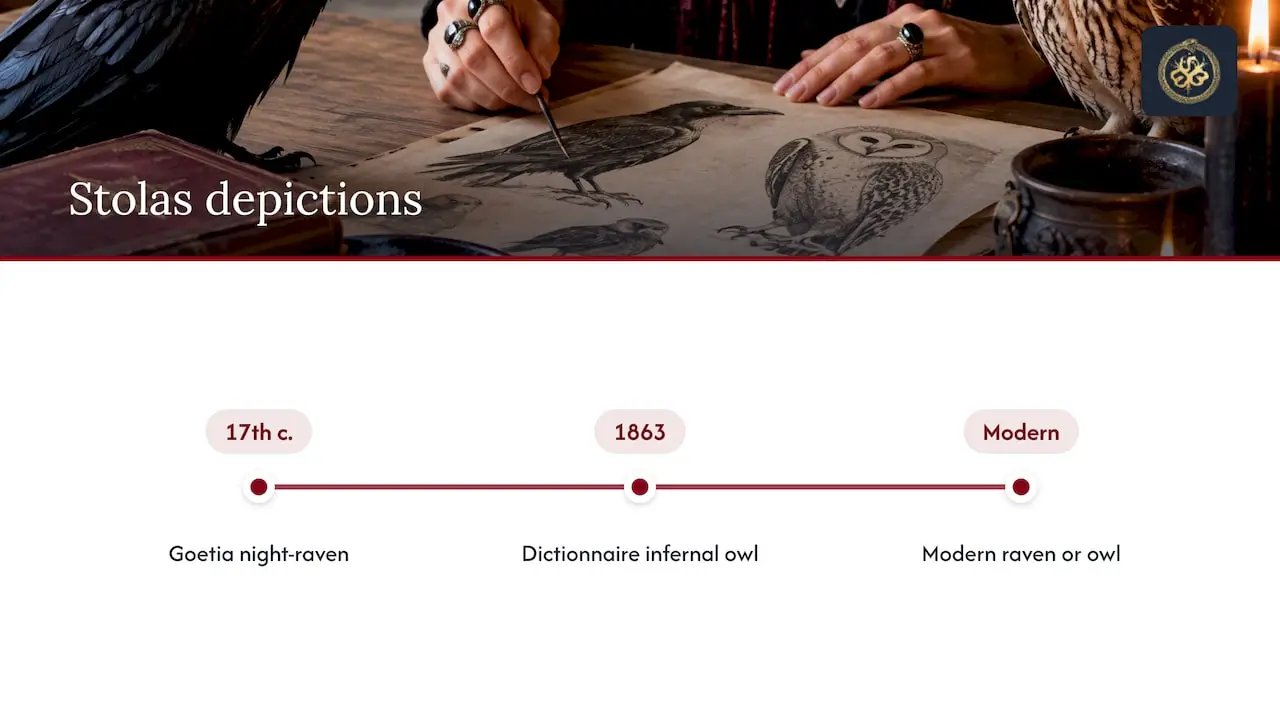
Here you can watch a spirit’s image drift. A single word in a seventeenth-century manuscript, “night-raven,” invites interpretation. A bird of the night, associated with astronomy, wisdom and herbs, is easily read as an owl, an animal with centuries of its own association with Athena, Minerva and nocturnal knowledge. Picturing a raven or an owl during a working is your decision, and either is sound so long as you know which source you are following. Stolas also turns up as an owl in modern animation; that image owes everything to the Dictionnaire and nothing to the Goetia. A researcher keeping to the Goetia uses the night-raven. One working in the later illustrated line uses the owl.
Origins: what the evidence supports
Practitioners often ask whether Stolas descends from an older deity, or from a figure outside the Solomonic tradition entirely, including theories of beings from other planets or planetary systems. The documents do not support a lineage of that kind. What they do support is a clear chain of transmission:
- Weyer (1577) lists him.
- Scot (1584) carries Weyer’s list into English.
- The Lemegeton compilers of the seventeenth century fold the material into the Ars Goetia and add seals and ritual.
- The Dictionnaire infernal (1863) reshapes the visual image.
The Lemegeton itself is a composite, anonymous early modern work, and its appeal to Solomon is a claim of authority made by its compilers. The catalogue records who Stolas is and what he gives. It does not record an earlier cult, and no surviving text names one.
There is a real astronomical layer. The Goetic hierarchy of kings, dukes, princes and marquises follows the Ptolemaic cosmos of seven wandering planets, and in the planetary scheme attached to later editions of the Goetia the rank of prince falls under Jupiter, the planet of wisdom, expansion and authority. The sky matters to Stolas, then, as the old sky of the planets. That tells you which planetary day and which correspondences connect to the work.
What is documented and what is modern
The old core is narrow: form, rank, astronomy, herbs, stones, 26 legions. Modern practice expands that sketch into a detailed personality and a full system of work. Living traditions grow this way, and the practitioner who knows where the boundary sits works with more precision.
Documented:
- The name, number and rank
- The raven form and the human form
- The three fields of knowledge
- The seal and conjuration apparatus of the Lemegeton, as a later layer
Modern:
- Devotional and meditative approaches. Demonolatry, as outlined by writers such as S. Connolly, uses devotional or meditative practice to connect with Stolas for study and focus, which departs from the coercive conjuration of the Goetia.
- Elaborate planetary staging. Some modern workings run through lunar, Mercurial and Saturnian stages, with meditation, visualization, automatic writing, fasting, astral immersion, gems, herbs and black-fire work. These are recent constructions, some of them well built.
- Personality traits, favored offerings and relationship models
The historical Goetia is also coercive in tone: the exorcist commands, binds and dismisses. Modern devotional work reverses the posture. Decide which model you follow before you start. The most common confusion is mixing a command-based conjuration with a devotional approach in one session, and the work then has no consistent tone.
Building a working with Stolas
Because the historical record gives a field of knowledge, the strongest working is one that asks for what the record says he offers. Align the goal with the office instead of asking him for something outside it.
Goals that fit the documented profile:
- Learning astronomy or astrology in a structured way
- Mastering the properties of herbs for a herbal or hoodoo practice
- Understanding the traditional virtues of stones and gems
- Research, study discipline and focused intellectual work
- Scrying the night sky or a dark glass for impressions, using a tool such as a black obsidian scrying mirror
This same logic is the point of matching a demon to a specialization: a working succeeds more reliably when the goal and the spirit’s recorded office agree.
A four-week study working
Here is a concrete structure for a practitioner who wants to learn the sky and a plant or stone correspondence set over a month. Adapt it to your tradition.
- Week one, preparation. Choose your source text, either the Goetia wording or a devotional model such as the one taught in Demonolatry, and write down which one you are following. Study the entry itself. Choose a fixed place and a fixed hour. Because Stolas is a prince tied to Jupiter in the Goetic planetary logic, Thursday, the day traditionally assigned to Jupiter, is a coherent choice.
- Week two, first contact. Use the conjuring method of your tradition. If you follow the Lemegeton line, the Goetia conjuring method from the Lesser Key gives the frame of circle, seal and address. Keep the request narrow: a single field, for example the movements of the planets across the month.
- Week three, practice. Between sessions, do the real-world work. Observe the sky nightly. Keep a planisphere or star chart beside the altar. If the interest is herbs, handle and identify a plant each day.
- Week four, review. Reread your notes, mark what you learned, and close the working formally.
Typical use: the herbalist
Take a practitioner who already works hoodoo and wants to deepen her use of herbs. She aligns the working with the documented office: herbs and their virtues. Over four weeks she chooses six plants she already stocks, sits with one each Thursday, records everything she notices, and cross-checks her impressions against a reliable herbal. At the end she has a notebook of correspondences she can test in later spells, and a clear record of which impressions matched her herbal and which went beyond it.

Typical use: the student of astronomy
A student who works Goetic magick wants help with the quantitative discipline of an astronomy course. She builds the working around the habit: a fixed nightly observation, a short invocation before study, and a log. Over the month the log shows her which nights the opening rite was performed and how the study went on each.
Keeping records that mean something
Many who seek Stolas are scholars by temperament, and a scholar’s record keeping suits him. Use written terms, a bounded duration, a fixed time and place, consistent materials, and records of quiet sessions as well as striking ones. None of this is in the Goetia entry. It is good working practice, and it lets you see what the spirit actually brought.
Apply it like this:
- Write the intention in one sentence before the first session.
- Set the end date in advance, for example four weeks.
- Use the same materials each time, so changes in outcome are not explained by changes in setup.
- Log every session, including the ones where nothing happened.
- At the end, read the log from the beginning before you decide what the working did.
The grimoires tell you his office and his forms. Your own record of the work tells you how he deals with you, and over months that record becomes the most valuable Stolas text you own.
Closing a working cleanly
A working with a spirit builds a connection, and a connection should have a defined end. Dismiss the spirit formally in the way your tradition does. Then close the energetic loop on your side: clear the space, wash, eat, and note the time of closing in the log. Some practitioners add a step-by-step cord cutting ritual at the end of an intensive period, to release any residual attachment to the outcome and to the working itself. Use that or a simple dismissal; either way the working has a clear edge. A longer relationship with Stolas is open to you, and it is best entered by a deliberate choice, for example through a written demonic pact.
Our perspective
We read Stolas as a reminder that Left-Hand Path work is strongest where history and practice are kept apart and then joined on purpose. The Goetia gives a small, precise profile: a prince, a night-raven, a teacher of the sky, of herbs and of stones. Practitioners who respect that profile choose goals that fit it, and they tend to get cleaner results than those who ask for everything from every name.
We also hold that a practitioner should know where each piece comes from. When you know that the owl came later, that the seal belongs to the Lemegeton compilers, and that the devotional model is modern, you can choose each element on purpose.
Finally, we believe ritual and real-world action belong together. The best Stolas working is the one where the star chart is on the desk and the herbs are in the hand. Magick works through the life it is applied to.
Black Witch Coven
Working with Goetic spirits with us
If you want a Goetic or daemonic working carried out for a specific aim, our daemonic spell casting work lists the rituals we perform, each matched to the spirit’s recorded office.
FAQ
Who is Stolas in the Ars Goetia?
Stolas is the 36th of the 72 spirits of the Ars Goetia, a great and powerful prince who commands 26 legions. He appears as a night-raven, then takes human form, and teaches astronomy and the virtues of herbs and precious stones. The profile first appears in print in Weyer’s 1577 catalogue.
Is Stolas an owl or a raven?
The principal English Goetia wording describes a night-raven. The owl image became common later, for example in the 1863 Dictionnaire infernal, and it dominates modern art and popular culture. Practitioners may use either, provided they know which source they are following.
Which parts of modern Stolas practice are historical?
Only the name, rank, legions, forms and three fields of knowledge come from the older record. Devotional approaches, planetary staging and personality traits are modern developments. Treat them as tools you may adopt.
