
Blog, Demons, Working With Demons
Crocell Demon: History, Seal and How to Work With Him
Nov
Crocell is the 49th spirit of the Ars Goetia, a Duke who commands 48 legions, appears in the form of an angel, teaches geometry and the liberal sciences, and warms waters and reveals baths. That is the whole of what the classic text says about him, and it is brief. Everything else you will read about Crocell, from his planetary ties to his place in modern devotional work, was built on top of those few lines by later writers. Below, the layers are taken one at a time: what the grimoire says, where the entry came from, what is later interpretation, and how to work with him. His seal and correspondences are on our Crocell Demon Directory page.
What the Ars Goetia says about Crocell
In the 1904 Mathers and Crowley edition, the entry for the Forty-ninth Spirit gives the name as Crocell, or Crokel. He appears in the form of an angel and is a Duke, great and strong, who speaks of hidden things in a mystical manner. The same entry says he teaches geometry and the liberal sciences. At the exorcist’s command he produces great noises like the rushing of many waters, even when no water is present. He warms waters and discovers baths. Before his fall he belonged to the Order of Potestates, or Powers, as he told King Solomon.
That gives four distinct offices:
- Instruction in geometry and the liberal sciences.
- Mystical speech about hidden things.
- Sound, the roar of water produced on command.
- Thermal water, meaning heating it and revealing where baths lie.
Notice what is absent. The entry gives no special hour, offering, incense or rule for Crocell alone. He is operated through the general Goetic procedure, which the text applies to all 72 spirits. Anything more specific you encounter, such as a preferred day or a sacrifice, is later practice, not the grimoire.
His names: Crocell, Crokel, Procell, Pucel
The name drifts from text to text, and the drift tells you the age of the text you are reading. In Johann Weyer’s Pseudomonarchia Daemonum the spirit is Pucel, and Reginald Scot’s English version of 1584 calls him Procell. The later Goetia manuscripts settle on Crocell or Crokel.
The usual explanation is a copyist’s deformation. Procell and Pucel point toward the Latin procella, a storm or squall, including the roaring of the sea. That reading fits his only physical offices: noisy water and heated water. A competing suggestion derives Crocell from a Hebrew form meaning “angel of God,” but that etymology is speculative. It appeals because he looks like an angel, and that convenience is the reason to doubt it. The Latin explains the storms and the roaring water; the Hebrew explains only the image.
The practical consequence: if you work from the Weyer and Scot line, you are working with Pucel or Procell, a spirit of storms and baths. If you work from the Goetia line, you inherit the geometry and the liberal sciences, which are an added emphasis. Know which text your working leans on, and you know what you are asking for.
Where the entry came from
The Ars Goetia is the first book of the Lemegeton, an anonymous compilation generally dated to the 17th century. Its catalog of 72 spirits rests on an earlier list of 69, printed with Weyer’s work in 1577 or later, and carried into English by Abraham Fleming’s translation in Scot’s Discoverie of Witchcraft in 1584. In Weyer the spirit sits at 38th place. The Goetia reordered and expanded the list, which is how Crocell ended up 49th.
Scot describes Procell as one who distempers baths at certain times, as the exorcist appoints. The Goetia text turns that into discovering baths. Here a grimoire changes in transmission: a spirit who disturbs or heats baths on schedule becomes one who finds them. Both readings hold, and they suggest different operations. One is about control of a temperature and a timing. The other is about revelation of a location.
Two features of the Goetia are later than the spirit list itself. The elaborate ritual with circle, triangle and lamen, and the seals of the individual spirits, are absent from the earlier Weyer-type material, which invokes spirits by a simple conjuration. The Goetic apparatus belongs to the compilers of the 17th century, not to any ancient Solomonic original. Then, in the modern period, the Mathers translation was published through Crowley in 1904, adding further orations, and Goetia was broadly revived through the nineteenth-century ceremonial tradition that Eliphas Levi and Aleister Crowley shaped.
For a researcher, the verifiable chain is therefore short: Weyer, Scot, the Lemegeton, Mathers and Crowley. Claims of Crocell’s Sumerian, Babylonian or older roots are not supported anywhere in that chain.
Is Crocell a fallen angel?
Within the text, yes, and in his own words. The Goetia has him declare to Solomon that he was of the Order of Powers before he fell. Other versions of the entry also have him say he hopes to return to the seventh throne, a detail that gives him an unusual voice among the 72: he speaks of a fall that he regards as reversible.
Two points keep this precise. First, “fallen angel” here is the grimoire’s Christian frame. The Goetia classifies its spirits under a Christian hierarchy of angelic orders, and a Left-Hand Path reader treats the fall as the compiler’s category. Black Witch Coven regards spirits like Crocell as older powers that Christian writers fitted into their own scheme. Second, the appearance is worth noting: Crocell is one of the few Goetic spirits described as appearing as an angel without monstrous features, which is part of why modern devotees frame him as mild or approachable. The text says nothing about temperament. The mildness is inferred from the form.
Geometry as a magickal discipline
It is easy to read “teaches geometry and the liberal sciences” as a generic scholarly gift. In the Renaissance context it was more specific. The liberal arts split into the trivium (grammar, logic, rhetoric) and the quadrivium (arithmetic, geometry, music, astronomy). Geometry was the science of measurement and proportion, the basis of surveying, architecture and astronomy. In occult philosophy it was close to the language of creation: Agrippa’s Three Books of Occult Philosophy, published in 1533, devotes whole chapters to the numerical and geometric properties of the universe. Our section on ceremonial, Solomonic and planetary magick covers that tradition.
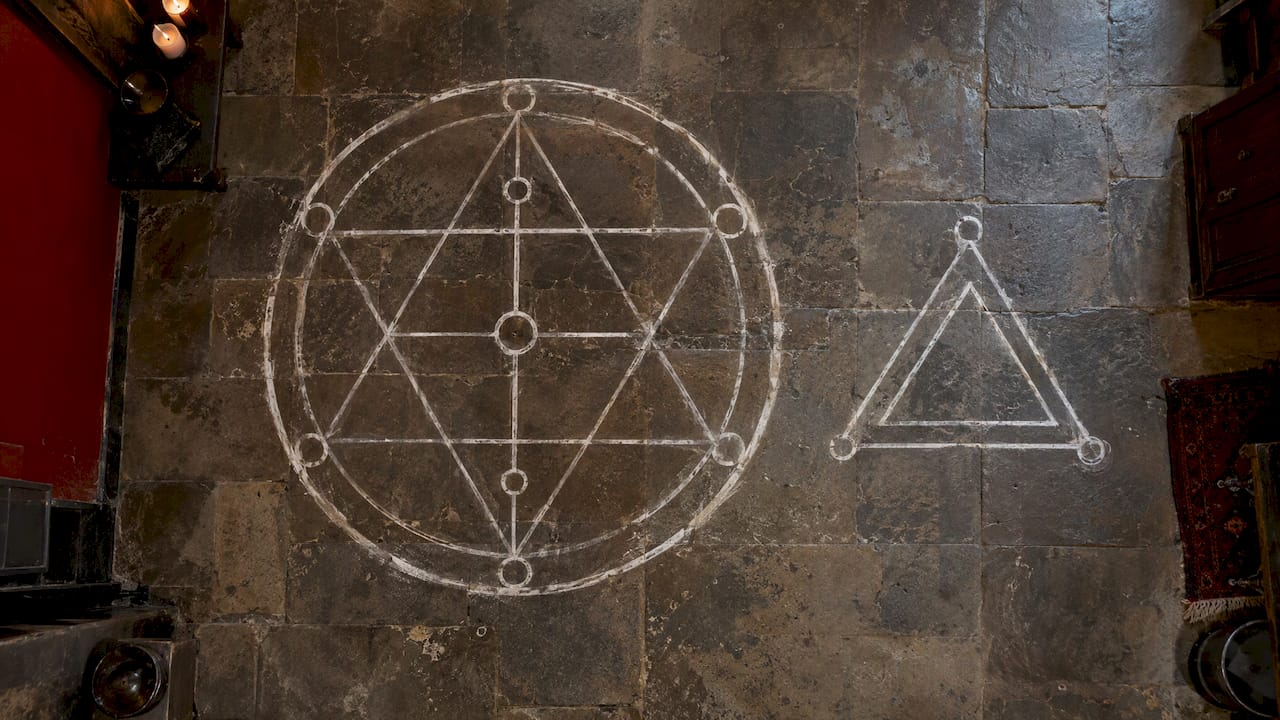
That matters for practice, because the circle, the triangle and the seal of the Goetic operation are themselves geometric constructions. A spirit whose office is geometry has a natural relation to the working space. If you build your own Goetic diagrams, then drawing the nine-foot circle accurately, dividing it correctly, and constructing the Triangle of Art with real precision is a form of the study you are petitioning him to deepen.
A typical use: structured learning
Take a magician studying architecture who keeps stalling on projective geometry. A Crocell working suited to that goal would not be a request for sudden understanding. It would pair a defined study block with the ritual: a fixed hour each day, a notebook for constructions done by hand with compass and straightedge, and a short opening rite that names the work. The rite opens each study block under his rule, and the notebook records what follows. After four to six weeks the student has a record of what was solved, how fast, and in what mood. This is how scholarly practitioners combine magick with real-world strategy: the magickal act frames a disciplined effort, and the effort can be checked.
Practitioners often report that his insights surface in or after a warm bath. Keep the study hours anyway, since he teaches the one who studies.
Waters, baths and sound
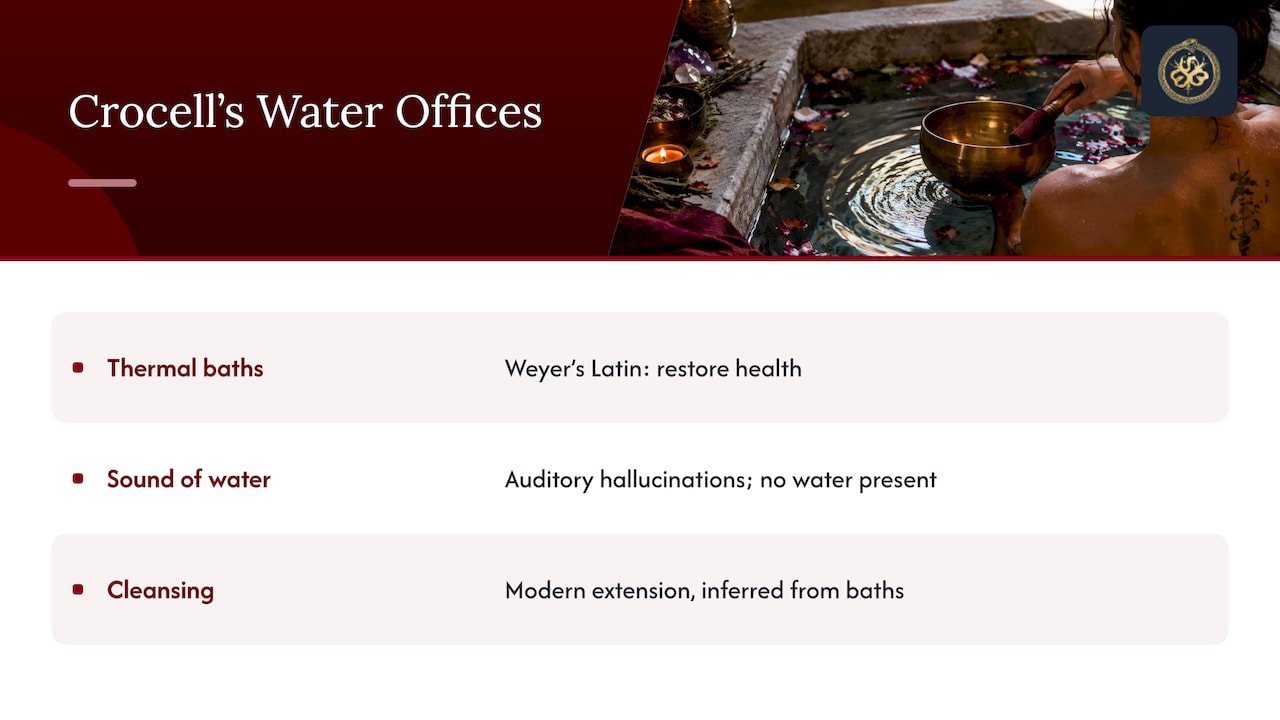
The water offices are the oldest part of the entry, since they appear in Scot as well. They divide into three.
Thermal waters. Weyer’s Latin describes the baths as serving to restore health (recuperandae sanitati servientia); that is what the grimoire says of them. A practitioner who treats Crocell as a spirit of springs, hot baths and natural heat sources is on solid textual ground.
The sound of water. The roar of many waters with no water present is a sign of his presence, given at the exorcist’s command. Modern lists of his powers include voices and sounds heard in the working for this reason. Many practitioners know he has arrived by that rushing sound before they see anything.
Cleansing. A common modern extension holds that his waters purify. That is not in the text, but it follows naturally from baths. For readers who work with energy cleansing, the bath is already a ritual form: a defined container, a temperature, a duration and a clear before and after.
The planetary question
Some readers ask whether Crocell comes from another planet or planetary system. Nothing in the primary material says so. What the sources do contain is planetary correspondence in the traditional astrological sense, which is a different claim. The 1904 Goetia’s classified list places Crocell among the Dukes whose seal is made in copper, the metal of Venus. Venus governs water, softness and beauty in the old schemes, which suits a spirit of baths who looks like an angel.
If you want a Venusian framework for him, you have an actual textual hook: the copper seal. If you want an extraterrestrial one, you are working from modern speculation, and it belongs in its own column of your notes. Keep two columns throughout, “in the text” and “added later.”
Working with Crocell: historical frame and modern practice
The historical Goetic operation is the same for all 72 spirits. You draw the magick circle, usually nine feet across and inscribed with divine names, and you do not leave it. A Triangle of Art sits a few paces away where the spirit is to appear. You wear the lamen with the spirit’s seal on your breast and use a brass vessel and the ring of Solomon. After purification and banishing, you recite conjurations calling the spirit by its names and divine names. Constraint, including the chain of spirits, is for a spirit that resists. The license to depart is given only after the request is granted. Our own page on the Goetia conjuring method walks through the sequence from the Lesser Key.
Modern practice divides. Some practitioners adhere strictly to the 17th-century text and command spirits by divine authority. Others take syncretic or partnership-based approaches. In demonolatry, the Goetic spirits are approached much as gods are in neo-pagan pantheons, and the conjuring methods of the Lesser Key are widely rejected there. Devotional practice approaches Crocell as a spirit who softens aggressive emotion, brings understanding and supports divination, and calls him with a modern enn, a short invocation specific to him. The enn and the devotional framing are modern.
A working outline for study and divination
This outline respects the text where it speaks and marks the rest as modern.
- Define one aim. The grimoire gives geometry, the liberal sciences, hidden things, and waters. Choose a single one. A mixed request gives a muddled answer.
- Prepare the space. Construct the circle and triangle by hand and with compass and straightedge. Treat the geometry as the first act of the working.
- Use the seal. Make the lamen or at least a drawn seal, and keep it the same across sessions so your records compare cleanly.
- Choose your frame. Either the classical conjuration and license to depart, or a devotional approach with an offering and a modern enn. Do not blend them within one session.
- Add the water. For a divination or insight aim, finish with a warm bath in which you hold the question and nothing else, or gaze into dark water or a black obsidian scrying mirror beside it. This is modern, and it follows the textual theme.
- Record at once. Write down impressions, sounds, images and the time before you interpret anything.
A second typical use: divination and the warm bath
A practitioner wants clarity on whether to leave an institution. She sets the aim as a single question, performs the short devotional frame, and takes the bath afterward, writing within ten minutes. She repeats this on three occasions a week apart, then reads the three entries together. Recurring images or phrasing carry the answer. A single vivid session is one message; three similar ones make a pattern. We advise the same discipline for all divinatory work.
Reading your own results critically
Crocell’s signature offices are sensory: a roar of water, a feeling of warmth, a vision. Those are personal experiences, and memory reshapes them with each retelling. Write them down plainly and early.
- Record the experience before any research into what it “should” be.
- Note the conditions: time, temperature, fatigue, what you had read that week.
- Look for corroboration that is external to you, such as the proof you solved or the scheduled outcome of a decision.
- Be grounded in the traditional methods before layering new ones, since many books circulate techniques that cannot be verified and may go against the system they borrow from.
To see what Crocell is doing in your life, measure the thing he governs: the study, the divination, the decision.
Our perspective on Crocell
We read Crocell as a spirit of structure and softness, which is an unusual pairing in the Goetia. Geometry gives form to space and thought. Warm water removes the guard a person keeps up. Together they suit the practitioner who is analytical and done with forcing results.
The mistake we see most often is asking him for an outcome in the world instead of a change in the practitioner’s capacity. His documented offices are teaching, perception and water. The strongest uses we know are the ones aligned with that: sustained study, clearer divination, and a settled state of mind before a hard decision.
We also hold that a spirit worked with seriously deserves a serious record. Keep the seal, the hour and the wording constant, write down what happens, and pair the ritual with the real-world effort it supports.
Black Witch Coven
Taking it further
If you want a spirit working built around your own situation, our demon rituals and spells cover Goetic and Luciferian work, and a Demonic Tarot Reading can help you decide which spirit fits your aim before you commit to a single operation.
FAQ
Who is Crocell?
Crocell is the 49th spirit of the Ars Goetia, a Duke ruling 48 legions. He appears as an angel, teaches geometry and the liberal sciences, makes the sound of rushing water, and warms waters and reveals baths. He is also written Crokel, and in Weyer and Scot as Pucel or Procell.
Is Crocell a fallen angel?
The Goetia says he was of the Order of Powers before his fall, as he told Solomon. That is the grimoire’s Christian framing. The text does not give a story of how or why he fell.
What does Crocell’s name mean?
The name is most plausibly a copyist’s change of the older Procel or Pucel, which resembles the Latin procella, meaning storm or the roaring of the sea. A Hebrew derivation meaning “angel of God” has been proposed but is speculative.
What is Crocell used for in modern practice?
Practitioners work with him for study, especially mathematics and design, for divination, for softening aggressive emotions, and for cleansing rituals involving water. These uses extend the historical offices of geometry, hidden things and baths.
