
Blog, Demons, Working With Demons
Astaroth Demon: Origins, Powers and How to Work With Him
Sep
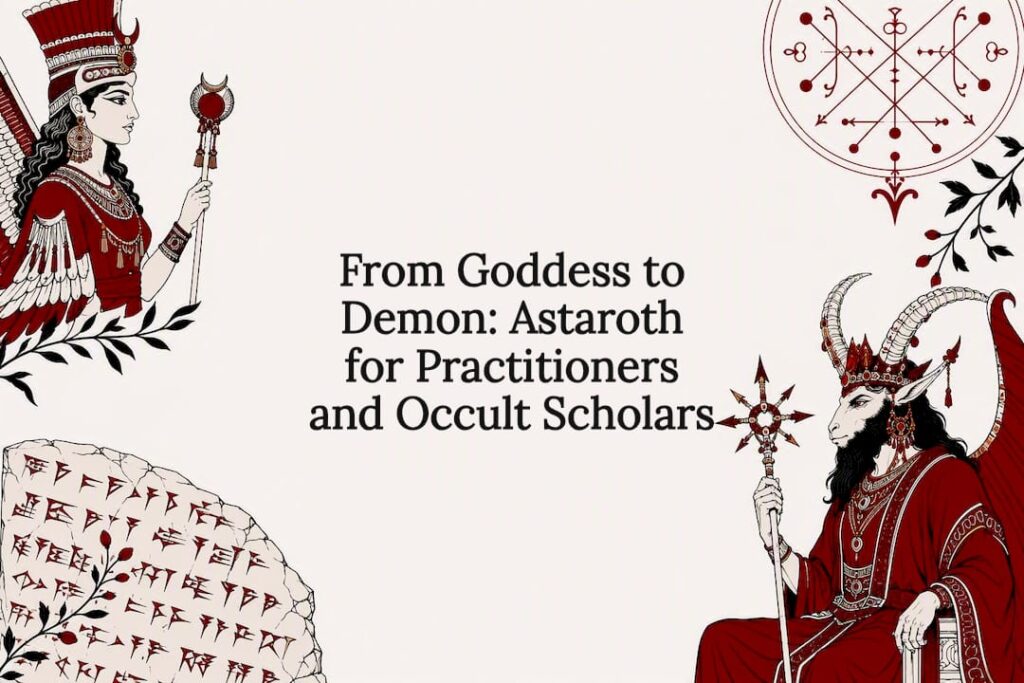
His name descends from Astarte, the Phoenician goddess tied to Ishtar and Inanna, and the shift from a revered female deity to a male demon is documented across the Book of Abramelin, the Pseudomonarchia Daemonum, and later grimoires.
Where Does the Name Astaroth Come From?
Astarte’s worship stretches back to the Bronze Age Levant, attested in Ugaritic and Phoenician texts nearly four thousand years old. She stood alongside Ishtar and Inanna as one of the ancient Near East’s most durable goddess figures, associated with fertility, war, and celestial power depending on the region and period. Her cult spread from coastal Canaan into Egypt, where she was absorbed into local pantheons without losing her original character.
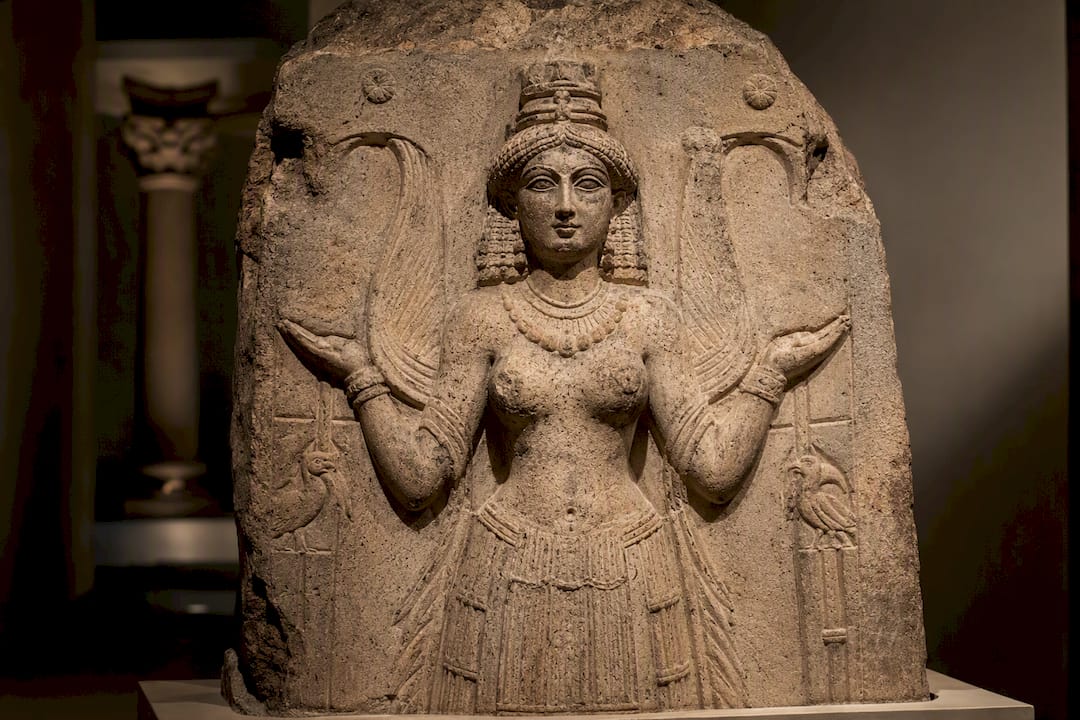
The Hebrew Bible complicates the picture. Scripture renders her name as Ashtoreth in the singular and Ashtaroth in the plural, a grammatical detail that matters more than it looks. Ashtaroth is technically a feminine plural form, likely used by biblical authors as a deliberate plural of contempt, a way of flattening a foreign goddess into a generic category of “the Astartes” or foreign idols collectively. That plural form, centuries later, got read by Christian demonologists as if it named a single entity, and a male one at that.
A few things happened linguistically and theologically on the way from goddess to demon:
- Hebrew scribes vocalized her name with vowels borrowed from bosheth (“shame”), a polemical trick used elsewhere in scripture to degrade pagan names.
- Medieval Latin translators and demonologists, working from garbled or secondhand Hebrew sources, lost the plural-of-contempt nuance entirely.
- The grammatical gender of the name stopped mattering once it was slotted into a demonic hierarchy that assumed male command structures.
- Astarte’s original attributes (fertility, sovereignty, war) got redistributed into demonic categories like temptation and forbidden knowledge.
Scholars still debate exactly when the singular masculine “Astaroth” solidified as a proper name rather than a collective noun, but the trajectory from Ugarit to grimoire is well documented, even if a few of the transitional steps are still murky.
What Does Astaroth Look Like in Goetic Art?
The image most people picture when they hear the name comes almost entirely from one source: the Le Breton plate in Dictionnaire Infernal. That illustration fixed several motifs that grimoire text had described in words but never rendered visually with this much specificity.
- A crowned, naked figure, often androgynous or male despite the goddess origin, signaling rank rather than gender fidelity to Astarte.
- A viper held or coiled at the figure’s side, representing hidden danger and forbidden knowledge.
- An infernal mount, usually described as a dragon or monstrous beast, underscoring dominion over lower spirits.
- Wings, marking him among the “winged” class of higher demons in Goetic classification.
- A foul or poisonous breath, which grimoire text tells conjurers to guard against with a ring or magickal instrument held to the face.
Compare that to Astarte’s own iconography: she’s typically shown with a lion, a star disk, or horns evoking fertility and celestial rule. The transformation from goddess-with-lion to demon-with-viper is not subtle. It swaps an animal associated with royal protection for one associated with venom and deception, which tells you exactly which symbolic register medieval Christian illustrators wanted Astarte’s descendant filed under.
The Le Breton engraving has been reprinted in occult reference works for over 150 years, and it is still the picture most people mean when they say his name.
What Powers and Roles Does Astaroth Hold?
Goetic tradition assigns Astaroth a specific job description, distinct from demons associated with lust, wrath, or war. His portfolio centers on knowledge, and that focus is consistent across every major source that names him.
- Revealing secrets about the past, present, and future to the conjurer who successfully commands him.
- Teaching the liberal sciences, meaning logic, mathematics, and the mechanical arts, a curriculum lifted almost directly from medieval university structure.
- Locating hidden treasure, a common demand across nearly every treasure-hunting grimoire tradition of the period.
- Granting invisibility under specific ritual conditions, though grimoire text is vague on mechanics.
- Encouraging sloth and intellectual pride, framed by demonologists as the moral cost of pursuing forbidden knowledge.
In rank, he’s consistently named a Great Duke, one tier below the demon kings in most hierarchical schemes, commanding his forty legions directly. Some Kabbalistic-influenced occult systems place him in correspondence with the qlipha tied to Jupiter, framing his temptations as corruptions of Jupiter’s positive attributes: expansion, wisdom, and authority twisted into pride and false knowledge. Certain later demonological writers label him “Prince of Accusers,” a title that plays on his association with revealing secrets, recast as a talent for exposing and condemning.
Pro Tip: If you’re cross-referencing Astaroth’s attributes against other Goetic entries, pay attention to which powers repeat across multiple demons versus which are unique to him. Treasure-finding and secret-revealing show up constantly across the seventy-two spirits of the Ars Goetia. The liberal sciences teaching function is rarer and more specifically his.
How Did a Goddess Become a Demon?
The mechanics of demonization weren’t random. They followed a fairly predictable playbook that Christian polemicists used across dozens of pagan deities, not just Astarte.
Biblical authors set the template first. Passages referencing Ashtoreth and Ashtaroth treat her worship as a recurring temptation for the Israelites, something kings needed to stamp out repeatedly. That repetition itself did rhetorical work, framing her cult as a persistent threat rather than a one-time lapse. Later Pauline and post-Pauline Christian theology extended this logic further, treating all pagan deities as either illusions or, more commonly, disguised demons actively deceiving worshippers.
- Hebrew scribes’ use of degrading vowel patterns turned a goddess’s name into something that sounded shameful before any demon catalog existed.
- Medieval commentators inherited biblical polemic without inherited context, reading condemnation of a cult as confirmation of a demon’s existence.
- Grammatical confusion around Ashtaroth’s plural form let commentators collapse many local Astarte cults into one singular demonic figure.
- The gender switch from goddess to demon reflects medieval assumptions about which sex holds authority in an infernal court, not any textual requirement in the source material.
Astarte’s afterlife shows how religious memory gets reshaped by whoever holds interpretive power. The people writing the grimoires and biblical commentary were never neutral historians. They were participants in an active campaign to delegitimize competing religious systems, and Astaroth is what remained after that campaign ran its course for over a thousand years.
How Has Astaroth Appeared in Literature and Culture?
Astaroth shows up repeatedly in accounts of demonic possession, most notably in the Loudun possessions and the trial of Urbain Grandier in 17th-century France, where exorcists named him among the spirits supposedly tormenting the possessed nuns. Those trial records fed directly into later demonological literature, reinforcing his reputation as a spirit worth naming specifically rather than lumping in with generic “unclean spirits.”
- Golden Legend traditions and other medieval hagiographic literature reference demons matching Astaroth’s profile in stories about saints overcoming pagan idols.
- Faust literature, including versions of the Faustbuch tradition, occasionally lists Astaroth among the spirits summoned or discussed by the legendary magician.
- Some modern writers attach invented labels like “demon of August” or reduce him to a generic personification of sloth, a simplification with no real grounding in the older grimoire material.
The pattern across nine centuries is consistent: each era keeps the name and the rough outline of rank and power, then reshapes the details to fit whatever cultural anxiety needs a demon attached to it.
How Do Practitioners Work With Astaroth Today?
Contemporary Goetic practitioners approach Astaroth primarily as a source of knowledge, not wealth or love, which sets him apart from demons more commonly invoked for those goals. Petitioners historically asked for answers about hidden matters, instruction in logic and the sciences, and help locating buried or lost property. Modern ceremonial work tends to preserve that same focus, framing requests around clarity, research breakthroughs, or uncovering information that’s been deliberately concealed. Our Astaroth Demon Directory page sets out his rank, offices and correspondences in one place.
Grimoire text is specific about how he is received. Weyer and the Ars Goetia both describe his foul breath, and the operator is told to hold the magickal ring near the face while he is present. The structure comes straight from the conjuring method of the Goetia: circle, triangle, ring, and questions prepared before the call.
- Ritual framing today usually centers on structured questions rather than open-ended requests, mirroring the “reveals secrets” function from the original grimoires.
- Practitioners experienced in Goetic and Luciferian work often treat protective measures (a triangle, a ring, clear ritual boundaries) as standard practice rather than optional flourish.
- Requests for treasure-finding have shifted in modern practice toward broader prosperity and opportunity work, adapted from the literal buried-gold framing of medieval grimoires.
Pro Tip: Before working with any high-ranking Goetic spirit, cross-reference at least two primary sources on his attributes rather than relying on a single modern summary. Weyer and the Ars Goetia occasionally diverge on small details, and knowing where they agree versus where later grimoires added embellishment keeps your ritual framing historically grounded.
Why Astaroth Still Matters to Serious Occult Study
Astaroth rewards patience. He’s one of the clearest cases where you can trace a figure from Bronze Age temple worship straight through to a Renaissance grimoire sigil, and every step of that transformation is documented rather than speculative. Most demons in the Goetic canon don’t offer that kind of paper trail.
What strikes us most is how much the “demon of knowledge” framing actually preserves something true about Astarte’s original sovereignty, even while the church that recast her intended the opposite effect. Read Weyer alongside the Ugaritic and biblical material on Astarte, and Abramelin alongside the Ars Goetia, before you form an opinion of your own.
Black Witch Coven
Where to Read Further on Astaroth
For his office and rank, go to the Ars Goetia and Weyer’s Pseudomonarchia Daemonum (1577). The Book of Abramelin places him among the sub-princes, and Collin de Plancy’s Dictionnaire Infernal carries the Le Breton plate. For the goddess behind him, the Hebrew Bible’s Ashtoreth passages and the Ugaritic texts are the starting point. On the altar, Astaroth Oil and Astaroth Incense Sticks are blended for his workings.
If you’re working through Goetic material and want to know which spirit fits a specific working, Black Witch Coven offers one-on-one Left-Hand Path readings. For work carried out on your behalf, our daemonic spell casting services are performed by coven members who know the history behind names like Astaroth as well as the sigil.
FAQ
What Is Astaroth the Demon Of?
Astaroth is primarily associated with revealing hidden knowledge, teaching the liberal sciences, and locating treasure, according to the Ars Goetia and Weyer’s Pseudomonarchia Daemonum. He holds the rank of Great Duke and commands forty legions in Goetic hierarchy.
Is Astaroth Mentioned in the Bible?
Not by that exact name. The Hebrew Bible references Ashtoreth (singular) and Ashtaroth (plural), forms tied to the goddess Astarte, and later demonologists transformed that biblical name into the male demon Astaroth centuries afterward.
Is Astaroth Good or Bad?
Within Christian demonological tradition, Astaroth is classified as an infernal spirit, one of the higher-ranking demons in the Ars Goetia. That classification reflects centuries of religious polemic against Astarte worship rather than any neutral moral judgment, and practitioners today approach him as a spirit of knowledge.
Is Astaroth a Fallen Angel?
Grimoire tradition does not consistently describe Astaroth as a fallen angel in the way it does for figures like Lucifer. He’s categorized as a Great Duke of Hell in the Ars Goetia, a rank tied to the infernal hierarchy rather than a specific fall-from-heaven narrative.
