
Blog, Demons, Working With Demons
Focalor Demon: Goetia Entry, Seal and How to Work With Him
Oct
Focalor is the 41st spirit of the Ars Goetia, a Great Duke who commands thirty legions, appears as a man with griffin’s wings, and holds power over winds and seas. He is also the spirit whose own text hands the operator the key to him: if he is commanded to forbear, he harms no one. That one clause explains most of what is useful about him. He is a force of raw, destructive water and weather that answers to a disciplined will.
This article covers where Focalor comes from in the manuscripts, what the texts actually say, where modern claims drift from them, and how to build a working around him. It is written for readers who want to handle the source material critically and then use it. His short profile sits on our Focalor Demon Directory page.
What the Goetia says about Focalor
The seventeenth-century English manuscript text of the Lemegeton, Part 1: Goetia lists him as the forty-first spirit, a great and strong duke. His form is a man with griffin’s wings. His stated office is to kill men and drown them in the waters, and to overturn ships of war. The same entry gives him power over the winds and the sea, and says that he will not hurt any man or thing if commanded by the exorcist to forbear. He rules thirty legions, though some versions give three.
Then comes the detail that makes him more than a storm-bringer. The text says he hopes to return to the Seventh Throne after a thousand years, and the manuscripts add that he is deceived in this hope. Focalor is a fallen spirit with a long-memory grievance and an unmet expectation, and any evoker should take that seriously: he is patient, he is bound to a timeline, and he has something he wants.
Names vary. Focalor, Forcalor and Furcalor all refer to the same spirit, and the three spellings run through the Goetia manuscripts and Weyer’s catalog. This matters when you search catalogs and grimoire indexes. If you only look for one spelling, you will miss the earlier witnesses.
Where the name comes from: Weyer and the chain of transmission
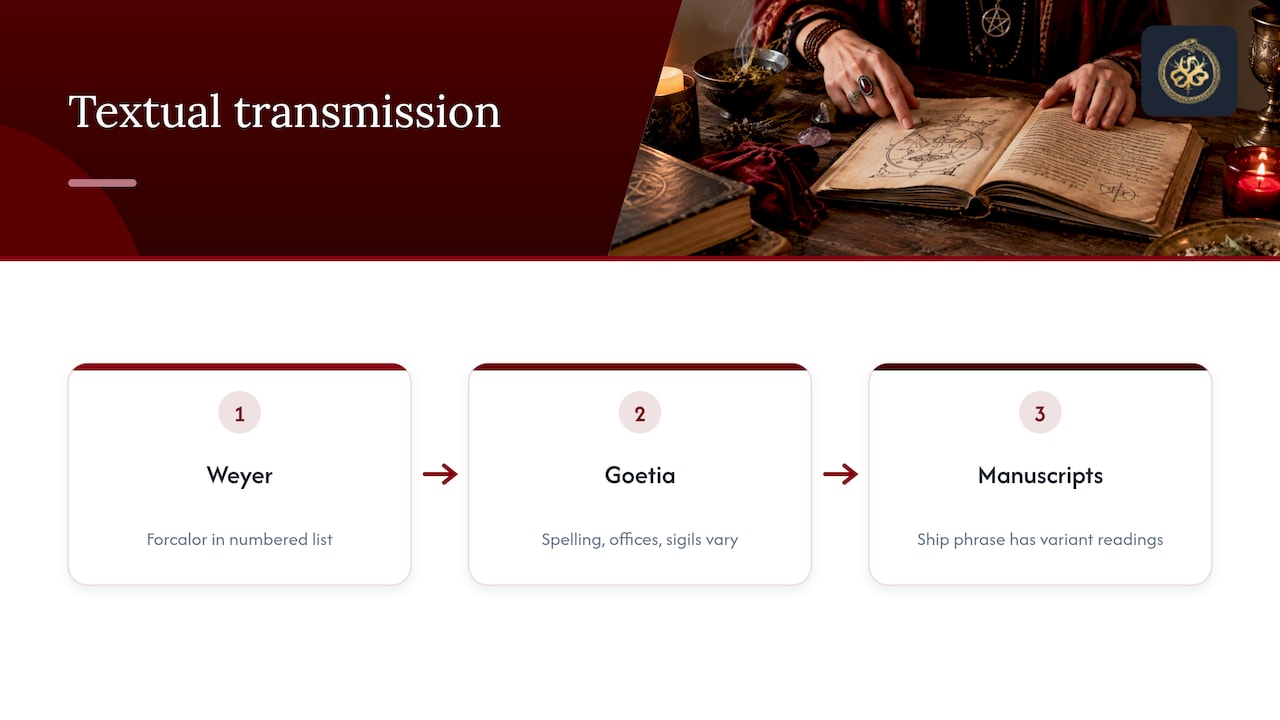
The Goetia did not appear fully formed. The work now known as the Goetia is a collection of sections drawn from separate manuscripts. The catalog of spirits itself traces back to Johann Weyer’s Pseudomonarchia Daemonum, the appendix to his De Praestigiis Daemonum. Weyer gives a numbered list of spirits, and that is where the spelling Forcalor sits.
Weyer’s catalog, printed in 1577, predates the Goetia and already records the name as Forcalor. So the form we now use most often, Focalor, is a later development in the chain. Weyer was writing as a physician and critic of witch persecution, cataloging spirits in order to describe what he considered a corrupt practice. The practitioners who later absorbed his list were using it for the opposite purpose.
For the working occultist this has a practical consequence. The text is a fluid chain of copies. Comparing versions is part of the craft. A Goetia edition derived from earlier sources will differ from the manuscript transcription in orthography, in the rendering of the offices, and in the sigils. Manuscript copies even differ on phrases like the one about overturning ships, with some readings correct and others corrupt. Before you draw his seal or build an invocation, read at least two witnesses side by side and note where they disagree.
Separating Focalor from Lucifuge Rofocale
A persistent claim in modern occult writing holds that Rofocale in Lucifuge Rofocale is an anagram of Focalor, which would make the two the same entity or closely related. The evidence does not support that. Lucifuge Rofocale appears in only one text, the Grand Grimoire, a French handbook of black magick from the seventeenth or eighteenth century, and not in the Ars Goetia at all. The two have different textual homes, different roles and different histories.
The resemblance in the names is real, and it is fair to say the anagram is a tempting observation. It is still only an observation; no document records a lineage. If you want to work with Lucifuge, work from the Grand Grimoire’s own procedures. If you want Focalor, work from the Goetia and Weyer. Mixing the two frameworks because the letters rhyme produces a muddled rite and no insight.
What Focalor is for
A blunt reading of his office, killing and drowning, makes him sound like a one-purpose weapon. A more careful reading sees three layers.
Elemental command. He governs winds and seas. In a historical setting that meant weather, passage, shipwreck, and the fortunes of anyone who depended on water. Translate this to a modern setting and you get the logic of flows: trade routes, shipping, logistics, migration, anything that moves through a medium you cannot control directly.
Destruction with a leash. His clause about forbearing is unusual. Most of the spirits are described by what they give. Focalor is described by what he does and by what he can be told not to do. He holds the destructive potential of chaotic elements alongside a capacity for protection when properly commanded, and the text supports that reading. A spirit who can sink a fleet and also be instructed to spare it is a spirit whose most valuable work is restraint under command.
Negotiated transition. Some modern interpretations connect him to Mercury or to Neptune-ruled Pisces because of his fluid, maritime nature and his association with moving through emotional change. The grimoire does not state this; it is interpretation layered on the text.
Planetary and timing correspondences
The Goetia’s rank scheme ties dukes to Venus, which gives Focalor a Venus correspondence, and some modern readers prefer Mercury or Neptune-ruled Pisces. Wednesday, Mercury’s day, or Venus-ruled timings are used depending on the framework. This is a matter of interpretation, so choose one system and keep it consistent throughout the working.
A workable approach:
- Decide whether your purpose is movement and communication (Mercury, Wednesday) or relational and aesthetic leverage (Venus, Friday).
- Calculate the planetary hour for your location rather than relying on a table printed for another latitude.
- Note the moon phase. Waning phases suit dissolving, ending or clearing work. Waxing phases suit building passage or opening a route.
- Record your choice and your reasoning in your working journal, so that you can compare results across attempts.
Fixed timing gives you a controlled variable. If you change the day, the hour, the incense and the aim all at once, you will never know what mattered.
Preparing the working
Before any evocation, decide what you are asking and what you are not. The Goetic tradition is transactional, and working with these spirits is active: it involves clear boundaries, formal commands and sovereign authority over the ritual space. That makes the preparation the larger share of the work.
Read the sources and draw the seal
Copy the seal from a manuscript-based source rather than a derivative image. Draw it by hand on clean paper or parchment, in a single sitting, and keep the proportions. Write his name in the spellings you found, Focalor, Forcalor and Furcalor, on the same sheet.
Frame a single, narrow request
Focalor’s office suggests requests about passage, obstruction and protection from the specific harm of someone else’s forces. Keep to one problem at a time. A request that tries to repair a business, a marriage and a reputation in one rite gives the spirit nothing precise to act on, and gives you nothing to measure.
Divination first
Many practitioners test the ground with a reading before they open the rite, to see what is moving around the question. A spread that looks at what is hidden and what is ending suits his office, and our Demonic Tarot Reading can do that work before you commit to a rite. Whatever spread you use, write the result down before the evocation and compare it with the outcome afterward.
Set the space
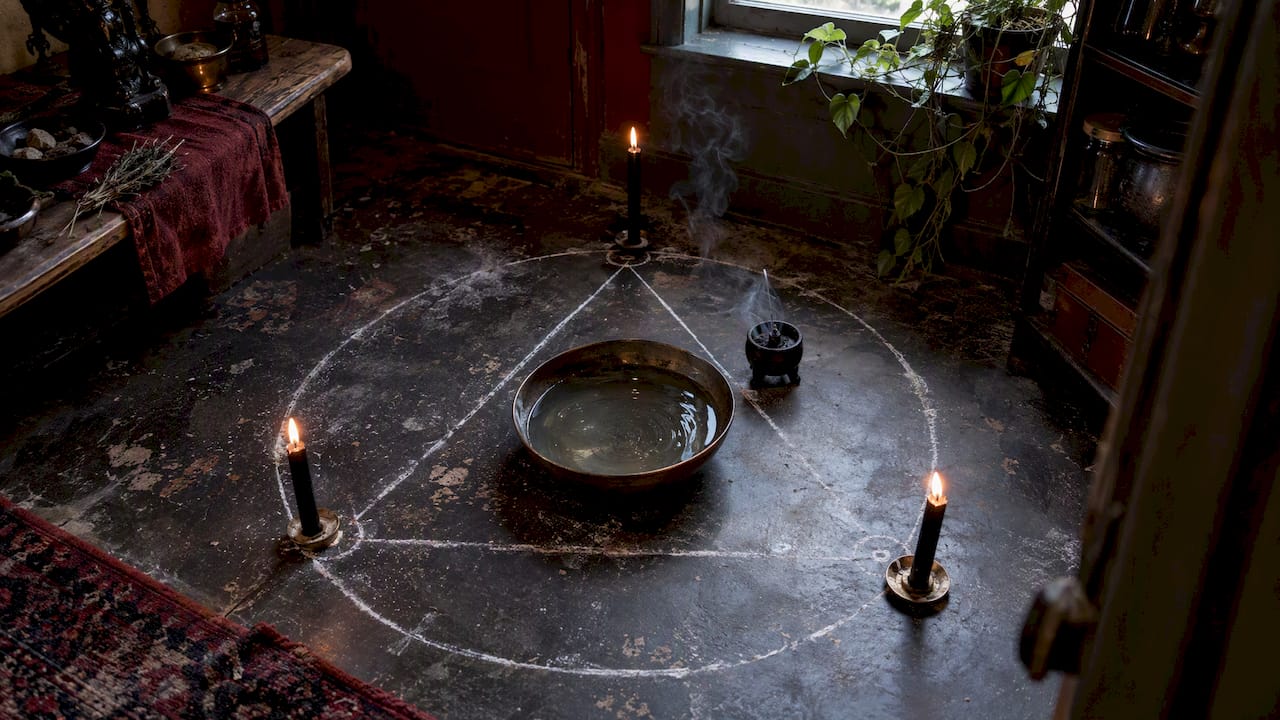
The formal Goetic frame uses a circle and a triangle, with the operator in the circle and the spirit manifested in the triangle, as set out in our conjuring method from the Goetia. Mark both. Keep your tools within reach: seal, candle, incense, a bowl of water, a notebook and a pen. A bowl of water on the altar is a fitting focus for this spirit, a small sea in the working space.
A working method for evocation
The following is a practical sequence built on the Goetic structure. It is our synthesis of the tradition, not a verbatim procedure from the grimoire.
- Open. Establish the circle, state your name and your authority, and state the purpose of the rite in a single sentence.
- Call. Address the spirit by his rank and names: Focalor, Forcalor, Furcalor, Great Duke. Describe the form you expect, a man with griffin’s wings, so that you recognize what arrives and notice what does not match.
- Direct the attention. Fix your eyes on the seal and the bowl of water. Many practitioners report the first sign as a change in the room’s air or sound. Record it without interpreting it yet.
- Command restraint. This is the step the text itself builds in. Say plainly that he is to harm no person and no thing in the course of this working. The grimoire records that he will comply when commanded to forbear, so use that clause at the start, not as an afterthought.
- State the request. One sentence, concrete, with a time limit.
- Listen and record. Write down impressions, images, words and body sensations during the rite, not afterward.
- Dismiss. Give formal license to depart, close the circle, and clear the space.
- Review. Within an hour, read your notes aloud once. After a week, compare outcomes against the request.
The discipline here is no different from any structured experiment: you want a clean record of what you did and what followed.
Three case examples
These are typical uses, written as composites to show method.
The logistics manager. Suppose a regional manager at a freight company faces repeated delays at a port, each with a different stated cause. She frames one request: that the shipments in question move without interference over the next four weeks. She works on a Wednesday in a Mercury hour, keeps a log of container release dates, and compares them with the prior four weeks. With a baseline and a measure, she can see exactly what the working moved.
The person in a transition. Someone leaving a long career and a long relationship in the same year uses the modern Pisces reading of Focalor as a figure for moving through emotional change. Her working asks for clarity about which commitments to release first. Her journal after each session records one decision made and one avoided. That is the fluid, maritime association put to use: a way of moving through change.
The defensive working. A practitioner who believes a rival has been directing hostile magick at him builds the working around Focalor’s restraint clause. He commands the spirit to forbear against anyone not involved, and asks for the rival’s pressure to turn aside like a swell around a breakwater. He pairs the rite with real defensive action, documenting incidents and tightening access to his accounts.
Modern sources and their limits
Modern writing on Focalor ranges from careful to careless. Some modern authors describe him as a tool for psychic defense and call him a demon of salvation as well as destruction. The textual basis for that is thin. The grimoire says nothing explicit about psychic defense. What it does say is that he drowns, overturns ships, commands winds and seas, and can be told to forbear. The protective reading is a reasonable extension of the forbearance clause; label it as extension in your own notes.
The same applies to claims about his origin beyond the grimoire tradition, whether in older pantheons or other worlds. Nothing in the Weyer catalog or the Goetia manuscripts supports a specific earlier source for him. When someone claims one, ask for the manuscript. If none is offered, treat it as speculation.
Our perspective
We approach Focalor as a spirit of controlled force. What interests us is the single clause in the text that makes him workable: he does what he does unless told otherwise. That puts the entire weight of the rite on the operator’s clarity. A vague operator gets a vague storm.
In our experience of left-hand path practice, the difference between a rite that moves something and one that merely feels intense is the same as in any craft: a narrow aim, a clean method, a record, and the willingness to take real-world action alongside the ritual. Spiritual sovereignty means you are the one who sets the terms. Focalor is a good teacher of that because the grimoire gives him no way to be passive on your behalf. You command, you specify, you dismiss, and you review.
We also think the scholarly work matters to the practitioner. Knowing that his name passes through Weyer’s catalog before the Goetia, that the manuscripts disagree, and that the Rofocale link is conjecture keeps you from building a practice on borrowed certainty.
If you want the working done for you
Some readers prefer to have a rite performed by an experienced hand while they handle the practical side. We offer daemonic workings, including protection and prosperity castings, and Left-Hand Path readings for those who want a read on the situation first.
Frequently asked questions
Is Focalor a demon name?
Yes. Focalor, also spelled Forcalor or Furcalor, is the 41st of the 72 spirits in the Ars Goetia, the first book of the Lesser Key of Solomon. The name goes back to Weyer’s catalog of spirits, where it appears as Forcalor.
What is Focalor’s office?
The Goetia says he kills and drowns men, overturns warships, and has power over winds and seas. The same text says he will harm no one if the exorcist commands him to forbear. He commands thirty legions, though some versions give three.
Is Focalor the same as Lucifuge Rofocale?
There is no documentary basis for saying so. Lucifuge Rofocale appears in the Grand Grimoire, not the Ars Goetia, and the anagram theory is speculation. Treat them as separate spirits with separate textual traditions.
What planet and day belong to Focalor?
The Goetia’s rank scheme gives dukes, and so Focalor, to Venus. Some modern practitioners use Mercury, and therefore Wednesday, or Neptune-ruled Pisces. Pick one framework, apply it consistently, and log your results.
