
 New Years Eve Ritual 2026/2027 with Savannah
Blog, Occultism, Psychic Ability
Testing Personal Gnosis: How to Tell Revelation From Wishful Thinking
Jan
Personal gnosis is direct, experiential knowledge gained through ritual, trance, dreamwork, or spirit contact rather than through doctrine or secondhand report. The practical stance that follows from this: treat the experience as raw data, record it precisely, test it against repeatable methods, and integrate only what survives honest scrutiny and proves useful over time. What follows breaks down the definitions, the methods, and the evaluation framework that make this workable.
Table of Contents
- What scholars and magicians mean by personal gnosis
- Repeatable practices to cultivate personal gnosis
- How to evaluate, record, and validate unverified personal gnosis
- Phenomenology: what personal gnosis can feel like
- Personal gnosis, historical Gnosticism, and adjacent traditions
- Working tools: journaling, exercises, and a testing checklist
- A working stance toward personal gnosis
- FAQ
- Sources
What scholars and magicians mean by personal gnosis
Academic and occult communities use “gnosis” in related but distinct ways, and conflating them causes most of the confusion around unverified personal gnosis, or UPG. In scholarly use, gnosis names a form of knowledge that exceeds ordinary discursive reasoning: a 2019 article in Gnosis: Journal of Gnostic Studies describes it as transformative insight that cannot be reached through step-by-step argument alone. It is a category of knowing, not a specific doctrine or historical movement.
Occult communities use the term more narrowly and personally. A University of California, Riverside thesis on personal gnosis among Pagans, witches, and occult occultists defines it as spiritually meaningful understanding formed through lived experience: dreams, trance states, ritual, divination, or perceived contact with a deity or spirit. The thesis treats this understanding as embodied and emotional, arising from practices meant to connect the individual to something beyond the self.
The distinction that matters for evaluation:
- Academic gnosis describes a mode of knowing that transcends discursive logic.
- Personal UPG describes a specific individual’s claim, formed through personal practice.
- Personal insight carries a different evidential weight than claims corroborated by text, tradition, or multiple independent magicians.
Keeping these three senses separate lets you make precise claims about what you experienced without overstating what it proves.
Repeatable practices to cultivate personal gnosis
Most witches reach gnosis through a small set of overlapping techniques, and the strongest results tend to come from applying one method consistently rather than sampling some once each.
- Ritual invocation or evocation: structured ceremonial contact with a deity, spirit, or entity, performed with consistent timing, tools, and intent.
- Trance work: induced altered states through rhythmic sound, breath control, or stillness, used to lower discursive mental chatter.
- Dreamwork: deliberate dream incubation, lucid dreaming, or structured dream recall aimed at a specific question.
- Meditation and contemplative practice: sustained attention practices that create the stillness in which subtle impressions become noticeable.
- Active imagination: a waking, guided inner dialogue with an image, figure, or symbol, recorded as it unfolds.
- Divination: tarot, runes, or similar systems used either to generate insight directly or to cross-check an impression gained elsewhere.
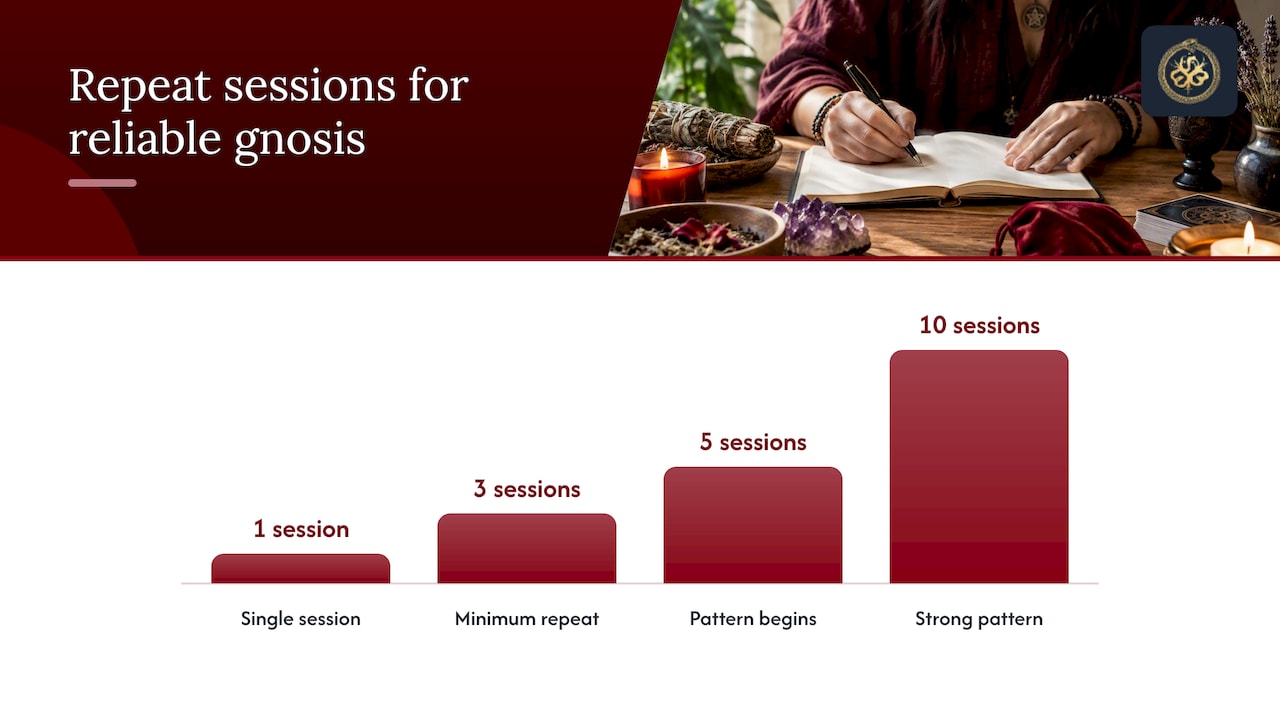
A repeatable experiment follows a simple structure: set a single clear intent before starting, hold conditions as constant as you can across sessions, such as the same time of day, same space, and same tools, then repeat the session multiple times before drawing conclusions. A single session proves nothing; a pattern across five or ten sessions under similar conditions starts to mean something.
Build a grounding step into every session, a few minutes of centering before you begin and a deliberate return to ordinary awareness afterward, as described in our spiritual awakening guide to inner peace, and treat any session that leaves you disoriented or emotionally flooded as a signal to pause and reflect rather than push forward.
Pro Tip: Run the same working at least three times before treating any single impression as meaningful. One vivid session is an anecdote, not a pattern.
How to evaluate, record, and validate unverified personal gnosis
Raw experience and verified insight are not the same thing, and the gap between them closes only through disciplined recordkeeping. The UC Riverside research on personal gnosis as scripture among occult occultists outlines a four-layer record model that keeps these elements from blurring together:
- Event: what objectively happened, described without interpretation.
- Bodily and emotional response: physical sensations, mood shifts, or involuntary reactions during the experience.
- Interpretation: the meaning you assigned, labeled explicitly as your reading of events.
- Action taken: what you did as a result, and why.
Separating these four layers prevents your interpretation from quietly becoming “what happened” in your own memory, which is the most common way UPG curdles into false certainty.
Once you have a record, test it. Repeat the working under similar conditions and compare outcomes. Use divination as an independent cross-check, asking a separate question through a separate system to see whether the answers converge. Bring the experience to a trusted peer or small group and let them question it directly rather than simply affirm it. Repeated, independently corroborated impressions can become what the same research calls “shared personal gnosis,” though even shared reports fall short of historical or doctrinal proof.
Three criteria decide whether an insight is worth integrating: it stays coherent across repeated sessions rather than shifting with your mood, it survives honest doubt and pointed peer questioning, and it proves useful when applied in practice.
Phenomenology: what personal gnosis can feel like
Personal gnosis has no single emotional signature, and expecting one leads magicians to dismiss quieter, more reliable impressions in favor of dramatic ones. Research on the recoverability of gnosis in Gnosis: Journal of Gnostic Studies notes that gnostic experience ranges from pessimistic, dualist framings, where the self feels trapped and the insight concerns escape or liberation, to optimistic, non-dual framings, where separation itself dissolves and the insight concerns unity.
In practice this spans vivid visionary states with sensory detail, barely perceptible felt-senses that arrive as a shift in mood or certainty, ongoing relational exchanges that feel like conversation with a distinct other, and slower cognitive transformations where a belief or assumption simply stops making sense after weeks of practice. None of these forms is inherently more valid than another.
The implication for interpretation is direct: a quiet, barely-there impression that holds up over months of testing is more trustworthy than an overwhelming vision that collapses under the first honest question. Affective intensity measures how strongly you felt something, not whether it was accurate.
Personal gnosis, historical Gnosticism, and adjacent traditions
“Gnosticism” names a contested historical category, not a single ancient religion, and the Dictionary of Gnosis and Western Esotericism cautions that the term covers genuinely diverse currents from the ancient world, making it methodologically risky to equate your own modern UPG directly with any specific ancient gnostic movement. Personal gnosis, as used by today’s witches, is a modern descriptive term for individual experience, not a claim about reviving a particular lost sect.
Several adjacent traditions frame gnosis differently. Hermeticism treats experiential knowing as part of an ascent toward divine mind. Certain strands of Neoplatonic theurgy treat ritual contact with higher powers as a technical art with its own graded stages. Contemporary pagans generally use UPG as a working category for individual revelation that sits alongside, rather than replaces, shared lore.
The practical advice is simple: keep historical scholarship about ancient movements and your own lived experience in separate registers, and resist the temptation to validate a personal insight by dressing it in borrowed antiquity.
Working tools: journaling, exercises, and a testing checklist
A working template turns the four-layer model into something you can use the same night you have an experience.
- Event: Write exactly what happened, in order, with no explanation attached.
- Response: Note physical sensations (temperature, tension, breath) and emotional tone as they occurred.
- Interpretation: Write your reading of the event, flagged clearly as interpretation.
- Action: Record what you did next and what you intend to test going forward.
A short exercise for generating a testable data point: spend two or three minutes centering with slow breath, then hold a single focused intent or sigil in attention for five to seven minutes without forcing an outcome, then immediately write the four-layer record before doing anything else. Repeat this exact structure at the same time of day for at least five sessions before comparing notes across the set.
A testing checklist before you integrate any conclusion: hold your conditions (time, space, tools) constant across repeats, run a minimum of three to five repeats before drawing a pattern, cross-check with an independent divination method, and bring the record to a peer for direct questioning rather than casual sharing.
Pro Tip: Date every entry and review the full set after a month; patterns that only appear when you reread in sequence are often the most reliable ones.
A working stance toward personal gnosis
Treat every experience as data first and meaning second. The impulse to interpret immediately is strong, especially after something vivid, but the discipline that separates durable insight from self-deception is writing down what happened before deciding what it means. Accountable peer review matters here, not as ritual courtesy but as a genuine check against motivated reasoning; a small, trusted circle willing to question your conclusions does more for your practice than any amount of solitary conviction. The routines above are not elaborate. They work because they are repeated, recorded, and checked, and that consistency is what turns a string of private experiences into something you can actually rely on.
**
FAQ
What religion is closest to Gnosticism?
No single modern religion is a direct continuation of ancient Gnosticism, since the Dictionary of Gnosis and Western Esotericism treats it as a diverse, contested historical category rather than one coherent faith. Currents such as Hermeticism and certain Pagan traditions that center personal revelation share a family resemblance in valuing direct experiential knowledge, but none should be presented as a straightforward modern equivalent.
How can I become spiritual?
There is no single required path, and research on spiritual individualism shows that private spiritual practice can coexist with community involvement and accountability rather than requiring a choice between the two. Starting with a consistent practice, such as meditation, dreamwork, or ritual, and keeping an honest record of what arises is a practical way to begin.
What does the term gnosis mean?
Gnosis refers to direct, experiential knowledge that exceeds ordinary discursive reasoning, as defined in a 2019 article in Gnosis: Journal of Gnostic Studies. In working contexts, personal gnosis specifically means individually gained insight through practices like trance, dreamwork, or ritual, as distinct from knowledge drawn from shared text or doctrine.
What are the four main types of spirituality?
There is no single agreed taxonomy, but a practical working framework used by occultists groups spiritual approaches into contemplative, devotional, ritual or embodied, and relational or communal practice. This framework is a convenience for discussion rather than a fixed scholarly classification, and most magicians draw on more than one category at once.
Sources
- What Is Gnosis? An Exploration
- In the Words of the Gods: Exploring Personal Gnosis as Scripture Among Pagans, Witches, and Occult Practitioners
- Dictionary of Gnosis and Western Esotericism
