
 New Years Eve Ritual 2026/2027 with Savannah
Blog, Herbs & Oils
Belladonna (Deadly Nightshade): Magical Uses & Toxicity
Feb
Belladonna (Deadly Nightshade): Magical Uses & Toxicity
By Edwin
Belladonna has one of the strongest reputations in European witchcraft.
Its common name—deadly nightshade—already tells you why.
Atropa belladonna is a highly poisonous plant associated with folklore, witchcraft, visions, poison lore, and traditional magical symbolism. It is also a plant that should be treated as a genuine toxic hazard rather than a casual witchcraft ingredient.
That distinction matters.
The old version of this article mixed folklore, magical claims, medical information, poisoning history, and practical growing instructions. The result made a dangerous plant sound more usable than it actually is.
This version focuses on what is useful to know: what belladonna is, why it appears in witchcraft history, what its symbolism means, and why you should not experiment with the plant.
What is belladonna?
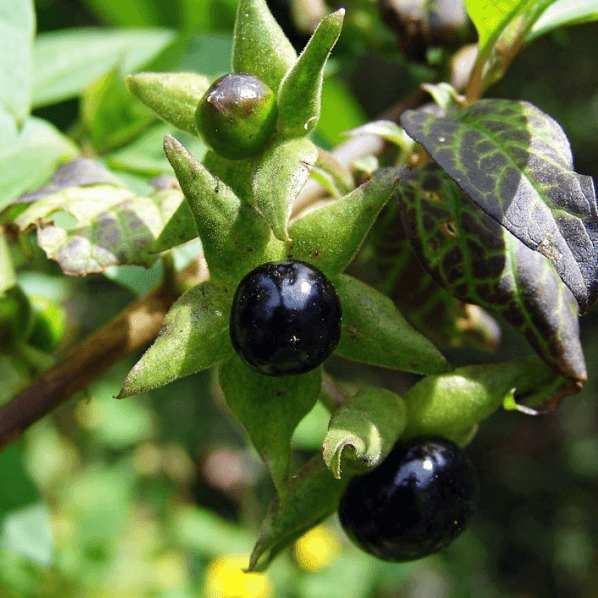
Belladonna (Atropa belladonna) is commonly known as deadly nightshade.
It belongs to the nightshade family, Solanaceae, and is native to parts of Europe, North Africa, and western Asia. It has also been introduced or cultivated elsewhere.
The plant is recognizable for its:
- branching growth;
- dark green leaves;
- bell-shaped flowers;
- and shiny dark berries when mature.
The berries can look deceptively attractive.
That is part of the danger.
Poison Control specifically lists deadly nightshade among poisonous plants and notes that poisonous plants can cause anything from irritation to severe illness or death.
Why is belladonna poisonous?
Belladonna contains tropane alkaloids, particularly atropine and scopolamine. These compounds affect the nervous system and can produce serious anticholinergic poisoning.
The important practical point is simple:
Do not ingest belladonna.
Do not make tea from it.
Do not make a tincture.
Do not experiment with homemade extracts.
Do not attempt to determine a “safe” amount.
The concentration of toxic compounds can vary between plant parts and specimens, making home experimentation particularly dangerous. Research reviewed by the UK’s Food Standards Agency documents significant variation in tropane alkaloid concentrations in different parts of A. belladonna.
Belladonna and witchcraft
Belladonna became deeply associated with European witchcraft folklore.
It appears in discussions of so-called flying ointments, visionary practices, poison lore, and stories about witches traveling beyond ordinary physical limitations.
The historical material is complicated.
Some accounts describe witches using poisonous plants in preparations associated with flight or altered states. Later writers also connected belladonna with visions, astral travel, and supernatural experiences.
But these accounts should not be treated as straightforward recipes.
There is an enormous difference between saying:
“Belladonna appears in historical accounts of witchcraft.”
and saying:
“You should use belladonna to produce a magical experience.”
The first is historical study.
The second can become a poisoning incident.
The flying ointment connection
One of belladonna’s most famous occult associations is the traditional idea of the witch’s flying ointment.
Folklore and later occult literature sometimes describe ointments containing plants such as belladonna and other toxic species.
These stories were used to explain reports of witches flying, transforming, attending sabbats, or traveling in visionary states.
There are several problems with treating these stories as practical instructions.
Historical sources are inconsistent.
The exact ingredients are uncertain.
Accounts were sometimes written by outsiders describing supposed witchcraft rather than by practitioners documenting their own methods.
And the plants involved can be extremely poisonous.
For a modern witch, the historical value is much greater than the practical value.
Study the folklore.
Don’t reproduce the poison.
Belladonna in magical symbolism
If you’re studying traditional European magical symbolism, belladonna can be understood through themes of:
- death;
- danger;
- poison;
- the threshold between ordinary and altered consciousness;
- forbidden knowledge;
- transformation;
- darkness;
- and the boundary between life and death.
These associations make belladonna an interesting symbolic plant.
They do not require physical contact with the plant.
A photograph, botanical illustration, drawing, or written reference can be enough for research or symbolic work.
Why the name Atropa matters
The botanical name Atropa belladonna contains its own mythological reference.
Atropos was one of the three Fates in Greek mythology, the one associated with cutting the thread of life.
That association fits the plant’s reputation remarkably well.
It is another example of how botanical names, mythology, folklore, and magical symbolism can become intertwined.
For a witch studying correspondences, this gives belladonna a strong symbolic relationship with mortality and the ending of a cycle.
Belladonna and Saturn
The original article assigned belladonna to Saturn.
Planetary correspondences vary between magical systems, so this should not be presented as a universal occult rule.
Within a Saturnian framework, however, the association makes symbolic sense.
Saturn is commonly connected with:
- boundaries;
- endings;
- limitation;
- age;
- death;
- time;
- solitude;
- and the structures that define what is permitted and what is not.
Belladonna’s folklore fits naturally into that symbolic territory.
If your own magical tradition assigns the plant differently, use the correspondence system you actually practice.
Belladonna and Hecate
Modern witchcraft frequently associates belladonna with Hecate, particularly because of the plant’s connection with crossroads, death, night, poison, and witchcraft imagery.
But be careful with historical certainty.
A modern correspondence appearing repeatedly in occult books does not automatically prove that an ancient cult used the plant in exactly that way.
When working with deities, separate:
historical evidence
from
modern magical correspondence.
Both can be meaningful, but they are not the same thing.
Belladonna is not a beginner’s herb
This is where the old article needed the biggest correction.
Belladonna should not be treated like rosemary, lavender, basil, or other herbs commonly used in household witchcraft.
It is not a casual tea ingredient.
It is not an herb for experimentation.
It is not something to taste during a ritual.
And it is not a plant you should process into an ointment or extract because an old occult text tells you that witches once did something similar.
The danger is not theoretical. Belladonna is recognized as a poisonous plant, and its tropane alkaloids can produce serious toxic effects.
What can you do instead?
If you want to incorporate belladonna into magical study, keep the practice symbolic and non-ingestive.
You can:
- Study the botanical history of the plant.
- Research its folklore and appearance in witchcraft literature.
- Work with an illustration or photograph.
- Explore its mythology and planetary associations.
- Use the plant as a subject for meditation or journaling without handling it.
- Compare historical claims with modern toxicology.
- Record the symbolism in your grimoire.
You do not need to physically use a poisonous plant to understand its place in witchcraft.
Why that order?
The order matters because knowledge comes before correspondence.
First identify the plant.
Then understand its toxicity.
Then examine its historical and folkloric associations.
Only after that should you consider what the plant represents within a magical system.
That prevents a common occult mistake: taking a symbolic correspondence and turning it into an instruction to physically experiment with something dangerous.
What does belladonna poisoning look like?
Exposure can cause serious anticholinergic symptoms.
Reported effects can include confusion, hallucinations, delirium, abnormal heart rate, visual disturbances, and other neurological and physical symptoms. Severe poisoning can become life-threatening.
The presence of hallucinations does not make belladonna a safe way to pursue visions.
A toxic reaction is not the same thing as controlled spiritual practice.
That distinction is especially important when discussing historical claims about witches using poisonous plants to achieve altered states.
What if someone accidentally ingests belladonna?
Treat it as a poisoning emergency rather than trying to manage it with magical or household remedies.
Do not wait for symptoms before seeking expert advice. Poison Control specifically recommends getting help immediately after a suspected poisoning and provides online and telephone assistance.
In the United States, Poison Control can be reached at 1-800-222-1222. Outside the US, contact your local poison center or emergency medical service.
If someone collapses, has a seizure, has trouble breathing, or cannot be awakened, seek emergency medical assistance immediately.
Should you grow belladonna?
For a general witchcraft garden, there is little reason to choose a highly toxic plant when safer plants can provide similar symbolic or magical associations.
The original article included growing instructions. I would remove them.
There is no need to turn an educational article about a poisonous plant into a cultivation guide.
If you’re studying poisonous plants botanically, use reputable botanical references and appropriate professional safety procedures rather than treating a witchcraft article as a horticultural manual.
What about using belladonna in a spell?
You don’t need the physical plant.
If your working calls for the symbolism of deadly nightshade, substitute a representation:
- a drawing;
- a printed botanical image;
- a written name;
- a symbolic color;
- or another correspondence from your magical system.
The magical meaning does not disappear because you refused to put poison on your altar.
In fact, knowing when not to use a physical ingredient is part of becoming a competent practitioner.
Belladonna as a lesson in magical discernment
Belladonna is an excellent example of why witches need both occult knowledge and ordinary judgment.
A plant can be:
historically fascinating,
magically significant,
and
physically dangerous
at the same time.
You don’t have to choose between respecting its occult history and respecting its toxicology.
Do both.
Study the folklore.
Question questionable historical claims.
Learn the symbolism.
And leave the poison alone.
Final thoughts
Belladonna has earned its place in the history and folklore of witchcraft because it sits at an interesting intersection of poison, mythology, death, altered consciousness, and magical symbolism.
But its reputation should not be confused with an invitation to experiment.
For modern magical practice, belladonna is best approached as a subject of study and symbolism, not a household herb.
The strongest lesson here is simple:
You can study dangerous magic without physically reproducing dangerous historical practices.
That is not less witchcraft.
That’s discernment.
