
 New Years Eve Ritual 2026/2027 with Savannah
Blog, Chaos Magic
3 Routines and a Full Ritual Tonight to Charge Sigils Safely
Jun
The most reliable way to charge a sigil is to induce a genuine altered state, called gnosis, and then perform a sharp, deliberate release. Method choice matters far less than depth of focus. Whether you get there through meditation, exhaustion, or arousal, the mechanism is the same: you bypass the analytical mind long enough to plant intent in the subconscious, then you let go of it completely.
TL;DR:
- Gnosis depth, achieved through focused effort like exertion or meditation, is more important than method complexity when charging a sigil.
- Inhibitory methods such as breathwork or sleep-onset are safest for beginners and best suited for slow, long-term goals.
- Excitatory techniques like sprints, breath patterns, or sexual visualization quickly induce peak states but require rehearsed physical mechanics and clear timing.
- Passive approaches involving constant exposure, like setting sigils as wallpaper or in a box, suit long-term projects and reduce conscious interference.
- Proper release involves destroying or concealing the sigil immediately after focus, as lingering attention undermines the subconscious integration.
Sigil Charging Methods: The Core Principle Behind Gnosis
Charging a sigil means implanting a compressed statement of intent into the subconscious so it operates without your conscious mind interfering or second-guessing it. Peter J. Carroll’s foundational chaos magic text Liber Null & Psychonaut frames this process around achieving gnosis, an altered state where the ordinary chatter of the mind quiets down enough for a symbol to slip past your usual filters.
There are three families of gnosis, and none of them is inherently superior:
- Inhibitory gnosis comes from slowing down: meditation, sensory deprivation, the drowsy edge of sleep.
- Excitatory gnosis comes from speeding up: exertion, breath work, drumming, sexual peak states.
- Indifferent vacuity comes from distraction: you plant the sigil somewhere and let your conscious attention wander elsewhere entirely.
Phil Hine’s Condensed Chaos echoes this same convergence: what matters isn’t which door you walk through, it’s whether you actually cross the threshold. A five-minute breath sequence that genuinely blanks your mind beats a forty-minute candlelit ceremony performed on autopilot.
Inhibitory Sigil Charging: Meditation, Breath, and Sleep-Onset Methods
Inhibitory methods work by quieting mental noise until the sigil has nowhere to compete for attention. They’re the best entry point if you’re new to gnosis work, since they require no physical exertion and can be done anywhere quiet.
- Sit upright, sigil placed at eye level about two feet away, and dim the lights.
- Breathe in a slow four-count, hold for four, exhale for six. Repeat this for three to five minutes until your thoughts start to thin out.
- Fix your gaze softly on the sigil. Don’t stare hard. Let your peripheral vision blur.
- Hold that gaze for one to three minutes, no longer, until the image seems to float or pulse slightly.
- Look away sharply and shift your attention to something mundane, like counting ceiling tiles.
The whole sequence runs 10 to 20 minutes. For sleep-onset (hypnagogic) charging, place the sigil under your pillow or visualize it as you drift toward sleep, then let sleep take you before you consciously “finish” the visualization. Write down anything that surfaces the next morning, dream fragments, physical sensations, sudden clarity, since hypnagogic states often produce useful feedback about whether the charge took.
Pro Tip: If your mind keeps wandering back to the sigil’s meaning during meditation, you haven’t hit gnosis yet. The state you want feels closer to mental static than concentration.
Excitatory Sigil Charging: Exercise, Breathwork, and Sexual Peak States
Excitatory methods flood the nervous system until conscious thought can’t keep pace, which is exactly the point. This family works well for people who find stillness frustrating or who want a faster route to a peak state.
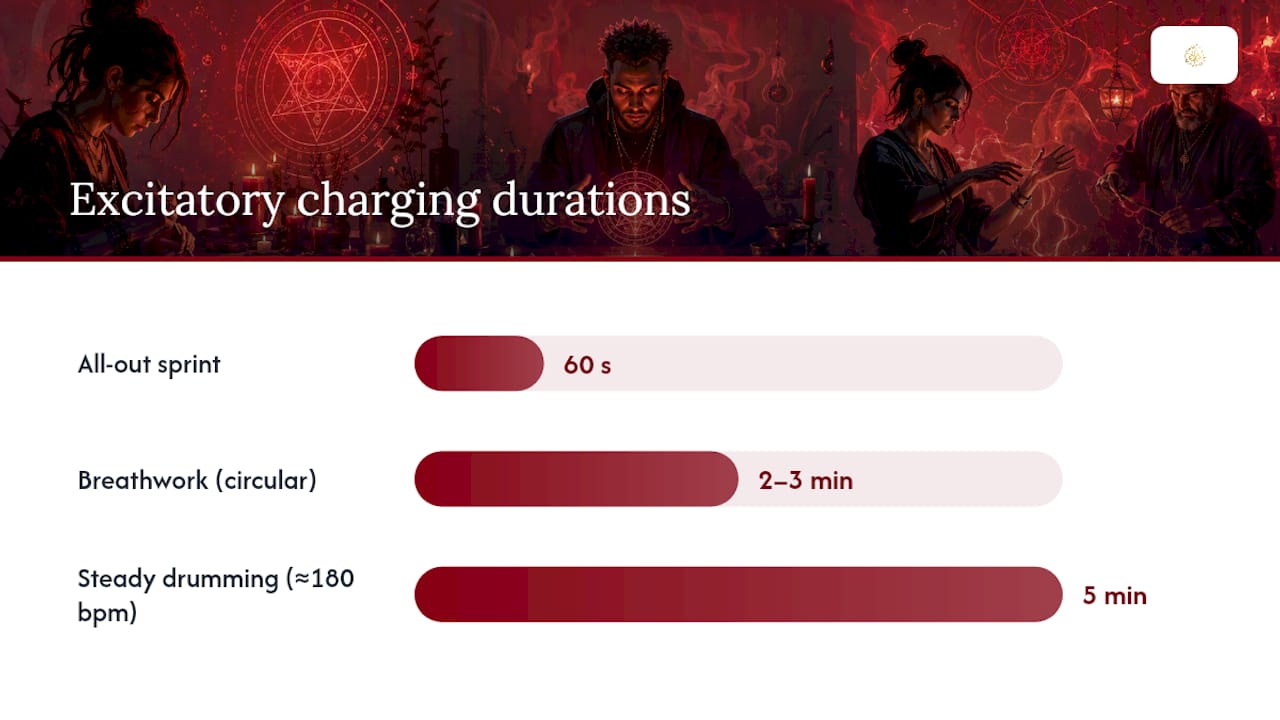
- A 60 second all-out sprint, or 30 rapid squat thrusts, spikes heart rate enough to thin conscious thought within a minute.
- Circular breathwork, quick inhale through the nose, quick exhale through the mouth, sustained for two to three minutes, produces a similar effect without leaving your room.
- Steady drumming at roughly 180 beats per minute for five minutes can induce a comparable trance state, a technique with roots in shamanic practice long before chaos magic adopted it.
- Sexual charging, specifically visualizing the sigil at the moment of orgasm, is one of the most cited excitatory methods in practical guides from Chaos Magick Forge.
If you use sexual charging, do it alone or with a partner who has given clear, informed consent to the practice and understands what you’re doing. Never involve a partner without disclosure. Timing is everything here: hold the sigil’s image in mind through the build, and at the exact peak, let the image fill your entire awareness for a second, then immediately release it, look away, think of something else.
Pro Tip: Whatever excitatory method you pick, rehearse the physical mechanics beforehand. Fumbling with a candle or losing your breath count during the actual peak breaks the state you’re trying to build.
Passive Charging: The Wallpaper and Shoebox Methods
Indifferent vacuity works on a completely different timeline than the other two families. Instead of a single intense moment, you plant the sigil and then deliberately forget about it while your subconscious works in the background.
- Wallpaper method: Set the sigil as your phone or desktop background, small enough that you see it constantly but rarely look at it directly, for one to four weeks.
- Shoebox method: Write the sigil on paper, place it in a box with other charged sigils, and don’t look at it again until the desire either manifests or fades. Chaos Magick Forge lists this among the standard indifferent vacuity techniques.
- Keep a simple log, date charged, method used, outcome noticed, so you can compare results across sigils over months.
- Passive charging tends to outperform peak rituals for slow-developing goals like career shifts or long-term healing, where a single burst of intensity has less to work with over time.
One nuance experienced practitioners flag often: once a wallpaper sigil is set, don’t keep consciously restaring at it or “reinforcing” it. Repeated attention undermines the mechanism, since indifferent vacuity depends on the sigil operating below conscious notice, not above it.
Elemental and Object Charging: Candles, Moonlight, Crystals, and Smoke
Elemental methods add sensory ritual to whichever gnosis state you’re already using, and they give beginners a structure to hold onto while they build comfort with the less tangible inhibitory and excitatory approaches.
- Candle-carve method: Carve the sigil into a candle’s wax with a pin, choosing color by intent (red for passion or drive, green for money, black for banishing), then burn it down while holding focus on the symbol in the flame.
- Moon charging: Leave the sigil on a windowsill or outdoors under a full moon for receptive workings, or a new moon for new beginnings. If you lack outdoor access, a bowl of water reflecting moonlight through a window works as a substitute.
- Crystal charging: Place the sigil under a stone matched to intent (citrine for prosperity, rose quartz for love) overnight, letting the object hold ambient charge rather than requiring active focus.
- Smoke and water: Pass the sigil through incense smoke while visualizing intent, or dissolve a water-soluble ink version in a bowl of water as both a charging and release step at once. Wicca-Spells documents this dual-purpose technique in detail.
Keep an open flame away from paper, hair, and loose sleeves, and never leave a burning candle unattended, even mid-ritual.
Release and Destruction: Why Forgetting Completes the Charge
The release step is not optional decoration. It’s the moment that tells your subconscious the working is finished and the conscious mind should stop rehearsing it. Carroll’s original framing treats this transition, the sudden symbolic act of tearing, burning, or discarding, as the psychological seal on the entire process.
- Burn the sigil in a fireproof dish immediately after your peak or meditative state, and watch it fully consume.
- Tear it into small pieces and scatter them somewhere unrelated to your daily routine.
- Bury it outdoors, ideally somewhere you won’t walk past regularly.
- Dissolve it in water if you used water-soluble ink, combining charge and release in one motion.
Thalira’s practitioner guidance notes that repeated recharging often signals the original release didn’t fully register, meaning the mind kept rehearsing the intent instead of letting it go. Avoid breathwork techniques that involve extended breath holding without supervision, and never combine excitatory sprinting with pre-existing cardiac or respiratory conditions. Gnosis states are meant to be brief and controlled, not extreme.
Choosing a Charging Method: A Quick Decision Framework
Match the method to your actual circumstances before you match it to aesthetic preference. Ask yourself four questions:
- Time: Do you have 60 seconds or 20 minutes available right now?
- Privacy: Can you move, breathe loudly, or work alone without interruption?
- Physical capacity: Any cardiac, respiratory, or mobility limits that rule out excitatory sprinting?
- Emotional safety: Are you charging from a calm state, or from anger or desperation that might cloud your focus?
Favor inhibitory methods when you’re tired, anxious, or short on privacy. Favor excitatory methods when you have physical energy and want a fast result. Favor passive methods for long-horizon goals where you’d rather not fixate daily. If a sigil produces no movement after several weeks, the likely culprits are shallow gnosis, incomplete release, or unconsciously checking on the sigil too often, all of which point back to technique, not the symbol itself.
Three Routines and One Full Ritual You Can Run Tonight
Micro routine (60 seconds): Sprint in place or do 30 fast squats while holding the sigil’s image in mind. At the point of breathlessness, flash the image once, then immediately look away and change activity.
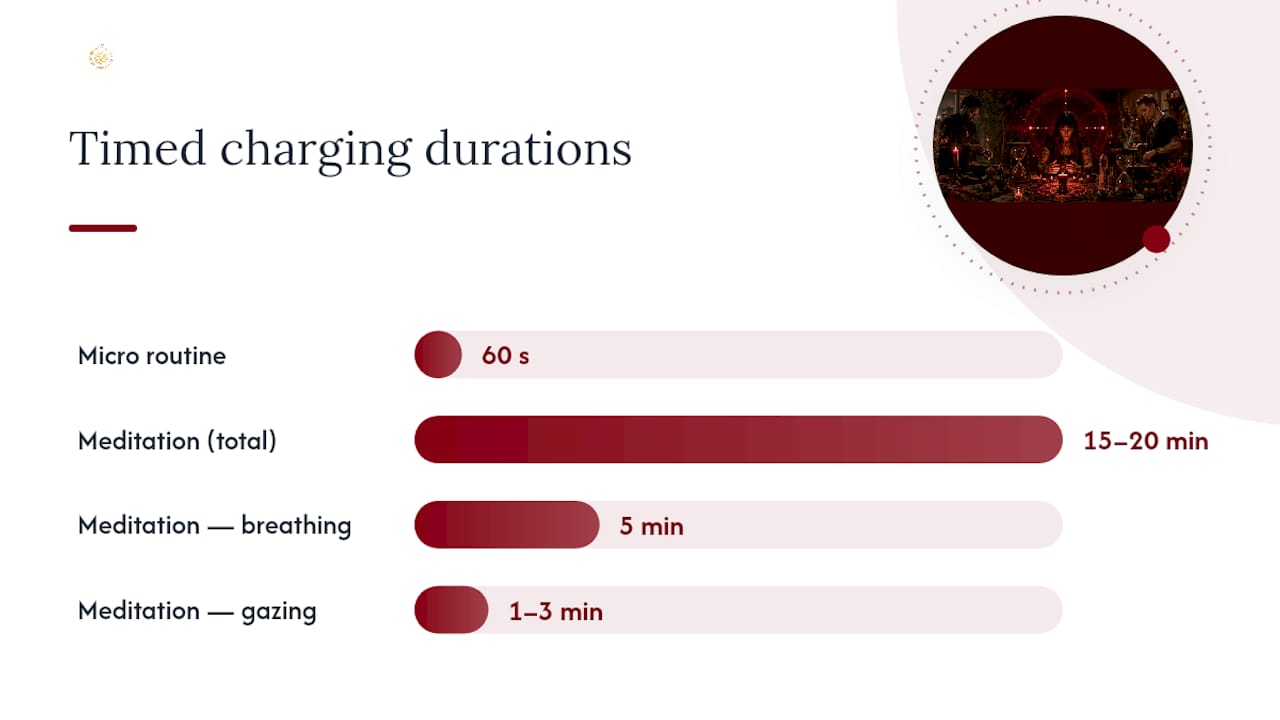
Meditation routine (15 to 20 minutes): Breathe in a four-count, hold four, exhale six, for five minutes. Gaze softly at the sigil for one to three minutes. Look away sharply and log the session.
Shoebox routine: Charge the sigil through any method above, then seal it in a box with other sigils. Check back monthly, log outcomes, and resist the urge to peek weekly.
Full ritual, tools needed: paper, pen, a fireproof dish, a match or lighter, and a quiet room.
- Draw your sigil from a condensed statement of intent, reducing letters to a single abstract glyph.
- Sit with the sigil for two minutes of slow breathing to settle your mind.
- Choose excitatory or inhibitory gnosis based on your energy level that night.
- At peak focus, hold the sigil’s image for no more than three seconds, then look away completely.
- Immediately burn the sigil in the fireproof dish, watching it burn fully.
- Leave the room or change activity at once. Do not discuss or revisit the working that night.
What Repeated Practice Actually Teaches You
The pattern that shows up again and again isn’t about props. A plain breath count in a dark room beats an elaborate altar performed half distracted. Track your sessions honestly, method, state achieved, outcome, because the data you collect on yourself matters more than any generic instruction. The mistakes that sink most attempts are fixation after release, unnecessary recharging, and pushing breathwork or exertion past what’s physically safe.
— Black Witch Coven
When to Bring in Professional Ritual Work
Self-charged sigils work well for personal, low-stakes goals, but some situations call for more than a solo practitioner can reliably deliver: entrenched patterns, high-stakes love or legal matters, or workings where a single misstep in gnosis or release can produce a stalled or backfired result. Black Witch Coven builds bespoke ritual work around your exact intent, with the discretion and structural precision that solo sigil work can’t always guarantee, particularly when previous attempts have gone sideways. If you’ve noticed a working produce the opposite of what you intended, read what typically causes a spell to backfire before your next attempt. When you’re ready for guided or done-for-you ritual work matched to your specific situation, reach out to Black Witch Coven to discuss what a custom working looks like for you.
Sources
- Archive
- How to Create a Sigil? | Chaos Magick Forge
- How to Make a Sigil: Drawing, Charging and Release – Wicca-Spells
- Sigil magic: how to create and charge sigils – Thalira
FAQ
How do I charge a sigil?
Reach a genuine altered state through meditation, exertion, or focused breathwork, hold the sigil’s image briefly at the peak of that state, then release your attention completely and destroy or hide the sigil.
How do you power up a sigil?
Power comes from the depth of gnosis you reach, not the complexity of the ritual. A one-minute sprint or breathwork sequence that fully blanks your mind produces stronger results than a long, distracted ceremony.
Does burning a sigil activate it?
Burning isn’t the activation step, it’s the release step that follows activation. The sigil is charged during your peak focus state; burning afterward seals the working by signaling completion to the subconscious.
How does sigil magic work?
Sigil magic condenses a stated intent into an abstract symbol, then bypasses conscious analysis through an altered state so the intent settles into the subconscious without interference or doubt.
