
 New Years Eve Ritual 2026/2027 with Savannah
Blog, Chaos Magic, Sorcery
Sigil Magick for Beginners: Spare’s Method and a Quick Session to Try Tonight
Mar
A sigil is a symbol built from your own written intention, then activated so it works on your desired outcome without your conscious mind interfering. A simple way to start is the letter-reduction method: write a clear statement of intent, strip the repeated letters, and fuse what remains into a single abstract glyph. Charge it, forget it, and let it work. The rest of this guide walks through exactly how.
Table of Contents
- What Is Sigil Magick and Where Did It Come From?
- How to Create a Sigil: The Letter-Reduction Method
- Beyond Letter-Reduction: Other Ways to Build a Sigil
- Charging and Forgetting: How a Sigil Actually Activates
- A 15-Minute Sigil Session You Can Run Tonight
- When a Sigil Doesn’t Seem to Work
- Field notes from Black Witch Coven
- Weaving Sigils Into a Larger Practice
- Why Sigils Have Lasted a Century as a Core Technique
- Custom Ritual Work When You Want It Done for You
- Sources
- FAQ
What Is Sigil Magick and Where Did It Come From?
A sigil is a symbol used in magick that, in modern practice, encodes the witch’s desired outcome rather than a spirit’s name or signature. That distinction matters because it marks a real break from older traditions.
Medieval grimoires like The Lesser Key of Solomon treat sigils as seals belonging to specific spirits, fixed signatures used to summon or identify an entity. You didn’t design one. You copied it.
Everything changed with Austin Osman Spare, the early 20th century artist and occultist who fused image-making with automatic drawing to build a personal, repeatable system. Spare’s innovation was insisting the finished sigil should not read as a sentence anymore. Deliberate abstraction, he argued, is what lets the symbol bypass conscious resistance and lodge in what he called the “less-conscious” mind.
That idea became the backbone of chaos magick, the loosely organized movement that treats belief and technique as interchangeable tools rather than fixed doctrine. A few things separate the modern approach from the medieval one:
- Sigils are self-authored, built from your own stated intention rather than copied from a grimoire.
- The symbol is intentionally made unreadable, not decorative or legible.
- Effectiveness is tied to psychological technique (belief, focus, forgetting) rather than to invoking a named spirit.
- The practice is portable across traditions, including left-hand path and Luciferian frameworks that use sigils alongside pact work or petition rites.
How to Create a Sigil: The Letter-Reduction Method
This is the method most beginners learn first, and for good reason. It requires no tools beyond paper, a pen, and about ten minutes of focus.
Step one: write the intention correctly. State it in the present tense, as if it’s already true, and keep it specific. “I attract steady clients for my business” works. “I want to be successful” does not, because it gives your unconscious nothing concrete to act on. Avoid negatives like “I am not broke.” The mind tends to fixate on the noun (“broke”) rather than the negation.
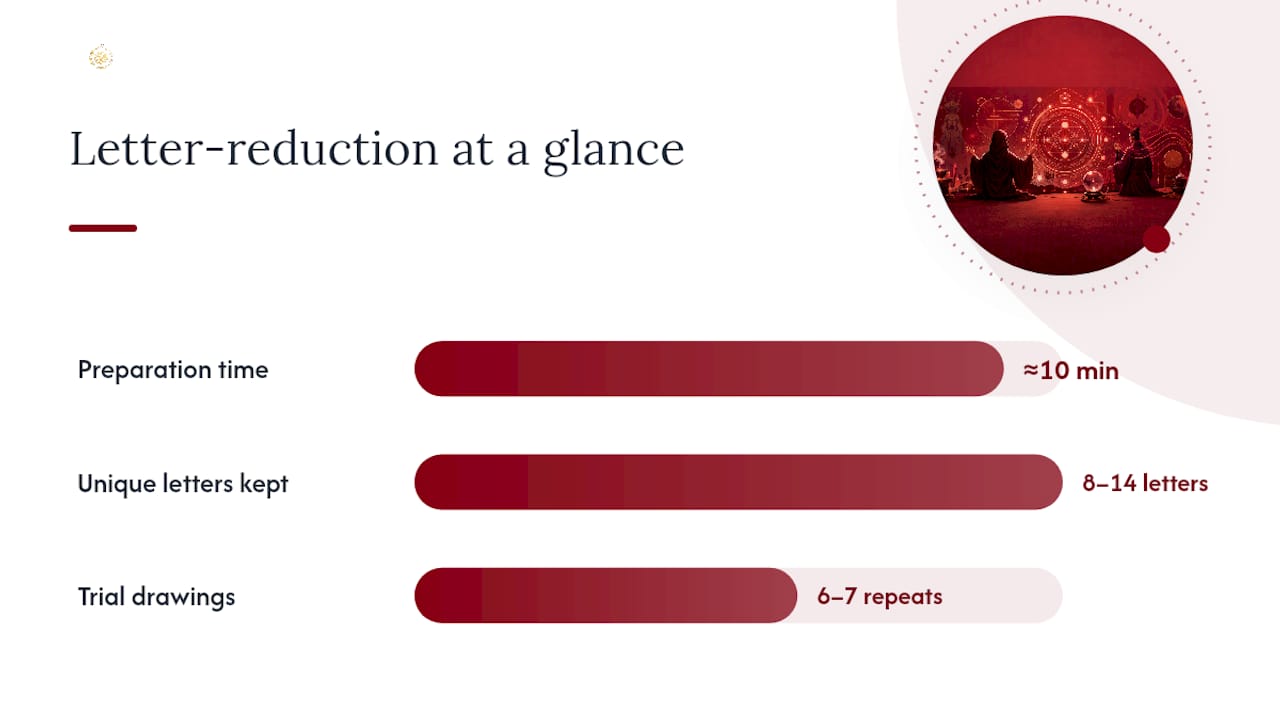
Step two: strip the letters. Write the sentence out, remove every space and every repeated letter, keeping only the first instance of each. “I attract steady clients for my business” collapses down to a short run of unique letters, usually somewhere between eight and fourteen depending on the phrase.
Step three: build the glyph. Take those remaining letters and combine them into one image. Overlap the strokes. Rotate letters on their axis. Mirror them. Nest a small letter inside the curve of a larger one.
Here’s the numbered version to follow at your desk:
- Write your intention in one full present-tense sentence.
- Cross out all spaces, vowels are optional to remove depending on your style, and every duplicate letter.
- Sketch the surviving letters as one connected symbol, overlapping and rotating freely.
- Simplify repeatedly until the design no longer reads as letters to your eye.
- Stop when the shape feels visually settled, not when it looks pretty.
Pro Tip: Draw the sigil at least six or seven times in slightly different arrangements before picking a final version. The “right” one usually reveals itself by feeling inevitable, not by looking the most artistic.
You’ll know it’s finished when a fresh look at the page gives you no urge to read it as words. That loss of legibility is the entire point, not a side effect.
Beyond Letter-Reduction: Other Ways to Build a Sigil
Letter-reduction isn’t the only route, and it isn’t always the best fit. Three alternatives cover most of what serious witches reach for.
- Kamea (magick-square) sigils: convert your intention’s letters into numbers, then plot those numbers as coordinates on a planetary magick square tied to the relevant planet (Venus for love work, Jupiter for expansion, and so on). Connecting the plotted points produces an angular, often striking figure. It takes longer and demands you know your correspondences, but it carries real symbolic weight for anyone already working with planetary magick.
- Bindrunes: fuse two or three runes from a system like the Elder Futhark into a single compound symbol. This suits occultists already rooted in Norse or Germanic frameworks, where the individual runes carry established meaning you don’t have to invent from scratch.
- Hypersigils: extend the concept across an entire creative work, a story, a piece of art, a ritual drama performed over weeks, rather than compressing it into one static glyph. Best reserved for large, long-arc intentions rather than quick, specific requests.
Complexity and cultural fit decide which to use. If you want something fast and universal, letter-reduction wins. If you already think in planetary or runic terms, lean into that system instead of forcing an unfamiliar one.
Charging and Forgetting: How a Sigil Actually Activates
A finished sigil is inert until it’s charged. Charging means pushing the symbol into your mind through a state where the analytical, chattering part of your brain temporarily steps aside, what chaos magicians call gnosis.
You don’t need trance training to get there. Low-barrier substitutes work fine:
- Staring fixedly at the sigil until your vision blurs slightly.
- Controlled breath cycles, four counts in, four counts out, repeated until your mind quiets.
- Short, intense physical exertion (a hard sprint, a fast set of push-ups) followed immediately by viewing the symbol.
- Repetitive drawing of the sigil until the hand moves without conscious direction.
Once charged, close the working: burn the paper, bury it, or lock it away somewhere you won’t stumble on it. Then deliberately forget the working ever happened. Magicians report outcomes surfacing anywhere from days to months out, so judge results over weeks, not hours.
A 15-Minute Sigil Session You Can Run Tonight
Three beginner-friendly intentions to start with: drawing a specific new client, easing tension in a strained relationship, or steadying your finances for the month ahead.
- Prepare (2 minutes): write your intention as one clear present-tense sentence.
- Create (5 minutes): run the letter-reduction method and finalize your glyph.
- Charge (3 minutes): use breath cycles or brief visual fixation while viewing the symbol.
- Close (2 minutes): burn or put away the paper.
- Forget and move on (3 minutes): do something unrelated and physical, wash dishes, take a short walk, to break the mental loop.
Scale up to bigger intentions only after you’ve run a few small ones and can compare outcomes honestly.
When a Sigil Doesn’t Seem to Work
Results vary. Some sigils resolve in days, others take months, and a few never seem to land at all. That’s normal, not a sign you did it wrong.
- If you keep consciously thinking about the sigil after charging, the forgetting step failed. Bury or destroy the image sooner next time, or pick a more intense charging method that leaves you mentally spent.
- Running too many sigils at once dilutes focus. Cap active workings at two or three so you can actually track which produced what.
- Keep a simple log: intention, date charged, date resolved. Patterns emerge after five or six entries that you won’t see after one.
- Switch methods (try kamea instead of letter-reduction) only after several honest attempts with proper charging and forgetting, not after a single disappointing week.
Field notes from Black Witch Coven
Experienced occult witches have guided many through spell work and ritual design, with sigil work showing up constantly inside larger left-hand path practice, not just as a standalone exercise. Advanced occultists often pair a charged sigil with a petition to a specific entity, using the symbol as a focal point during invocation rather than a one-time gesture. Case outcomes and client notes are documented separately.
Weaving Sigils Into a Larger Practice
A sigil rarely stands alone once you move past the beginner stage. Left-hand path and Luciferian magicians commonly place a charged glyph on an altar during a petition to an entity such as Lucifer, Astaroth, or Clauneck, using the symbol as a visual anchor while stating intent aloud. The sigil isn’t the working itself in that context. It’s a compression of the goal that keeps the ritual focused when longer invocations pull attention in several directions.
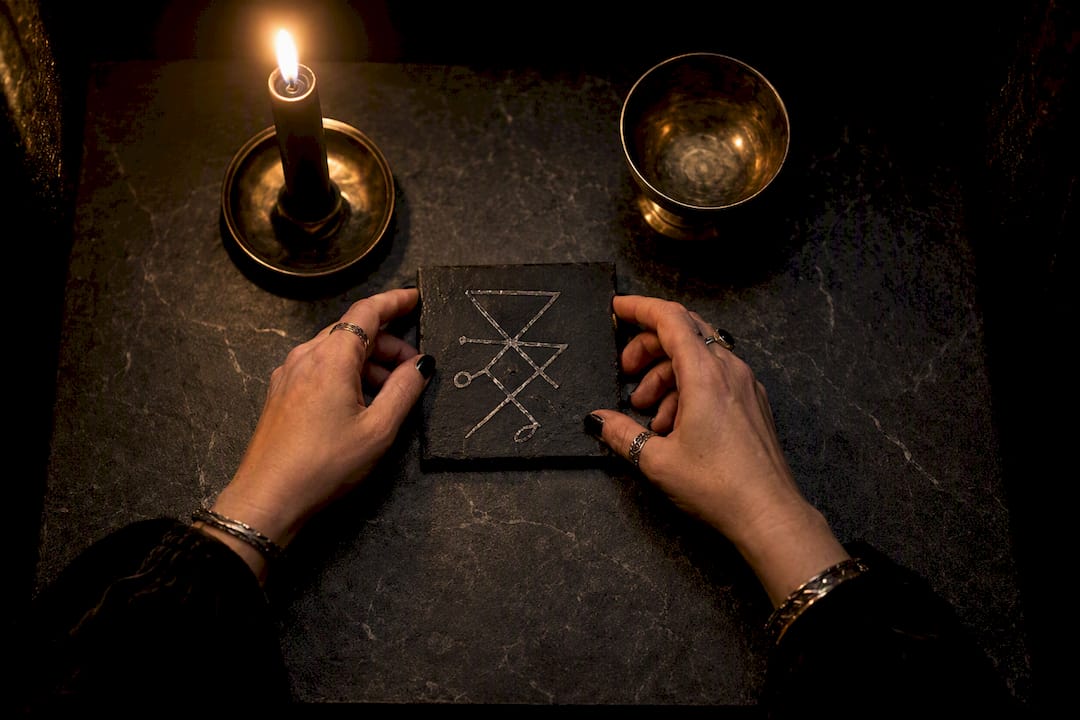
Candle work benefits the same way. Carving a sigil into the wax of a money or love candle before dressing it with oil gives the flame something specific to burn toward, rather than a vague petition. Jar spells work similarly: drop the sigil paper directly into the jar alongside herbs and correspondences tied to the same intention, so every physical component reinforces one encoded goal instead of several loosely related ones.
Sigils also pair naturally with divination. Draw a sigil, charge it, then pull a tarot card the same night to gauge resistance or momentum around the intention. This isn’t traditional to any single grimoire tradition, it’s a modern synthesis, but it reflects how chaos magick was built from the start: borrow the technique that produces results and discard the doctrine that doesn’t serve the working.
The common thread across all these applications is that a sigil concentrates attention. Whether it sits on an altar, inside a jar, or carved into wax, it does the same job: turning a diffuse wish into one fixed point the rest of the ritual can build around.
Why Sigils Have Lasted a Century as a Core Technique
Sigils survive because they’re portable. A symbol you built yourself adapts to candle work, jar spells, or a full ritual without needing anyone else’s permission or blessing. My advice: keep a written log of every sigil you charge, the date, the method, and the outcome, because patterns only become visible in hindsight. For deeper ritual integration, look at how Black Witch Coven approaches chaos sigil work directly.
— Black Witch Coven
Custom Ritual Work When You Want It Done for You
Self-made sigils handle a lot, but some intentions carry more weight than a solo glyph and a burned scrap of paper can address, a legal battle, a stalled love situation, a financial block that won’t move no matter how many sigils you charge. Custom ritual work is built around exactly those cases, combining sigil-style intention encoding with direct petition to entities like Clauneck for prosperity or Astaroth for deeper personal work. The Daemonic Prosperity Magick and related demon-work services start at $450 and are built for readers who want a magician handling the charging and closing, not just the design. For ongoing support instead of a single working, the Full Moon Magic Monthly Subscription runs $32 a month and keeps a ritual cadence going long after your last hand-drawn sigil has been burned. Reach out through the main consultation page to discuss which option fits your situation.
Sources
- Sigil
- Sigil Magic: A Complete Practical Guide to Creating and Charging Sigils – Shadow Grimoire
- Austin Osman Spare: the artist’s books (1905-1927) – Kent Academic Repository
FAQ
How Does Sigil Magick Work?
You encode a specific intention into an abstract symbol, then charge it through a focused or altered state so it bypasses conscious overthinking. After charging, you deliberately forget the sigil, letting the unconscious act on it without interference.
What Is the Most Powerful Sigil?
There’s no single strongest design. A sigil’s strength comes from how clearly you defined the intention and how completely you charged and then forgot it, not from any particular shape or symbol.
Is a Sigil Considered Witchcraft?
Sigil work sits comfortably inside witchcraft and broader occult practice, and it also stands on its own as a secular-leaning technique some people use without any wider spiritual framework. Chaos magick in particular treats it as a standalone tool that can slot into almost any tradition, left-hand path practice included.
How Do I Activate My Sigil?
Activation, or charging, means viewing the sigil while your analytical mind is quieted, through breathwork, visual fixation, physical exertion, or repetitive drawing. Once charged, close the working and forget it happened so your conscious mind stops interfering with the outcome.
