
Blog, Demons, Working With Demons
Caim Demon (Camio): History, Seal and How to Work With Him
Oct
Camio, also written Caim or Caym, is the 53rd spirit of the Ars Goetia: a Great President of Hell who commands 30 legions, appears first as a thrush and then as a man with a sharp sword, and gives the understanding of birds, animals and the sound of water, along with skill in disputation and prognostication. That is the short version. The useful version requires going back to the manuscripts, separating what the 1577 catalog actually says from what later editors added, and then deciding how an operator with a serious practice would work with the office as it was written. His short profile sits on our Caim Demon Directory page.
This article does that in order: who he is in the sources, how his name and offices moved from Weyer to the Lemegeton to Mathers, where the Cain identification comes from, and how to build a practice around his actual offices instead of generic Goetic boilerplate.
Name and pronunciation
Most practitioners say the Caim spelling as KAH-im. Camio is read as a three-syllable name, KAH-mee-oh, though no historical source fixes the sound. The manuscripts spell the name inconsistently, which is itself useful evidence: Caim, Caym and Camio are variants in transmission, not different beings.
What the Goetia says about him
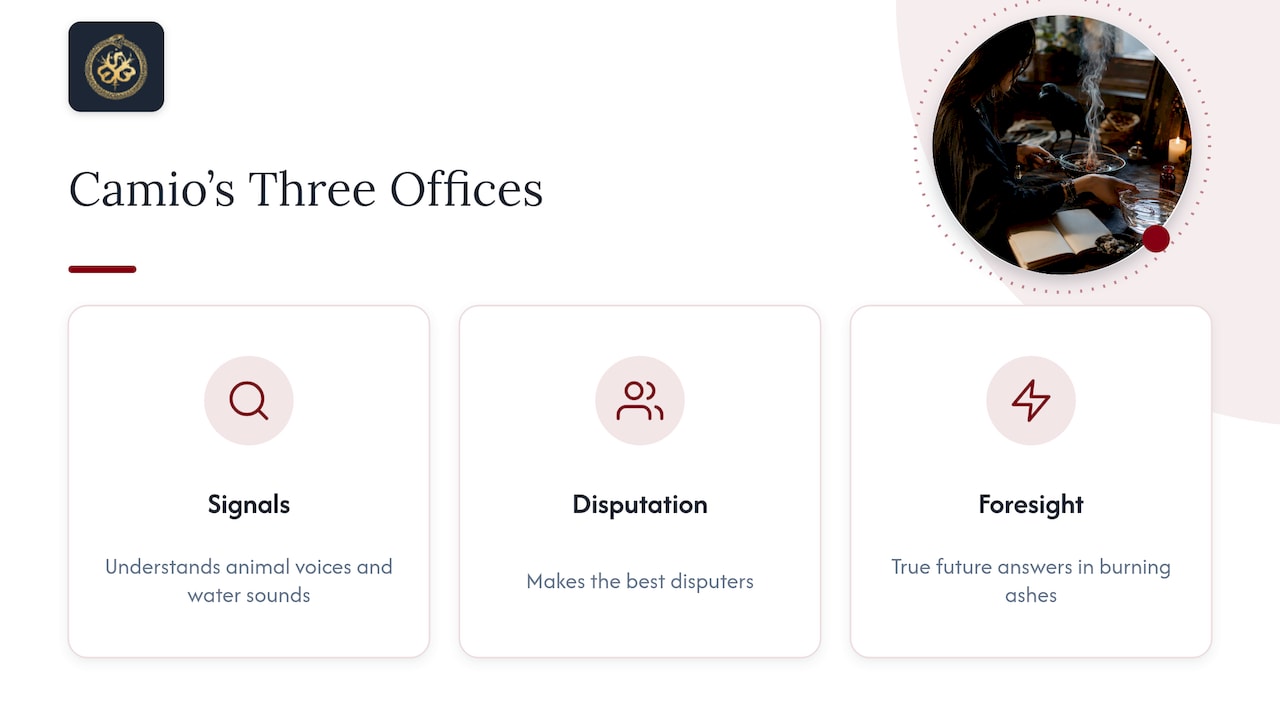
The standard text, the Mathers edition of the Goetia, calls him the fifty-third spirit, Camio or Caim, a Great President. He appears first in the form of a thrush, then takes the shape of a man carrying a sharp sword. He answers in burning ashes or coals of fire. He makes the best disputers, and he gives men the understanding of the voices of birds, bullocks, dogs and other creatures, and of the noise of the waters. He also gives true answers about things to come, and he governs 30 legions.
The older English manuscript text in the Sloane collection has the same structure: a great president who appears first as a thrush and later in human shape with a sharp sword. The offices cluster into three groups worth separating, because each suggests a different kind of work.
Perception: animal and water speech
The understanding of birds, cattle, dogs and waters is an office of reading. It does not describe commanding animals. It describes interpreting signals from the living and the elemental environment. A practitioner would take that as a mandate for attention, pattern recognition and omen reading in a place, not for dramatic communication with pets.
Speech: disputation
Weyer says Caim makes the best disputers. That is an office of argument: structuring a case, anticipating objections, and answering under pressure. It is the part of his profile with the clearest modern application, and the one that gets neglected because it sounds less exciting than prophecy.
Foresight: prognostication
The third office is accurate answers about the future. In a catalog that also gives him the manner of answering, in ashes and coals, the prophetic office is tied to a fire-based mode of divination, which matters when you design the working.
From Weyer to the Lemegeton
Camio did not begin in the Lesser Key. The earliest widely read catalog entry is in Johann Weyer’s Pseudomonarchia Daemonum, appended to the 1577 edition of his De praestigiis daemonum (first published 1563). Weyer describes Caim as a great president in the form of a thrush, who gives men understanding of the voices of birds and other animals, and who answers in burning ashes while carrying a sword.
The Lemegeton’s Goetia then took that catalog entry and attached it to a larger apparatus. Joseph H. Peterson’s printed critical edition, The Lesser Key of Solomon (2001), draws on the Sloane manuscripts in the British Library, which is why it is the standard recommendation for anyone who wants the text as compiled instead of as reworked in the twentieth century.
There are three practical consequences of this lineage.
- The offices are older than the ritual frame. The entry’s content comes from the catalog. The circle, triangle and lamen came afterward, from a mid-17th-century compilation drawing on materials a couple of centuries older.
- Weyer was not writing a manual. He was a physician arguing against witch trials, and his catalog was an attempt to classify the demonic hierarchy inside the theological frame of his day. Treating it as a ritual instruction set misreads its purpose, though the descriptions of the spirits’ offices are still the earliest layer we have.
- The sigil is a later addition. The seal of Camio that practitioners draw is from the Lemegeton tradition, and appears in the Mathers plates as the 53rd seal. It was not part of Weyer’s description.
If you want a working relationship built on the oldest layer, start from Weyer’s description of the spirit and add the apparatus only where your own tradition requires it.
The Cain question
Many modern occultists treat Caim as Cain, the first murderer of Genesis, and build a lineage of the first craftsman, outcast and wanderer on top of that. It is an attractive reading, and it appears in plenty of Left-Hand Path literature. The manuscript evidence is thinner than the popularity suggests.
Early sources such as the Liber Officiorum Spirituum give forms like Kayne or Caim, but the Genesis account has nothing about bird augury or water speech. The name and the offices look to have evolved separately and been joined later by copyists. For a working practitioner the Cain identification is an interpretive layer. It can be a legitimate devotional frame if you adopt it knowingly, but it is no proof of the spirit’s origin.
There is a useful test here for all Goetic research: ask whether an attribute appears in Weyer, in the Sloane-derived Goetia, or only in Mathers, Crowley, or later. Camio’s bird and water offices pass all three. The Cain link passes none until a later period.
Why the Mathers edition needs care
The 1904 Mathers and Crowley edition is the one most people own, and the one most often reprinted. It is a synthesis, shaped heavily by Crowley’s Thelemic framing. Researchers after accuracy prefer the critical editions based on the Sloane manuscripts, Peterson’s among them. That holds for Camio in particular, because his entry is short and any editorial addition shows up at once.
A practical routine: read Weyer’s entry, then the Peterson edition, then the Mathers entry, and note every difference in a notebook. For Camio the differences are small, which is good news. The core profile is stable across the traditions.
Building a working with Camio
What follows is a method, not a transcription of a historical rite. Where the sources are silent, the choices are the operator’s. We mark those choices as such.
Step 1: Decide which office you are engaging
Camio does not do everything, and the strongest results in any Goetic practice come from matching the request to the spirit’s recorded function. Choose one:
- Perception: you want better reading of a space, a situation or the signals around a decision.
- Disputation: you need to argue, negotiate, testify or debate well.
- Foresight: you want a structured divinatory answer.
A working that asks for all three at once is a working with no direction. One problem at a time is the cleanest discipline.
Step 2: Prepare the operating frame
The 17th-century frame of circle, triangle and lamen is a specific structure introduced in the mid-1600s, not a universal requirement of ancient practice. Practitioners who use it get the benefit of a defined, tested container, laid out step by step in our conjuring method from the Goetia. Practitioners who work devotionally or through offerings and a simple altar are working from a different strand and should say so honestly in their records.
Whichever frame you choose, include the elements the text gives you for Camio himself:
- A fire or ash element. The spirit answers in burning ashes or coals. A small heatproof dish with charcoal or burnt herbs is the direct correspondence.
- A bird correspondence. A thrush feather, a black feather, or a drawn bird image stands in for his first form.
- A blade. A sharp sword in the text translates, in practice, to an athame or a knife on the altar.
- Water. A bowl of water for the water office, if you are working the perception function.
Step 3: Open with study, not demand
Because Weyer’s entry belongs to the scholar’s record and the Lemegeton to a command-based model, there is a real choice about tone. The shift from Weyer’s simpler description to the Lemegeton’s mandatory ritual structure reflects growing concern with control and security in the 17th century. An operator who reads that history is free to choose the model that suits their relationship with the spirit. Many working Left-Hand Path practitioners prefer an exchange model: a clear request, a clear offering, a clear time frame. Others retain the compulsion model. Both are documented choices, and both should be recorded.
Step 4: Run a short, bounded operation
A three-session structure is enough for a first engagement:
- Session one: introduction, statement of the office you are engaging, an offering, and a simple divination to see whether the contact feels established.
- Session two (about a week later): the actual request, tied to a defined situation and a defined deadline.
- Session three: review. Compare what happened in the real world with what you requested and what you perceived.
The review is not optional. Without it you are collecting impressions and no data.
Case examples
These are typical uses, written as composites to show method.
A litigator preparing for a hearing
She works with Camio’s disputation office. For two weeks before the hearing she keeps a small altar with the seal and a dish of ash. Each evening she rehearses the opposing argument aloud, then her own, and records which points feel weak. The magickal act and the legal preparation run in parallel: Camio’s office sharpens the argument, and the rehearsal puts it into words. After the hearing she compares what she felt and what actually happened. The result is a record she can reuse.

A property manager reading a neighborhood
He is evaluating a building purchase and uses the perception office. He spends three early mornings at the site, opening each with a brief call to Camio, and notes which birds are present, the sound of water in the drains, and who comes and goes. He writes down his impressions before looking at any documents, then compares them with the inspection report. Camio’s recorded office, the understanding of birds and the noise of the waters, matches the task directly.
A writer in a creative block
She uses a fire divination. She burns a sheet of paper with her question, reads the ash pattern as an intuitive prompt, and writes for twenty minutes without stopping. The Goetia says Camio answers in burning ashes, so the ash is where she looks for his reply, and she records and tests what she reads.
Divination as a check
Any working with a prophetic spirit needs an independent channel for verification. Tarot is a common choice, and a Demonic Tarot Reading can serve as that outside channel. Scrying is another, and a black obsidian scrying mirror suits a spirit who answers in fire and ash. Use a method that you can score afterward. Write the question, the answer you got, and the outcome, and tally hits and misses over several months.
Reading the manuscripts as an operator
The physical grimoires matter here. The major collections, including the British Library’s Sloane collection and Yale’s Beinecke, preserve the record of how magickal practice has been redacted and reinterpreted over centuries. No single unbroken tradition of demonology survives in them, and for the operator that is permission. The tradition was always edited by the people using it, and the edits are part of the evidence.
In practice, keep three documents: your source comparison, your working log, and your scored divination record. Together they turn a general interest in Goetia into something that behaves like a research program.
Our perspective
We read Camio as one of the more practical spirits in the Goetia, mostly because his offices are about information and speech, which are the two things most people lack when a decision is hard. The dramatic parts of the entry, the thrush, the sword and the ashes, are the packaging. The substance is perception, argument and foresight.
We also think the Cain identification gets more weight than it deserves. It makes a good devotional story, and we do not object to using it that way, but the manuscript trail does not support it as history. The same discipline applies across the Goetia: know which layer of the tradition you are standing on.
Our advice to operators is consistent. Take one office, one problem and one time frame. Pair the ritual with ordinary preparation, because the lawyer who rehearses and the buyer who walks the site are doing the part of the work that you can verify. Keep records, and treat your own results as evidence. Spiritual sovereignty, as we use the term, means choosing your model, whether command or exchange, with full knowledge of where it came from, instead of inheriting it by default.
If you want a spirit reading first
Operators who want an outside read on whether Camio is the right contact for a specific situation can book one of our Left-Hand Path readings. For longer ritual work with demonic spirits, the daemonic spell casting category lists the current services.
FAQ
What does Camio mean?
Camio is one spelling of the name of the 53rd spirit of the Ars Goetia, also written Caim or Caym. The spelling varies across manuscripts, and the name has no agreed etymology. It identifies a Great President of Hell who commands 30 legions.
How do you pronounce Camio?
The Caim spelling is usually given as KAH-im. Camio is commonly read as KAH-mee-oh. No historical source fixes the pronunciation, so use one consistently in your records.
What is Camio the demon known for?
He is known for giving understanding of the voices of birds, cattle, dogs and the noise of waters, for making skilled disputers, and for accurate answers about the future, according to the Goetia text. He appears first as a thrush and then as a man with a sharp sword.
Is Camio the same as Cain?
Many modern occultists say so, but the manuscript evidence does not support a direct link. The name and the offices appear to have developed independently before later copyists associated them. Treat the identification as an interpretive choice, not a documented fact.
