
 New Years Eve Ritual 2026/2027 with Savannah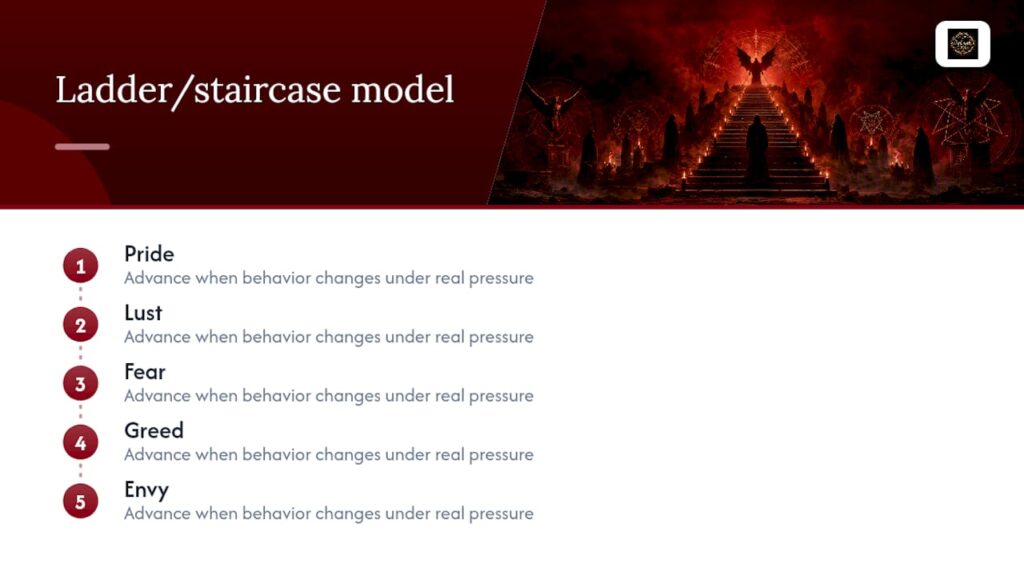
Summary
- Pressure shows you your real weak spots.
- You only advance when you actually act differently under that same pressure.
- Progress is measured only by real behaviour, not by insight, belief, or temporary feeling.
- The work stays grounded in your own observed data.
- No extra systems or maps are required to begin.
- This is an early-stage structure for people who need a clear way to start.
- It is not for everyone. The full page explains who it tends to help and who it does not.
Lucifer’s Initiatory Staircase: Structure for the Early Left-Hand Path
Lucifer teaches by delivering tailored initiatory ordeals that force the conversion of specific shadow impulses into usable power. This is not metaphor. It is operative pedagogy. The teaching treats Lucifer as a psychological trainer, an aspect of the inner Logos that tests and educates rather than merely punishes.
What makes the teaching usable, especially at the beginning, is a simple structure: the initiatory staircase. Each rung corresponds to a concrete egoic pattern. Pressure reveals the pattern. Consistent change in behavior under that same pressure is the only evidence of advancement. Belief, insight, or temporary feeling do not count.
This kind of clear structure is what many practitioners find missing when they first encounter the left-hand path. The path correctly insists on self-responsibility and the rejection of external moral authority. Those principles are powerful. They also leave a large number of people without reliable ways to tell whether they are actually changing or simply accumulating more intense versions of the same failures. The staircase is offered as one practical answer to that gap. It is not a universal system and it does not require knowledge of other maps or traditions.
Before going further, perform one direct readiness check: write down the three areas of your life in which you most consistently fail under pressure. Those areas name your first possible rungs.
Why clear structure is often absent
A good deal of accessible left-hand path material emphasizes liberation from imposed systems. Graded curricula and external criteria of progress are frequently treated with suspicion. The result for many people is a collection of strong experiences, rituals, and ideas without a personal method for distinguishing real conversion of a defect from temporary intensity or self-deception.
This is not true of every current within the left-hand path. Some maintain rigorous internal discipline. Yet a significant portion of what a newcomer first meets offers little more than the instruction to act from will. When the will is still entangled with the very patterns it is supposed to master, the instruction remains circular. The staircase addresses that circularity by staying grounded in the practitioner’s own observed failures and in measurable behavioral change.
Who this model helps and who it does not
No structure serves every person or every stage. Precision about suitability is part of the model itself.
People who tend to benefit
- Those who feel adrift after the first wave of excitement fades. They have done the reading and the rituals yet still cannot tell whether anything fundamental has changed. The staircase gives them an external check: the same pressure must produce a different action, repeatedly.
- People whose self-assessment collapses under real stakes. Inner narrative often explains failure away. Observable change in behavior, noticed by others without prompting, and the eventual cessation of a specific form of pressure supply a harder test.
- Practitioners whose temperament works better with a sequential, diagnostic frame. Naming the current decisive pattern and knowing what “passing” looks like reduces scattered effort.
- Those at an early or intermediate stage who need a bounded way to begin before opening more volatile work. The readiness check and a simple progressive sequence function as a contained experiment rather than an open-ended immersion.
- Anyone who has already seen that unstructured intensity tends to recycle the same patterns rather than transform them.
People who are less likely to benefit or who may be hindered
- Experienced practitioners who already possess a reliable internal compass and experience external maps as limiting. For them the staircase can feel like a step backward.
- Currents that deliberately reject sequential models in favor of pure will, chaos, or non-linear approaches. In those streams any ladder risks being felt as a re-imposition of order.
- People in acute psychological distress, active trauma loops, or with clear clinical contraindications. Structure does not replace professional mental-health care. The readiness check and the explicit pause rules exist because pressure work can amplify instability.
- Those whose primary orientation is ecstatic, artistic, or purely experiential. The emphasis on calibrated tests and behavioral evidence can feel mechanical.
- Anyone who will turn the staircase itself into a new status project or ego performance. Clear progressive models are easily co-opted by the very pride they are meant to address. Discretion and the integration steps later in this page are necessary countermeasures.
- Stating these limits openly is deliberate. It refuses to recruit everyone, reduces the chance that unsuitable people will force themselves into a frame that worsens their difficulties, and protects the model from being diluted. Self-responsibility includes knowing when a tool is not the right one.
How the staircase works
The logic is deliberately limited.
Ordeals are calibrated to the specific patterns you actually carry, not assigned at random. Pressure functions as revelation: it shows the real material of the current rung. Advancement occurs only when behavior under that pressure changes consistently.
A traditional formulation captures the sequence cleanly: temptation is fire; triumph over temptation is light.
Each rung is a concrete egoic pattern (pride, lust, fear, greed, envy, and their quieter variations). You do not pass a rung by understanding it, feeling different about it, or believing you have risen above it. You pass it when the same class of pressure reliably produces a different action. That is the measurable criterion.
Three observable results commonly accompany genuine work: clearer will, demonstrable restraint when provoked, and at least one unmistakable confirmatory sign (a change in how others respond to you, the sudden resolution of a previously blocked situation, or a vivid and precise dream).
From the first day, keep a single-page log. Date, the pressure that appeared, what you did, and the outcome. After thirty days the repeated failures become difficult to ignore. Those repetitions name the current rung.
Beginning the work: consent and basic protections
Do not begin without preparation.
Journal your mental state for at least two weeks. Note active trauma patterns, any suicidal ideation (a hard stop), or dissociative episodes. These are contraindications, not moral judgments.
State consent clearly if you choose to formalize the work. Clarity is required; coercion is not.
Assess the stability of your finances and primary relationships. Pressure will test the weakest external structures. If either is already near breaking, limit the scope or wait.
Any formal agreement should contain an explicit way to pause or renegotiate. An arrangement without an exit is not a workable contract.
Maintain basic psychic hygiene throughout. A simple banishing practice is sufficient for most early work.
If the work is high-risk, tell one trusted person what you are doing. This is for safety, not permission.
Practical starting sequence
The following four-week sequence is offered only as a contained way to test the model. It requires no external system.
- Week 1: Identify the primary pattern from your readiness list. Journal daily. No ritual.
- Week 2: Begin noting every instance of pressure related to that pattern. Record what you did.
- Week 3: When the pressure appears, pause, choose one different concrete action, and log the result. Track the success rate honestly.
- Week 4: Review the month. Measure only by behavioral change. Decide whether to continue, narrow the focus, or pause.
A minimal ritual container can be added later if desired: a clear statement of intent, a period of silence, and accurate recording of what follows. Nothing more is required for the model to function.
Simple responses to common pressures (always secondary to the behavioral test):
- Pride: when recognition or credit appears, perform one genuine act of service that remains anonymous.
- Lust: when fixation disrupts will, redirect the energy into physical effort or focused creative work.
- Greed: when an opportunity requires ethical compromise, state aloud what you are refusing and why, then record it.
- Fear: when avoidance appears, take the smallest concrete step toward the avoided action within one hour.
- Envy: when another’s success triggers comparison, acknowledge your own current rung and take one concrete step on it.
These are tactical aids, not new doctrines. The only criterion that matters remains whether behavior under pressure changes.
Recognizing progress and lack of progress
A rung is passed when the same pressure produces a different action without internal struggle, when others notice the change without being told, and when that specific form of pressure stops recurring.
Incomplete work shows itself as the same failure repeating or as elaborate explanations that the failure was caused by external circumstances. The response is not self-punishment. Restate the intent, acknowledge the failure directly, and continue. Partial results are information; work the specific edge that is still active.
Integrating gains
Gains fade without deliberate maintenance.
After clear behavioral change, make a simple acknowledgment within forty-eight hours (written, spoken, or through a brief focused act). Repeat monthly.
Choose one concrete behavior that embodies the new pattern and perform it daily for twenty-one days.
Answer two questions weekly:
“What did I refuse that I would have accepted three months ago?” and “What did I choose that I could not have chosen before?”
Keep results private while the work is active. Premature display of progress often becomes the next test.
After roughly ninety days of stable change, some practitioners find value in outside perspective. Solo work has limits; another experienced person can sometimes see blind spots faster than a journal.
Risks and hard limits
Do not begin if any of the following are present: active suicidality or self-harm ideation, finances with no safety margin, violent intent toward any person, ongoing legal matters that ritual records could worsen, or minors in the working space without proper separation.
Stop immediately if acute psychological distress, prolonged sleep disruption, or impulses toward self-harm appear. Seek professional help when clinical symptoms emerge. Spiritual frameworks do not override mental-health realities.
Document consent and any formal terms in writing for your own clarity. This is a psychological anchor, not a legal document.
And that’s the model!
The staircase is offered as one early-stage structure. It makes a limited set of claims: pressure reveals specific patterns; consistent behavioral change under that pressure is the measure of advancement; the work stays grounded in the practitioner’s own data.
It does not require other systems, elaborate delivery theories, or prior mastery of additional maps. Its value stands or falls on whether it produces observable change in the people for whom it is suited.
That is the entire model.
-
 Luciferian Goetia: The Book of Howling
Original price was: $68.52.$29.95Current price is: $29.95.
Luciferian Goetia: The Book of Howling
Original price was: $68.52.$29.95Current price is: $29.95. -
 Wisdom of Eosphoros: The Luciferian Philosophy
Original price was: $101.96.$34.50Current price is: $34.50.
Wisdom of Eosphoros: The Luciferian Philosophy
Original price was: $101.96.$34.50Current price is: $34.50. -
 The Luminous Stone: Lucifer in Western Esotericism (Western Esotericism in Context)
Original price was: $75.00.$29.95Current price is: $29.95.
The Luminous Stone: Lucifer in Western Esotericism (Western Esotericism in Context)
Original price was: $75.00.$29.95Current price is: $29.95. -
 Luciferian Ascent Mentorship
$3,500.00
Luciferian Ascent Mentorship
$3,500.00 -
 The Demon Dictionary Volume Two: An Exposé on Cultural Practices, Symbols, Myths, and the Luciferian Doctrine
Original price was: $40.00.$6.99Current price is: $6.99.
The Demon Dictionary Volume Two: An Exposé on Cultural Practices, Symbols, Myths, and the Luciferian Doctrine
Original price was: $40.00.$6.99Current price is: $6.99. -
 Lucifer Oleum
Price range: $15.50 through $57.95
Lucifer Oleum
Price range: $15.50 through $57.95 -
 Ritual to Lucifer: Light of Liberation, Wisdom, and Sovereignty
$190.00
Ritual to Lucifer: Light of Liberation, Wisdom, and Sovereignty
$190.00