
 New Years Eve Ritual 2026/2027 with Savannah
Blog, Moon Magic, Rituals
Five Short Monthly Rituals You Can Start Tonight

May
Start with a monthly recap ritual: 30 minutes, one Sunday near the end of the month, journal and candle only. That single habit builds more consistency than five scattered practices you never repeat. Put it on your calendar today, same day next month, and treat it like an appointment you’d cancel a work call for. If you’d rather have someone build the practice for you, an experienced witch group can hand you a guided monthly framework instead of leaving you to design one from scratch.
Why Monthly Ritual Work Actually Sticks
Daily practices die under busy weeks. Yearly resolutions die from lack of feedback. Monthly ritual work survives because it hits a sweet spot: frequent enough to catch problems early, spaced out enough to fit around a real schedule.
Peer-reviewed research on reflective practice backs this up. Structured, periodic reflection is linked to better self-awareness and stronger long-term planning, which is exactly what a once-a-month check-in gives you that daily journaling often doesn’t: enough distance to see a pattern instead of just a mood.
Monthly cadence tends to fit best when:
- Your schedule is already packed and a daily commitment would get dropped within two weeks.
- You want deeper reflection than a quick weekly journal entry allows.
- You’d rather sync ritual work to something external, like the new moon, instead of an arbitrary daily alarm.
The fix that makes it stick: pick a repeat rule, not a vague intention. “Last Sunday of the month” survives a busy year. “Whenever I feel called to it” does not. Set a recurring calendar event with a reminder two days out so you can prep supplies instead of scrambling.
Psychology Today’s framework for monthly ritual days splits the month into three functions: an admin day for logistics, a rest day, and a reflection day. You don’t need all three. Pick the one your life is missing most.
Five Monthly Ritual Templates You Can Copy Tonight
Each template below runs on minimal supplies and a fixed time budget, so you can start this weekend instead of waiting for the “right” setup.
- Monthly recap and reflection (30 to 45 minutes). Light a candle, open a journal, and answer three questions: what worked, what drained you, what you’re carrying into next month. Close by writing one sentence of intention for the coming four weeks.
- Think Day (45 minutes). This is a strategic reset, not a feelings check. One well-known monthly ritual model uses a single day away from routine tasks to zoom out on goals, finances, and relationships. Bring a notebook, a coffee, and no phone.
- New Moon Friendship Circle (30 to 45 minutes, group). Gather two to four people once a month near the new moon. Each person states one intention out loud and one thing they’re releasing. The structured circle format works because the group becomes your accountability system automatically.
- Household and altar maintenance (20 minutes). Clear old offerings, wipe down surfaces, and reset any candles or objects. A clean, tended space keeps the rest of your practice from feeling neglected.
- Quick prosperity or protection micro-ritual (15 minutes). Light a candle, hold a coin, and state one clear intention for the month ahead. This is the low-barrier option for the month you’re exhausted but don’t want to skip entirely.
Pro Tip: Keep a small “ritual kit” (candle, matches, coin, notebook) pre-packed in a drawer. The single biggest reason people skip a ritual isn’t lack of belief, it’s not being able to find the supplies at 9 p.m.
How to Design a Monthly Practice That Fits Your Actual Life
Templates get you started. A repeatable system keeps you going past month three.
- Define success before you start. Decide what “it worked” looks like: fewer scattered thoughts, a cleared altar, a specific goal met. Vague intentions collapse the first time you’re tired.
- Pick a timing rule and lock it into your calendar. Choose a fixed date, a weekday (“first Saturday”), or a lunar anchor like the new moon, then set a recurring reminder two days ahead.
- Write your script and gather minimal supplies. A short checklist beats an elaborate ceremony you’ll eventually abandon. Three to five steps is enough.
- Build in accountability. Text a friend your intention, join a small circle, or set a mid-month check-in reminder to see if you’ve drifted.
- Review every three months. At the quarter mark, ask what’s working and cut anything you’re doing out of guilt rather than value.
Simple guardrails that keep the system honest:
- If a ritual takes longer than 45 minutes, shrink it. Length isn’t the point.
- If you miss a month, don’t restart the whole system. Just do next month’s ritual.
- If a template stops feeling useful, swap it. The practice serves you, not the other way around.
When the Ritual Falls Apart (and How to Fix It Fast)
Most monthly practices die from three causes: forgetting, perfectionism, or rituals that run too long.
- Forgetting: set two phone reminders, one week out and one the day before.
- Perfectionism: keep a 15-minute backup version of your main ritual for rough months.
- Rituals that drag: cut the script to five steps max; you can always add back later.
- Falling off entirely: don’t try to “make up” missed months. Just resume on the next scheduled date.
Pro Tip: Bundle your ritual with a bill you already pay monthly, like rent or a subscription charge. The existing habit becomes the trigger, so you’re not relying on memory alone.
What Consistent Monthly Practice Looks Like Over Time
Preparing the physical space matters as much as the ritual itself. A dedicated corner, even a small shelf, cuts setup time and removes the “where do I even do this” hesitation that kills a lot of good intentions.
Practical upkeep worth building into your monthly rhythm:
- Clean and reset your ritual space before, not after, using it.
- Journal immediately following the ritual while details are still fresh.
- Dispose of offerings respectfully rather than leaving them to accumulate; a documented cleaning order for cleanse, clean, refill, and seal keeps the process from feeling improvised.
In practice, what regular monthly work tends to produce isn’t dramatic overnight change. It’s consistency: fewer decisions made in a panic, clearer thinking heading into each new month, and small shifts that compound over six or eight cycles. That’s a working observation, not a guarantee, but it’s the pattern that shows up again and again in people who actually keep the schedule.
Tracking Whether Your Rituals Are Actually Working
A ritual you can’t measure is a ritual you’ll eventually abandon, because there’s no evidence it’s doing anything. Tracking doesn’t need to be elaborate. A single recurring note in your journal, dated and tagged by ritual type, is enough to spot patterns after three or four months.
Three things worth logging each time:
- Mood and energy before and after. A quick one-to-ten score takes ten seconds and shows trends a memory alone won’t catch.
- What you set as intention, and whether it landed. Not every intention will resolve cleanly, but writing it down lets you see which categories of goals actually move.
- What you changed about the ritual itself. Shorter script, different timing, added a friend to the circle. Small tweaks matter over a year of practice.
Guides on monthly shadow work and reflection recommend tracking recurring patterns specifically, not just single-month snapshots, since the value often shows up in the third or fourth repetition, not the first. If you notice the same obstacle appearing in your notes for three months running, that’s the actual signal to act on, more useful than any single month’s read.
Review your notes on a quarterly basis rather than monthly. A month-to-month review can feel noisy; a quarter gives enough data points to separate a real pattern from a rough week.
The Part of Monthly Ritual Work Most People Get Backward
Most advice on this topic treats elaborate ritual design as the goal, more candles, more correspondences, more steps. That’s backward. The research on reflective practice points the other way: the benefit comes from repetition and structure, not complexity.
A 15-minute ritual you actually do every month beats a 90-minute ceremony you do twice and abandon. That’s the gap between what most guides promise and what actually holds up over a year.
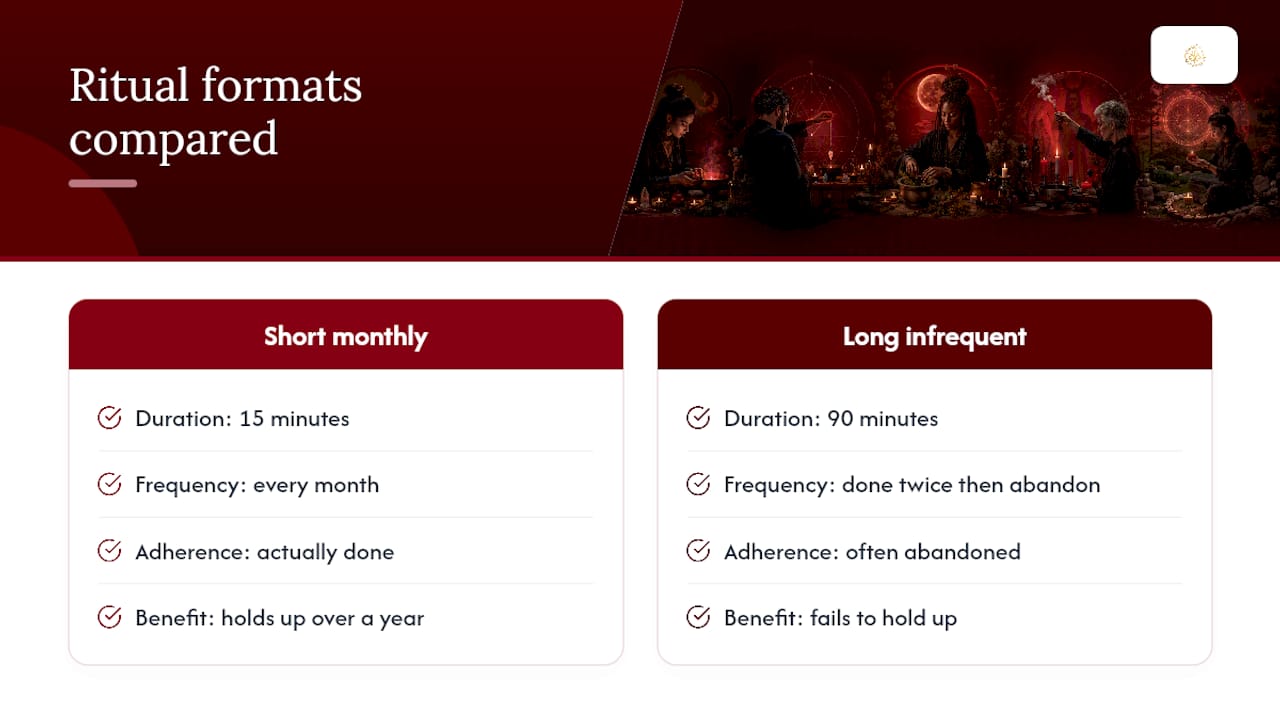
Where conventional advice really fails people is timing. Everyone talks about what to do in a ritual and almost nobody talks about when, and timing is the variable that determines whether the practice survives contact with a busy October or a chaotic tax season. Pick your date before you pick your candle color.
If you’re starting from zero, prioritize one thing: a fixed calendar slot. Everything else, the script, the tools, the group, can be refined later. The slot is what turns an idea into a habit.
— Black Witch Coven
Want a Managed Monthly Ritual Instead of Building Your Own?
Not everyone wants to write scripts and troubleshoot timing. If you’d rather have a crafted monthly practice handed to you, recurring ritual work can give you a prepared monthly casting tied to the moon’s phases, without the trial and error of designing your own system from scratch.
This fits serious witches who want a turnkey monthly practice: someone who wants results without spending an evening every month researching correspondences or second-guessing their own script. An approach to monthly spell casting timed to the full and new moon can build consistency into the calendar for you, month after month, so the only thing you have to remember is to show up.
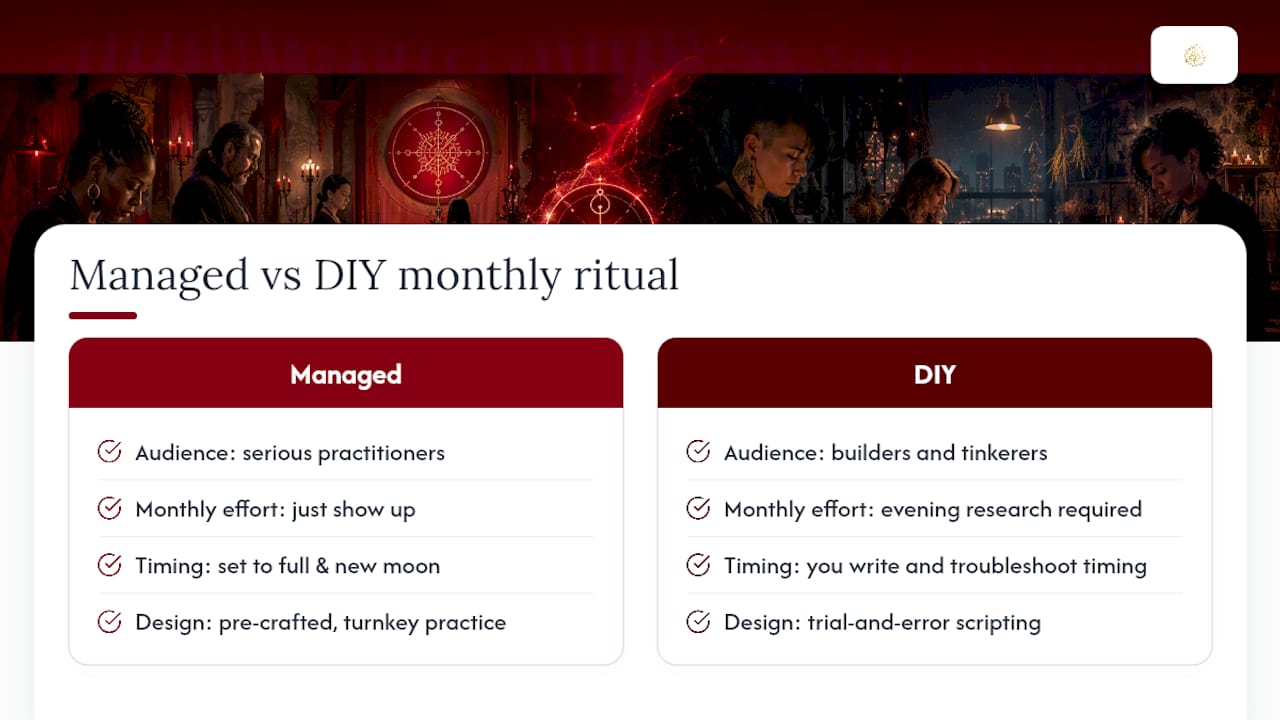
If that sounds like the version of monthly ritual work you want, start by reading how the full and new moon timing works and see whether a managed monthly practice fits your goals better than a DIY one.
Sources
- 3 Monthly Ritual Days That’ll Help You Turn Your Life Around | Psychology Today
- PubMed indexed study (relevant literature on reflective practices)
- NCBI/PMC article on ritual/compulsive behaviors
FAQ
What Are Some Good Examples of Monthly Rituals?
Five solid starting points are a monthly recap and reflection session, a Think Day for strategic planning, a new moon friendship circle for accountability, household or altar maintenance, and a quick 15-minute prosperity or protection ritual.
What Does a Good Monthly Planning Ritual Look Like?
A working monthly planning ritual runs 30 to 45 minutes on a fixed recurring date, reviews what worked and what drained you over the past month, and closes with one written intention for the month ahead.
What Should I Focus on During a First-of-the-Month Ritual?
A first-of-the-month ritual commonly centers on cleansing your space, setting a clear financial or personal intention, and using a simple object like a coin or candle to mark the start of the cycle; community practice around this varies widely, so choose the version that matches your actual goal.
How Do I Know if a Ritual Habit Has Become Obsessive?
A ritual becomes a concern when it causes distress if skipped, expands uncontrollably in length or frequency, or interferes with daily responsibilities; clinical literature on ritualized behavior draws this line at whether the behavior relieves anxiety or is driven by it. If a ritual feels compulsory rather than chosen, that’s worth addressing directly rather than working around.
Can I Add Numerology or Lunar Timing to a Monthly Ritual?
Yes. Many occultists anchor rituals to lunar phases or personal numerology cycles for added structure; a resource like this numerology guide can help you pick meaningful dates if you want a system beyond a plain calendar date.
