
 New Years Eve Ritual 2026/2027 with Savannah
Blog, Demonolatry, Demons, Praise to Lucifer
What Demons Actually Want from Practitioners: 2026 Guide

Apr
Let’s begin this article with Savannah’s latest video where she talks about her relationship with demons in 2026.
In this Q&A I answer the questions people actually send about demonic work…. I had fun answering these questions tonight!
1. What is my go-to spirit for money magic?
2. Are demons and aliens are the same ?
3. What I do I ask from Lucifer?
4. If I could keep one demon for the rest of my life, who it would be?
5. What work am I doing now…that I can share with you all?
6. Which demon would i use if someone pissed me off ?
7. What’s your go to demon for protection?
8. If TWO demons offered you the same thing…who would you choose?
9. What is the funniest situation during a ritual?
Demons do not want your soul. That idea is medieval Christian propaganda, designed to frighten people away from occult practice. What demons actually want from practitioners is far more demanding and far more interesting: your energy, your will, your genuine transformation, and your commitment to embodying their archetypal force in the physical world.
Here is the core of it:
- Energy and devotion, not souls. Demons seek practitioners who channel their power consistently through aligned action and lifestyle.
- Archetypal embodiment. Each entity represents a specific force. They want you to become a living expression of that force.
- Ritual sovereignty. Structured, respectful interaction. Not groveling, not casual. Commanding presence.
- Meaningful offerings that create a genuine debt structure, signaling real commitment rather than theatrical gesture.
- Your transformation. Demons function as catalysts. They push practitioners to dismantle internal blocks and restructure the psyche for greater power.
This is the foundation. Everything else builds from it.
What demons actually want from practitioners: energy, will, and archetypal alignment
The soul-selling myth has no basis in any historical occult system. No grimoire, no Goetic text, no Luciferian tradition demands a soul. What the tradition actually describes is an energy exchange: the practitioner offers devotion, lifestyle alignment, and focused will, and the demon channels its archetypal power toward material results.
Demons represent forces that exist beyond ordinary human perception. They do not need your soul because souls are not currency in their economy. What they need is a capable human conduit. The practitioner who has genuinely aligned their life to a demon’s nature becomes a vessel through which that force amplifies itself in the physical world. That amplification produces the results practitioners seek: wealth, power, influence, transformation.
The psychological dimension here is real. Offerings to infernal entities create a debt structure that compels the practitioner’s own psyche to align. When you sacrifice something of genuine value, you create internal pressure. That pressure drives action. The demon does not do the work for you; it excavates the capacity within you to do it yourself.
Practitioners who approach this as a transaction, offering insincere or trivial offerings and expecting miracles, get nothing. Demons, as the grimoire tradition consistently warns, can sense insincere offerings and will reject contracts built on meaningless gestures.
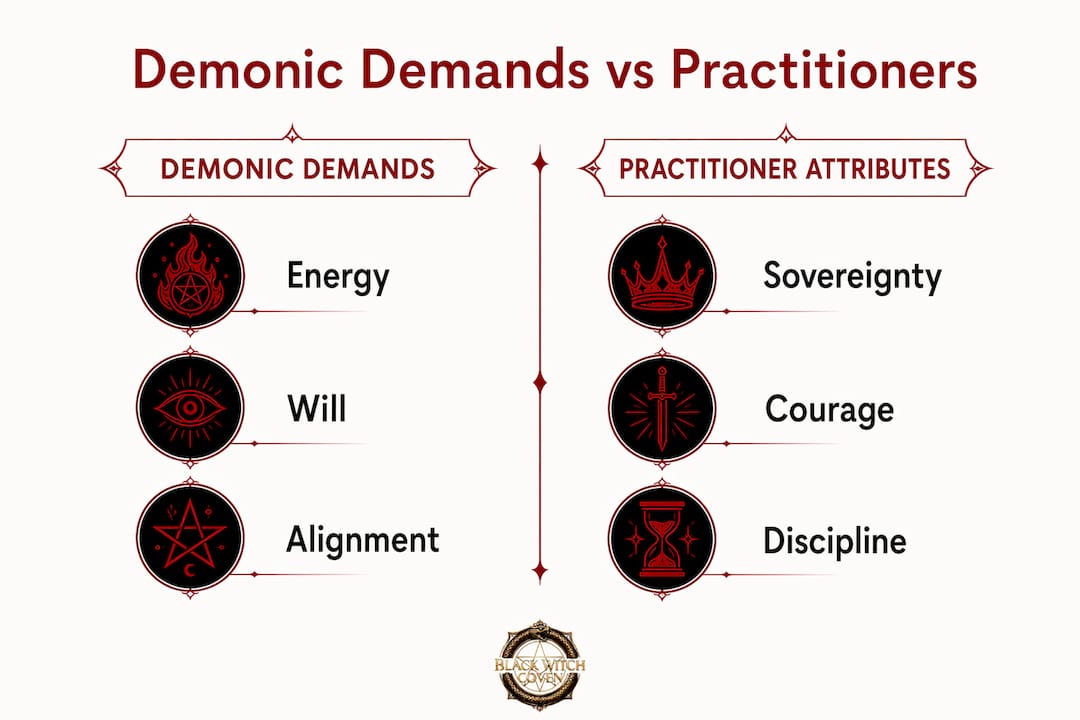
How ritual sovereignty and lifestyle alignment shape every interaction
Lifestyle alignment is not optional. If you invoke a demon of wealth while living in financial chaos with no discipline, you are asking a sovereign force to work through a broken vessel. The results will reflect that. Sustained demonic partnership requires that your daily life increasingly mirrors the nature of the entity you work with.
Respectful treatment and a sovereign attitude are equally non-negotiable. Real results come from commanding respect and informed ritualism, not from casual belief or metaphorical treatment. You do not grovel. You do not bluff. You arrive with a clear request, a real offering, and the willingness to change.
Ritual structure matters in concrete ways: altar geometry, deliberate movement, offerings chosen to resonate with the specific entity, incantations spoken with precision. Every act of ritual builds psychic infrastructure. Passive study produces nothing. The practitioner who reads a thousand books on a spirit but never invokes it has built no relationship.
Pro Tip: When working with emotionally volatile entities like Duke Zepar, emotional regulation is not a soft skill. It is a hard requirement. Zepar’s energy manipulates romantic and martial domains simultaneously. Practitioners who enter that working in a state of emotional turbulence risk chaotic outcomes rather than directed results. Stabilize before you open the circle.
Risk factors in demon work are real. Emotional turbulence, unclear intent, and insufficient ritual structure all create openings for manipulation rather than partnership. Sovereignty is the protection.
Key demonic entities and what they specifically demand from you
Understanding demon motivations at the individual level is where practice gets precise. Each entity has a distinct archetypal domain, and their demands reflect it. Black Witch Coven’s demonic invocation protocols are built around exactly this specificity.
Lucifer demands willpower and sovereignty above all else. He is the archetype of enlightenment, rebellion, and self-deification. Lucifer does not respond to weakness or supplication. He responds to practitioners who have genuinely claimed their own authority and are actively expanding their consciousness. The lifestyle requirement here is intellectual rigor, continuous self-development, and the refusal to submit to external authority without reason.
Andras requires courage and strategic aggression. He is a Great Marquis of Hell commanding legions, and his domain is disruption, conflict, and the destruction of enemies. Andras demands that the practitioner be willing to act, not just intend. He has no patience for hesitation. Working with Andras without genuine courage and a clear tactical objective is genuinely dangerous.
Clauneck seeks financial devotion and practical offerings. He is the demon of treasures, riches, and the accumulation of wealth, and he responds to practitioners who treat money as a serious spiritual practice rather than a side concern. Regular offerings, financial discipline, and demonstrated commitment to wealth-building are his requirements. A Clauneck pact is among the most practical working relationships available to a Left-Hand Path practitioner focused on material results.
Astaroth demands intellectual alignment and the relentless pursuit of knowledge. As an archetype of wisdom and hidden truth, Astaroth works with practitioners who are genuinely committed to understanding, not just power-seeking. He reveals deep knowledge, including uncomfortable truths about the practitioner themselves. The obligation here is honesty and intellectual rigor.
Core practitioner obligations by entity:
- Lucifer: Daily will-building, sovereignty practice, intellectual expansion
- Andras: Courage, decisive action, clear tactical purpose
- Clauneck: Financial discipline, consistent material offerings, wealth focus
- Astaroth: Knowledge pursuit, honest self-examination, intellectual dedication
How demon-practitioner relationships developed across history and cultures
The relationship between humans and demonic forces predates Christianity by millennia. Mesopotamian texts describe negotiations with shadow gods requiring gifts and precise ritual language. The Ars Goetia, compiled in the 17th century as part of the Lesser Key of Solomon, codified 72 spirits with specific seals, attributes, and interaction protocols. The Book of Enoch frames fallen angels as teachers of forbidden knowledge, transmitting arts of war, cosmetics, astrology, and metalworking to humanity in exchange for devotion.
What is consistent across these traditions is the contractual nature of the relationship. The practitioner does not worship blindly. They negotiate, offer, and receive. The medieval grimoire tradition, despite its Christian framing, preserves this architecture intact. Demonic contracts employ specific magical alphabets, including Theban, Celestial, and Passing the River scripts, with wording that must be precise because demons are known for exploiting loose language.
The Left-Hand Path tradition, as it developed through figures like Aleister Crowley and later through Demonolatry and Luciferianism, stripped away the Christian guilt framework and returned to the older model: the practitioner as sovereign agent, the demon as powerful ally, the relationship as mutual and purposeful.
How to tell genuine demon engagement from deception
Genuine demonic contact has a specific quality that experienced practitioners recognize. It tends to arrive with clarity, not confusion. Visions are coherent. Synchronicities are precise and timely. The entity’s communications align with its known archetypal domain. Lucifer does not suddenly start giving you lottery numbers. Andras does not offer gentle emotional healing.
Deceptive engagement, by contrast, often flatters. It tells the practitioner what they want to hear. It escalates demands without delivering results. It creates emotional dependency rather than empowerment. Grimoires consistently warn that certain entities establish escalating expectations, building dependency when offerings lack genuine value.
The practitioner’s own emotional state is a major variable. Demons can manipulate emotions by altering the perspective one has on internal imagery. A practitioner in a state of desperation or ego inflation is far more susceptible to receiving distorted communications. Sovereignty is not just ritual posture; it is the cognitive baseline that makes accurate discernment possible.
How to establish real boundaries in demon work
Boundaries in demon work are structural, not emotional. They are built into the ritual itself through the circle, the triangle of manifestation, the license to depart, and the precise terms of any agreement. Wording in demonic contracts must be extremely precise, with specific definitions for terms and clear conditions for all agreements, because vague language creates exploitable loopholes.
Practical boundary-setting methods:
- Define the scope explicitly. State what you are asking for, the timeframe, and what you are offering in return.
- Use protective geometry. The circle is not decoration. It is the boundary between your space and the entity’s.
- Maintain the license to depart. Every evocation ends with a formal dismissal. Never leave a working open.
- Keep a ritual journal. Tracking interactions over time reveals patterns, including whether an entity is delivering or escalating without result.
The practitioner who remains sovereign throughout, adapting when unexpected things occur without panicking, signals to the entity that they are a worthy working partner.
What long-term demon partnerships actually produce
Long-term demonic partnerships produce transformation that goes well beyond the original request. Practitioners who maintain sustained relationships with specific entities report heightened psychic sensitivity, accelerated manifestation, and a fundamental restructuring of their worldview and capabilities. The relationship deepens from transactional to integrated.
This evolution has costs. Sustained demon work tends to isolate practitioners from conventional social frameworks. The worldview shift is permanent. Practitioners who enter these relationships expecting a quick fix and then a return to ordinary life are consistently disappointed. The demon’s demand is not a one-time payment; it is an ongoing alignment.
The practical upside is real. Practitioners working with Black Witch Coven over many years have documented tangible outcomes in wealth, legal matters, relationship dynamics, and personal power. The pattern is consistent: results arrive when the practitioner’s actions align with the purpose of the working. The spirits support you; they do not replace you. If you want to understand the variables that affect outcomes before you commit, Black Witch Coven’s analysis of unknown casting variables is worth reading before you begin any serious working.
Key Takeaways
Demons seek energy, will, and archetypal embodiment from practitioners, not souls. The exchange is transformational, structured, and demands genuine lifestyle alignment to produce lasting results.
| Point | Details |
|---|---|
| No soul exchange | Demons seek energy, devotion, and will-based alignment, not souls. |
| Offerings create commitment | Genuine sacrifice creates psychological pressure that drives real practitioner transformation. |
| Entity-specific demands | Lucifer requires sovereignty; Andras demands courage; Clauneck needs financial devotion; Astaroth demands knowledge. |
| Sovereignty prevents manipulation | Emotional regulation and ritual structure protect against deceptive or chaotic engagement. |
| Long-term partnerships transform | Sustained demon work restructures the practitioner’s psyche, capabilities, and worldview permanently. |
FAQ
What do demons actually want from practitioners?
Demons want energy, devoted will, and lifestyle alignment to their archetypal nature. They function as catalysts for transformation, channeling power through practitioners who embody their specific force in the material world.
Do demons want human souls?
No. The soul-selling concept originates in medieval Christian propaganda designed to discourage occult practice. Historical occult systems describe practical energy exchange and transformational outcomes, not soul transactions.
Who are the main demons practitioners work with?
The most prominent Goetic and Luciferian entities include Lucifer, Andras, Clauneck, and Astaroth, each governing distinct domains: enlightenment and sovereignty, conflict and aggression, wealth, and wisdom respectively.
Who are demons most drawn to as practitioners?
Demons respond to practitioners who approach with sovereign confidence, genuine commitment, and a lifestyle that reflects the entity’s archetypal domain. Desperation, flattery, and casual curiosity tend to produce either no response or deceptive engagement.
What are the risks of demon work without proper structure?
Unstructured demon work opens the practitioner to emotional manipulation, escalating demands without results, and chaotic outcomes. Ritual discipline, clear intent, and emotional regulation are the primary protections.
