New Years Eve Ritual 2026/2027 with Savannah
Blog, Demonolatry, Demons
Working with Andras: What It Actually Feels Like Over Time
Aug
Working with Andras over time is not a gentle unfolding. It is a systematic dismantling of every habit, relationship, and internal pattern that keeps you small.
Andras is a spirit of destruction and boundary enforcement. His primary function is cutting what no longer serves you, whether you are ready for that or not. He does not ease people into change. He forces it.
Practitioners across the Left-Hand Path report the same core experience: contact with him rarely feels supportive in the conventional sense. It feels like pressure applied exactly where you have been avoiding pressure.
Most publicly available information on Andras stays at the grimoire level. The Ars Goetia describes him as a Marquis who appears as an angel with the head of a raven, riding a black wolf and carrying a sharp sword. He is said to sow discord and to teach those who work with him how to kill their enemies and create conflict. That description is not wrong. It is simply incomplete.
Operators who work with him over months and years tend to discover that the discord he produces is often secondary. The primary action is the removal of the practitioner’s capacity to keep living inside compromised structures.
| Aspect | What Andras Can Do |
|---|---|
| Boundary Enforcement | Forces the end of patterns where you tolerate disrespect, silence, or self-abandonment. |
| Cutting Toxic Ties | Severs relationships and arrangements that drain you, even ones you still feel obligated to keep. |
| Rage Transmutation | Surfaces long-suppressed anger and converts it into clearer, more decisive action. |
| Personal Sovereignty | Builds the capacity to act without seeking permission or over-explaining. |
| Pattern Disruption | Goes beyond the surface problem and attacks the deeper habit that created it. |
| Discord & Conflict | Creates division, mistrust, and rupture between people or within groups (traditional office). |
| Forced Confrontation | Brings avoided conflicts into the open, often faster and harder than the operator expects. |
| Destabilization Risk | Can collapse situations or internal structures before new ones are ready, leaving a period of exposure. |
| Aggressive Current | The energy itself can feel sharp, cold, or overwhelming, especially for those used to gentler spirits. |
| Traditional Danger | Classical sources warn he can harm the operator and assistants if the work is approached carelessly or without proper containment. |
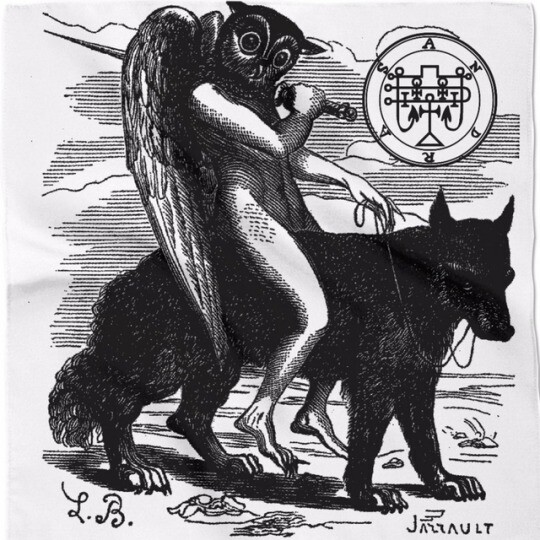
Andras’s typical appearance
The classical description is consistent across the major sources.
In the Ars Goetia and Pseudomonarchia Daemonum, Andras appears as an angelic figure with the head of a black raven (sometimes described as a night-raven), riding a strong black wolf, and carrying a sharp, bright sword raised in his hand. Some later accounts substitute an owl’s head for the raven, but the raven is the older and more common form.
The image is deliberate.
- The angelic body points to his origin as a fallen spirit of a higher order, while the raven head removes any softness from that origin.
- The raven is a bird of omen, battlefield, and death & not a messenger of comfort.
- The black wolf beneath him reinforces the same current: predatory, relentless, and unbound by human social rules.
- The sword is not ceremonial. It is held aloft as a weapon of severance.
In practical work, operators rarely report a gentle or ambiguous manifestation. When Andras is perceived visually or in strong impression, the elements tend to arrive together: the sense of a tall, upright presence, the black avian head, the feeling of something crouched or coiled beneath (the wolf), and the distinct impression of a blade.
Even when the full form is not seen, many describe a sharp, cutting quality in the air or a sudden drop in emotional temperature that matches the imagery.
The appearance is not theatrical decoration. It communicates function.
Everything in the traditional description ( the hybrid of angel and scavenger bird, the wolf, the raised sword) points to the same operation: the removal of what cannot be allowed to remain.
Operators who work with him over time often find that simply holding the classical image in mind during contact is enough to stabilize the current. Attempting to soften or humanize the form usually weakens the connection rather than improving it.
In ritual with Andras: if you have any issue connecting with the sigil, read the above, and it might provide a more powerful image of who this demon is and what he does!
The energy people call aggressive
A common report among those who approach Andras is that his presence feels aggressive, sharp, or difficult to tolerate. This deserves direct clarification.
What most practitioners are perceiving is not personal hostility. It is the energetic signature of a spirit who does not cooperate with soft denial. Andras’s current tends to amplify whatever has been suppressed in the name of keeping the peace. If you have been swallowing anger, tolerating disrespect, or maintaining relationships that require you to stay smaller than you are, his presence makes that arrangement harder to sustain. The resulting internal pressure can feel aggressive, especially for people used to spirits who operate through seduction, illumination, or gradual expansion.
The distinction matters. Difficulty is not the same as attack. Many operators find that once they stop trying to remain comfortable inside the old pattern and begin acting on what the pressure reveals, the sense of aggression lessens. The energy was never random. It was directional.
Those who treat the discomfort as a sign they should withdraw often miss the mechanism entirely. Those who treat it as information tend to move faster.
What Andras actually cuts
Andras is best understood as a breaker spirit. His work targets the architecture of tolerance that keeps a person functional while diminished. This includes:
- Relationships held together by the practitioner’s silence rather than mutual respect
- Environments that reward self-suppression and punish directness
- Internal rules about not making things worse, not being difficult, or waiting until it is safer to speak
- The habit of over-explaining, over-apologizing, or seeking permission before acting
- Bonds that persist mainly because ending them would force a confrontation with loss or guilt
He is particularly effective against arrangements the practitioner has already privately recognized as corrosive but has continued to maintain for secondary reasons: financial stability, shared history, fear of being seen as the one who destroyed the peace, or the belief that enduring it is a form of strength.
Andras has little interest in helping someone look strong while remaining easy to manage. His pressure tends to make the cost of continued compliance higher than the cost of change.
How the work tends to unfold
Sustained contact with Andras usually moves through recognizable phases, though the timeline varies.
Disruption
Old tolerances begin to fail. Situations that were previously endured become sharper and harder to ignore. Conversations that were postponed start to feel urgent. Some relationships become openly unstable. This phase is often misread as the work going wrong. In most cases it is the work beginning in earnest.
Clarity
Once enough has been stripped away, the practitioner can see more cleanly. Preferences that were previously muted become harder to deny. The difference between people who respect them and people who preferred them compliant becomes obvious. Anger that was previously diffuse or turned inward becomes more specific.
Consolidation
New responses start to require less effort. Boundaries are set earlier and with less emotional residue. The practitioner becomes harder to manipulate through guilt, tone, or the threat of withdrawal. What began as deliberate effort starts to operate as default posture.
Andras rarely confines the work to the original request. A person who approaches him about one damaging relationship often finds the same pattern being challenged in work, family, and friendships. He tends to address the underlying structure rather than the single instance. This is one of the reasons long-term operators describe the work as larger than they initially bargained for.
Rage as material, not obstacle
Suppressed anger is one of the most common materials Andras surfaces. Many people arrive at this work carrying years of unexpressed rage buried under politeness, conflict-avoidance, or the belief that anger itself is the problem. Andras does not treat that anger as a defect. He treats it as stored force that has been misdirected.
The process is rarely comfortable. Practitioners often report periods of heightened irritability, disrupted sleep, vivid confrontational dreams, and sudden clarity about situations they had previously rationalized. This is the transmutation phase. The anger is not being created. It is being brought into usable form.
Those who try to suppress the intensity during this stage frequently stall. Those who move it eg through writing, physical training, deliberate speech, or ritual action, tend to convert it into cleaner decisiveness. The goal is not permanent rage. The goal is the recovery of the capacity to act without first securing permission or consensus.
How to call him and structure the work
Andras responds to directness. Elaborate performance is less important than clarity of intent and consistency of return.
the following is to give you an idea of how you could begin a working
A functional method of initial contact:
- Draw or print his sigil. Black ground or dark paper is traditional and effective.
- Use a black candle and a red candle.
- Open by naming yourself, naming Andras, and stating what you want cut or enforced. Specificity matters. Vague requests for “strength” or “protection” produce weaker currents than precise statements about the pattern or arrangement you are ready to end.
- Make a simple offering. Traditional options include blood in some lines of work, but it is not required. Incense, strong alcohol, or a concrete act of personal discipline offered under his name can serve.
- Remain present without constant talking. Note what arises in the body and in thought.
- Close the session cleanly. Acknowledge him, extinguish the candles, and end. Do not leave the working open.
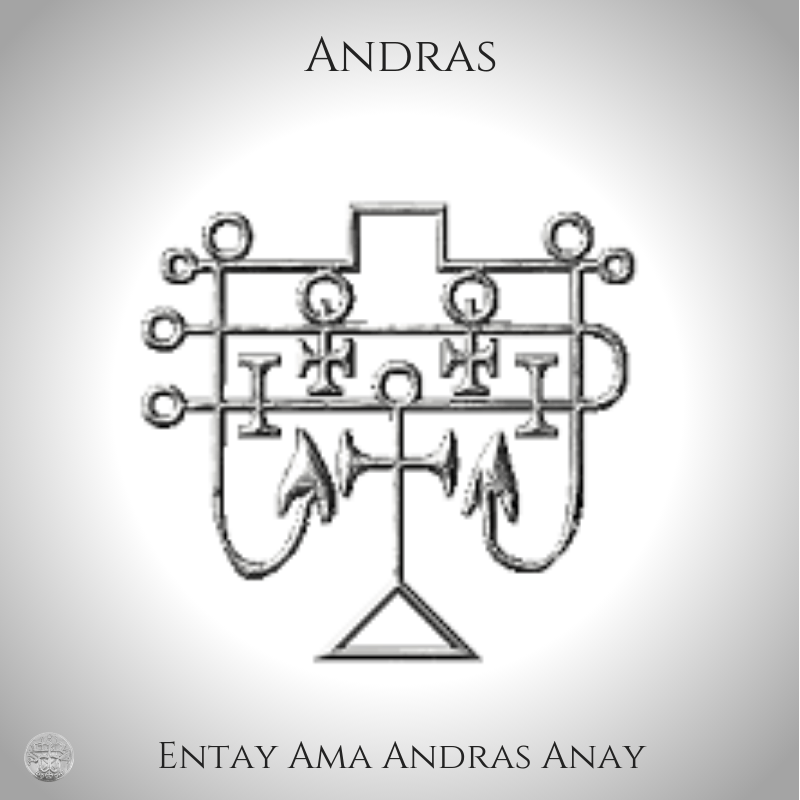
Sample petition
“Andras, Marquis, I call you by name and by your sigil.
I am [Name]. I stand here with clear intent.I ask you to cut the pattern of silence I have kept when I am spoken to with disrespect.
I ask you to sever my willingness to remain in arrangements that require me to abandon my own position for the comfort of others.
I will act on what you bring forward. I will not ask you to do for me what I am unwilling to do myself.Receive this offering. Stand with me in this work.
I close this session cleanly and will return.”
Andras’s elemental associations
Elemental attributions for Andras are not consistent across sources, which is common with Goetic spirits. The primary grimoires do not assign elements in a rigid system, so later practitioners have filled the gap according to function and experience.
Most common practical attribution: Fire
The majority of modern operators link Andras to Fire.
This follows from his martial character, the raised sword, the destructive and severing quality of his work, and the heat of forced confrontation. Fire fits the way his current tends to burn through tolerance, accelerate rupture, and leave little room for negotiation.
When practitioners speak of his energy feeling sharp, hot, or consuming, they are usually describing a Fire signature.
IMPORTANT TIP
The first contact is not the full relationship. Andras appears to respond more strongly to operators who return on a regular basis than to those who make one intense demand and vanish. Short, consistent contact with clear intent outperforms occasional dramatic rites.
When the pressure increases, treat it as part of the working rather than an interruption. If the intensity becomes disorienting rather than clarifying, pause, cleanse, and reassess. Difficulty is expected. Loss of functional stability is a signal to adjust, not to force.
What changes over longer periods
Operators who maintain contact over months and years tend to describe shifts that become structural rather than temporary:
- Faster recognition of when a situation is already over
- Reduced willingness to negotiate away their own position for the comfort of others
- Less dependence on being liked as a form of safety
- Cleaner endings with less residual self-doubt
- A higher tolerance for being seen as difficult by people who benefited from their previous compliance
One recurring pattern is that people who begin the work focused on a single external problem often end up confronting the internal rules that made them available for that problem in the first place. Andras does not seem interested in helping a person remain internally submissive while appearing externally harder.
Those who approach him primarily as a tool for dominating others frequently find the current turns inward first. He has limited interest in lending force to someone who has not yet stopped yielding their own ground.
Andras’s role in ceremonial magic
In classical Solomonic and Goetic ceremonial magic, Andras occupies a narrow and explicitly hazardous position. The Ars Goetia states his office simply: he sows discords.
The same entry immediately adds the warning that if the exorcist is not careful, Andras will kill both the operator and those assisting. And we agree with this description. We teach that you should not be working with this demon unless you have some experience working with the demons.
Ceremonial magic rituals are highly symbolic and structured and have centuries of power in the words of the ritual itself, which adds to the effect. The occultist must know what they’re doing during the ritual because the demon will not pity those who are practicing or come across as disrespectful.
This is one of the few places in the text where a spirit is singled out with that level of direct caution.
Because of that warning, traditional ceremonial work with Andras was never casual. He was approached inside the full apparatus of the art: a properly constructed circle, the triangle of manifestation, the use of divine names and constraining orations, and a clear hierarchical stance of command.
In that framework his function was external and targeted to insert conflict, rupture alliances, turn associates against one another, or destroy cohesion in a group or relationship. The magician’s authority and the integrity of the ritual structure were considered the only things standing between a successful operation and serious harm.
Modern ceremonial practice has split into two broad approaches.
The first remains close to the Solomonic model. The operator treats Andras as a dangerous but usable force for creating discord or separation, maintains strong ritual containment, and keeps the relationship coercive and limited in duration. Results are expected to appear in the external situation the magician has named.
The second approach, more common among Left-Hand Path and post-Solomonic practitioners, reinterprets the old warning. The danger is understood less as arbitrary malevolence and more as a reflection of the spirit’s nature: Andras does not cooperate with divided intent, weak boundaries, or the operator’s desire to remain comfortable.
In this model his ceremonial role expands. He is still capable of external disruption, but he is equally (and often primarily) used to force rupture inside the operator’s own structures like relationships, habits of compliance, and internal rules that keep the person small.
The formal elements of ceremonial magic (clear opening, defined space, precise statement of intent, and clean closure) are retained, but the stance shifts from pure command toward a more direct and accountable working relationship.
In both approaches, one consistent observation holds: Andras does not reward vagueness.
Ceremonial work with him tends to fail or turn unstable when the operator’s will is split, when the goal is left sentimental, or when the ritual is treated as performance rather than operation. The same sharpness that makes him effective at cutting also makes him unforgiving of sloppy construction.
His place in ceremonial magic is therefore not that of a general-purpose spirit. He is a specialist of rupture. Whether that rupture is directed outward at a target or inward at the operator’s own compromised patterns depends on the framework and the honesty of the intent brought into the circle.
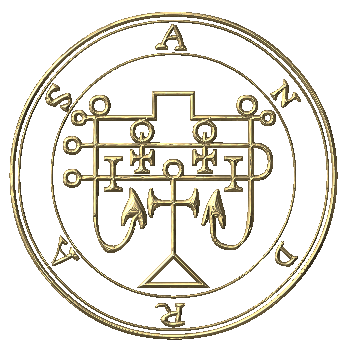
Sigil selection and use with Andras
The sigil is not decorative. It is the primary point of contact and recognition. How you select and maintain it affects the consistency of the current.
1. The traditional Goetia sigil
For most operators, the standard sigil of Andras from the Ars Goetia (and its common manuscript variants) remains the most reliable starting point. It carries the accumulated recognition of centuries of use. When the goal is to establish clear contact with the entity as he is known in the grimoiric current, the classical form is usually the strongest choice. Minor stylistic differences between manuscripts rarely matter as much as clean rendering and consistent use.
2. Fixed versus living sigils
There are two main approaches:
- Fixed traditional sigil: Draw or print the classical form and keep it unchanged. This is the better option for beginners and for anyone building a long-term working relationship. The stability of the image supports the stability of the contact. Daily work with the same unchanged sigil builds a clearer energetic thread.
- Personal or modified sigil: Some experienced operators eventually create a personal version after repeated contact, incorporating elements that arose in vision or through direct interaction. This should not be done at the beginning. Altering the sigil before recognition is established often weakens the link rather than strengthening it. If a personal form emerges later, it is usually treated as an addition or a private key, not a replacement for the classical seal in formal work.
3. Medium and permanence
Andras’s current tends to respond well to sigils that feel deliberate and durable:
- Black paper or dark card stock is traditional and effective for altar use.
- Heavier materials (wood, metal, or thick card) work better for long-term daily contact than thin printer paper that degrades.
- Some operators keep a primary altar sigil and a smaller, more portable version for travel or discreet work.
- Digital sigils can function for short-term or emergency contact, but most practitioners report stronger results with a physical object that remains in the same place and accumulates use.
4. Selection by working style
If the work is primarily about boundary enforcement, cutting ties, and internal dismantling, the classical Goetia sigil is usually sufficient and preferred. Creating an elaborate new sigil for this purpose is rarely necessary and can become a form of delay. The power is in repeated contact with a stable image, not in constantly redesigning it.
TIP: Consecration and daily use
Once selected, the sigil should be treated as a working tool rather than a static symbol.
A simple consecration eg stating that this image is the point of contact with Andras for this operator is enough to begin. From that point, the daily act of opening the working in front of the same sigil does more to charge it than any single elaborate ritual.
Operators who change sigils frequently, or who treat the image as interchangeable, tend to report thinner results. Those who keep one primary sigil and return to it consistently build a clearer recognition current.
In Closing
Andras is not a spirit of gradual improvement or emotional support. He is a force of necessary rupture. His traditional office is the sowing of discord; in sustained work this becomes the systematic removal of everything the practitioner has used to remain functional while diminished.
The classical image w the raven-headed angel on the black wolf, sword raised is an accurate summary of the current. The energy can feel aggressive because it refuses to cooperate with self-deception. That pressure is not random hostility. It is directional. It surfaces what has been tolerated and then demands that it be cut.
Whether approached through formal Solomonic structure or through consistent relational contact, Andras responds to clarity and punishes vagueness. He does not stop at the surface problem the operator names. He goes after the pattern that made the problem possible. The operators who gain lasting sovereignty from him are those willing to let the cutting reach into places they would prefer to leave untouched.
The work is not comfortable. It is effective. Those who call him should do so with clean intent, return consistently, and be prepared to act on what he brings forward. Anything less produces pressure without transformation.
I hope these tips help you with your working with Andras, and thank you for asking me to talk about this powerful demon!