
 New Years Eve Ritual 2026/2027 with Savannah
Black Magic, Blog, Rituals
Left Hand Path Philosophy and Practical Magic: A Results Guide
Aug
Combine Left-Hand Path philosophy with practical magic by centering sovereignty the doctrine of self-deification, and converting every ritual from a supplication into a command-style operation. That single pivot separates LHP practice from every other magical tradition. Black Witch Coven has applied this framework for many years, working with entities including Lucifer and Clauneck to produce measurable outcomes for numerous clients worldwide. Start here:
- Establish a daily sovereignty practice (10 minutes minimum: grounding, shadow journaling, intent declaration)
- Build every ritual around assertive grammar: I WILL, I COMMAND, I BIND
- Select entities by goal fit, not familiarity
- Record every working in a ritual ledger before and after
- Run protection and aftercare protocols every time, without exception
Table of Contents
- How does Left-Hand Path philosophy shape practical magic?
- What operating principles must you adopt before casting?
- What daily practices build a sovereign ritual state?
- How do you build a repeatable command-style ritual?
- Which entities do you work with, and how do you negotiate?
- Three worked examples: wealth, protection, and justice
- How do you protect yourself and handle backfires?
- What timelines and measurements should you expect?
- Key Takeaways
- What experienced practice actually looks like
- Black Witch Coven offers guided LHP ritual work
- Useful sources and further reading
- FAQ
How does Left-Hand Path philosophy shape practical magic?
The core LHP philosophy is the elevation of the self to personal divinity, using magic as the mechanism for autonomy and self-directed evolution. You are not petitioning a higher power. You are the operative center of your own reality.
The Left/Right-hand path dichotomy originated in tantric concepts, vāmācāra versus dakṣiṇācāra, and was reframed in Western esotericism over centuries. Modern usage carries no automatic moral judgment. What it does carry is a structural difference:
Right-Hand Path practice orients toward unity with a divine source, moral authority, and supplication.
LHP practice orients toward separation, sovereignty, and command.
That structural difference changes everything about ritual design. Taboo-breaking in LHP is functional, not merely transgressive it strips conditioned responses and increases the psychological potency of a magical act. Shadow integration replaces shadow suppression. The practitioner assimilates jealousy, aggression, and desire rather than purging them, converting those energies into fuel.
Scholarly analysis identifies five core elements of LHP practice: ideological individualism, psycho-physical totality, emphasis on present life, the goal of self-deification, and antinomian practices.
Every practical technique you use should serve at least one of those five.
What operating principles must you adopt before casting?
Experienced LHP practice demands more discipline than most newcomers expect. There is no external divine authority to absorb your errors. Operational competency is the only safety net.
- Sovereign language: Every ritual statement uses first-person command grammar. “Please bring me wealth” is dead on arrival. “I COMMAND the flow of wealth into my life” is operative.
- Assertive mental state: Your internal state during ritual matters more than any tool on your altar. Doubt is not humility — it is interference.
- Rigorous recordkeeping: Date, intent, method, entity, offering, and outcome. No exceptions.
- Shadow integration: Identify the emotion you are suppressing and put it to work. Anger directed at a justice working is fuel, not contamination.
- Consent and harm ethics: LHP does not mean reckless. Coerced harm to non-consenting third parties creates blowback you own entirely — there is no divine forgiveness to absorb it.
- Operational coherency: One goal per ritual. Diluted intent produces diluted results.
Pro Tip: Keep a ritual diary with two entries per working: one written before you enter gnosis (intent, state, tools) and one written within an hour of closing (observations, physical sensations, synchronicities). This pre- and post-gnosis anchoring is how patterns become visible across dozens of workings.
What daily practices build a sovereign ritual state?
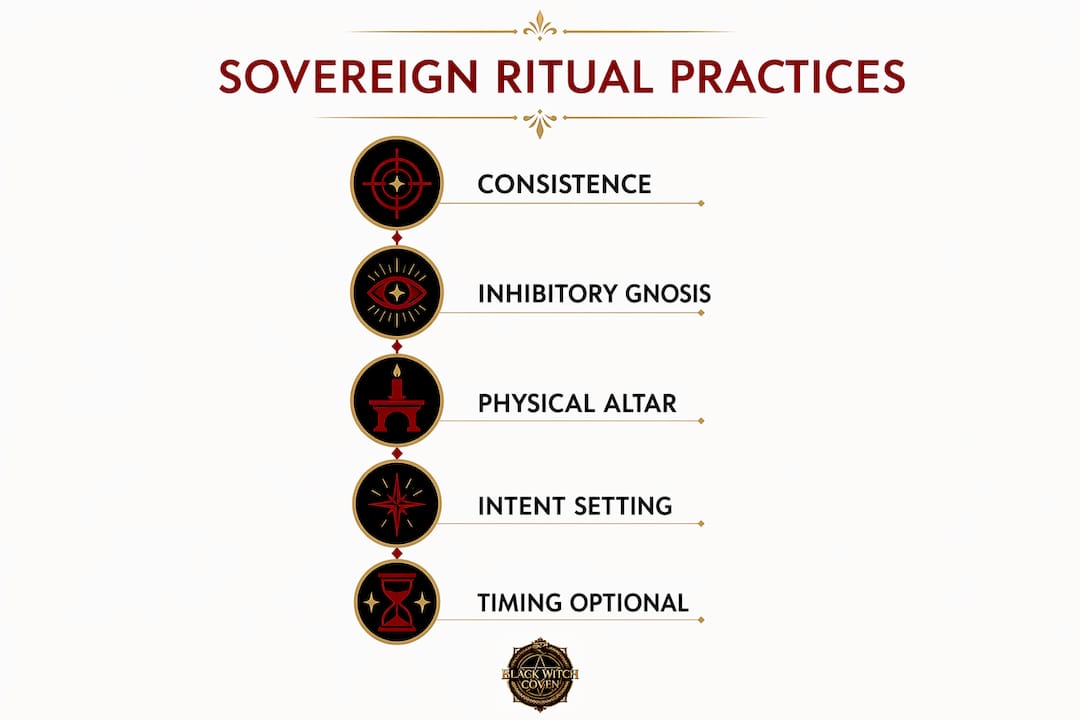
Consistency beats intensity. A 10-minute daily practice maintained for 90 days produces more operational coherency than a monthly elaborate ceremony.
Internal practices:
Short inhibitory gnosis sessions — breath-focused stillness, narrowed attention — train the mind to drop into ritual state on command. Excitatory gnosis (rhythmic movement, intense music, physical exertion) is the counterpart; use it when you need to break through psychological resistance before a high-stakes working. Shadow-work journaling takes 5 minutes: identify one suppressed impulse, name it, and write one sentence on how it could serve a current goal.
Physical setup:
Your altar needs a minimum of four elements ( although this will be argued and debated amongst us, team members here, you will find your own way, but I’m telling you my way right now )…..candles (black and red as primary), an athame or blade for directing will, consecrated offerings, and a ritual ledger.
Sigil materials (paper, ink, a burning vessel) complete the kit.
For Goetic work, add the relevant seal of the entity you are calling.
Consecration of tools matters; a well-crafted blade used with focused intent outperforms an expensive one treated as decoration.
For guidance on ceremonial tool consecration, the craft and purpose behind each instrument repays study.

Timing:
Moon and planetary timing are optional refinements, not prerequisites. Philosophy-first, timing-second. If the working is urgent, cast now. If you have flexibility, a waxing moon favors growth workings; waning favors banishing and severance.
How do you build a repeatable command-style ritual?
This template adapts to any LHP goal. Run it in sequence every time until the structure is automatic.
- Preparation (5 minutes): Clear the space physically. Review your ritual ledger entry for this working. Ground with three slow breaths, feet flat, spine straight.
- Opening declaration: State your name, your authority, and your intent aloud. “I, [name], sovereign of my will, open this working to [specific outcome].”
- Gnosis induction (5–15 minutes): Choose inhibitory (breath, stillness) or excitatory (drumming, physical exertion) based on the working. Inhibitory for precision; excitatory for breaking through resistance.
- Intent compression: Create or activate your sigil. Using the Spare-style method: write the intent statement, remove repeated letters, combine the remaining letters into an abstract symbol. Charge it in gnosis by fixing your gaze softly on it until a sense of completion arrives.
- Command/invocation: Speak the command aloud with full conviction. “I COMMAND [specific outcome]. I WILL [specific action]. This is my sovereign decree.” For entity work, add the invocation here.
- Offering and exchange: Present the offering. State the terms clearly.
- Sealing: “This working is sealed. The intent is released. It is done.”
- Closure: Ground residual energy. Extinguish candles. Destroy or bury the sigil — forgetting it is the final step that bypasses the conscious censor and lets the working operate.
Sigil charging note: After charging, stop monitoring the sigil. Obsessive checking is the single most common reason workings stall.
- Sample command script: “By my sovereign will, I BIND [obstacle] and COMMAND its dissolution. I INVOKE [entity name] as witness and ally. The path is clear. It is done.”
- Sample phrasing for wealth: “I COMMAND the flow of abundance. Clauneck, I call you as partner in this work. The offering is made. The terms are set.”
Which entities do you work with, and how do you negotiate?
Entity selection is a strategic decision, not a devotional one. Match the entity to the operational goal.
Lucifer governs sovereignty, illumination, and the dissolution of false authority. Call on Lucifer when the working involves self-elevation, breaking conditioning, or initiatory transformation. His seal appears in the Grimorium Verum.
Clauneck is the demon of treasures and financial power, cited in the Grimoirium Verum as one who can reveal hidden wealth and bring money from great distances. Wealth workings, business expansion, and pacts with Clauneck are among the most documented in Goetic practice.
Andras is a Grand Marquis of Hell governing discord, disruption, and the destruction of enemies. The Ars Goetia warns he is dangerous to the operator if protocols are loose. Use him for justice workings and domination operations — never casually.
Astaroth provides cunning, counsel, and access to hidden knowledge. Call on Astaroth when you need strategic clarity before a major working or when you want to understand the forces opposing you.
Pact skeleton:
- Clear statement of what you are requesting
- What you offer in return (material, vibrational, or symbolic)
- Duration of the agreement
- Exit clause: how the pact dissolves if terms are not met
- Record everything in the ritual ledger, dated and signed
Acceptable offerings include blood (your own, consensual), incense, alcohol, food, dedicated ritual time, and symbolic objects aligned with the entity’s domain. Non-negotiables: no coerced harm to non-consenting third parties. The blowback from that category of working lands entirely on you.
SAFTY TIP
Avoid pacts during periods of psychological instability. Seal every entity contact with closing language. If you are new to Goetic work, invoking demonic influences through proper summoning symbols is the place to start before attempting formal pacts.
Three worked examples: wealth, protection, and justice
Wealth working with Clauneck:
- Sigil: compress “MY BUSINESS GENERATES CONSISTENT WEALTH” using the letter-reduction method
- Invocation: “Clauneck, I call you by your seal. I offer [incense/wine]. I COMMAND the opening of financial channels. The terms are set. It is done.”
- Pair with a concrete real-world action the same day: send the proposal, make the call, launch the listing. Magic amplifies action; it does not replace it.
- Warning: Do not cast this working while carrying significant financial fear. Fear is interference. Resolve the emotional state first.
Protection binding:
- Command: “I BIND all hostile intent directed at me. I SEAL this space against intrusion. By my sovereign will, this protection holds.”
- Aftercare: burn black salt at the perimeter of your space; record the sealing in your ledger.
- Repeat the sealing language monthly or after any significant conflict.
Justice/domination working with Andras:
- Frame the intent precisely: name the specific situation, not a general enemy.
- Invocation: “Andras, Grand Marquis, I call you to witness this injustice and act as instrument of disruption. I COMMAND [specific outcome]. The offering is made.”
- Containment: set a hard end date in the pact. Andras workings without a terminus tend to keep running.
- Warning: Do not run this working out of personal anger alone. Emotional clarity is required. If you cannot state the harm done to you in two sentences without escalating, wait.
How do you protect yourself and handle backfires?
Pre-ritual protection is not optional. Before every working: review your ledger for unresolved open workings, cast a personal shield (visualized barrier + sealing language), and confirm your intent is specific enough to avoid unintended targets.
When a working backfires, triage in three steps. First, neutralize: cast a severance working to cut the energetic attachment. Second, sever: destroy any physical components of the original working (burn the sigil, dispose of offerings). Third, redistribute: reground your psyche with inhibitory gnosis and write a full account in your ledger. The unknown variables in spellcasting are real eg ambiguous intent and unresolved psychological conflict are the two most common causes of misfires.
Escalate to a senior practitioner when: the working is affecting people outside the intended scope, you are experiencing persistent intrusive thoughts or sleep disruption, or you cannot identify what went wrong after two triage attempts. Aftercare after any significant working includes energetic hygiene (salt bath or smoke cleansing), a full ledger entry, and at least 24 hours before casting again.
What timelines and measurements should you expect?
LHP magic operates on probability, not certainty. Realistic expectations prevent both premature abandonment and delusional overclaiming.
| Goal Category | Typical Timeframe | Verification Method |
|---|---|---|
| Influence / synchronicity | Days | Observable behavioral shifts in target |
| Wealth / financial opening | 2–8 weeks | Measurable income change, new opportunity |
| Protection / severance | Immediate–2 weeks | Absence of expected conflict or contact |
| Justice / domination | 4–12 weeks | Documented outcome in target situation |
| Sovereignty / self-elevation | Months–years | Behavioral change, decision patterns, resilience |
Logging template fields: intent statement, method used, entity invoked, offering made, date cast, observable outcomes (weekly), follow-up actions required.
Measure behavioral changes and material indicators, not feelings. If the wealth working produced three new client inquiries in two weeks, that is data. If it “felt powerful,” that is not.
Key Takeaways
Left-Hand Path magic produces measurable results when sovereignty is the operating principle and every ritual is structured as a command, not a request.
| Point | Details |
|---|---|
| Sovereignty first | Every ritual must center self-deification; supplication undermines the entire operational framework. |
| Command grammar | Use I WILL, I COMMAND, I BIND — assertive language is not stylistic, it is functional. |
| Entity-goal matching | Clauneck for wealth, Andras for justice/domination, Astaroth for counsel, Lucifer for sovereignty work. |
| Rigorous recordkeeping | Log intent, method, entity, offering, and outcome for every working without exception. |
| Black Witch Coven | Results-driven Goetic and Luciferian spellwork; guided pacts and protection work available for practitioners who want professional support. |
What experienced practice actually looks like
The practitioners who get consistent results from LHP work share one trait: they treat it as a discipline, not an event. The sovereignty-first framework is not a philosophy you read once. It is a posture you rebuild daily through shadow work, ledger entries, and deliberate gnosis practice.
Over many years, Black Witch Coven has worked with numerous clients across wealth, protection, justice, and personal power operations. The pattern in successful cases is consistent: the client came with a specific, clearly stated goal, paired the ritual work with real-world action, and maintained patience through the probabilistic timeline. One anonymized example: a business owner sought financial expansion through a Clauneck working combined with a structured pact. Within six weeks, two dormant contracts reactivated and a new partnership materialized. The client had also, critically, taken three concrete business actions in the same period. Magic and action are not competitors.
The cases that struggle share a different pattern: vague intent, no ledger, and an expectation that the working substitutes for effort. LHP philosophy is unambiguous on this point. You own the outcome. That is the cost and the power of the path.
Useful sources and further reading
Primary practitioner sources used in this guide:
- Left Hand Sorcery (lefthandsorcery.com) — Operational LHP framework; strong on gnosis types, sovereignty doctrine, and discipline requirements. The most practically useful modern practitioner resource cited here.
- Giansanti Codex, Entry XXIX (giansanti.org) — Covers taboo-breaking as a functional catalyst and shadow integration. Useful for understanding the psychological mechanics behind LHP ritual design.
- Kennet Granholm, “Approaches to Nature in Contemporary Left-Hand Path Magic” (kennetgranholm.com) — Academic PDF; identifies the five core scholarly elements of LHP and covers Spare-style sigil methodology. Essential for practitioners who want theoretical grounding alongside practice.
- Wikipedia, “Left-hand path and right-hand path” — Reliable starting point for the tantric origins and Western reframing of the LHP/RHP dichotomy. Use as orientation, not as depth.
- The Enlightenment Journey, “Left-Hand Manifestation Practices Explained” — Covers the integration of shadow work, sigils, and real-world action; useful for measurement and ethics framing.
Ritual tools: For practitioners building or consecrating their altar kit, a handcrafted kuripe represents the kind of purpose-built ceremonial instrument that carries genuine focal weight in excitatory gnosis work.
FAQ
What is the core difference between LHP and RHP magic?
LHP magic centers the practitioner as sovereign authority, using commands and invocations rather than supplication. RHP magic orients toward unity with a divine source and moral alignment with external authority.
How do you start working with Clauneck for wealth?
Create a sigil from a specific wealth intent statement, invoke Clauneck using his seal from the Grimoirium Verum, state your offering and terms clearly, and pair the working with a concrete real-world financial action the same day.
What causes a spell to backfire?
The most common causes are ambiguous intent, unresolved psychological conflict during casting, and open workings left without a terminus or exit clause. Triage by severing the working, destroying its physical components, and regrounding before attempting again.
How long does LHP ritual work take to produce results?
Influence and synchronicity can appear within days; wealth and justice workings typically run 2–12 weeks depending on complexity. Sovereignty and self-elevation work unfolds over months to years.
Do you need elaborate tools to practice LHP magic effectively?
No. Internal sovereignty and assertive intent matter more than any tool. A candle, an athame, a sigil, and a ritual ledger are sufficient for most workings. Tools focus the mind and structure the ritual; they do not generate the operative force.
