
 New Years Eve Ritual 2026/2027 with Savannah
Blog, Demonolatry, Demons, Occult Practices General, Working With Demons
Developing Spiritual Discernment When Working With Spirits

May
Reliable discernment in spirit work comes down to one discipline: verify before you trust, and record everything. Before your next contact with any entity, including Lucifer or Clauneck, run this three-step pre-session check:
- Ground and set explicit boundaries. State aloud what you will and will not permit during the session.
- Request identification and a verifiable sign. Ask the entity to confirm its identity through a specific, pre-agreed token or physical signal.
- Perform one low-risk verification action. A small, testable request with a measurable outcome before any deeper engagement.
Black Witch Coven has spent many years refining these protocols across numerous client sessions. The method works because it treats discernment as a skill you build, not a gift you either have or don’t.
Table of Contents
- What does spiritual discernment mean in Left-Hand Path practice?
- Core principles every serious practitioner must internalize
- How to verify a spirit’s authenticity with repeatable protocols
- Managing fear, ego, and projection during contact
- Safety checklist and abort protocols for Goetic work
- How to validate contact over time with a research-style method
- Entity-specific discernment markers for Lucifer, Andras, Clauneck, and Astaroth
- An 8-week practice plan to build reliable discernment
- A case study in disciplined discernment
- Key Takeaways
- What experienced practitioners know that beginners don’t
- When you need a second set of eyes on your practice
- Primary texts and further reading
- FAQ
What does spiritual discernment mean in Left-Hand Path practice?
In a Left-Hand Path or demonolatry context, spiritual discernment is the practiced ability to distinguish genuine external intelligences from internal projections, wishful thinking, or adversarial entities posing as something they are not. The goal is not passive reception. It is sovereign evaluation.
A strong discernment practice produces four concrete outcomes: clarity about what contacted you, verifiable results that align with your stated intent, preserved autonomy throughout the working, and the ethical agency to sever contact when something goes wrong. These are operational standards, not spiritual ideals.
One critical distinction separates serious practitioners from beginners: the difference between Unverified Personal Gnosis (UPG), Shared Personal Gnosis (SPG), and established grimoire or Goetic signals. UPG is your subjective impression. SPG is when multiple practitioners independently report the same markers. Grimoire signals are documented in classical sources like the Ars Goetia or the Book of Enoch. Reliable discernment in spiritual work requires you to know which category your evidence falls into before you act on it.
Core principles every serious practitioner must internalize
Discernment is a cultivated skill that demands tolerating uncertainty rather than forcing premature conclusions. These principles are the operational foundation:
- Presence over performance. Your job during contact is to observe, not to produce a dramatic experience. Rushing to interpret kills accuracy.
- Steadiness over urgency. Any entity that pressures you for an immediate decision is a red flag, not a sign of power.
- Boundary-first mindset. Define your limits before the session opens. Retroactive boundary-setting rarely holds.
- Tolerate ambiguity. Not every session yields clear data. Forcing a verdict from thin evidence is how confirmation bias takes root.
Common beginner errors map directly to these principles. Rushing ID verification (violates steadiness), mistaking fear of the unknown for a genuine warning (violates presence), and accepting flattery as authentication (violates boundary-first thinking) are the three most frequent failure points. Each principle, applied correctly, changes how you design a verification test: a boundary-first practitioner builds the abort protocol before the invocation, not after something goes wrong.

How to verify a spirit’s authenticity with repeatable protocols
The core verification sequence is: ID request, triple confirmation, small evidence action.
ID request: At the opening of any contact, ask the entity to state its name, its nature, and its purpose. Do not accept vague or evasive responses.
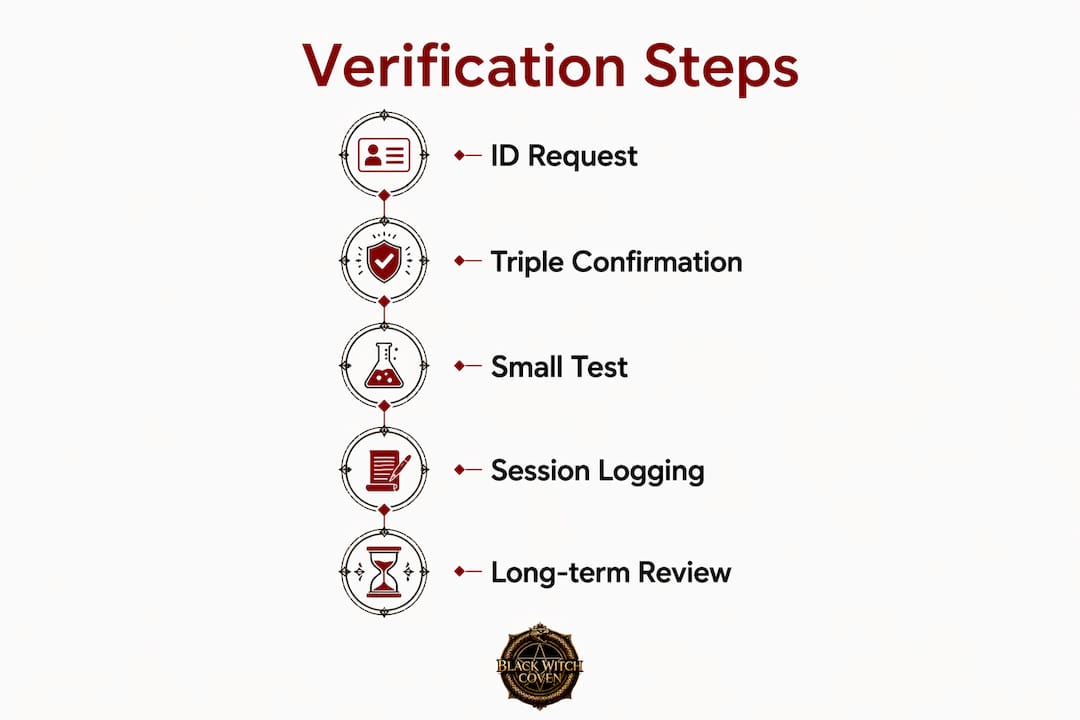
Triple confirmation: Cross-check the stated identity against at least three independent data points: a grimoire description, a divination reading (tarot, pendulum, or scrying), and a physical or environmental sign you specified in advance. Vetting involves asking for IDs, cross-checking via divination, and watching how the entity treats your stated limits.
Small evidence action: Before any significant working, request one low-stakes, observable outcome with a defined timeframe. A specific number appearing, a named person making contact, a physical object moving. If the outcome arrives within the window, you have one data point. One is not enough to trust; it is enough to continue testing.
Ritual template:
- Open with grounding and space clearing.
- State your intention and explicit consent terms aloud.
- Invoke the entity by name and sigil.
- Request identification and your pre-specified verifiable sign.
- Close formally, regardless of whether contact felt complete.
- Ground again immediately after closing.
Pro Tip: Start with the smallest possible request. A spirit that resists a minor, low-stakes test is telling you something important. Reserve escalated protocols for contacts that have passed at least three independent verification cycles.
Managing fear, ego, and projection during contact
Somatic state directly affects signal quality. A dysregulated nervous system produces noise that mimics spirit communication.
- Pre-session breath work. Four counts in, hold four, out four. Three cycles minimum. This quiets the sympathetic nervous system before you open any channel.
- Post-session body scan. Immediately after closing, note where you feel tension, heat, or pressure. Log it. Patterns across sessions reveal whether your body is responding to genuine external contact or internal anxiety.
- Trance log with motive check. Before reviewing your session notes, write one sentence answering: “What did I want to happen?” Then compare that to what you actually recorded. The gap between desire and observation is where projection lives.
Fear can indicate inner initiation or growth rather than an external threat. Track how interactions affect your sovereignty over time to tell the difference. A genuine warning tends to arrive as a clear, quiet signal. Anxiety-driven fear floods the channel with noise and urgency. The practitioner who learns to recognize subtle spirit messages through somatic grounding rather than dramatic sensation builds far more reliable discernment than one chasing peak experiences.
Safety checklist and abort protocols for Goetic work
Grounding and space clearing are non-negotiable pre-ritual steps. Use this checklist before every session:
- Physical health check: fatigue, illness, or emotional crisis impairs discernment.
- Space clearing: smoke, sound, or banishing ritual appropriate to your tradition.
- Energetic shielding: a psychic shield or ward set before the circle opens.
- Named boundary statements spoken aloud: what you permit, what you prohibit.
- Anchor protocol: a trusted person who knows you are working and can check in afterward.
Abort-signal protocol: Choose two trigger phrases before the session. If you speak either phrase aloud, the session ends immediately. Close the circle, perform a banishing, ground physically (feet on floor, cold water on wrists), and do not re-open contact for at least 24 hours. Log what triggered the abort.
Red flags that indicate manipulation or sovereignty erosion:
- The entity discourages verification or dismisses your tests.
- You feel compelled to act immediately without reflection.
- Your stated limits are repeatedly tested or ignored.
- The “fruit” of the contact consistently contradicts your stated intent.
Failure to define and enforce pre-ritual boundaries is the most common failure point in Goetic work. Define them before you open, not after the pressure starts.
Pro Tip: A spirit that genuinely holds the power it claims has no reason to rush you. Urgency is a manipulation tactic, not a mark of authority.
How to validate contact over time with a research-style method
Subjective impressions become verifiable patterns only when you track them systematically. Use this journal template for every session:
| Field | What to record |
|---|---|
| Date / time / lunar phase | Exact session context |
| Pre-session state | Physical and emotional baseline |
| Ritual used | Invocation method, tools, sigils |
| Requested evidence | Specific sign and timeframe |
| Observed sign | What actually occurred |
| Third-party check | Divination or external corroboration |
| Outcome | Aligned / partial / contradicted intent |
Weighted evidence criteria:
- Consistency: Does the entity behave the same way across multiple sessions?
- Boundary respect: Does it stay within your stated limits?
- Actionable fruit: Do outcomes align with your intent in measurable ways?
- Corroboration: Do grimoire descriptions, divination, and physical signs agree?
30/90-day validation cycle: For the first 30 days, run only low-stakes tests. Score each session using the four criteria above on a 1–3 scale. At day 30, review totals. A contact scoring consistently low on boundary respect or fruit alignment gets restricted or severed. At day 90, a contact with strong scores across all four criteria can be considered for deeper working. Testing the “fruit” of a spirit means evaluating whether its influence produces outcomes aligned with your intent, sovereignty, and integrity.
Entity-specific discernment markers for Lucifer, Andras, Clauneck, and Astaroth
| Entity | Typical communication mode | Signature markers | Watch for | Verification flip |
|---|---|---|---|---|
| Lucifer | Intellectual clarity, light imagery, sudden insight | Expanded awareness, absence of coercion, long-term perspective | Flattery that bypasses your critical thinking | Ask for a specific piece of verifiable information you do not already know |
| Andras | Intense pressure, heat, conflict-oriented imagery | Directness, no reassurance, outcomes in conflict or severance | Escalating aggression that erodes your agency | Test boundary respect: state a limit and observe whether it holds |
| Clauneck | Practical, transactional, wealth-oriented signs | Concrete financial synchronicities, clear terms | Promises without conditions; vague timelines | Request a specific, small financial outcome within a defined window |
| Astaroth | Revelatory, knowledge-focused, sometimes melancholic | Deep insight, historical or esoteric accuracy, emotional weight | Dependency-building; contact that discourages other sources | Cross-check revealed information against classical sources independently |
Key notes by entity:
- Lucifer rarely demands urgency. A contact claiming Lucifer’s authority while pressuring you for immediate action is almost certainly not him.
- Andras is genuinely dangerous to work with carelessly. His invocation protocols require explicit pre-defined limits and a tested abort sequence before you open the working.
- Clauneck responds to precision. A pact with Clauneck built on vague terms produces vague results. Specificity is both the offering and the test.
- Astaroth tends to surface information that is verifiable. Use that. If what Astaroth reveals cannot be independently checked against any source, treat it as UPG until corroborated.
An 8-week practice plan to build reliable discernment
- Weeks 1–2: Daily five-minute grounding ritual. Log baseline emotional and somatic state each morning. No active spirit contact yet.
- Weeks 3–4: Introduce low-stakes contact sessions twice weekly. Use the full verification sequence. Record every session using the journal template.
- Weeks 5–6: Add divination cross-checks to each session. Compare divination results to direct impressions. Note discrepancies without forcing resolution.
- Week 7: Conduct your 30-day review. Score all sessions on the four weighted criteria. Identify your strongest and weakest discernment areas.
- Week 8: Adjust protocols based on review findings. Introduce one new verification method (a different divination system, a physical sign category you haven’t used). Set 90-day targets.
Metrics to track: Number of sessions with verifiable outcomes, boundary deviations per entity, emotional reactivity score (1–5 scale, self-rated), and consistency of entity behavior across sessions.
On mentorship: if your 30-day review reveals repeated boundary violations or consistently unverifiable fruit, bring a more experienced practitioner into your validation loop before continuing. A second set of eyes on your logs catches blind spots that solo practice cannot.
A case study in disciplined discernment
A practitioner working with a new contact that presented as a wealth-current entity ran the full 30-day protocol before committing to any significant working. Sessions 1–4 produced consistent imagery and a specific financial synchronicity that arrived within the stated window. Divination cross-checks agreed with direct impressions in three of four sessions.
At session 5, the entity began discouraging the practitioner from continuing the verification process, suggesting the tests were “unnecessary” and that trust should be extended immediately.
The practitioner noted the boundary deviation in the log, applied the abort protocol, and did not re-open contact for two weeks. On return, the entity’s behavior had shifted: it accepted the verification framework without resistance. The 90-day review showed strong scores on consistency and fruit alignment, with the single boundary deviation as a documented anomaly. The contact was ultimately validated for deeper working.
The lesson: a single red flag does not automatically invalidate a contact. It requires a documented response, a cooling period, and a re-test. The protocol held because it was written down before the pressure started.
Key Takeaways
Developing spiritual discernment when working with spirits requires systematic verification, consistent record-keeping, and the discipline to sever or restrict contact when evidence fails to support continued engagement.
| Point | Details |
|---|---|
| Verify before you trust | Run ID request, triple confirmation, and a small evidence action before any significant working. |
| Record every session | Use a structured journal with date, state, ritual, requested evidence, observed sign, and outcome fields. |
| Test the fruit | Evaluate whether a spirit’s influence aligns with your stated intent across 30 and 90-day cycles. |
| Know your abort signals | Pre-define two trigger phrases and a full closing routine before every session opens. |
| Black Witch Coven | Offers 16+ years of Goetic and demonolatry experience for practitioners who need third-party validation or guided ritual design. |
What experienced practitioners know that beginners don’t
Most practitioners who struggle with discernment are not lacking sensitivity. They are lacking patience. The expectation of dramatic, unmistakable contact is the single biggest obstacle to developing reliable skill. Real Goetic entities, including Lucifer and Astaroth, tend to communicate with a precision that rewards quiet attention, not emotional intensity.
The tactical habit worth adopting immediately: a five-minute morning sovereignty check. Before you engage with anything, including your phone, ask yourself one question aloud: “Am I operating from my own will today, or am I reacting?” Write the answer. Over weeks, this builds the same internal observer muscle that makes discernment possible during actual contact. Steady, undramatic evidence collection beats a single overwhelming experience every time.
When you need a second set of eyes on your practice
Black Witch Coven provides discreet discernment coaching and ritual validation for practitioners who have reached the limits of solo verification. The service is straightforward: you bring your session logs, your stated objectives, and your consent. Black Witch Coven brings 16 years of documented Goetic and demonolatry experience, plus third-party verification protocols that go beyond what any single practitioner can run alone.
If your logs show repeated boundary violations, unverifiable fruit, or contact that feels like it may have backfired before it fully opened, that is exactly the situation this service is built for. Confidentiality is absolute. Results are the standard. Reach out directly through blackwitchcoven.com to discuss your situation.
Primary texts and further reading
- The Ars Goetia (Lesser Key of Solomon, 17th century): The foundational Goetic grimoire. Use it to cross-check entity descriptions, seals, and stated powers against your direct impressions. Any contact claiming a Goetic identity should be verifiable against this source.
- The Book of Enoch (1 Enoch, 3rd–2nd century BCE): Essential background on the Watchers and the cosmological framework underlying demonolatry. Use it to understand entity hierarchies and the nature of fallen intelligences.
- The Pseudomonarchia Daemonum (Johann Weyer, 1563): An earlier catalog of demonic entities with descriptions that differ in useful ways from the Ars Goetia. Discrepancies between sources are data, not errors.
- S. Connolly, Demonolatry (2009): A modern practitioner’s framework for working with demonic entities from a devotional rather than purely ceremonial perspective. Useful for understanding consent-based protocols.
- Lon Milo DuQuette, My Life with the Spirits (1999): Practical case notes from decades of Goetic work. Particularly useful for understanding how verification failures manifest in real practice.
- The Spiritual Exercises of Ignatius of Loyola (1548): The classical framework for discerning inner movements and distinguishing genuine guidance from deception. The Rules for Discernment of Spirits map directly onto LHP verification protocols despite their theological framing.
- Spiritual grounding techniques: Practical pre- and post-session grounding methods that reduce projection and improve signal clarity. Use before every contact session.
On source hierarchy: prioritize sources that describe reproducible protocols and outcome-based evaluation over raw UPG accounts. A grimoire description you can test beats a practitioner’s unverified personal narrative every time.
FAQ
What is spiritual discernment in demonolatry?
Spiritual discernment in demonolatry is the practiced ability to verify whether a contacted entity is what it claims to be, using ID requests, divination cross-checks, and outcome-based fruit testing rather than subjective impression alone.
How do you know if a spirit contact is genuine?
Run a triple confirmation: check the entity’s stated identity against a grimoire description, a divination reading, and a pre-specified physical sign. A genuine contact passes all three; a manipulative one typically resists or deflects at least one.
What are the abort signals for Goetic work?
Pre-define two trigger phrases before the session. If the entity discourages verification, pressures you for immediate action, or repeatedly violates your stated limits, speak your abort phrase, close the circle, and do not re-open contact for at least 24 hours.
How long does it take to develop reliable discernment?
The 8-week practice plan outlined here builds a functional baseline. Meaningful pattern recognition across multiple entities typically requires 90 days of consistent, logged practice with at least two sessions per week.
Can you work with Lucifer or Clauneck safely as a beginner?
Yes, with the full verification protocol in place. Both entities reward precision and clear terms. The risk is not the entity itself but the practitioner’s failure to define limits, verify identity, and test fruit before escalating the working.
