
 New Years Eve Ritual 2026/2027 with Savannah
Blog, Rituals, Working With Demons
Why Small, Regular Offerings Build Stronger Spirit Relationships
Nov
A ritual offering is a ritualized gift, material or symbolic, presented to a spirit, ancestor, or sacred force to open, maintain, or repair a relationship. The power lies in the ritual frame and the intention behind it, not in the item’s market value. This guide covers the main types of offerings, why they matter across traditions, how to prepare and present one, and what to do once the rite ends.
Table of Contents
- Types of ritual offerings across traditions
- Why offerings matter: the functions behind the form
- How to prepare and present an offering
- What happens to offerings after the ritual
- Offerings to ancestors: timing and ongoing care
- What different offerings symbolize
- How ritual offerings have changed over time
- Common mistakes and taboos to avoid
- Offerings, belief, and the mythologies behind them
- What experienced witches watch for
- When professional ritual work makes sense
- FAQ
- Sources
Types of ritual offerings across traditions
Offerings fall into a handful of recognizable categories, though every tradition adapts them to its own cosmology and available materials.
- Food and drink: plates of grain, fruit, or prepared dishes, and libations of water, wine, milk, or spirits poured out for a spirit, deity, or ancestor.
- Incense, smoke, and fire: burned resins, herbs, or candle flames, including formal fire rites such as the Vedic homa or havan, where the fire itself carries the offering upward.
- Material tokens: flowers, cloth, coins, carved or crafted objects left at a shrine, grave, or altar as a durable mark of respect.
- Animal offerings: practiced in specific cultural and religious contexts, where the act carries social as well as spiritual weight. Contemporary fieldwork on the Yi ‘xiō bū’ ritual, for instance, documents livestock based offerings and communal consumption as central to maintaining ecological ethics and community identity.
- Internal or symbolic offerings: the dedication of an action itself, a practice the Vedic Hindu tradition calls atmarpana, where ordinary deeds become a form of sacrifice when offered with the right attitude.
Food and drink offerings remain the most universal because they mirror the most basic human act of hospitality: you feed the guest you want to keep close. Material tokens tend to persist longer and accumulate meaning the way a well kept altar does, layer by layer, visit by visit.
Why offerings matter: the functions behind the form
Offerings do more than one job at once. Scholars studying ancient Greek sacrificial practice describe meat offerings and sacrificial banquets as acts that honored deities while simultaneously binding communities and reinforcing social hierarchies through shared consumption. The same offering form, a communal feast, can carry out several functions at once: honoring a power, redistributing resources, and marking someone’s legal or social standing within the group.
Instrumental aims like propitiation and reciprocity sit alongside symbolic aims like remembrance and identity, often in the same rite. A libation poured for an ancestor is both a request for favor and an act of memory. Occultists tend to judge efficacy less by any single gesture and more by the consistency of the ritual form itself: whether it is repeated, whether the community participates, and whether the same structure is honored each time.
How to prepare and present an offering
Preparation matters as much as the gesture itself. A clumsy offering made with full attention often lands better than an elaborate one made carelessly.
- Set your intention and clean the space. State plainly, even silently, who the offering is for and why, then clear the altar surface of clutter.
- Gather materials, with acceptable substitutions in mind. Fresh fruit can replace a specific dish; a plain candle can stand in for consecrated incense when supplies are limited.
- Lay out the altar with a simple hierarchy. A common approach uses tiers: the focal point for the spirit or deity, a secondary space for ancestors, and a household or working level in front.
- Invite the recipient. Speak the name or title of the spirit, ancestor, or force you are addressing.
- Present the offering. Place food or tokens deliberately, pour any libation, and light incense or a candle if your practice calls for it.
- Hold the moment. Speak your petition or sit in silence, depending on what the rite requires.
- Close the rite. Thank the recipient, seal the working verbally or with a gesture, and step back from the altar.
Sourcing matters beyond convenience. Choosing sustainably grown flowers or biodegradable tokens avoids leaving synthetic waste at outdoor shrines, and it keeps the offering consistent with the respect it is meant to convey.
Pro Tip: When traveling or working with limited supplies, a small dish of water or a single lit match can carry the same intention as a full spread, as long as the invitation and closing are still spoken aloud.
What happens to offerings after the ritual
Disposal is not an afterthought. It is part of the rite, and different materials call for different handling.
- Share or consume communally. Food offerings are often eaten by the household or community after the spirit’s portion has been symbolically taken, since many traditions treat the recipient’s share as an essence rather than a literal consumption.
- Return to earth. Biodegradable items can be buried near the altar or composted where that is appropriate.
- Burn to ash. Paper petitions, certain herbs, and some tokens are meant to be reduced to ash and scattered.
- Wash and discard respectfully. Liquids and residues can be poured onto soil rather than down a drain, and containers rinsed with intention before reuse.
Daily cult practices documented in ancient Egyptian temple religion treated offerings to a cult image as a channel to the divine. The physical items often remained afterward but were ritually consecrated so their essence, not their matter, was what reached the god or spirit being honored. That framework explains why leftover offerings can be handled, reused, or decommissioned without implying the rite failed. Archaeological work on curated remains shows that final disposal of ritual materials is sometimes a plain, unelaborate clearing rather than continued veneration of the object itself, which is worth remembering before assuming every offering needs an elaborate send off.
Offerings to ancestors: timing and ongoing care
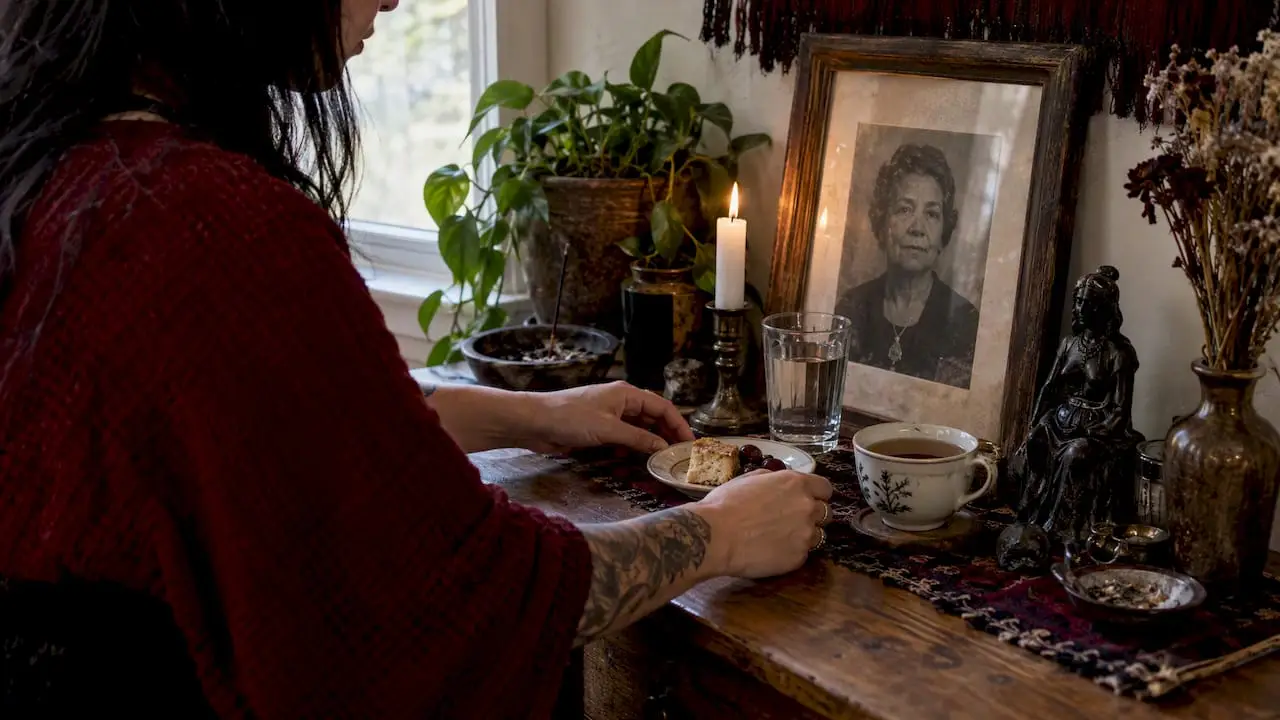
Ancestor work runs on its own calendar, separate from offerings to deities or spirits tied to a specific working. The purpose is ongoing care: reinforcing lineage ties, keeping the dead fed and remembered, and maintaining a channel that stays open over years rather than a single rite.
Secondary burial and ancestor rites across many cultures follow staged markers, often at the 3rd, 9th, and 30th day after death, along with annual memorials and seasonal or harvest observances. These staged rites manage both the spiritual transition of the dead and the social obligations of the living.
An ancestral altar benefits from a simple maintenance rhythm: fresh water or tea refreshed weekly, food offerings rotated rather than left to spoil, and a record kept of what was given and when, so patterns of response become easier to notice over time. Communal meals built around these dates, where the family eats together after the ancestor’s portion is set aside, remain one of the most consistent features of ancestor practice worldwide.
What different offerings symbolize
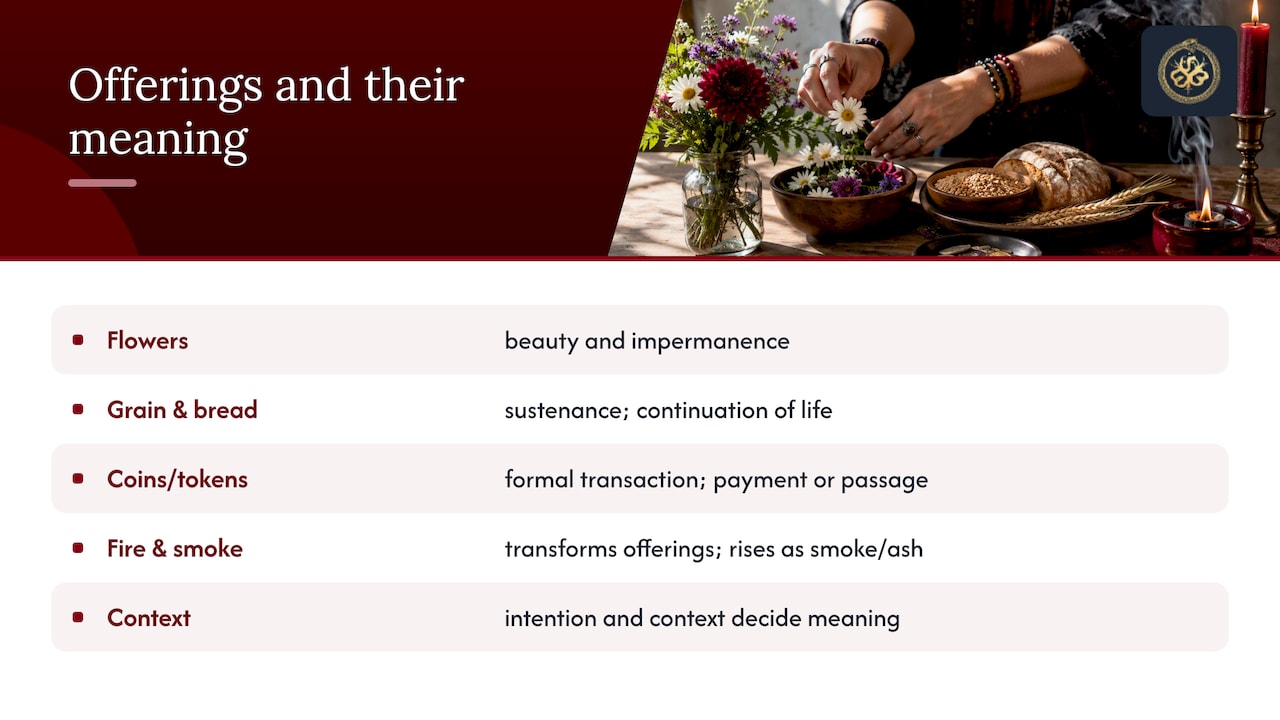
The material chosen for an offering is rarely arbitrary. Flowers carry connotations of beauty and impermanence, which is part of why they suit funerary and memorial contexts as much as devotional ones. Grain and bread speak to sustenance and the basic continuation of life, making them common in both ancestor rites and harvest observances. Coins and metal tokens often signal a formal transaction, a payment for favor or passage, distinct from the gift logic of food or flowers.
Fire and smoke carry a different symbolic register entirely: they transform the physical offering into something that can travel, rising as smoke or ash rather than staying put. That is part of why fire features so heavily in rites meant to reach a distant or otherwise inaccessible power, from Vedic homa fires to candle offerings at a household shrine.
Color and number also carry weight in many systems. Red items frequently signal urgency, protection, or blood symbolism; white often marks purity or the presence of the dead; specific counts of items (three candles, nine coins) can encode a numerological message particular to the tradition being worked. None of this is universal law. The same object can mean opposite things in two different systems, which is exactly why intention and context, not the object alone, carry the weight of the gesture.
How ritual offerings have changed over time
The earliest offerings were likely inseparable from survival itself: a portion of the kill or the harvest set aside before the rest was consumed, a practical acknowledgment that the group’s fortune depended on something beyond its own effort. Ancient temple religions formalized this into daily cult practice, with professional priesthoods presenting food and incense to cult images on fixed schedules rather than leaving the gesture to individual households.
Greek and other Mediterranean traditions folded sacrifice into civic life, turning offerings into public banquets that reinforced status and belonging as much as piety. Over centuries, many traditions shifted away from animal sacrifice toward bloodless forms. Encyclopedic surveys of sacrifice note that offerings across religions now range from bloodless liturgical acts, such as the Eucharist, to animal sacrifice that persists in some traditions. The underlying logic, a gift that opens or maintains a relationship, has stayed remarkably stable even as the materials and settings around it have shifted from temple complex to household shrine to improvised urban altar.
Common mistakes and taboos to avoid
The most frequent error is treating the offering as a transaction with a guaranteed return, which misreads what most traditions actually claim about the practice. Offerings maintain a relationship; they do not purchase an outcome on demand.
Inconsistency undermines ancestor and ongoing spirit work more than almost anything else. A shrine fed faithfully for a month and then ignored for a year sends its own message, regardless of the words spoken over it. Using spoiled or disrespectful materials, stale food, wilted flowers left to rot, is read in many traditions as an insult rather than a neutral oversight. Mixing offerings meant for different recipients on the same plate or altar tier without clear separation is another common misstep, since many systems treat crossed offerings as confusing or even offensive to the parties involved.
Skipping the closing of a rite is easy to overlook but matters. An offering presented without a clear invitation and a clear close can leave a working feeling unfinished, both practically and psychologically. Finally, disposing of offerings carelessly, tossing food in household trash where a tradition calls for burial or burning, breaks the continuity between the gesture and its ending.
Offerings, belief, and the mythologies behind them
Every offering practice sits inside a larger story about what the recipient wants and why giving matters at all. In systems with a clear pantheon, specific deities are tied to specific offerings: a love deity might receive flowers and sweet foods, a wealth or commerce spirit might receive coins or gold colored items, a protective or martial power might receive sharp or red toned objects. These associations are not decorative. They come directly from the mythology describing what each power governs and values.
Ancestor veneration rests on a different mythological frame, one where the dead remain socially present and dependent on the living for continued care, which is why neglecting offerings can be read as a breach of family obligation rather than a simple lapse. Vedic fire sacrifice rests on its own cosmology, where the fire god Agni carries the offering between the human and divine realms, making the fire itself a mythological actor rather than a neutral tool.
Left-Hand Path and demonic working traditions carry their own internal logic here: offerings and pacts to entities such as those invoked in Goetic or Luciferian practice are framed as negotiated exchanges between the witch and a specific, named power, with the offering serving as a gesture of respect that opens the channel for the working itself. Understanding which mythology underlies a given practice changes what counts as an appropriate offering, which is why borrowing a gesture from one system and applying it inside another without understanding the underlying story behind it so often falls flat.
What experienced magicians watch for
Ritual structure and repetition matter more than the size of the offering. A modest, consistent gesture, repeated on the same schedule with the same words, tends to outperform an elaborate one-off attempt, largely because specificity in intention does the real work. Vague wishes produce vague results; naming the exact outcome, the exact entity, and the exact timeframe gives the working something to answer.
Different recipients call for different adjustments. Ancestors respond well to routine and familiar foods, while named entities in demonic or Goetic work often call for more formal protocol and precise wording. After presenting an offering, watch for signs over the following 24 to 72 hours: dreams, unusual synchronicities, or a shift in the situation itself. Repeat or adjust the offering if nothing registers after a few cycles, rather than assuming the first attempt failed outright.
**
When professional ritual work makes sense
Some offerings call for more precision than a solo magician can easily manage, particularly entity-specific protocols, timing tied to planetary or lunar cycles, and the sourcing of materials matched to a named power. Black Witch Coven builds that precision into services designed around specific outcomes rather than general gestures.
- Custom ritual construction for love, money, protection, or legal matters, built around the entity and outcome you specify.
- Daemonic spell casting for entity-specific protocols, including Daemonic Prosperity Magick and Demonic Ritual for Court & Legal Success.
- Monthly maintenance options, including the Full Moon Magick Monthly Subscription for $32 per month, for readers who want their altar work handled on an ongoing basis.
If timing your own offerings to lunar phases interests you, this guide to ritualizing new moon and full moon phases covers the practical scheduling side well.
FAQ
What is a ritual offering?
A ritual offering is a gift, material or symbolic, given to a spirit, ancestor, or sacred power within a structured rite. Its purpose is to open, maintain, or repair a relationship, with the ritual frame and intention mattering more than the item’s cost.
What are 5 examples of rituals?
Common examples include food and libation offerings, incense or fire rites such as the Vedic homa, ancestor memorial observances tied to specific day markers, communal sacrificial feasts, and personal petition rites performed at a household altar. Each uses a different combination of materials and timing depending on the tradition and the recipient being addressed.
What are some examples of spiritual offerings?
Spiritual offerings include flowers, food and drink, burned incense or candles, coins and crafted tokens, and in some traditions animal sacrifice performed within a defined ritual and social context. Internal offerings, such as dedicating an action itself, also count in traditions like the Vedic concept of atmarpana.
What do you do with offerings after a ritual?
Depending on the material, offerings are shared and eaten communally, returned to earth through burial or composting, reduced to ash through burning, or washed and discarded onto soil rather than in household trash. Many traditions treat the recipient’s share as an essence taken from the offering, which is why leftover physical material can be handled or decommissioned afterward without undoing the rite.
Sources
- Greek sacrificial ritual in practice: belief and theory
- Secondary rites and ancestor practices (archaeological/ethnographic analysis)
- The wooded mountains, ancestral spirits and community: Yi religious ecology in the ‘xiō bū’ ritual
- Daily cult and offerings (Digital Egypt / UCL)
