
 New Years Eve Ritual 2026/2027 with Savannah
Blog, Luciferianism, Pacts
Lucifer Pact Risks: What the Sources Actually Describe
Nov
The risks of a pact with Lucifer depend on which tradition you mean. In the classical grimoire and Faust model, the risk is the price: a fixed term, a soul or body as collateral, and a counterparty who reads the contract literally. In modern Luciferianism, the pact is closer to a self-authored covenant of liberation, and the real risks are the ones any binding commitment carries: vague terms, inflated expectations, and a witch who cannot tell a genuine contact from his or her own mind under strain.
This article separates those layers. It covers where the pact idea came from, what the surviving texts say about terms and offerings, which risks are narrative, which are practical, and how a magician who wants a working covenant writes one that holds.
Table of Contents
- What “a pact with Lucifer” has meant
- Oral, written, tacit and manifest
- The terms accounts describe
- Risks as the old stories frame them
- The risks the grimoires do not list
- Writing terms that hold
- Changing or ending a pact
- Why the fear persists
- Perspective
- Working with Lucifer through the Coven
- FAQ
- Sources
What “a pact with Lucifer” has meant
Three different things share the phrase, and most confusion comes from mixing them.
The theological pact. According to the Encyclopedia of Occultism and Parapsychology, accounts of pacts with the devil emerged as Satan became a key figure in Christian theology, with Isaiah 28:15 often cited as the biblical basis. The same entry notes that in the sixteenth century the pact was redefined to include homage and reverence to the devil, which made it apostasy and heresy and a matter for the Inquisition. That redefinition matters: most of what people call “pact lore” was written by prosecutors and demonologists, not by witches.
The folk and literary pact. The Faustian bargain is a long-running trope in which a person trades the soul for knowledge, youth, fame and power. Lapham’s Quarterly reads these stories as warnings about hubris and its consequences, and notes that they vary by period and culture while sharing one narrative of ambition pushed to an extreme. In the United States the same pattern appears in the crossroads legend, where, per the Mississippi Encyclopedia, a frustrated guitarist meets the devil at midnight and trades his soul for mastery of the instrument. Scholars there disagree on its roots: some trace it to African trickster figures such as Legba or Eshu, others stress Western elements and the legacy of slavery. A reader who wants the history right should keep that disagreement in view rather than pick a single origin.
The Luciferian covenant. Modern Luciferianism, as advocated by Michael Ford, has been described as a non-dogmatic philosophy of self-liberation rather than Satan worship. Here Lucifer is a figure of illumination, autonomy and the pursuit of one’s own godhood. A pact in this setting is rarely a soul sale. It is an agreement about work: what you will do, what you ask to be strengthened, and over what period.
When a search engine returns forum threads asking what happens “if you make a pact,” the replies usually blend all three. Keep them apart and most of the apparent risk becomes easy to classify.
Oral, written, tacit and manifest
The older sources sort pacts by form, and the form determines the risk profile.
Traditions describe two types of pact: oral, usually made through ritual invocation and leaving no physical record, and written, historically signed in blood. The grimoires add a second axis. The Grimorium Verum, as presented in Waite’s Book of Ceremonial Magick, separates pacts into tacit and manifest kinds, and notes that some spirits require something personally belonging to the operator.
In practical terms:
- Oral pacts are easy to make and easy to blur. Without a record, you cannot later check what you actually promised. Anyone who has tried to recall the exact wording of a vow made in the heat of a rite knows the problem.
- Written pacts fix the language. That is their advantage, and their danger, because a fixed text is read as written, not as intended.
- Tacit arrangements grow out of repeated practice, where an understanding forms without a ceremony. They are the hardest to audit.
- Manifest arrangements are explicit, with named terms, and are the only kind you can fairly evaluate for risk.
The requirement that a spirit may ask for something personally yours, such as hair, blood or a signed sigil, is a collateral clause. It tells you the tradition treats the pact as a transaction with security, and you should read any such demand the way you would read a lien.
The terms accounts describe
There is no single Lucifer contract. The sources preserve several, and they disagree.
| Source tradition | Term | What the operator receives | What the operator gives |
|---|---|---|---|
| Faust chapbook (1587) | 24 years | Answers, wishes, luxury, worldly enjoyment | Soul, renunciation of Christianity |
| Grand Grimoire, Lucifuge Rofocale | 50 years | Treasure | Secrecy, a gold or silver coin on the first day of each month, obedience to the invocation rules, body and soul at term |
| Reproduced pact text, 1676 to 1727 | Per clause | Money, health protection, knowledge, transport, social influence | Renunciation of God, body and soul |
| Urbain Grandier (17th century) | Per record | Wealth, worldly honor, the love of women | Allegiance |
The figures come from several pages. The New York Times account of the Faust chapbook says Faust receives 24 years of answers, wishes and worldly enjoyment in return for his soul and renunciation of Christianity, and that at term’s end the devil claims the soul and tears the body apart. An account of the Grand Grimoire tradition describes Lucifuge Rofocale demanding body and soul after 50 years, promising treasure if the magician keeps the pact secret, gives a coin on the first of each month and follows the invocation rules. A reproduced pact text from the 1676 to 1727 period lists reciprocal promises of money, health protection, knowledge, transportation and social influence, and states that the pact becomes void if the spirit fails any clause. The seventeenth-century agreement of Urbain Grandier is cited in the encyclopedia entry mentioned above as an example of promises of wealth, worldly honor and the love of women.
Three patterns are worth drawing out.
Offerings are small and regular. The Grand Grimoire’s monthly coin is the model of a recurring offering: a modest, scheduled act that keeps the relationship active. Nothing in these accounts treats offerings as a one-time spectacle. If you want a pact that functions as a practice, the monthly coin is a better template than a blood signing.
Terms are time-boxed. Twenty-four years and fifty years are the extremes. A fixed term gives the pact an end date, which is the single most useful structural feature for risk management, because it limits the exposure to a known period.
Voiding clauses exist. The reproduced 1676 to 1727 text makes the contract void if the spirit defaults on any clause. The older operators did not assume the spirit was a benevolent partner. They wrote default remedies.
Risks as the old stories frame them
The narrative risks cluster into four types.
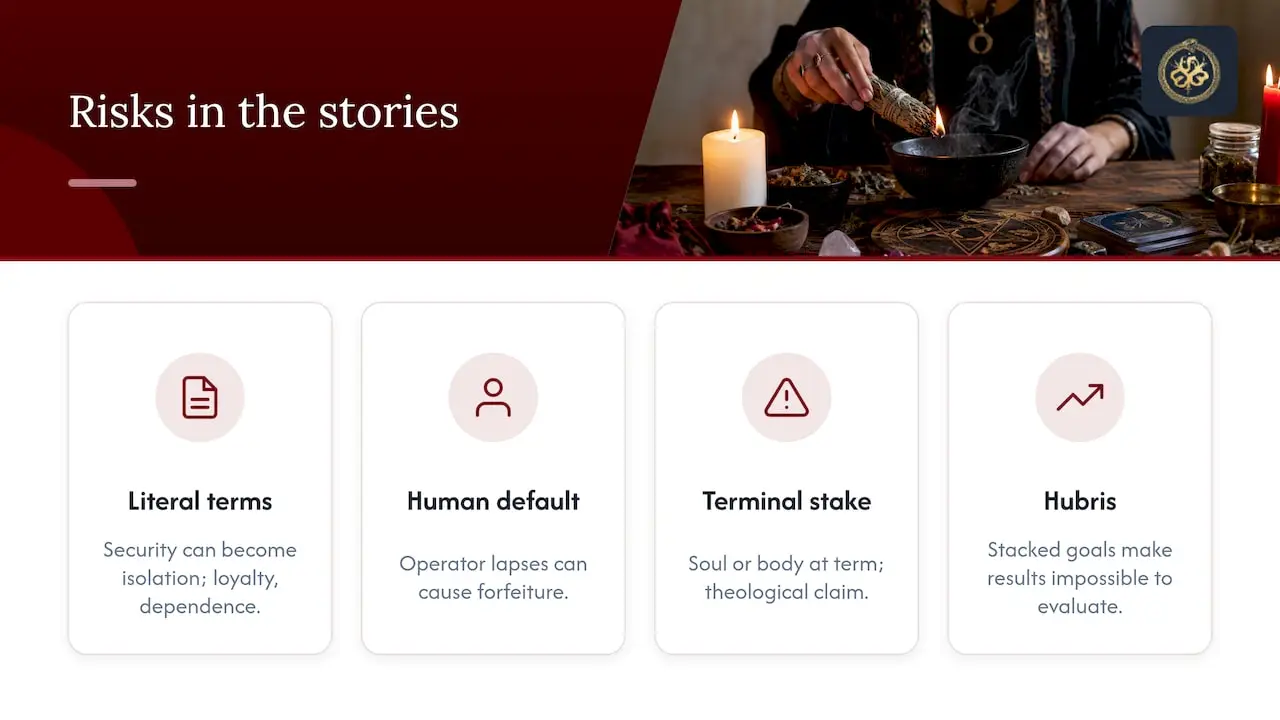
Literal enforcement. In a University of Virginia discussion of devil contracts in popular culture, the devil is described as one who occasionally honors the letter but not the spirit of a contract. The Twilight Zone example given there: immortality turns into life in prison, and the devil grants the protagonist’s wish to die. For a witch this translates directly. A request for “security” can be met with isolation. A request for “loyalty” can be met with dependence. The remedy is drafting, which we cover below.
Human default. The same discussion observes that the mortal is more likely to break the bargain than the devil. This is the most useful sentence in the literature for anyone who wants results. The recurring offering, the secrecy clause, the invocation rules: these are the operator’s obligations, and the grimoires treat failure to perform them as the cause of forfeiture. Most pact “disasters” in the accounts begin with a lapse of discipline.
Terminal collateral. The Faust and Grand Grimoire models put the soul or body at stake at the end of the term. This is a theological claim, not a verifiable fact. Within a Luciferian frame that rejects the premise that Lucifer is an adversary who collects souls, the clause is simply not part of the agreement.
Hubris. Lapham’s Quarterly reads the whole genre as a story about overreach. The practical version: asking for the largest outcome first. A pact that stacks wealth, love, status and protection in one document is the one that fails in the stories, and it is also the one that is impossible to evaluate in real life, since you cannot tell which clause produced which result.
The risks the grimoires do not list
The pact literature is silent on the risk that most commonly affects people in real life: what intense belief and intense practice do to the person doing them.
A clinical and legal literature does exist. A 2019 review of the devil in recent American law found the figure appearing in several contexts, including as a symptom of mental illness or delusion severe enough to raise criminal insanity or probate capacity questions. That does not make every pact worker delusional. It does mean that courts and clinicians have a working vocabulary for the point where belief becomes impairment, and a magician benefits from knowing where that line sits.
The federal guide on first-episode psychosis describes it as a cluster of symptoms that can be due to medical conditions, prescription drugs, substance use or toxicities, as well as psychiatric disorders, and says the symptoms can make it harder to tell what is real, think clearly and communicate. The same guide states that coordinated specialty care programs offer the most effective early treatment. Two things follow for the serious witch.
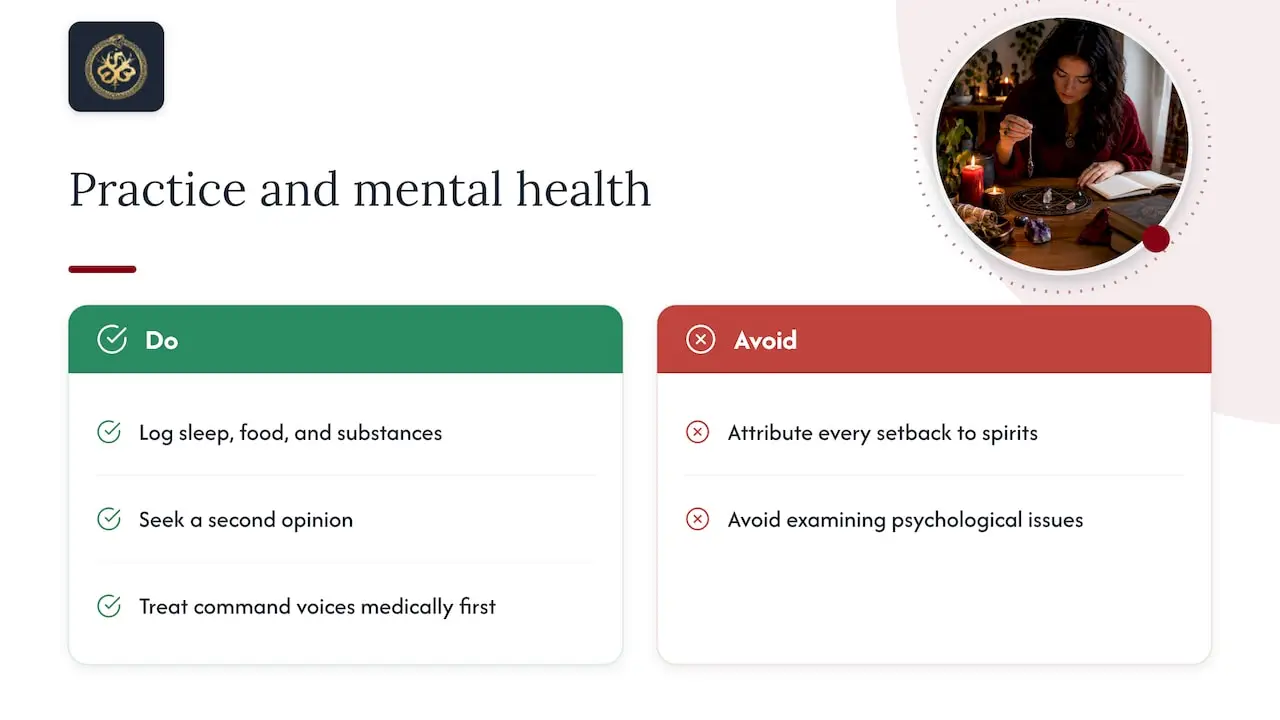
First, sleep loss, fasting, stimulants and long solitary rites are the standard ingredients of ritual intensity, and they are also standard physiological triggers. A disciplined practice logs sleep, food and substances beside the working notes, so that an odd experience can be checked against its conditions.
Second, a second opinion belongs in any serious practice. If contact begins to include voices that issue commands, a growing certainty that you are being watched, or a collapse of your ability to work and sleep, treat that as a medical question first and a ritual question second. That is not a moral judgment. It is the same triage a careful operator in any tradition uses, and the 988 Lifeline offers 24/7 access to trained counselors for anyone in a mental health, suicide or substance use crisis. Keeping a clinician and a ritual practice in the same life is entirely compatible. The APA’s professional literature on religion in clinical practice notes that clinicians view religious beliefs as potent motivators that allow people to find meaning, coherence and courage.
There is also the opposite error, the one researchers call spiritual bypass. A 2023 study of Muslims in the United States found that it strengthened the correlations between negative religious coping and depression, anxiety and stress, and that over-attributing difficulties to spiritual causes while avoiding psychological issues may not promote better mental health. The sample is specific, but the mechanism is general. If every setback in the months after a pact is read as the spirit’s work, the magician stops examining sleep, money habits and relationships, which are the most likely causes.
Symbolism helps here. The Devil card in the tarot is traditionally read as bondage that is partly chosen, chains loose enough to lift off. A Devil tarot card meaning guide with upright and reversed readings is a useful companion when you are auditing a pact: ask whether the commitment is one you hold freely or one that holds you.
Writing terms that hold
The old contracts are good drafting models because they were written by people who expected the counterparty to exploit ambiguity. A Luciferian covenant built on that logic has six parts.
- One objective. Name a single measurable outcome. “A promotion to department chair within 18 months” is a clause. “Success” is not.
- A term. Choose a period and end date. The classical pacts used 24 and 50 years; a working witch is better served by a year, renewable.
- Your obligations. List what you will do, in the form the Grand Grimoire used: a recurring offering, specific rite dates, and any secrecy you accept. Keep them performable.
- Real-world actions. The agreement should include what you will do outside the temple: the applications, the meetings, the filings. This is the clause that prevents the literal-enforcement problem, because the outcome then has a path that does not run through coincidence.
- A default clause. Borrow the 1676 to 1727 text’s idea: state what happens if the terms are not met by either side. For a self-authored covenant, that can mean the working ends and is reviewed.
- A review date. Put a calendar entry at the midpoint. Compare notes, sleep logs and outcomes.
A worked example
Picture a surgeon in her late thirties who wants to leave a hospital system and open an independent practice. She does not write “success and wealth.” Her covenant names one objective: a signed lease and a first-year patient panel of a stated size within 14 months. Her offerings are a coin and a candle on the first of each month, with a short rite on each new moon. Her real-world obligations are the business plan, a meeting with an accountant and a banker each quarter, and a licensing timeline. The review date is month seven. At that review she finds the lease secured but the panel behind schedule, which tells her the next quarter’s work belongs in marketing, not in the temple. The covenant gave her a diagnostic, not only a hope.
A second case: a magician wants a reconciliation with an estranged partner. The literal-enforcement problem is acute here, since “bring him back” could be fulfilled in ways nobody wants. Her clause is narrower: a conversation, initiated by him, within a set period, with the choice remaining hers. The covenant is built so that any result is one she can live with.
Changing or ending a pact
The traditions disagree on whether an exit exists. According to the Virginia discussion, some Faust versions have Faust renounce the devil and escape the contract, while in other stories the devil holds the soul to the term. The difference tracks the theology behind each story. Where the devil is a sovereign adversary, the contract is binding and exit is a miracle. Where the story is a morality tale about the human, renunciation is available because the lesson is in the choice.
In the Luciferian frame, the exit is whatever you wrote. That is the strongest argument for a term and a default clause. A pact with a stated end date ends by expiry: you thank the current, close the working, burn or bury the document, and record the date. A pact with no term needs a closing rite you design after the fact, which is harder, and the difficulty is the reason to avoid open-ended wording from the start.
If you want to revise rather than end, do it at the review date, in writing, and keep both versions. A pact that evolves without a record is back to being tacit.
Why the fear persists
Some of the dread around Lucifer pacts is cultural residue. In the late twentieth century, discourse about Satanic ritual abuse fueled public anxieties and prejudices against non-Christian religions in the United States, according to Megan Goodwin’s academic analysis. Search results for this topic still mix real texts with that inherited panic and with video-game and role-playing threads about paladins and warlocks. Reading the primary sources and the scholarship, rather than the commentary around them, is the first act of sovereignty in this area.
Perspective
We read the pact as a tool of sovereignty or not at all. The classical texts were written inside a theology that needed the devil to be a creditor, so they describe collateral, forfeiture and terror. A Luciferian practice starts from a different premise: the current we call Lucifer is a force of illumination and self-direction, and the agreement is about what you will build with it.
That changes what we consider a good pact. It is narrow, written, time-limited and paired with action in the physical world. It names one problem, because our approach is to fix one problem at a time and measure it. It also treats the witch’s own mind as part of the instrument, which is why we want sleep, food, mood and money tracked alongside the rite.
We also see a pattern in who comes to this work. Doctors, surgeons, business owners and entrepreneurs, people who spend their days making decisions under pressure, are drawn to a spirituality that gives them agency and a contract they can read. They do not want vague comfort. They want a structure that can be tested, and a covenant with a review date is exactly that.
The old demonologists built their pacts on distrust. We build ours on precision, and precision is a form of respect for the spirit, for the work and for yourself.
Black Witch Coven
Working with Lucifer through the Coven
For those who prefer to have a Lucifer working carried out for them, we offer the Ritual to Lucifer: Light of Liberation, Wisdom, and Sovereignty for $190, alongside other daemonic workings in the same category.
FAQ
What happens if someone makes a deal with the devil?
In the stories, the person gets the agreed benefit for a term and then forfeits the soul. Faust receives 24 years of wishes and enjoyment before the devil collects. In the American crossroads legend the guitarist gains musical mastery and his soul belongs to Satan. These are narratives, and within modern Luciferianism the pact is a self-authored covenant without a soul-collection clause.
Is a pact with Lucifer the same as a pact with the devil?
No. The devil of Christian theology and the pact of the Inquisition were defined as heresy, with homage and reverence to Satan. Modern Luciferianism, as Michael Ford describes it, is a philosophy of self-liberation and not Satan worship. The grimoire figure Lucifuge Rofocale is a third thing: a spirit in the Grand Grimoire tradition with a set contract of treasure for body and soul.
What offerings do accounts of a Lucifer pact describe?
The Grand Grimoire account describes a gold or silver coin given on the first day of each month, with secrecy and obedience to the invocation rules. Written pacts historically used blood signatures. The Grimorium Verum notes that some spirits require an item personally belonging to the operator. A small, regular offering is the most consistent pattern.
Can a pact be broken or ended?
That depends on the tradition. Some Faust versions have him renounce the devil and escape the contract, while in others the devil holds to the term. A pact with a stated end date and a default clause ends by its own terms, which is why serious occultists write both in from the start.
Sources
- Deal with the Devil (Wikipedia)
- Pacts with the Devil (Encyclopedia.com)
- Crossroads Myth (Mississippi Encyclopedia)
- In Lucifer’s Name (Houston Press)
- Speak of the Devil (Lapham’s Quarterly)
- It Takes All Kinds; Faust: The Deal Maker (The New York Times)
- Lucifuge Rofocale (Occult World)
- Book of Ceremonial Magic, Chapter IV (Internet Sacred Text Archive)
- Dealing with the Devil (University of Virginia School of Law)
- The Devil in Recent American Law (Pace Law Review)
- Signs You Need To Seek Help (SAMHSA)
- Religion and the Clinical Practice of Psychology (APA)
- Spiritual bypass as a moderator (APA PsycNet)
- They Couldn’t Get My Soul (Megan Goodwin)
