
 New Years Eve Ritual 2026/2027 with Savannah
Blog, Demons, Working With Demons
Sallos Demon: History, Seal and How to Work With Him
Nov
Sallos is the nineteenth spirit of the Ars Goetia, a duke who rides a crocodile, wears a ducal crown and appears with a peaceable bearing. The grimoire gives him one office: he causes love between women and men. He is also one of the few Goetic spirits whose recorded manner is gentle, which shapes how a working with him is built. This article gives his history from the printed and manuscript sources, the variants of his name, the question of his seal, and a full ritual working with materials, timing, petition, offerings, signs of presence and a proper closing. Sallos has no page of his own yet; the rest of the 72 are in our Demon Directory.
The Names of Sallos
You will meet this spirit under three spellings. Weyer gives Zaleos. Scot gives Saleos, and the Goetia manuscripts mostly follow him, though one reads Zaleos. The 1904 printed edition prefers Sallos, with Saleos in brackets.
These are variants of one spirit. Each reflects the hand of a copyist or translator, and the same pattern runs through the whole catalog: Bune is Bime, Valefor is Malephar, and so on. When you work with him, pick one spelling and keep it. The one that will appear on your seal and in your petition should be the one you have studied most closely. No meaning for the name itself is established, and any etymology offered for it is a guess.
What the Primary Texts Say
The sequence of sources matters, because the picture of Sallos grows richer as you move forward in time.
Weyer, 1577. Johann Weyer’s Pseudomonarchia Daemonum, appended to the 1577 edition of his book on demons, is the earliest catalog this entry descends from. It calls Sallos (as Zaleos) a great earl and gives a short description of a soldier mounted on a crocodile, wearing a crown. Weyer’s list held 69 spirits and carried no seals.
Scot, 1584. Reginald Scot printed an English version of the same material, and the later Goetia was built on an earlier version of the Offices of Spirits via this translation. Scot’s form of the name, Saleos, is the one most manuscripts follow.
The Lemegeton manuscripts, seventeenth century. The Goetia as we now use it took its shape when an English compiler reordered the list, added three spirits and supplied a full set of sigils. That is why Sallos’s seal and his numbered place among the 72 come from this later compilation and not from Weyer. Here his rank rises from earl to duke, and he receives his office and his command.
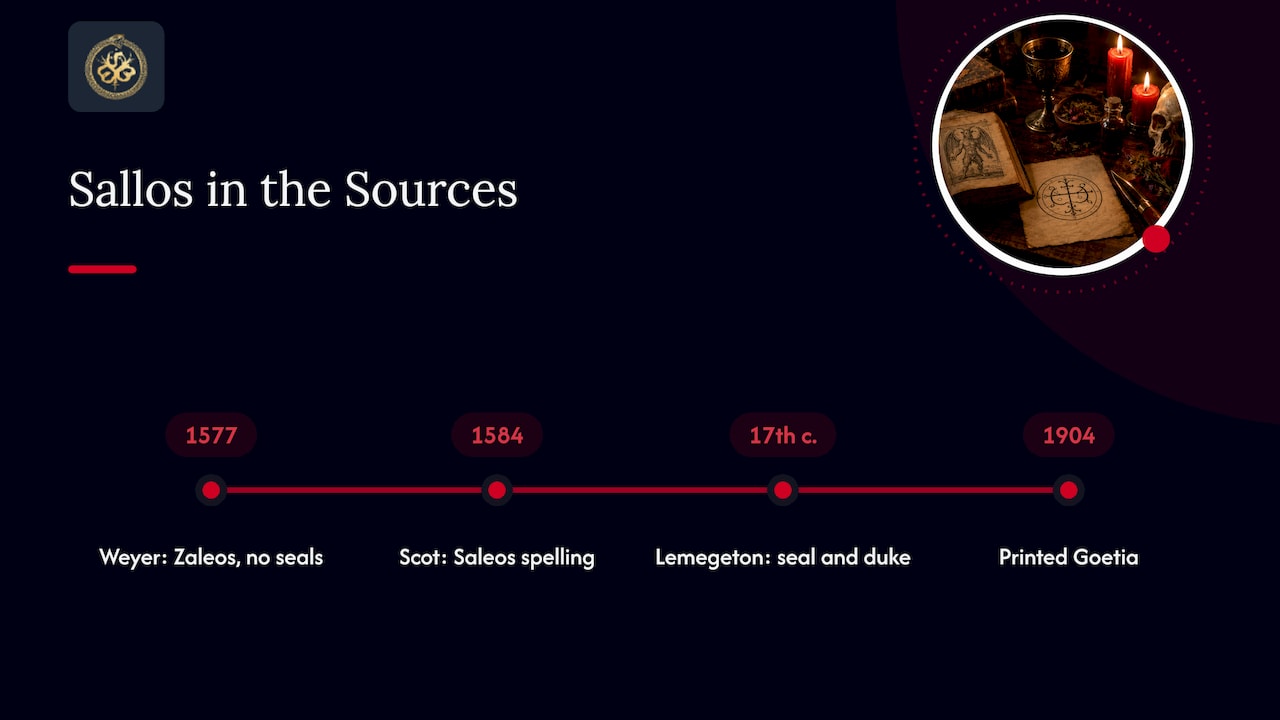
The printed Goetia. The text describes a great and mighty duke who appears as a gallant soldier riding a crocodile, with a duke’s crown on his head, and who is peaceable in his coming. He causes love between women and men, and he governs thirty legions. It is a short entry, and it was copied faithfully into the 1904 Mathers edition, which fixed it for the English-speaking world. The source of the love office and the legion count is not identified in the surviving record.
The other primary works you may wish to read alongside these are the Grimorium Verum, the Testament of Solomon and the Dictionnaire Infernal. Sallos has no entry in the Testament of Solomon, whose spirits are named and bound in a different scheme. Reading that text still teaches you how the Solomonic tradition conceived of spirits as beings with offices, names and a proper manner of address, which is the logic the Goetic entries inherit.
The Seal
The seal is the visual signature of a Goetic spirit, and it is the focus of a working. It passed through manuscript copies, then through nineteenth and early twentieth century editions that standardized the printed form for English readers. Across those copies its core pattern stayed stable while line weight and orientation varied. That stability means the version in any good edition is a faithful line of descent, and you can draw your own from it by hand without worrying that you are working from a corrupted form.
A Note on Wider Origins
Some readers ask whether Sallos belongs to a much older tradition, or came from elsewhere entirely. The documented line begins in the sixteenth-century catalogs and runs forward from there. A resemblance between his name and an ancient deity or an unrelated word does not by itself establish that they are one being. For the question of an older, non-European presence behind the name, you will be working from your own gnosis rather than a source, and that is a legitimate place to work from, provided you keep it separate in your notes from what the manuscripts say. The same discipline applies to other spirits with long histories, such as Azazel, whose names and identities shift from the Book of Enoch onward.
Why Sallos Is Linked to Love Magick
The grimoire gives him a single office, and it is love. Modern magicians have extended it into reconciliation, harmony between partners, and the steadying of a relationship. This is later devotional practice, separate from the entry in the grimoire, and it helps to keep the two apart: the text gives you the rank, the legions, the crocodile and the office; your own working, and the experience of others, gives you the character.
The devotional accounts are consistent on one point. Those who sit with Sallos describe a warm, calm and dignified presence, in keeping with the peaceable manner the text gives him. That has a practical consequence. Where other Goetic dukes are approached with firm command and a hard edge, Sallos responds to a steady, courteous and exact request. You do not bargain from desperation. You state what you want clearly, and you offer something fitting in return.
A Working with Sallos
This working is for a single aim: to draw love toward you, or to restore warmth where it has cooled. Keep it to one problem. If you also want money or protection, that is a separate working on another day.
Materials
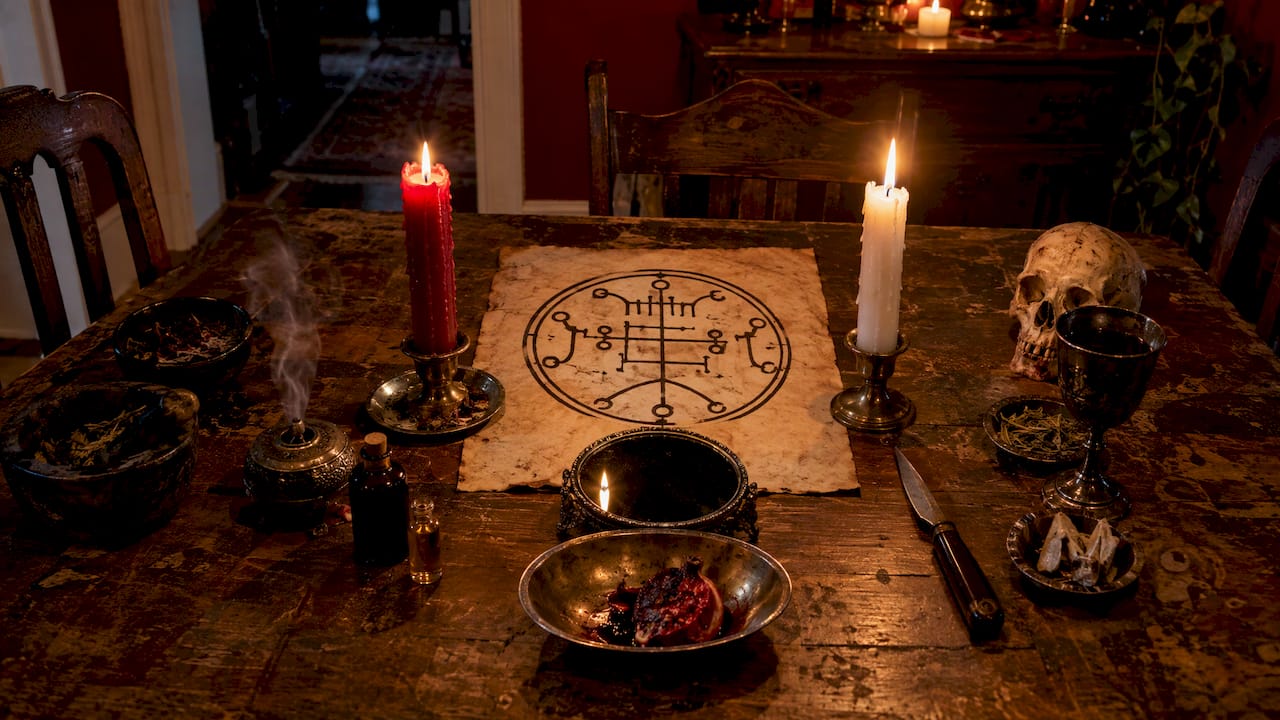
- A seal of Sallos drawn by your own hand on clean paper, about the size of a hand, in black or dark red ink
- One red candle, and one white or pink candle, both unused
- A small dish for the offering
- Offerings: a few fresh rose petals or a red flower, a small glass of red wine or sweet spirit, and a pinch of cinnamon or a drop of rose oil or Sallos Oil
- A small mirror or a photograph of yourself, set beside the seal
- Matches, a fireproof plate, and a notebook for the record of the working
- Incense of rose, sandalwood or myrrh, with a burner
If the working concerns a specific person, add a written line of their name on a small slip of paper. If your aim is general, such as opening yourself to a worthy partner, write your own name and the quality you seek.
Timing
Venus governs love, and the planetary day of Venus is Friday. Work on a Friday, ideally in the planetary hour of Venus, which you can calculate for your own location from sunrise and sunset. For a working that builds and attracts, choose the waxing moon, from the first visible crescent to the full. For a working of reconciliation, many magicians prefer the days around the full moon, when the light is at its height. Keep a note of the date, the day and the hour in your record, because you will compare them with later events.
Preparation
Bathe, and dress in something you feel confident in, ideally in red or black. Clear a flat surface, such as a table or a shelf, and set the seal in the center. Place the red candle to the left of the seal and the white or pink candle to the right. The mirror or photograph goes before the seal, and the offering dish sits in front of all. Light the incense. Sit for several minutes in silence until your breathing is steady and your mind has narrowed to a single aim. Sallos is gentle, but he is a duke with thirty legions, and he should be met by someone composed.
The Enn and the Petition
The enn is the invocation in the language used in modern demonolatry for this spirit. For Sallos it is:
Serena Alora Sallos Aken
Speak it slowly, nine times, with your eyes on the seal. Light the red candle on the first repetition and the white candle on the last.
Then speak the petition aloud, in your own voice, without hurry:
Sallos, great duke, rider of the crocodile, crowned and peaceable, I call you by your name and by your seal. I stand before you in sovereignty and in respect. I ask for your guidance and your office. Draw love toward me, and let warmth, honesty and loyalty grow where I am seen. Open the way to the one who is meant to stand beside me, and soften what has hardened between us. I offer you flowers, wine and my steady attention. Receive them and hear me. Let this be done with clarity, and let me act as one who is ready.
If you are working for a particular relationship, replace the line about the one who is meant to stand beside you with the name written on your slip. Keep the wording as it stands otherwise.
Step by Step
- Set the space and the materials as described, and light the incense.
- Sit in silence until you are steady. Look at the seal and let your eyes rest on its lines.
- Speak the enn nine times, lighting the candles as directed.
- Speak the petition aloud, once, from memory or from the page.
- Place the written slip beneath the seal, or hold the mirror and say your own name aloud with the quality you seek.
- Present the offerings: lay the petals in the dish, pour a little of the wine, and add the cinnamon or oil. Say: “Sallos, accept this.”
- Remain in silence for ten to twenty minutes. Keep your attention soft and open, and stay with whatever arises. Write notes before the candles burn down.
- Let the candles burn out on their own on the fireproof plate, or snuff them if you must leave, and relight them on the next Friday if you are repeating the working.
Many magicians repeat the working on successive Fridays through one waxing cycle, which gives four sittings. That is a choice for you to make, and your notebook will tell you whether the later sittings add anything.
Signs of Presence
During the working, the reports from those who sit with him are consistent: a warming of the room, a calm that comes without effort, a softening of the heart, a scent of roses or sweet wood without a visible cause, or a feeling of being regarded with courtesy. Images of water, a river bank or a reptile may rise in the mind’s eye. Candle flames may lean toward the seal or stand unusually tall and still. None of these is required, and their absence on a given night does not mean he is absent. Record what you notice and nothing more.
Signs the Working Is Taking Hold
In the days and weeks that follow, look for movement of the kind the office describes. Dreams of affection or reconciliation may come. People may respond to you with more warmth, old contacts may reach out, and conversation that was stiff may begin to flow. You may find yourself more at ease with being seen. Write each of these down with its date. Over a few weeks the notebook becomes the means by which you read the working honestly, and by which you decide whether to repeat it, refine it, or close the matter.
Closing the Working
When the candles have finished, thank him aloud:
Sallos, duke of love, I thank you for your presence and for your hearing. Go in peace to your own realm, and remain my ally in what I have asked. This working is complete.
Pour the wine and the petals outside at the base of a tree, or at running water, and not into the household waste. Fold the seal and keep it in a cloth in a private place, or burn it if the working is finished and you intend to draw a fresh seal next time. Wash your hands, eat something, and write the closing note in your record with the time.
Combining the Working with Action
A working with Sallos opens a door, and you still have to walk through it. The following are typical situations, not client cases.
Alone after a long relationship. A woman has been single for two years. She works through one waxing cycle with Sallos, with a petition aimed at meeting someone worthy, with no one person named. In the same weeks she accepts invitations she would normally decline and updates her profile on a dating site. The working supplies the clarity and the steadiness. Her actions supply the opportunities.
After a painful break. A man has split from his partner. He writes his petition for softening, and he sends one honest, unhurried message in the same week. He keeps his notebook and does not repeat the working until a full moon cycle has passed, so he can read what changed.
A cooled marriage. A wife wants warmth restored. She uses the working to settle her own temper before a hard conversation, and then has the conversation. Sallos’s peaceable manner is a model for how she holds herself in the room.
In each case, the working is paired with a concrete step in daily life, and the magician keeps a record.
Our Perspective
We treat Sallos as a real and intelligent spirit with a character of his own. The Goetia gives you the bones: his rank, his crocodile, his thirty legions and his single office of love. The rest is built through repeated contact.
The first mistake we see in love work is asking a spirit to do what only you can do. Sallos is a guide and an ally. He does not replace your own judgment, your own courage or your own sovereignty. A petition that names exactly what you want, offered with respect, is stronger than one that pleads.
The second mistake is to read the grimoire as if it were silent on its own history. It is not. Weyer’s catalog, Scot’s translation and the Lemegeton compilation each added something, and knowing the sequence lets you decide for yourself which parts of the tradition you hold as text and which as gnosis. Our Demon Directory follows the same approach.
For love and reconciliation, we pair spirit work with practical action, one problem at a time.
Black Witch Coven
Work with Sallos Through Us
If you would like the working done for you, we offer Bring Back an Ex-Partner with Demon Sallos as a one-off service, one of our daemonic spell casting rituals. Our wider love offerings include Daemonic Magick for Love & Marriage and a Black Magick Love Spell (No Demons).
FAQ
Is Sallos the same as Saleos and Zaleos?
Yes. These are spelling variants of the nineteenth spirit of the Goetia. Weyer’s manuscript tradition has Zaleos, Scot has Saleos, and the 1904 edition prints Sallos with Saleos in brackets. Choose one form for your seal and petition and keep to it.
What is Sallos’s rank and command?
The Goetia calls him a great and mighty duke who governs thirty legions. Weyer’s earlier catalog ranks him as a great earl. The printed Goetia also gives him the office of causing love between women and men.
What does Sallos look like?
The text describes a gallant soldier riding a crocodile and wearing a duke’s crown, peaceable in his manner. Those who work with him in devotion often describe a calm, warm and dignified presence in the room or the mind’s eye.
When is the best time to work with Sallos?
Friday, the day of Venus, is the traditional choice, ideally in the planetary hour of Venus and during the waxing moon. For reconciliation, the days around the full moon are also favored. Record the timing in your notebook so you can compare it with what follows.
