
 New Years Eve Ritual 2026/2027 with Savannah
Blog, Demons, Working With Demons
Valefor Demon: History, Seal and How to Work With Him
Nov
Valefor is the sixth of the 72 spirits in the Ars Goetia, a Mighty Duke of ten legions who comes as a lion, keeps company with those who call him and has a long, tangled paper trail. This article gives his textual history first and a clean working second: what Weyer, Scot and the Goetia actually record, how his shape shifted between them, and a full ritual with materials, timing, petition, steps, signs and closing. His short entry is on our Valefor Demon Directory page.
Valefor in the primary texts
The Goetia, the first book of the Lemegeton or Lesser Key of Solomon, lists Valefor as the sixth spirit. The British Library manuscript Sloane 3825 calls him a Mighty Duke who governs ten legions, appears as a lion with a man’s head, is a good familiar and tempts those he serves to steal. That short entry is nearly the whole classical record. No myth, genealogy or birthplace is attached to him. Everything beyond that entry is later working experience.
The earliest printed witness is Johann Weyer’s Pseudomonarchia Daemonum of 1577. Entry fourteen names him Valefar, alias Malaphar, a strong duke in the form of a lion with the head of a thief, who builds familiarity with his own until they are hanged, and who presides over ten legions. Weyer’s source manuscript, the Liber officiorum spirituum, was evidently much older than 1563, so the catalogue he printed is older than the book that carries it. Reginald Scot’s Discoverie of Witchcraft (1584) then carried the entry into English, and the English compiler of the Goetia worked from Scot’s rendering.
So the same spirit is known by several spellings: Valefar, Valefor, Malaphar, Malephar, Valafar. The variance tells you that the name travelled through hands, Latin, English and copyists, and that no single spelling is the “true” one. Pick one and use it consistently in your own petitions.
Lion, thief, ass or man: how the head changed
The lion body is constant. The head is where the sources split, and the split teaches you how the text was built.
| Source | Head | Judgment of his companionship |
|---|---|---|
| Weyer, 1577 (Latin) | capite latronis, the head of a thief | Familiarity until the gallows |
| Scot, 1584 | Head of a thief | Familiar until he brings them to the gallows |
| Goetia, Sloane ms. | A man’s head, “lowring” | A good familiar who tempts to steal |
| Mathers/Crowley, 1904 | An ass’s head, bellowing | A good familiar who tempts to steal |
The root of the confusion is in Weyer’s Latin: latronis can mean either “of a thief” or, from the verb latro, “barking.” A lion that barks or bellows, with a thief’s face or a man’s face, is a single figure seen through different translations of one ambiguous word. The Goetia otherwise follows Scot closely, copying his errors along with his phrasing.
For your working this matters in one concrete way. When you build the invocation and your visualization, choose one form and hold it steady for the whole operation. A lion body with a human face is the oldest Goetic reading. A bellowing lion with the head of an ass is the 1904 reading that most modern seals and illustrations follow. Either works. Mixing them mid-rite splits your attention.
How his seal and reputation reached the present
Weyer’s catalogue contained 69 spirits and no seals. The mid-17th-century English compiler of the Goetia expanded it to 72, rearranged the order and supplied the sigils. That is how Valefor acquired a seal and the number six. The Mathers and Crowley edition of 1904 then put that seal and a short office in front of twentieth-century occultists, which is why nearly every seal you see today descends from it.
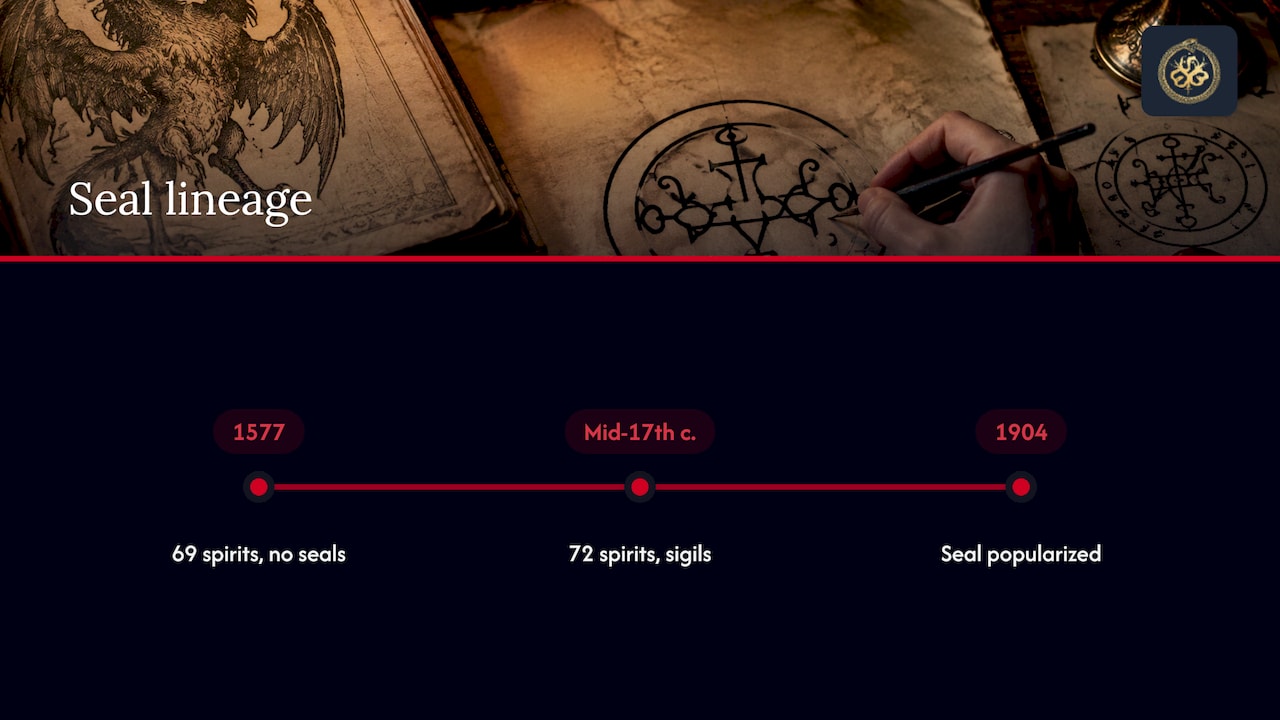
The Goetia’s own note on the seal is a useful operating instruction: it is to be worn, and the text states this applies whether or not you seek his familiarity. The same text assigns Dukes the metal copper and gives the Duke’s hours as sunrise to noon in clear weather. Those two details, copper and the morning hours, come straight from the manuscript tradition and shape the working below.
The Venus attribution is a later layer. It comes from the Golden Dawn scheme and Crowley’s 777, where Valefor is placed in the third decan of Taurus, not from the Goetic manuscripts. Many magicians still pair him with Friday, the day of Venus, as we do below. Know which layer you are standing on.
If you want to read this lineage beyond Weyer and the Goetia, choose editions that print the Latin or the manuscript readings, since the differences in the table above live in those details.
Origins: what can and cannot be said
Valefor does not appear in the Bible, and no tradition of ancient Jewish, Christian or Near Eastern religion records him under this name; his identity belongs to the learned grimoire literature of early modern Europe. The name has no securely established etymology, and the Solomonic attribution is legend, not evidence that he was known in Solomon’s time. Nothing in the record ties his lion-and-ass form to a particular Egyptian god or classical monster.
This matters for anyone chasing origins in other pantheons or other worlds. Nothing in the surviving record lets you say he descends from a named ancient deity or from another planetary system. What the record does show is the spirit as a stable figure across four centuries of catalogues. For a magician who treats spirits as real, intelligent beings, that stability counts for more. The name was recorded, copied, translated, mistranslated and invoked, and the same character kept answering: a lion, a duke, a companion with an edge.
Two historical ironies sharpen the picture. Weyer was a physician who printed his list as part of an argument against conjuring manuals, and Scot wrote to debunk witch-hunting. The spirits we work with reached us through the notebooks of their critics, so read the primary text yourself.
What the thief means in a working
The classical office is plain: companionship that turns to theft. Weyer and Scot end that companionship at the gallows; the Goetia softens it to “a good familiar.” Reading the three together gives you a spirit of intimate attendance, sharp perception of what is held and what is hidden, and a pull toward taking.
Modern demonolatry takes the office in several directions. Common modern uses include a loyal familiar bond, protection of wealth and home, insight into your own temptations, and finding what has been lost or taken. Some read the thievery as reclaiming: lost time, hidden knowledge, a position that was taken from you. In demonolatry, Valefor is also cast as a bodyguard whose knowledge of how thieves think makes him a strong guardian of property and boundaries.
We hold to a reading that stays close to the text and still works in a modern life. The thief knows exactly where the door is weak. Ask him to show you where your own are weak, and you receive a security audit from a being who has spent centuries on the other side of the lock. That is the reading the working below uses.
The old text does not say he hides a thief from consequences. It says nearly the opposite, that he stays with the thief until the catching. His strength lies in perception and recovery.
A working with Valefor: locating weak points and recovering what was lost
This rite asks Valefor to attend you as a familiar for one defined purpose. Keep to one problem per working, as with all Goetic work: a lost opportunity, a drained account of attention, a weak point in your home or business, an object that has gone missing.
Materials
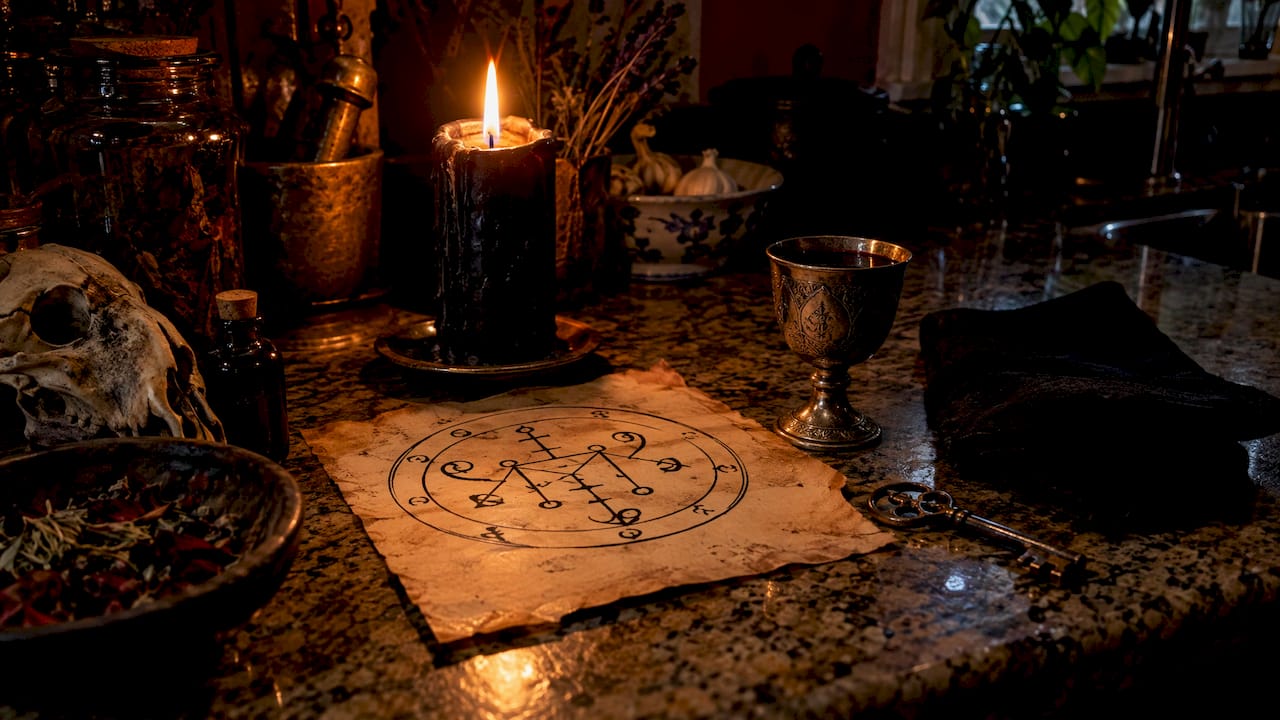
- A printed or hand-drawn Valefor seal on clean paper, or engraved on copper if you can. Copper is the metal the Goetia gives to Dukes.
- One red or dark orange candle, and a small dish to hold it.
- A key or a coin, which modern work often offers to him. The old manuscripts do not demand specific offerings, so treat these as gifts chosen for their link to secrecy and taking.
- A small cup of dark red wine or black coffee.
- A notebook and pen for your record.
- Incense of cassia, the incense assigned to his decan in 777, or any resin you already use for Venus work.
Timing
The Goetia gives the Duke’s hours as sunrise until noon in clear weather, so begin in the morning. Friday is the traditional day of Venus and fits the later Venusian attribution; the Venus hour after sunrise makes an excellent window. For recovery or retrieval, work as the moon wanes, which is the phase for taking back and releasing. For protection and building a lasting bond, work as the moon waxes. Choose one intent and match the phase to it.
Petition and enn
Modern demonolatry uses an enn, a short phrase in a constructed spirit language, for Valefor: Keyman vefa tasa Valefor. Enns belong to the modern tradition and do not appear in the Renaissance manuscripts, so use it as a focusing chant and not as a historical formula. Speak it three times, then the petition below in your own voice, adjusting the bracketed parts:
Valefor, Mighty Duke, lion of the ten legions, I call you by your seal and by your name. I am [your name], and I stand in my own authority. Attend me as a familiar for this one work. Show me where I am exposed. Return to me [state the single thing: the lost opportunity, the missing object, the stolen position]. Teach me to see what you see. I offer you this [key or coin] and ask you to take your place in my circle of work. Speak, and I will listen.
Step by step
- Prepare the room in the morning. Wash, dress plainly and clear the table. Fast lightly if that is your habit; a heavy meal dulls perception.
- Lay out the seal at the center of the table, the candle behind it and the key or coin in front. Place the wine or coffee to the right.
- Light the incense, then the candle. Sit for a few minutes and settle your breathing.
- Visualize one form. Pick the lion with a man’s head or the bellowing lion with an ass’s head, and hold it fixed.
- Vibrate the enn three times, then speak the petition aloud, slowly.
- Gaze at the seal for as long as your attention holds. Do not force images. Let impressions come: sounds, a sense of presence, words.
- Write everything down before you speak to anyone. Fast impressions fade within minutes.
- Leave the offering at the seal, and let the candle burn down in its dish.
Signs of presence and signs the work is taking hold
Modern demonolatry accounts of contact describe lion imagery, loud sounds heard internally, the feeling of being watched, sudden amusement, restless energy and an unusually sharp awareness of exits, objects and other people’s behavior. Keep your own log.
Signs that the work is moving include:
- You notice small gaps in your routines, accounts, locks or agreements within days of the rite.
- A missing object or piece of information turns up in a place you had already searched.
- Dreams of a lion, a doorway or a key recur.
- A person or a contract you had overlooked suddenly draws your attention.
If any of these appear, act on them in the ordinary world at once. That pairing is the point of the next section.
Closing the working
When you finish, speak aloud: Valefor, I thank you for your attendance. Our work for today is complete. Go with my gratitude, and return when I call you by name. Snuff the candle, or let it finish. Pour the wine or coffee onto the earth or down a drain with a word of thanks, and keep the key or coin as your link to him. Wrap the seal in cloth and store it. Then eat and drink something. If you work with the seal worn, as the Goetia describes, put it on after the rite so the bond carries into the days that follow.
Magick with real-world strategy
The following are typical situations, not client cases.
The leaking business. The owner of a small bookkeeping firm keeps losing minor sums to forgotten subscriptions and sloppy invoicing. She works with Valefor on a waning Friday morning, asks him to show her where her business is exposed, and logs her impressions. Within the week she finds herself reviewing every recurring charge and tightening her invoicing terms. The magick supplies attention, and she supplies the audit.
The street of break-ins. A night-shift nurse wants a protective bodyguard-style bond for his home after a string of break-ins on his street. He works on a waxing moon, wears a copper seal, and asks Valefor to attend him as a familiar. He also changes his locks and fits a motion light. The rite sets the intention and sharpens his awareness. The hardware is the other half of the same defense.
The stolen promotion. A former executive feels that a promotion and a reputation were taken from her years ago. She uses the “thief as reclaimer” reading, asks Valefor to show her where her power leaked, and finds in her notes that she kept deferring to a colleague in meetings. She rehearses the habit away and applies for a role elsewhere.
In each, the pattern is the same: one problem, one working, a written record and a concrete action. A thief-spirit’s nature is practical.
Keeping the bond focused
Valefor’s temptation is real in the texts: the good familiar who tempts to steal. In modern practice many feel it as a pull, a sense that ordinary rules no longer apply to you. Keep your log, review it every month and cut the work back to one purpose when it drifts.
The Goetia’s apparatus is ceremonial: circle, triangle, seals and compelling words. If you work in the Goetic manner, keep to the dimensions in your edition; our conjuring method from the Goetia sets out the full procedure. If you work in the collaborative, devotional manner of modern demonolatry, treat Valefor as a guide who walks beside you and keep your own authority. In both approaches, the spirit advises and you decide.
Our perspective
We read Valefor as one of the most practical spirits in the Goetia. His entry is short because his office is short: he attends, he perceives what is held and what is exposed, and he pulls toward taking. That is what a magician needs when a business leaks, a home is weak or a stolen opportunity needs reclaiming.
We also think the primary texts deserve more respect than the summaries. Weyer, Scot and the Goetia disagree about his head and about how his companionship ends, and those disagreements are information. When you know which layer you are working from, you can choose your form, your timing and your offerings on purpose.
Our work at Black Witch Coven is left-hand path, black magick and demonolatry. We treat spirits as real, intelligent beings and as guides, and we keep our work to one problem at a time and tied to action in the world. For Valefor, that means the rite, the record and the audit all in the same week.
Black Witch Coven
When you want the work done for you
If you would rather have this kind of working performed by an experienced coven member, our Dragon’s Veil Protection Spell: Draconian Shield covers protection of home and property. For work on income, there is the Daemonic Prosperity Magick service. Our guide to demons associated with specific powers shows where Valefor sits among the other spirits.
FAQ
Is Valefor the same as Valefar and Malaphar?
Yes. Weyer’s 1577 entry gives Valefar, alias Malaphar, and later sources add Malephar, Valafar and Valefor. They are variant forms of one name within the same grimoire tradition, so your choice of spelling is a matter of preference.
Is Valefor an ancient god?
The record places him in early modern European grimoires, beginning with Weyer’s printed catalogue. No ancient deity, planet or pre-Christian spirit has been securely identified with him, and attempts to derive his name from one remain speculation.
Which seal and offerings should I use?
The Goetia says his seal is to be worn, and it assigns copper to Dukes. Offerings are a modern development, with coins, keys, locks and objects tied to secrecy being the common choices, so select what is meaningful to you and keep it consistent.
When is the best time to call him?
The Goetia gives the Duke’s hours as sunrise to noon in clear weather. Many magicians add Friday, the day of Venus, and match the moon phase to the purpose: waning for recovery, waxing for building a bond.
