
 New Years Eve Ritual 2026/2027 with Savannah
Blog, Learn Witchcraft, Occultism
Hecate Through the Centuries: Myth, Archaeology, and Modern Witchcraft
Jul
Hecate is a Greek goddess of crossroads, magick, and the underworld, whose earliest attestation in Hesiod’s Theogony casts her as a Titaness with authority over heaven, earth, and sea. She began as one of the most powerful figures in the Greek pantheon and narrowed, over roughly a thousand years, into the liminal, torch bearing patroness of witches recognized today. This article traces that transformation through primary sources, cult evidence, and her place in contemporary occult practice.
Table of Contents
- What Does Hecate’s Name Actually Mean?
- What Do Hecate’s Symbols Actually Mean?
- What Are Hecate’s Main Roles and Functions?
- What Physical Evidence Survives From Hecate’s Cult?
- How Does Hecate Appear in Classical Myth?
- How Was Hecate Represented in Ancient Art?
- How Do Modern Witches Understand Hecate?
- How Black Witch Coven Approaches Hecate in Practice
- What Does Hecate’s Triple Form Actually Represent?
- How Does Hecate Compare to Similar Goddesses Elsewhere?
- Who Actually Worshipped Hecate in Antiquity?
- How Did Ancient Occultists Use Hecate in Ritual Magick?
- How Has Hecate’s Mythology Changed Over Time?
- The Editorial Take: Why the “Witchcraft Goddess” Label Undersells Her
- Sources
- FAQ
What Does Hecate’s Name Actually Mean?
Nobody has settled on a single, confirmed etymology for Hecate, and that ambiguity is itself telling. One prominent theory ties her name to the Greek word hekatos, meaning “far reaching” or “the far worker,” an epithet also applied to Apollo. Another line of thought connects her to Egyptian Heqet, a frog headed goddess of childbirth, though the phonetic and cultural links here are thinner and less widely accepted among classicists. Pronunciation in modern English commonly falls as “HEH-kuh-tee,” though some traditions render it closer to “heh-KAH-tay,” reflecting different transliteration choices from the ancient Greek.
The parentage traditions vary just as much as the name’s roots, and each version signals something different about how ancient authors were trying to place her:
- Perses and Asteria (Hesiod’s version): Ties her firmly to the Titan generation, explaining her cosmic authority and pre-Olympian status.
- Zeus and Demeter: A later tradition that pulls her closer to the Eleusinian sphere and reinforces her link to Persephone and the grain goddess cult.
- Nyx (Night): An alternative genealogy that emphasizes her nocturnal, chthonic character over her cosmic breadth.
- Zeus and Hera, or in some regional variants, a Thracian or Colchian origin: Reflects local efforts to integrate her into different regional pantheons.
These competing genealogies are not sloppy record keeping. They show a goddess whose worship spread across enough regions and centuries that local storytellers kept re-explaining her origins to fit their own theological frameworks, a pattern typical of deities absorbed from multiple cultural streams rather than invented once and left alone.
What Do Hecate’s Symbols Actually Mean?
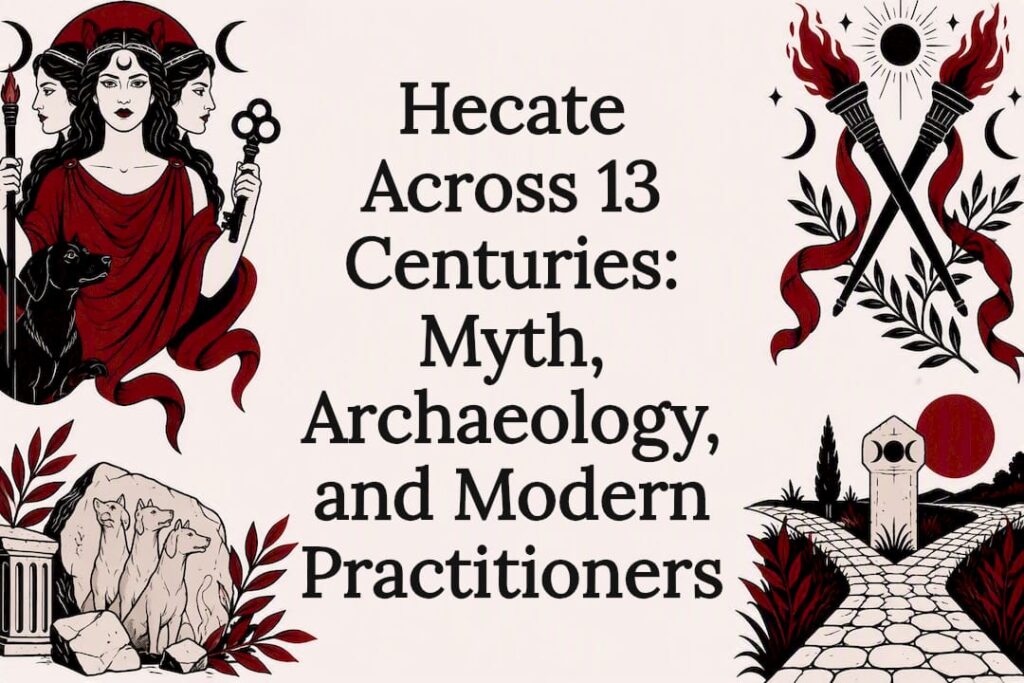
Hecate’s iconography reads almost like a coded résumé of her job description. Each element attached to her image points to a specific function she performed for ancient worshippers.
- Torches: The most consistent attribute across centuries, torches signal her role as a guide through darkness, both literal (night travel) and metaphorical (the underworld, transitions in life).
- Keys: Represent her power to unlock or seal passages, particularly the boundary between the world of the living and the underworld, a role tied directly to her escorting Persephone.
- Dogs: Her most famous animal companion, dogs mark her as a creature of the night and the wild margins outside city walls, and their barking was associated with her approach.
- Snakes: Appear in some depictions and reinforce her chthonic, earth bound authority, linking her visually to other underworld and prophetic figures.
- Triple form: Beginning in the Classical period, artists started depicting her with three bodies or three faces, a convention discussed in depth later in this article.
The hekataion was a specific type of small monument, often a triple form statue or pillar, placed at doorways, crossroads, and city gates. Households commonly set up a hekataion just outside the front door, treating Hecate as a gatekeeper against unwanted spiritual intrusion. That placement is not incidental. Ancient Greeks organized their spiritual defenses around thresholds precisely because they believed vulnerable transition points, doors, gates, roads that forked in three directions, needed active protection, and Hecate was the deity assigned to that job.
Statistic Callout: Cult evidence tied to Hecate is not confined to a single region. Sanctuary and inscriptional evidence appears at Lagina in Caria, Selinunte in Sicily, and additional sites across Samothrace, Aegina, and Athens, a geographic spread that suggests her cult traveled and adapted across the Mediterranean rather than radiating outward from one fixed center.
Depictions shifted over time too. Archaic era art rarely shows her at all, since her earliest textual prominence outpaced her visual one. By the Classical period, single figure depictions with torches dominate. The triple form image becomes standard by the Hellenistic period, and Roman era art frequently pairs her with lunar imagery, a connection that becomes central to her modern reception.
What Are Hecate’s Main Roles and Functions?
Hecate’s job description, if you can call it that, spans four overlapping domains, and different ancient sources emphasize different ones depending on their purpose and period.
- Guardian of crossroads and liminal spaces. Epithets like Enodia (“on the road”), Trioditis (“of the three ways”), and Propulaia (“before the gate”) appear across classical sources compiled at Perseus, marking her specifically as the deity who governs thresholds, forks in the road, and the space between defined categories.
- Chthonic guide and psychopomp. Her key and torch imagery ties directly to her role escorting Persephone between the underworld and the surface world, a function first documented in the Homeric Hymn to Demeter.
- Patroness of magick and cursing. The Greek Magical Papyri and surviving curse tablets invoke her by name for spellwork, binding rituals, and necromantic operations, cementing the association with sorcery that dominates her later reputation.
- Household protector. Monthly offerings called hekate’s suppers (deipna) were left at crossroads and doorsteps, typically on the night of the new moon, as both an offering and an act of ritual cleansing for the household.
These four roles are not competing theories about “the real Hecate.” They coexisted, sometimes within the same generation of worshippers, because ancient Greek religion did not demand a single, tidy job description for its deities the way modern systematic theology often does. A farmer leaving food at a crossroads shrine and a magician inscribing her name on a lead curse tablet were drawing on the same figure for different, entirely legitimate reasons.
Pro Tip: When researching Hecate’s epithets, pay attention to which region and period a source comes from before assuming a title like Trioditis applies universally. Regional cult centers often emphasized one function so heavily that outsiders mistook it for her only role, which is exactly how the modern “goddess of witchcraft” label became oversimplified.
What Physical Evidence Survives From Hecate’s Cult?
Literary sources tell you what ancient Greeks believed. Archaeology tells you what they actually did, and the two align closely enough with Hecate to give her cult unusual credibility among scholars who are often stuck reconciling contradictory myth with silent excavation sites.
The sanctuary at Lagina stands as the largest confirmed center of Hecate worship, complete with a monumental temple built during the Hellenistic period and expanded under Roman patronage. Selinunte in Sicily has produced inscriptional evidence tying local cult activity directly to her name, while altars uncovered near Miletus in Asia Minor point to consistent ritual use rather than a one-off dedication.
Ritual practice, as reconstructed from both literary references and physical remains, centered on a few consistent elements:
- Offerings left at crossroads on the night of the new moon, often called Hecate’s suppers.
- Sacrificial items recorded in ancient sources include dogs, honey, and black colored animals, reflecting her chthonic and nocturnal character.
- Small hekataia placed at household doorways functioned as ongoing, low ceremony protective devices rather than one-time ritual objects.
Regional variation shows up clearly once you compare sites. Samothrace folded Hecate into its famous mystery cult framework alongside other deities. Aegina developed distinct local rites tied to her. Athens integrated her worship into broader civic religious practice without the mystery emphasis found at Samothrace.
| Region | Type of Evidence | Distinguishing Feature |
|---|---|---|
| Lagina (Caria) | Monumental sanctuary and temple | Largest known cult center, Hellenistic through Roman periods |
| Selinunte (Sicily) | Inscriptions | Confirms cult presence outside mainland Greece |
| Miletus (Asia Minor) | Altars | Evidence of sustained ritual use |
| Samothrace | Mystery cult integration | Hecate folded into broader mystery rites |
| Athens | Civic and household shrines | Household hekataia at doorways, no mystery emphasis |
This spread of evidence, spanning mainland Greece, Asia Minor, and Sicily, argues against treating Hecate’s cult as a single, centralized religion. It behaved more like a widely adopted practice that different communities localized to fit their own ritual calendars and civic identities.
How Does Hecate Appear in Classical Myth?
Beyond her two foundational appearances, Hecate shows up across a surprising range of classical literature, and each new appearance tends to emphasize a different facet of her character.
- Hesiod’s Theogony: Establishes her cosmic authority and Titanine lineage, the baseline all later reinterpretations react against.
- Homeric Hymn to Demeter: Positions her as Persephone’s companion and the one who first hears her cries, cementing the underworld connection.
- Euripides and later Greek tragedy: Invoke her in connection with sorcery and madness, reflecting a shift toward her association with dangerous, uncontrollable magick.
- Virgil’s Aeneid: The Roman poet has Aeneas invoke Hecate before his descent into the underworld, borrowing her Greek chthonic authority for a distinctly Roman epic purpose.
- Ovid’s Metamorphoses and Medea’s invocations: Roman poetry increasingly frames her as the deity sorceresses call upon, a trope that solidifies her later witchcraft reputation.
- The Greek Magical Papyri: Treat her name as a functional ritual tool, invoked in binding spells and necromantic rites rather than narrated as a character in a story.
The trajectory across these sources is unmistakable. She starts as a cosmic power with heaven, earth, and sea under her authority, narrows into an underworld guide, and ends up, by the Roman period, functioning primarily as the name magicians and poets reach for when they need serious occult firepower in a text.
How Was Hecate Represented in Ancient Art?
Material culture backs up the literary trajectory and adds detail the texts leave out. Triple form statues, sometimes called hekataia when small and functional, appear placed at city gates, temple entrances, and household doorways across the Mediterranean, confirming that her protective role was not just a literary flourish but a genuine, widespread civic and domestic practice.
- Freestanding triple bodied statues placed at crossroads functioned as literal three way guardians, since a shrine at a three road fork could face all three directions simultaneously.
- Attic pottery from the Classical period shows her carrying twin torches, often alongside Persephone or Demeter in scenes depicting the Eleusinian narrative.
- The Pergamon Altar frieze, a major Hellenistic monument, includes Hecate among the gods battling the giants, situating her firmly within the Olympian side of that cosmic conflict despite her Titan origins.
- Household doorway placements, distinct from grand civic monuments, indicate an intimate, daily-use relationship with her image rather than purely formal state religion.
The placement pattern tells its own story. A goddess installed at city walls and acropolis gates was doing civic protective work on a large scale. The same goddess installed at a private household door was doing the exact same job in miniature. That consistency across scale, from empire-level sanctuaries at Lagina to a single family’s doorstep shrine, is part of why her protective and apotropaic reputation held together so coherently across thirteen centuries of documented worship.
How Do Modern Magicians Understand Hecate?
Modern Wicca and broader neopagan reconstruction movements, emerging primarily in the mid 20th century, generally place Hecate within a Triple Goddess framework, often paired with the crone archetype representing wisdom, old age, and the waning phase of the lunar cycle. This framing borrows heavily from her triple form iconography but applies a specifically modern interpretive lens that ancient worshippers would not have recognized in quite the same terms.
Contemporary occult witches, including those working within Luciferian and broader Left Hand Path traditions, tend to approach Hecate through a different lens than Wiccan reconstructionism. Rather than treating her primarily as a maiden-mother-crone archetype, many occultists engage her directly as the historical goddess of crossroads, thresholds, and necromantic power that the Greek Magical Papyri describe, working with her as a sovereign entity rather than a symbolic stage of womanhood.
A few patterns show up consistently in how modern devotional and ritual frameworks engage with her:
- Crossroads and threshold work remains central, echoing her ancient Enodia and Trioditis epithets almost exactly.
- New moon offerings, directly descended from the ancient deipna tradition, remain a common devotional practice among contemporary magicians.
- Her association with keys and gates gets reworked into modern boundary and protection magick, extending her ancient apotropaic function into new ritual language.
- Her connection to necromancy and spirit work, well attested in the Greek Magical Papyri, continues in contemporary practices involving spirit communication and underworld traffic.
Scholars have pushed back on the flattening of Hecate into simply “the goddess of witchcraft,” and that critique deserves real weight. Her earliest and broadest role, as described by Hesiod, was cosmic rather than occult. The witchcraft association is a later accretion, heavily shaped by the Roman period poets and the magical papyri, not her original defining trait. Most serious modern witches understand and even embrace this. Working with a goddess whose power expanded across a thousand years, rather than one confined to a single fixed archetype, arguably makes her a richer and more flexible figure to build a practice around, not a lesser one.
Pro Tip: If you are building any devotional or ritual relationship with Hecate, treat her chthonic, crossroads, and cosmic aspects as three genuinely distinct registers rather than interchangeable. A working aimed at boundary protection draws on a different facet of her than one aimed at necromantic contact, and conflating them tends to produce muddled results.
How Black Witch Coven Approaches Hecate in Practice
Occultists working within Left Hand Path frameworks often find Hecate occupies a distinct place because her documented history provides layered material for ritual work. Her attested association with necromancy, curse work, and threshold control in the Greek Magical Papyri aligns with ritual categories commonly employed for protection, boundary setting, and achieving outcomes in challenging situations.
A few themes recur in how her historical roles translate into contemporary ritual thinking:
- Liminality work: Her crossroads function makes her a natural point of engagement for clients navigating major life transitions, legal disputes, or relationship endings where a clean break matters.
- Boundary and protection rites: Her keys and gatekeeper symbolism connect directly to modern protection ritual work, an area where her ancient household-guardian role maps almost exactly onto client requests for shielding against hostile influence.
- Underworld and necromantic contact: Her role escorting Persephone and her later invocation in binding spells make her relevant to magicians doing serious spirit communication work.
Working with a figure this old means respecting the layers she has accumulated rather than picking one and discarding the rest.
What Does Hecate’s Triple Form Actually Represent?
Hecate’s triple form is one of the most discussed and least agreed upon symbols in Greek religion, and the disagreement itself is instructive. The most common modern interpretation ties her three faces or bodies to the three phases of the moon, waxing, full, and waning, a reading that fits comfortably with her later lunar associations but has thinner support in the earliest sources, where lunar imagery is largely absent.
A second interpretation, closer to her documented ancient function, ties the triple form to her rule over three realms: heaven, earth, and the underworld, directly echoing the domain Hesiod grants her in the Theogony. This reading has stronger textual grounding, since it connects a visual convention to an explicit claim made in the earliest surviving source about her.
A third, more practical reading ties the triple form to her role at three way crossroads, where a single statue needed to face three directions at once to function as an effective guardian. This interpretation is arguably the most literal and the best supported by the archaeological placement pattern of hekataia at actual road forks.
These three interpretations are not mutually exclusive, and that is likely the point. A goddess whose defining trait across every era of her worship was standing at intersections, geographic, cosmic, and lunar, would naturally accumulate a symbol that could be read multiple compatible ways simultaneously. The triple form’s ambiguity may be less a mystery to solve than a feature of a deity built around the concept of overlap itself.
How Does Hecate Compare to Similar Goddesses Elsewhere?
Hecate is not unique in occupying the crossroads-and-magick niche within ancient Mediterranean religion, and comparing her to neighboring traditions clarifies what actually makes her distinct.
The Roman goddess Trivia occupies remarkably similar territory, and Roman writers frequently equated her with Hecate directly, particularly in her three way crossroads function (the name Trivia literally derives from “three roads”). The overlap was close enough that Roman poets like Virgil use the names almost interchangeably in underworld contexts.
Egyptian Heqet, the frog headed goddess associated with childbirth and fertility, has sometimes been proposed as an etymological or cultural ancestor to Hecate, though the functional overlap is far weaker than the naming similarity suggests. Heqet governed birth and renewal, not thresholds or magick, making this connection more linguistic curiosity than genuine religious parallel.
Closer functional parallels exist in Near Eastern lunar and underworld goddesses, though direct lines of influence remain difficult to prove given the patchy survival of comparative textual evidence. What sets Hecate apart from most of these figures is the sheer durability of her cult, documented continuously from the 8th century BCE through the late Roman period, and the breadth of her portfolio, which never fully surrendered her cosmic Hesiodic origins even as her magical reputation grew.
Who Actually Worshipped Hecate in Antiquity?
Hecate’s worshippers cut across social lines in a way that distinguishes her from deities tied to a specific class or profession. Household level veneration through doorway hekataia suggests ordinary families, not just priestly elites, maintained an active relationship with her, leaving monthly offerings as a routine domestic practice rather than a rare formal event.
At the same time, her major sanctuary at Lagina operated with substantial civic and even royal patronage during the Hellenistic period, showing that elite and state level religion took her seriously enough to fund monumental temple construction. This dual presence, humble doorstep shrine on one end, state funded sanctuary on the other, indicates a genuinely broad worship base rather than a cult confined to a narrow social niche.
Gender roles within her worship present an interesting pattern. Her later strong association with magick, cursing, and necromancy in the Greek Magical Papyri connects her to witches of both genders, since surviving curse tablets and magical texts invoking her name come from a range of authors. Her role as household protector, tied to the new moon deipna tradition, likely fell disproportionately to women managing domestic ritual life, a common pattern across ancient Greek household religion generally. Her civic cult at sites like Lagina, by contrast, involved formal priesthoods that followed the broader patterns of Greek civic religion rather than any special gender restriction tied to Hecate specifically.
How Did Ancient Occultists Use Hecate in Ritual Magick?
The Greek Magical Papyri, a substantial body of ritual texts compiled between roughly the 2nd century BCE and the 5th century CE, treat Hecate as one of the most frequently invoked names in binding spells, love magick, and necromantic operations. Her name appears in formulas designed to compel spirits, bind enemies, and open communication with the dead, reflecting a practical, transactional relationship between ancient magicians and the goddess rather than a purely devotional one.
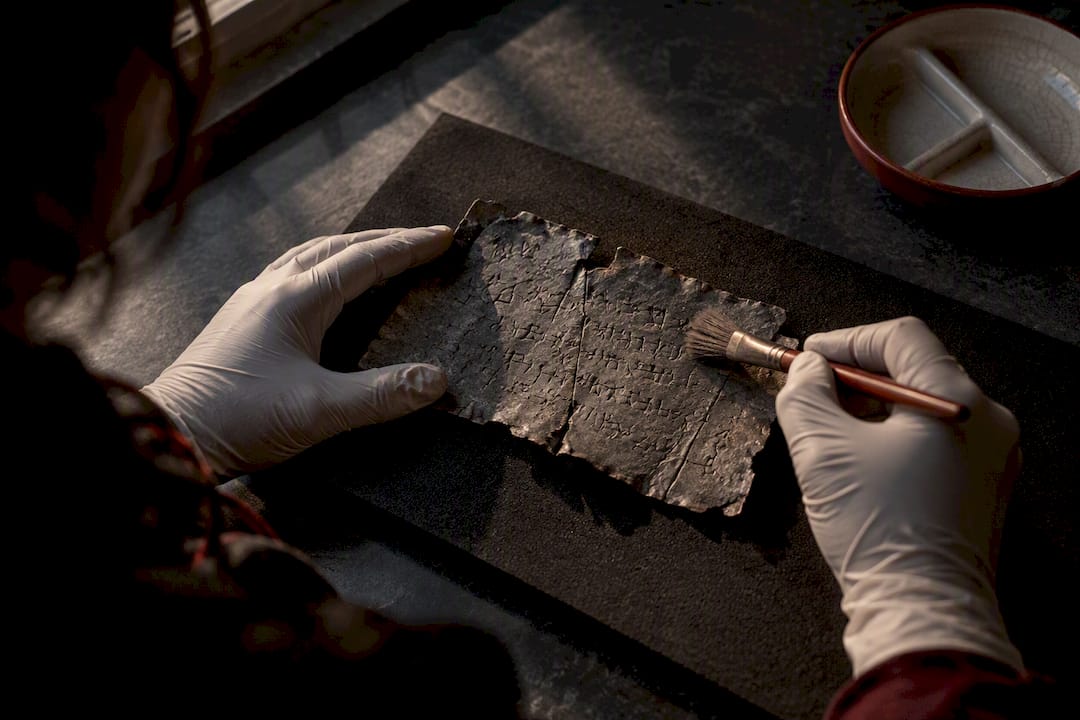
Curse tablets, small inscribed sheets of lead buried at crossroads, graves, or wells, frequently invoke her by name or by her epithets, asking her to bind a rival, silence an enemy, or influence a legal outcome. The choice of burial location for these tablets, often at literal crossroads, was not incidental. It directly mirrored her mythological role as guardian of exactly those liminal points, suggesting magicians believed proximity to her domain increased a spell’s potency.
Necromantic operations described in the papyri frequently call on her underworld authority and her role escorting souls, treating her as a functional intermediary between the world of the living and the realm of the dead. This practical, results oriented use of her name stands in real contrast to her grander, more abstract cosmic role in Hesiod, and it is largely this magical papyri tradition, not her earliest literary appearance, that shaped her modern reputation as a goddess of witchcraft specifically.
How Has Hecate’s Mythology Changed Over Time?
Hecate’s evolution across roughly thirteen centuries of documented worship breaks down into fairly distinct phases, each shaped by the political and religious currents of its era.
In the Archaic period, Hesiod’s Theogony establishes her as a broad, cosmic Titanine power, honored by Zeus and holding authority across heaven, earth, and sea, with no particular emphasis on magick or witchcraft.
The Classical period narrows her focus considerably. The Homeric Hymn to Demeter ties her firmly to the underworld and to Persephone, while Athenian tragedy begins associating her with sorcery, madness, and dangerous female power, reflecting broader Classical era anxieties about magick and gender.
The Hellenistic period sees her cult reach its architectural peak at Lagina, with major temple construction and mystery cult integration at sites like Samothrace, while her triple form iconography becomes standardized across artistic representation.
The Roman period completes her transformation into the go-to name for literary sorceresses, evident in Ovid and the Medea tradition, while syncretism with the Roman goddess Trivia cements her crossroads identity across the wider empire. The Greek Magical Papyri, largely compiled during this period, formalize her association with practical, results driven magick.
Each phase did not erase the previous one. It layered on top, which is exactly why a modern witch can meaningfully invoke her cosmic, chthonic, and magical aspects simultaneously without contradicting any single ancient source.
The Editorial Take: Why the “Witchcraft Goddess” Label Undersells Her
Reducing Hecate to “the goddess of witchcraft” is the single most common mistake in casual coverage of her, and it flattens a deity whose power was originally cosmic, not occult. Hesiod placed her among the most honored figures in existence, ruling heaven, earth, and sea, centuries before any magical papyrus ever inscribed her name on a curse tablet. The conventional treatment skips straight to the crossroads-and-cauldron imagery because it is more visually striking, but it shortchanges the reader who wants to actually understand her.
What should come first is her range. A magician or scholar approaching Hecate only through the witchcraft lens misses her legitimate authority over thresholds, sovereignty, and cosmic order, dimensions that make her a far more substantial figure to engage with than a one-note sorceress archetype. Start with Hesiod. Let the magical papyri come second. That order respects the actual historical record, and it gives anyone building a serious practice around her a far sturdier foundation to work from.
— Black Witch Coven
Sources
Readers who want to go beyond secondary summaries should start with Hesiod’s Theogony, available in scholarly translation and discussed in the GRBS academic article referenced throughout this piece, which covers her earliest cosmic portrayal. The Perseus Project’s Hecate entry collects classical passages, epithets, and genealogies in one searchable reference. The Theoi Project’s Hekate page compiles classical quotations useful for cross-referencing her mythic appearances and artistic depictions.
FAQ
What Does the Goddess Hecate Do?
Hecate governs crossroads, thresholds, and transitions, guides souls between the underworld and the world of the living, and presides over magick, cursing, and necromancy in later classical tradition. Her earliest role in Hesiod’s Theogony was even broader, granting her domains across heaven, earth, and sea.
How Do I Ask Hecate for Help?
Ancient witches left offerings at crossroads and doorsteps, commonly on the night of the new moon, a practice historically called Hecate’s suppers. Modern devotional approaches generally follow the same logic, favoring threshold locations, new moon timing, and direct address through her traditional epithets like Enodia or Trioditis.
How Do You Know if Hecate Is Calling You?
There is no single documented sign in ancient sources, since Hecate’s worship functioned through consistent devotional practice rather than reported personal callings. Occultists today generally describe a pull toward liminal experiences, crossroads symbolism, or underworld and boundary work as the pattern most associated with her.
Does the Bible Mention Hecate?
No, Hecate does not appear by name in the Bible. She belongs to Greek religious tradition, and her cult, documented from Hesiod’s Theogony forward, developed independently within the Greek and later Roman Mediterranean world rather than within the Hebrew or early Christian textual tradition.
