
 New Years Eve Ritual 2026/2027 with Savannah
Black Magic, Blog
What Is Black Magick? A Complete Beginner’s Guide

Jun
Black magick is the practice of directing supernatural forces through ritual and intent to influence reality, often by manipulating the free will or circumstances of others.
This guide covers the anthropological roots, modern interpretations, practical basics, and ethical dimensions of black magick for anyone approaching the subject with genuine curiosity.
NOTE – this article is for those who are interested in more of the folk magic or witchcraft origins of black magick.
Black magic is a wide variety of magical practices; however, mainstream typically lumps everything into the same bucket. Here we’re discussing the term black magic mainly from a witchcraft folk magic perspective.
What is black magick, and where does the definition come from?
The word “magick” itself carries specific weight in occult tradition. Crowley used the spelling to signal a system of willed action aimed at producing real change in the world. In that framework, black magick refers to workings directed outward with force, whether for protection, domination, justice, or harm. The intent behind the act is what defines it, not the act itself.
Black magick involves rituals such as sympathetic magic, binding objects to targets, incantations, and the conjuring of spirits to influence outcomes. These methods appear across cultures and centuries, which is why anthropologists treat the subject as a serious field of study rather than folklore.
Traditional and anthropological roots of black magick practices
Black magick is not a fringe invention. Documented in 77 societies worldwide, sympathetic magic practices appear across Africa, Asia, the Americas, and Europe. That global distribution shows these practices are a consistent feature of human spiritual life, not an aberration.
Two foundational principles govern most traditional black magick:
- Law of Similarity: Like produces like. A wax figure shaped like a person can be used to affect that person.
- Law of Contagion: Things once in contact remain connected. Hair, nail clippings, or personal objects carry a link to their original owner.
These laws explain why voodoo dolls, binding knots, and cursed objects appear in so many unrelated cultures. The logic is internally consistent and has been practiced with serious intent for thousands of years.
| Traditional method | Cultural origin | Core mechanism |
|---|---|---|
| Voodoo doll (effigy) | West African / Haitian Vodou | Law of Similarity |
| Knot binding spell | European folk magic | Contagion and symbolic restraint |
| Curse tablet (defixio) | Ancient Greece and Rome | Written incantation bound to target |
| Hex bag (mojo bag) | American Hoodoo | Contagion via personal items |
| Spirit conjuring | Goetic / Solomonic tradition | Direct invocation of named entities |
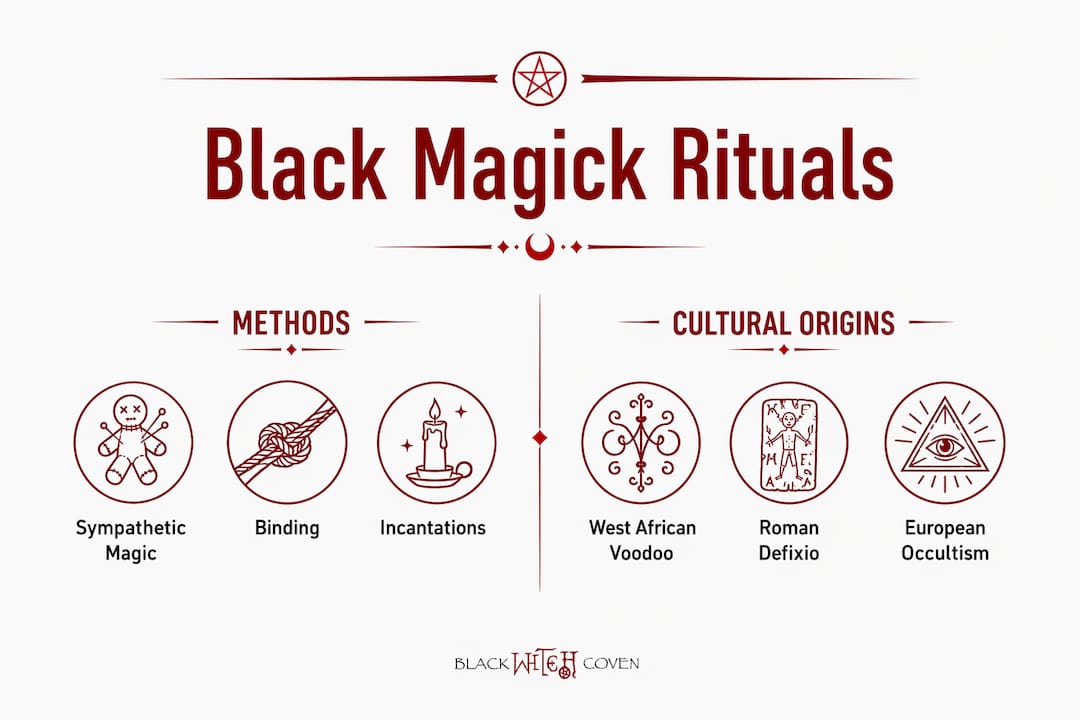
The table above shows how the same underlying logic produces different ritual forms across cultures. A Roman defixio buried near a courthouse and a Haitian binding spell share the same structural logic, even though they look nothing alike. Culture shapes the form; the intent and mechanism remain consistent.
Black magick vs white magick: is the distinction real?
The black versus white magick divide is largely a social construct. Scholar Robert M. Place argues the black and white divide is shaped by cultural bias, including the social status of the practitioner and their access to materials, rather than any objective moral difference. A wealthy practitioner performing the same ritual as a poor one was historically more likely to be called a healer than a witch.
The practical distinction most practitioners use today comes down to direction and consent:
- White magick: Workings intended to heal, protect, or attract, generally with the subject’s awareness or consent.
- Black magick: Workings that impose force on another’s will, circumstances, or body, with or without their knowledge.
- Dark magick: A broader category that includes shadow work, spirit contact, and workings in morally ambiguous territory.
These categories overlap constantly. A protection spell that harms an attacker sits in all three categories depending on who you ask. Black Witch Coven addresses this directly, arguing that the black and white distinction collapses under scrutiny because intent and outcome rarely fit a clean binary.
Pro Tip: Before labeling a working “black” or “white,” ask what it is designed to do to another person’s autonomy. That question cuts through most of the moral confusion faster than any category system.
How does basic black magick work in practice?
A beginner’s guide
Black magick rituals follow a structure that most serious practitioners treat as non-negotiable. Skipping steps does not make the ritual faster. It makes it less effective and potentially destabilizing for the practitioner.
- Set a single, clear intent. Vague intentions produce vague results. Write your intent in one sentence before you begin.
- Prepare your space. Salt circles, cleansed tools, and a quiet environment reduce interference. Safe beginner sessions last 15–30 minutes with basic protection methods like salt circles in place.
- Choose minimal, charged tools. A single well-charged sigil carries more focused power than a cluttered altar with many objects. Clarity of intent is the active ingredient, not the quantity of tools.
- Perform the working. This includes incantation, visualization, or symbolic action tied to your intent. Keep the ritual focused and contained.
- Ground and close. prevent energy bleed, which experienced practitioners describe as physical and mental fatigue that lingers after a ritual is left open. This step is not optional.
- Journal the session. Record the time, your emotional state, moon phase, tools used, and any immediate sensations. Detailed journaling is what separates practitioners who improve from those who repeat the same mistakes.
The most common beginner error is attempting to influence external outcomes before developing internal discipline. Beginners who skip foundational personal work and go straight to external influence tend to produce inconsistent results and burn out quickly. Shadow work, emotional regulation, and honest self-assessment come first. External workings follow from that foundation.
Pro Tip: Start with protection rituals before attempting any working aimed at another person. Knowing how to shield yourself is the most practical skill a beginner can develop.
Ethical considerations and cultural perceptions of black magick
The ethics of black magick are genuinely complex, and practitioners who dismiss that complexity tend to cause harm to themselves or others. The key ethical questions are not about good versus evil.
They are about consent, consequence, and intent.
- Manipulation of free will is the central ethical fault line. A working designed to make someone love you against their nature raises different questions than a working designed to protect your home.
- Historical persecution shaped how black magick is discussed today. Accusations of black magick were used to target marginalized communities, particularly women, people of color, and those outside mainstream religious structures.
- New Age and Wiccan communities have increasingly distanced themselves from baneful magic since the mid-2020s, focusing instead on benevolent spirituality. This creates a visible split in the broader occult community between those who avoid harm-directed workings entirely and those who see forceful magic as a legitimate tool.
- Self-mastery as the goal. Many serious Left-Hand Path practitioners use black magick primarily for internal transformation, shadow integration, and personal power rather than to harm others.
- Cultural misreading is common. Practices labeled “black magick” in one culture are healing traditions in another. The label says as much about the observer as it does about the practice.
The ethical path through black magick is not avoidance. It is accountability. Practitioners who track their intentions honestly, accept responsibility for outcomes, and work within a coherent personal philosophy tend to produce better results and fewer regrets than those who treat the practice as consequence-free.
Key Takeaways
Black magick is defined by forceful intent directed at influencing reality or free will, not by inherent evil, and responsible practice requires internal discipline before external workings.
| Point | Details |
|---|---|
| Intent defines black magick | Modern definitions center on forceful influence of free will, not evil acts or specific rituals. |
| Global anthropological roots | Sympathetic magic practices appear in 77 documented societies, showing consistent cross-cultural logic. |
| Black vs white is a construct | The moral divide between black and white magick reflects cultural bias more than objective difference. |
| Beginners need structure | Safe sessions run 15–30 minutes with protection, grounding, and journaling built into every ritual. |
| Ethics require accountability | Responsible practitioners track intent, accept consequences, and develop internal discipline first. |
What 16 years of Left-Hand Path work actually taught me
Most people who come to black magick are looking for power over something they cannot control. That is an honest starting point. What they rarely expect is that the practice turns that desire back on them almost immediately.
The practitioners I have seen struggle most are the ones who skipped the internal work. They came in wanting to dominate a situation or a person, and they had not yet learned to dominate their own fear, grief, or anger. The ritual becomes a mirror. If you are not ready for what it reflects, the experience is destabilizing rather than empowering.
The practitioners who get real results treat black magick as a discipline, not a shortcut. They journal obsessively. They work with specific entities like Lucifer, Clauneck, or Astaroth with the same seriousness they would bring to any long-term relationship. They understand that connecting with a spirit guide or daemon is a practice built over time, not a single dramatic event.
The fear-based approach to this subject, whether the fear comes from outsiders condemning it or from practitioners treating it as inherently dangerous, produces the worst outcomes. Respect and preparation produce the best ones. Black magick is not safe in the way that a walk in the park is safe. It is safe in the way that surgery is safe: when performed by someone who knows what they are doing and has prepared properly.
— Black Witch Coven
FAQ
What is the simplest definition of black magick?
Black magick is the use of ritual, intent, and supernatural force to influence reality, particularly by affecting another person’s will or circumstances. Modern definitions focus on the forceful nature of the intent rather than labeling the practice as inherently evil.
Is black magick dangerous for beginners?
Black magick carries real risks for beginners who skip protective protocols and internal preparation. Safe beginner sessions last 15–30 minutes with salt circles and grounding rituals in place to prevent energy bleed and emotional destabilization.
How is black magick different from white magick?
White magick generally works with consent and benevolent intent, while black magick applies force to influence outcomes or free will. The distinction is largely shaped by cultural bias rather than a fixed moral boundary, as scholar Robert M. Place has argued.
in truth, when you’re manipulating the natural flow or outcome of anything, it is manipulation… and therefore, by modern practitioners, would be considered black magick. labels are really very limiting and keep you locked into pleasing other people – Savannah
Recommended
- Understanding black magick – Black Witch Coven
- Beginners Blood Magick Do’s & Don’ts – Black Witch Coven
- The reason why there is no such thing as black and white magick – Black Witch Coven
- What Is Magick – Black Witch Coven
