
 New Years Eve Ritual 2026/2027 with Savannah
Black Magic, Blog, Divination
Shadow Magic & The Black Mirror Evocation Ritual
Mar
Shadow magick is the deliberate practice of confronting and integrating the disowned aspects of the self to unlock deeper personal power and sharpen magical efficacy.
Rooted in both Jungian psychology and Left-Hand Path tradition, the role of shadow magick goes far beyond self-help. It is the process of reclaiming the hidden fuel that drives your spellwork, your intent, and your results.
Practitioners who ignore their shadow do not escape it. They carry it unconsciously into every ritual, where it distorts outcomes, weakens intent, and creates the kind of magical misfires that no amount of technique can fix.
This article gives you the framework, the rituals, and the hard truths you need to work with shadow material effectively.
What is the role of shadow magick in serious occult practice?
Shadow magick is defined as the conscious engagement with the psychological and spiritual material the practitioner has repressed, denied, or disowned. Carl Jung first mapped the shadow as the unconscious repository of traits the ego refuses to claim. In occult practice, this concept carries direct operational weight. The shadow is not a metaphor. It is an active force shaping your magical instrument.
Unintegrated shadow material distorts magical intent and outcome. That distortion is not symbolic. It means spells that backfire, rituals that produce partial results, and workings that attract exactly what you were trying to repel. The shadow bleeds into your intent whether you acknowledge it or not.
Shadow magick, properly understood, is not about banishing or cleansing the shadow. It is about reclaiming disowned traits to create inner spaciousness for advanced spellcasting. That distinction separates serious Left-Hand Path work from surface-level spiritual hygiene. The shadow is not an enemy to be expelled. It is a reservoir of compressed power waiting to be consciously directed.
Black Witch Coven treats shadow integration as a foundational pillar of advanced ritual work. Before you can effectively direct entities like Andras, Astaroth, or Clauneck, you need to know which parts of yourself you are hiding from. Those hidden parts will show up in the working regardless.
What is the shadow self and how does it affect magical practice?
The shadow self is the collection of traits, impulses, memories, and desires the conscious mind has rejected. Jung identified two layers: the negative shadow, which holds traits deemed unacceptable (rage, greed, cruelty, lust), and the golden shadow, which holds disowned positive qualities (confidence, creativity, authority, ambition). Both layers affect magical practice equally.
The shadow is not an enemy. It is a wounded self-part and a source of power when consciously embraced. Treating it as something to eliminate guarantees it will keep operating from the dark, pulling your magical work in directions you never intended.
Practitioners who have not examined their shadow carry specific interference patterns into ritual work. Common examples include:
- Suppressed anger that turns protection spells into aggression workings with no clear target
- Disowned ambition that sabotages prosperity rituals through unconscious self-punishment
- Repressed fear that weakens banishing work by keeping the practitioner emotionally attached to what they claim to be releasing
- Hidden envy that corrupts glamour or influence spells by feeding the wrong emotional current
- Denied authority (golden shadow) that prevents the practitioner from holding commanding presence during evocation
Self-awareness is not a soft skill in occult practice. It is a technical requirement. The magical instrument is the practitioner. A distorted instrument produces distorted results. Shadow work clears the instrument so that intent travels cleanly from will to manifestation.
The golden shadow deserves particular attention in Left-Hand Path work. Many practitioners are quicker to claim their darkness than their greatness. Disowned confidence, disowned sovereignty, and disowned power are just as obstructive as suppressed rage. Reclaiming them through shadow integration is what produces the commanding presence that serious ritual work demands.
How do shadow magick practices and rituals work for integration?
Shadow integration rituals follow a structured process. The goal is not catharsis for its own sake. The goal is to bring a specific disowned trait into conscious awareness, acknowledge its origin, and reclaim its energy as a usable force.
Core ritual structure
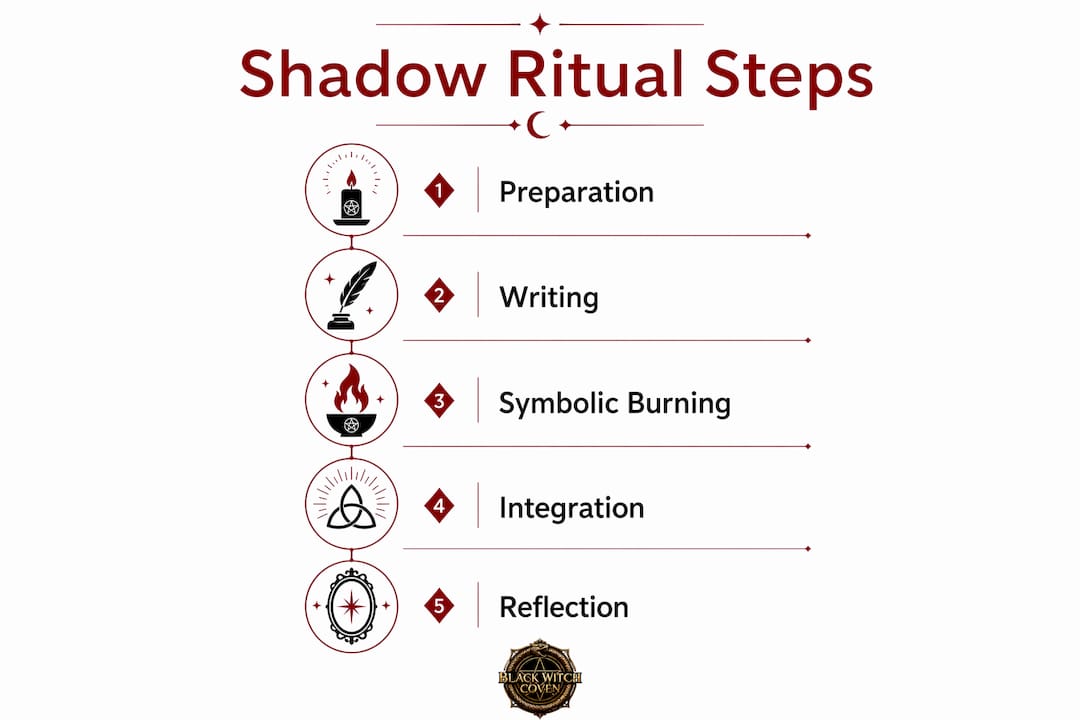
- Set the container. Choose a private space. Use black or dark purple candles to signal the unconscious that this is deliberate shadow territory. Ground yourself with a brief centering practice before beginning.
- Identify the target trait. Choose one specific shadow element per session. Trying to process multiple traits at once dilutes the work. Name the trait precisely: not “my anger” but “the rage I feel when my authority is dismissed.”
- Write and burn. Write the trait, its history, and its cost in full. Then burn the paper. This is not a banishing. It is an acknowledgment that the trait existed, served a purpose, and is now being consciously reclaimed rather than suppressed.
- Work with triggers. Identify the situations that activate this shadow trait most reliably. These are your access points. Triggers are not problems to eliminate. They are maps to the material.
- Refill the space. Shadow work is a cleansing and refilling process. After acknowledging and releasing the suppressed form of a trait, consciously install its integrated form. Rage becomes directed will. Greed becomes sovereign ambition. Fear becomes discernment.
- Close the ritual. Ground again. Eat something. Drink water. Mark the session as complete with a deliberate closing statement.
Timing and frequency
Shadow integration rituals require 90–120 minutes and should be spaced monthly or quarterly. That spacing is not arbitrary. The subconscious needs time to process what the ritual surfaces. Compressing sessions into weekly work is one of the most common mistakes serious practitioners make.
| Session element | Recommended approach |
|---|---|
| Session length | 90–120 minutes per deep integration ritual |
| Frequency | Monthly or quarterly for deep work |
| Daily practice | Journaling and reflection only, not full ritual |
| Aftercare window | Several days of internal settling before discussing the material |
| Number of traits per session | One specific trait per ritual |
Pro Tip: Discussing raw shadow content too soon after ritual dilutes its transformative power. Keep the material internal for several days. Let the subconscious process what the ritual opened before you externalize it in conversation or writing.
The magick theory and practice framework that supports shadow integration emphasizes one principle above all others: the ritual is not the end of the work. It is the beginning of a subconscious process that unfolds over days and weeks. Respecting that timeline is what separates effective integration from emotional performance.
What are the uses of shadow magick in advanced occult practice?
Shadow magick has direct, practical applications across the full spectrum of Left-Hand Path work. These are not theoretical benefits. They are operational advantages that show up in ritual results.
Channeling shadow traits in spellcraft
Practitioners consciously transform shadow traits into usable energy for protection, influence, and empowerment workings. A practitioner who has integrated their ruthlessness can call on it deliberately in a domination spell without it leaking into unrelated areas of their life. A practitioner who has reclaimed their greed can channel it cleanly into a Clauneck working for wealth without unconscious guilt sabotaging the result.
Shadow magick for protection
Shadow magick for protection works because the practitioner who knows their own darkness is not easily manipulated through it. Psychic attacks and curse work typically exploit the target’s unexamined shadow material. They find the cracks. A practitioner with integrated shadow material presents far fewer exploitable vulnerabilities. The psychic shield is stronger when it is built on self-knowledge rather than wishful thinking.
Empowerment and spiritual growth
- Reclaiming the golden shadow produces the sovereign presence required for effective evocation and pact work
- Integrating suppressed ambition removes the unconscious ceiling that limits prosperity and influence workings
- Owning disowned authority makes command over entities cleaner and more direct
- Claiming repressed creativity opens new ritual approaches that rigid, unexamined practitioners never access
- Processing suppressed grief or shame removes the emotional static that clouds divination and spirit communication
Ethical considerations
Shadow magick does not require moral neutrality. It requires honesty. The Left-Hand Path does not demand that you become your worst impulses. It demands that you know them, own them, and direct them consciously. The difference between a practitioner who uses shadow energy with precision and one who is simply acting out their unresolved material is integration. One is sovereign. The other is reactive.
Working with entities like Andras or Astaroth while carrying unexamined shadow material is like operating heavy machinery while impaired. The power is real. The lack of control is also real. Shadow integration is what gives you the wheel.
How do you avoid common pitfalls in shadow magick practice?
Shadow magick carries real risks. Acknowledging them is not weakness. It is the mark of a practitioner who takes the work seriously.
Pro Tip: Daily reflection supports shadow work, but deep integration rituals limited to monthly or quarterly frequency prevent burnout and maximize subconscious processing. Journaling between sessions keeps the channel open without forcing premature depth.
The most common pitfalls include:
- Overexposure: Running deep shadow rituals weekly or more frequently overwhelms the psyche’s ability to integrate. The result is emotional instability, not empowerment.
- Shadow obsession: Becoming fascinated with the darkness to the point of wallowing rather than integrating. The goal is reclamation, not residence.
- Shadow avoidance: Acknowledging the concept intellectually while refusing to engage with specific material. This is the most common form of self-deception in occult practice.
- Skipping the refill phase: Failing to install healthy integrated patterns after releasing suppressed ones leaves a vacuum that the old pattern will rush back to fill.
- Treating shadow work as a substitute for therapy: Shadow work is reflective and complementary to therapy, not a replacement for it. Traumatic material, including childhood abuse, severe dissociation, or active crisis, requires professional clinical support. Attempting to process that material through ritual alone is dangerous.
Recognizing when you have hit the boundary of what ritual can safely hold is a sign of advanced practice, not failure. The most effective practitioners know when to work alone, when to work with a skilled guide, and when to seek clinical support. Those boundaries are not contradictions of the Left-Hand Path. They are expressions of genuine sovereignty over your own process.
Key Takeaways
Shadow magick produces its most powerful results when practitioners integrate disowned traits through structured, infrequent rituals rather than forcing continuous exposure to raw shadow material.
| Point | Details |
|---|---|
| Shadow distorts magical intent | Unexamined shadow material corrupts spell outcomes by injecting unconscious beliefs into the working. |
| Integration, not banishment | Shadow magick reclaims disowned traits as usable power rather than eliminating or suppressing them. |
| Ritual timing matters | Deep shadow rituals should run 90–120 minutes and occur monthly or quarterly, not weekly. |
| Protection through self-knowledge | Integrated shadow material closes the psychological vulnerabilities that psychic attacks exploit. |
| Therapy has a role | Traumatic shadow material requires clinical support; ritual work alone is not sufficient for severe psychological wounds. |
FAQ
What is shadow magick in occult practice?
Shadow magick is the deliberate integration of repressed psychological and spiritual traits to strengthen magical intent and personal power. It draws from both Jungian psychology and Left-Hand Path tradition.
How does shadow magick work in a ritual context?
A shadow integration ritual identifies one specific disowned trait, processes it through writing and symbolic burning, and consciously reclaims its energy in integrated form. Sessions run 90–120 minutes and are spaced monthly or quarterly.
What are the main benefits of shadow magick for practitioners?
Shadow magick removes the unconscious distortions that corrupt spell outcomes, strengthens psychic protection by closing exploitable vulnerabilities, and produces the sovereign presence required for effective evocation and pact work.
Can shadow magick be used for protection?
Shadow magick for protection works by eliminating the unexamined psychological cracks that psychic attacks exploit. A practitioner with integrated shadow material presents far fewer entry points for external interference.
How often should you do shadow magick rituals?
Deep shadow integration rituals should occur monthly or quarterly. Daily journaling and reflection support the process between sessions without forcing premature depth or risking burnout.
How to Perform the Black Mirror Evocation Ritual
A black mirror is a working face: a darkened glass we use to call a spirit into sight, put a question to it, and take back what it will actually give us. In this house it has held Lucifer and Lilith, other people’s petitions, and nights when one person keeps the room while the other asks. If you have been around here for a while you already know the pattern.
The full moon comes, the petitions come in, and somebody has to put that work in front of a spirit that will actually answer. The mirror is how we give that answer a place to land.
This page is the method as we use it. How we think about the glass, how to make one and wake it, and how the evocation itself runs when the night is live.
What the black mirror is here
A black mirror is a scrying surface with enough dark in it that your ordinary face stops being the main event. Obsidian is the beautiful version. Painted glass is the version most people can make before the next moon. A bowl of black water, a slab of onyx, a big black stone with a shine on it: all of those can serve if you can look into them long enough for the chatter behind the eyes to thin out.
We treat it as a meeting place. The spirit is called to the glass, or to the dark around the glass, and the conversation happens there. That is why this tool sits so naturally with Lucifer and Lilith. They are not shy currents, and they do not need a theatre set, but they do need a surface you are willing to stare into while you hold a name. Petition work sits there for the same reason. You are carrying other people’s sentences into a dark face and asking a spirit to take them.
What the glass is doing, in plain terms, is taking attention and giving it a body. You look. The room gets quieter. The name has somewhere to arrive that is not only inside your head. Used with a question and enough stillness, that becomes evocation you can see, or at least evocation you can feel hard enough to write down afterward.
Older books love to pile cave stories and possession tales onto mirrors. We have always been more interested in what happens when you sit down, call a name, and stay with the glass long enough for the other side to use it. Sometimes that is a shape. Sometimes it is a pressure in the room. Sometimes it is a line so sharp you have to tease it into English later, which is exactly how the Lucifer and Lilith night ran when the messages came through fast and thick.
How to make one and wake it
You can buy obsidian and be done, or you can make a working glass tonight and have it on the altar before the moon is up. Take a picture frame you do not care about, take the glass out, paint one side with several coats of black enamel, and let it dry until it is truly hard. Cheap frames warp if you rush that part. Glass with black tape on the reverse will also work, and a dark bowl of black liquid will work if that is what the night has given you. We have never found that the expensive face automatically gets a better spirit. It gets a prettier object.
A full moon night is a good night to wake it, because that is when this house already likes to put work through the third eye and the psyche. Set the mirror where it will live, not where it will look pretty for a photograph. Sit until the ordinary chatter drops a little. Look at the glass. Breathe. Let it become something you are in a room with instead of something you are displaying.
We wake a mirror the way we wake any standing tool in this house: a name, some heat, and a job. Lucifer and Lilith are the names we have put in front of that glass when the moon work is theirs. Astaroth is an old prophetic face some people still use when the tool is meant for seeing. Use the name you are actually working. Speak to the glass as a thing that is about to take work. Put a little of that night into it. Breath and sight will do. Sex will do if that is how you charge. Blood will do if this mirror is meant to stay a house tool and not a one-off experiment. Then leave it on the altar as a face you intend to come back to.
The test is simple and unromantic. When you sit with it later, you should be able to look without manufacturing a mood. If it still feels like painted picture-frame, wake it again on another night and give it another name-and-heat. If it already feels like a door you have used, you are ready to call through it.
Keep the glass covered when you are not working it, if only because a seeing tool left out in a busy room picks up every stray look in the house. A cloth is enough. The point is that the face gets opened on purpose.
How we run evocation in this house
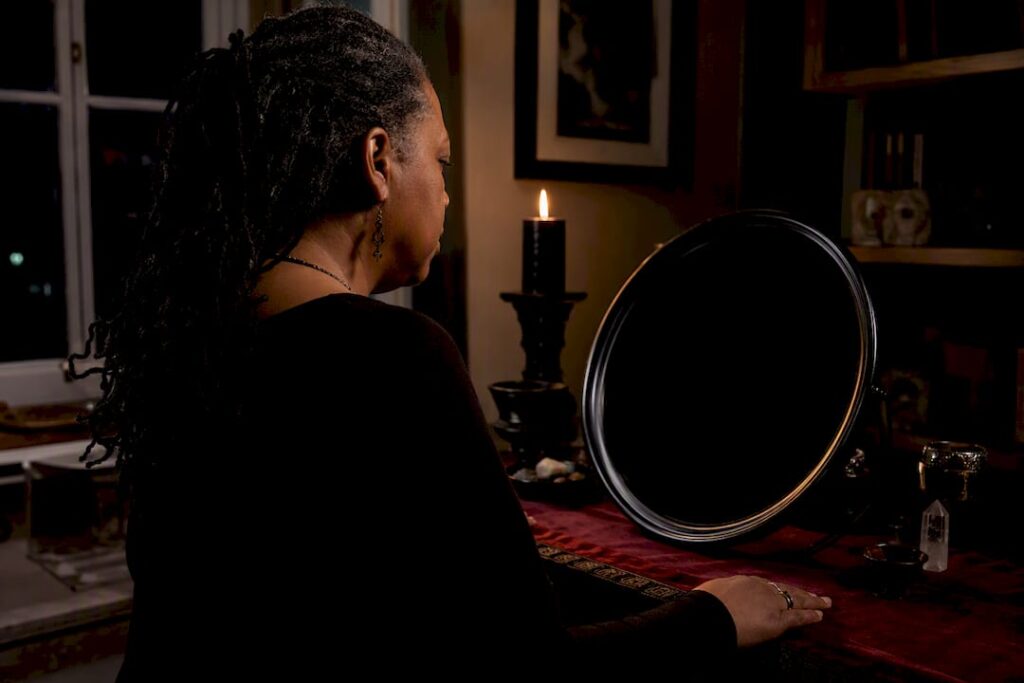
Evocation here is a conversation with a spirit in the glass. The night we ran for that March full moon is a fair picture of the shape. The group held their usual drawing-down in the temple. I went off with Edwin to the black mirror, called Lucifer and Lilith, and let him ask while I kept the contact. Your petitions went into that space, were read, and were burned at the end so they left the mouth and crossed. What came back was not a tidy sermon. It was hard pieces about the third eye, about getting out of other people’s thoughts, about staying on your own path. Afterward we sat with those pieces and teased them into language you could use. That teasing is part of the rite. The mirror rarely owes you a paragraph in real time.
Two people makes this easier when the night is heavy. One person holds the space: the name, the glass, the energy, the room. The other asks. If you have ever tried to do every job yourself, you already know why. You are holding the spirit, holding yourself, reading other people’s petitions, and keeping the dark from going slack, all in the same breath. With two, the questions stay clean and the contact can stay thick. If you are working alone, the same order holds. You will simply be doing both jobs, which means you go slower, you ask one thing at a time, and you write sooner so the sharp pieces do not dissolve into “I think something happened.”
Set the room so the mirror is the thing you look at. Low light. Incense if the spirit takes it. The glass tipped or stood so you are not fighting your own reflection the whole night. Petitions, if you are carrying other people’s work, get read into that space and then burned. Call the spirit by name to the glass.
You can use a short charge of this kind, with the name filled in:
Spirit N.,
I call you to this glass.
Rise from the dark you keep and show yourself in this reflection.
Give me what I have come to see, and the answer that belongs to the question I am putting to you.
Then you look. Stay longer than is comfortable. The first minute is usually your own face and your own nerves. The useful minute is the one after that, when the surface starts to do something besides sit there. What arrives may be a face, a movement in the dark, a run of images, a heat, or a sentence that is ruder than you wanted. In this house the other side often speaks in hard, short pieces. You take what you get. You ask the next question if the contact is still there. You do not pad the message into something prettier while you are still in the glass.
When the conversation is done, thank the spirit in the way you actually speak. Close the looking. Cover the glass. Write. Date, name, who asked, what you asked, what came, and what you made of it once you were out of the working. That notebook is how a night becomes a practice. It is also how you notice, months later, that the blunt thing said in the mirror was the thing that turned out to be true.
If the night is petition work for other people, say so in the opening. You are carrying sentences that are not yours. Read them. Burn them. Ask what can be given back to the people who sent them. Then do the human part afterward, which is turning a sharp spiritual answer into something a tired person can use on a Thursday.
That is the black mirror evocation ritual as we use it. A dark face, woken on purpose. A spirit called to that face. Questions asked, petitions released, answers taken down while they are still sharp. The rest of the furniture, triangles and extra names and extra theatre, can come in when your own work asks for it. The glass, the name, the question, and the notebook will already get you into the room.
