
 New Years Eve Ritual 2026/2027 with Savannah
Blog, Demonolatry, Satanism
Demonolatry vs. Luciferianism: A Scholarly Comparison
Aug
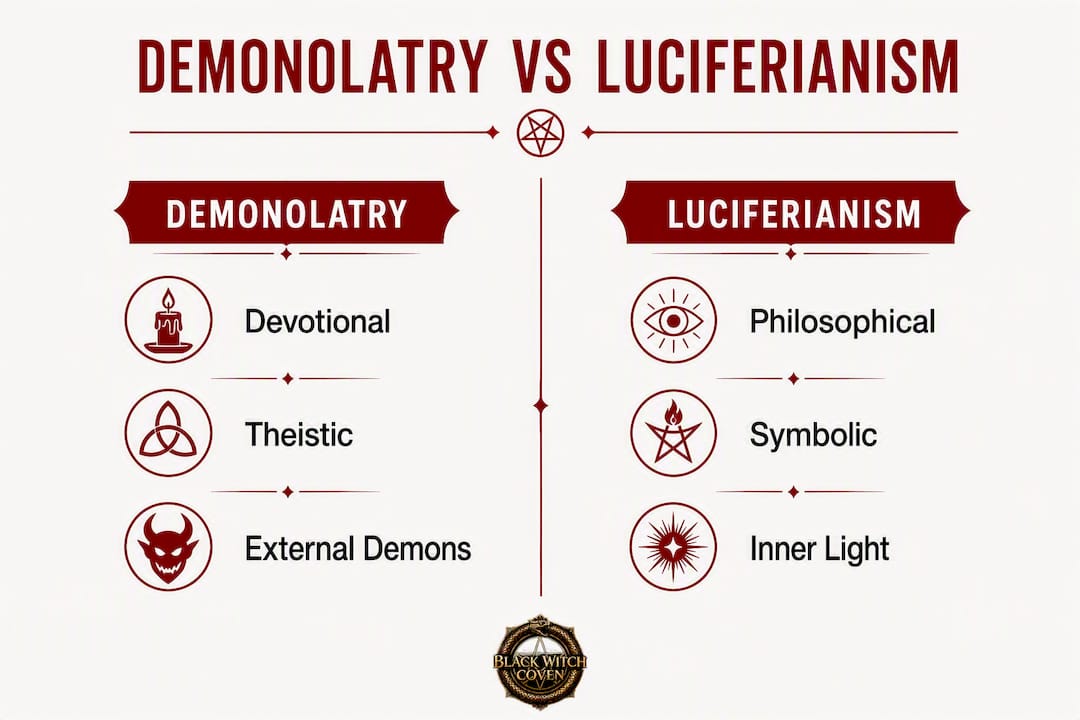
Demonolatry and Luciferianism are two distinct intellectual traditions within the Left-Hand Path, and the core difference is directional: Demonolatry centers on devotional relationship with external demonic intelligences, while Luciferianism centers on internalizing the Lucifer archetype to achieve apotheosis through knowledge and illumination.
- For practitioners: Demonolatry demands reciprocal engagement with specific entities through offerings, pacts, and invocation. Luciferianism demands rigorous self-examination, initiatory rites, and the deliberate cultivation of gnosis.
- For ontology and ethics: Demonolatry treats demons as genuinely external beings deserving devotion. Luciferianism treats Lucifer primarily as an archetypal or psychological force to be internalized and embodied.
For ritual and practical differences, go directly to the ritual praxis section. For historical lineage and primary texts, the history section covers the full timeline from the Book of Enoch through modern grimoire traditions.
Table of Contents
- How scholars and practitioners define each path
- Historical origins and the primary texts that shaped both paths
- A point-by-point intellectual comparison of both traditions
- How ritual practice actually differs between the two paths
- The philosophical scaffolding: ontology, ethics, and cosmology
- Modern movements, organizations, and the thinkers who shaped them
- Practitioner-informed insights: applied examples and E-E-A-T
- Common misconceptions and the debates worth taking seriously
- Key Takeaways
- Why the path you choose should match the question you are actually asking
- Selected bibliography and trustworthy sources
- FAQ
How scholars and practitioners define each path
Demonolatry is the devotional practice of working with demonic entities as intelligent, external beings worthy of reverence, reciprocal exchange, and ongoing relationship. Practitioners invoke specific spirits from established traditions, most commonly the Goetia, and engage them through offerings, pacts, and liturgical rites rather than commanding or banishing them.
Luciferianism is a philosophical and spiritual path that uses Lucifer as the central symbol of intellect, self-liberation, and deliberate self-evolution. The philosophy of Luciferianism frames the practitioner’s goal as apotheosis: becoming, through knowledge and will, something closer to a sovereign, self-created being. Whether Lucifer is treated as a literal deity or a psychological archetype depends entirely on the individual or group.
Both traditions sit within the broader category of Satanism, but neither maps cleanly onto it. Demonolatry is often theistic and devotional in ways that distinguish it from philosophical Satanism. Luciferianism shares Satanism’s antinomian individualism but typically rejects the reactive, anti-Christian framing that defines some Satanic currents. The terms are frequently conflated online, which is one reason a precise vocabulary matters.
The theistic-to-symbolic spectrum runs through both traditions. Most Demonolatry practitioners are theistic. Luciferians split more evenly: some hold Lucifer as a genuine cosmic intelligence, others treat him as a “deific mask,” a usable archetype for motivating inner transformation. Both positions are intellectually defensible within their own cosmological frameworks.
Historical origins and the primary texts that shaped both paths
The intellectual roots of both traditions reach back centuries, though their modern forms crystallized in the twentieth century.
| Period | Development | Key Texts / Figures |
|---|---|---|
| 2nd century BCE | Enochic literature establishes the Watchers mythology and a taxonomy of fallen angels | 1 Enoch (Book of the Watchers) |
| Medieval–Renaissance | European demonology systematizes demon hierarchies; grimoire tradition emerges | Ars Goetia, Lemegeton, Pseudomonarchia Daemonum |
| Early modern | Demonology becomes a field of serious scholarly and theological debate | Johann Weyer, De Praestigiis Daemonum; Nathan Johnstone’s research on the Devil in early modern England |
| — | Occult revival; grimoire reissues; Lucifer reframed as symbol of enlightenment | Éliphas Lévi, Dogme et Rituel de la Haute Magie |
| twentieth century | Modern Satanism and LHP movements codify distinct paths | Anton LaVey’s The Satanic Bible; Michael Aquino’s Temple of Set |
| modern era | Demonolatry and Luciferianism emerge as distinct, self-identified traditions | S. Connolly’s The Complete Book of Demonolatry; Michael W. Ford’s Luciferian writings |
The Book of Enoch is foundational for both paths. Its account of the Watchers, fallen angels who transmitted forbidden knowledge to humanity, provides the mythological scaffolding for understanding demonic intelligences as teachers rather than adversaries. The Lesser Key of Solomon, specifically the Ars Goetia, supplies the 72-spirit hierarchy that Demonolatry practitioners most commonly work with.
Historian Jan Machielsen’s work frames “thinking with demons” as a deliberate intellectual strategy used across centuries to resolve metaphysical and epistemological problems. Early modern scholars did not simply fear demons; they used demonological reasoning as a conceptual tool. That precedent matters for modern practitioners: ritual engagement with demonic intelligences has a long, serious intellectual history, not merely a folkloric one.
Academic volumes like Philosophical Approaches to Demonology (Taylor & Francis) situate demonology within philosophy proper, treating it as a subject of legitimate inquiry across metaphysics, epistemology, and moral philosophy. This is not fringe scholarship.
A point-by-point intellectual comparison of both traditions
| Axis | Demonolatry | Luciferianism |
|---|---|---|
| Primary focus/aim | Devotional relationship with demonic entities; practical outcomes through reciprocal exchange | Apotheosis through knowledge; self-deification via internalization of the Lucifer archetype |
| Ontology of demons | Demons as genuinely external, intelligent beings deserving reverence | Lucifer/demons as archetypal or “deific mask” forces; sometimes literal entities, often psychic tools |
| Typical ritual forms | Devotional altars, offerings, pacts, invocations, reciprocal exchanges | Initiatory rites, gnosis-focused ceremonies, self-apotheosis workings |
| Theistic spectrum | Predominantly theistic | Ranges from fully theistic to symbolic/atheistic |
| Ethical framing | Transactional devotion; mutual respect and reciprocity with entities | Self-sovereignty, illumination, antinomianism; ethics derived from personal gnosis |
| Primary textual sources | Ars Goetia, Book of Enoch, S. Connolly’s practitioner manuals | Michael W. Ford’s Luciferian writings, Gnostic texts, Hermetic philosophy, the 11 Points of Power |
| Common practitioner outcomes | Specific material and spiritual results through spirit relationships | Psychological transformation, expanded consciousness, long-term self-evolution |
The comparison above captures the dominant tendencies, but the edges blur in practice. A serious Demonolatry practitioner often develops a sophisticated philosophical framework around their spirit relationships. A committed Luciferian may work with specific Goetic entities as part of their initiatory curriculum. The shared Left-Hand Path values of individualism, self-deification, and antinomianism mean both traditions draw from overlapping intellectual wells.
Hybrid practitioners are common and intellectually coherent. Someone might maintain a devotional altar to Astaroth while simultaneously pursuing a Luciferian initiatory program. The two approaches are not mutually exclusive; they address different aspects of the same sovereign project.
How ritual practice actually differs between the two paths
The structural difference in ritual is clearest when you look at what each practitioner is trying to accomplish in the working itself.
Demonolatry ritual forms typically include:
- Devotional altars dedicated to specific entities, maintained with regular offerings of incense, candles, food, or libations
- Formal invocations that address the entity as a sovereign intelligence, using respectful, relational language
- Pacts structured as genuine agreements with reciprocal obligations on both sides
- Enns (devotional chants specific to each demon) used to open and deepen the relationship
- Seasonal rites tied to the demonic calendar, honoring entities at specific times of year
Luciferian ritual forms typically include:
- Initiatory rites designed to mark stages of self-transformation and expanded awareness
- Gnosis-focused workings where the practitioner seeks direct illumination rather than a specific external outcome
- Self-apotheosis ceremonies that symbolically enact the practitioner’s evolution toward divine selfhood
- Invocation of Lucifer as an interior force, drawing the archetype into the self rather than petitioning an external being
- Use of summoning symbols and sigils as focal points for psychological and spiritual transformation
The relational tone differs sharply. Demonolatry invocation speaks to an entity with devotion and respect. Luciferian invocation often speaks as or through the archetype, collapsing the distance between practitioner and force. Neither approach is superior; they serve different goals.
Pro Tip: Before working with any entity, establish your intent with precision. Vague requests produce vague results in Demonolatry, and vague self-concepts produce vague transformation in Luciferianism. Clarity of purpose is the one non-negotiable in both traditions. If you are new to pact work specifically, understanding the unknown variables in ritual before you begin will save you significant frustration.
The philosophical scaffolding: ontology, ethics, and cosmology
The intellectual difference between these paths runs deeper than ritual form. It reaches into how each tradition answers the most basic metaphysical questions.
On the ontology of demons:
Demonolatry holds that demonic entities are genuinely real, external intelligences with their own wills, preferences, and domains. This is not naive supernaturalism; many Demonolatry practitioners hold sophisticated philosophical positions about the nature of these beings, drawing on animism, polytheism, and even process philosophy. Luciferianism, by contrast, often treats Lucifer and associated forces as archetypal or psychic realities, real in the sense that psychological forces are real, but not necessarily ontologically independent of the practitioner’s mind. Some Luciferians hold a fully theistic position; the tradition accommodates both.
On ethics:
Demonolatry ethics are relational and transactional. You honor your agreements with entities, maintain your altars, fulfill your obligations. The moral framework is built around reciprocity. Luciferian ethics, as codified in frameworks like the 11 Points of Power, are built around self-sovereignty and personal responsibility. The practitioner is the ultimate moral authority in their own life. Both traditions share antinomianism, the rejection of externally imposed moral codes, but they arrive at that position through different reasoning.
On philosophical influences:
Gnosticism runs through both paths. The Gnostic idea that hidden knowledge liberates the self from false constraints maps directly onto Luciferian apotheosis. Hermeticism, with its “as above, so below” framework and its emphasis on the magician’s capacity to reshape reality through will and knowledge, informs both traditions’ ritual theory. Existentialism, particularly the emphasis on radical self-creation and the rejection of predetermined essence, shows up explicitly in modern Luciferian writing.
That framing matters. It means ritual is not primitive belief; it is a technology for producing real effects, psychological, social, and spiritual, grounded in centuries of serious intellectual work.
Modern movements, organizations, and the thinkers who shaped them
The contemporary landscape of both traditions was shaped by a handful of key figures and organizations whose work serious practitioners should know.
S. Connolly is the most widely read modern Demonolatry author. Her The Complete Book of Demonolatry established a systematic practitioner framework and remains the primary reference for newcomers. Her work emphasizes respectful, devotional engagement with entities and provides structured ritual forms drawn from older grimoire traditions.
Michael W. Ford is the central figure in modern Luciferianism. His Luciferian Witchcraft and The Bible of the Adversary codify a philosophical and initiatory system that draws on Gnostic, Hermetic, and Yezidi sources. Ford’s work is dense and demands serious engagement; it is not casual reading.
The Assembly of Light Bearers represents an organized Luciferian current that has articulated the 11 Points of Power as a philosophical framework, positioning self-deification as an ethical project rather than mere spiritual aspiration.
Jesper Aagaard Petersen’s doctoral research, Between Darwin and the Devil, provides the most rigorous academic mapping of modern Satanism and its adjacent traditions, including the intellectual currents that shaped both Demonolatry and Luciferianism. It is essential reading for anyone who wants scholarly grounding.
Practitioner-informed insights: applied examples and E-E-A-T
The intellectual distinction between these paths becomes concrete when you look at how practitioners actually make choices.
Case vignette 1: A practitioner seeking material prosperity faces a choice. The Demonolatry approach leads them to establish a working relationship with Clauneck, the Goetic spirit of wealth, through regular offerings, a dedicated altar, and a formal pact. The reasoning is relational: Clauneck is an intelligent being with domain over wealth, and a respectful, reciprocal relationship produces results. The Luciferian approach to the same goal might involve a self-apotheosis working in which the practitioner embodies the qualities of sovereignty and abundance, using Lucifer as the archetypal force of illumination to identify and dissolve internal blocks to wealth. Both can work. The difference is whether the practitioner is building a relationship with an external intelligence or transforming their own internal architecture.
Case vignette 2: A practitioner dealing with a persistent enemy might invoke Andras in a Demonolatry framework, petitioning the entity through proper ritual protocol and offering appropriate exchange. In a Luciferian framework, the same practitioner might work a rite of self-empowerment that draws on the adversarial current to strengthen their own will and strategic clarity. The Demonolatry working delegates power to an entity; the Luciferian working cultivates power within the self.
Pro Tip: Do not start with pact work. Build the relationship first through offerings, invocation, and study of the entity’s nature and domain. Pacts are binding agreements, not experiments. If you are considering a formal pact and are uncertain about the terms or the entity, professional guidance on pact structure is worth the investment before you commit.
Ethics and integration checklist:
- Establish clear intent before any working; vague intent produces unpredictable results
- Maintain psychological grounding through regular practice outside of ritual (journaling, physical exercise, structured study)
- Honor all agreements made with entities; failure to fulfill pact obligations has consequences
- Do not attempt major initiatory or pact work during periods of significant psychological instability
- Know how to close a working cleanly; unresolved ritual energy is a real hazard
Black Witch Coven brings over 16 years of applied experience in Goetic pacts, Luciferian practice, and Left-Hand Path ritual work. That depth of practice, across thousands of client engagements spanning protection, prosperity, domination, and reconciliation, is the foundation for the practitioner insights throughout this article.
Common misconceptions and the debates worth taking seriously
“Demonolatry is just devil worship.” This is the most persistent misconception, and it is wrong on two counts. First, Demonolatry practitioners do not worship a singular “devil” in the Christian sense; they work with a diverse pantheon of demonic intelligences, each with distinct domains and characteristics. Second, “worship” in the Demonolatry context means devotional reverence and reciprocal relationship, not blind submission. The devotional and pragmatic orientation of Demonolatry is closer to polytheistic religious practice than to the Christian concept of devil worship.
“Luciferianism is always atheistic.” Also wrong. Luciferianism spans a wide spectrum. Many Luciferians hold Lucifer as a genuine cosmic intelligence. The symbolic or archetypal interpretation is common, but it is not universal, and treating it as the default misrepresents the tradition.
“Both paths are the same as Satanism.” They overlap with Satanism in their antinomian values and Left-Hand Path orientation, but neither is identical to it. LaVeyan Satanism is primarily philosophical and atheistic; Demonolatry is theistic and devotional; Luciferianism is initiatory and apotheotic. Conflating them produces category errors that mislead practitioners.
Substantive scholarly debates worth knowing:
- The ontology question: Are demonic entities genuinely independent intelligences, or are they psychological constructs that the practitioner’s mind generates? This debate has no consensus resolution and probably never will. Both positions are intellectually defensible.
- Grimoire historicity: Many grimoires attributed to ancient or medieval sources are demonstrably later compositions. The Ars Goetia as we have it dates to the 17th century, not to Solomon. Practitioners who treat grimoire attributions as literal historical fact are on weak ground; practitioners who treat them as useful mythological frameworks are on much stronger ground.
- Red flags in practice: Unverified claims of secret initiatory lineages, guarantees of specific outcomes without qualification, and sources that cannot cite their textual precedents are all warning signs. Serious practitioners and serious scholars both cite their sources.
Key Takeaways
Demonolatry builds power through relationship with external demonic intelligences; Luciferianism builds power through internalization of the Lucifer archetype and deliberate self-transformation toward apotheosis.
| Point | Details |
|---|---|
| Core intellectual distinction | Demonolatry is relational and devotional; Luciferianism is initiatory and apotheotic. |
| Ontology shapes practice | How you understand demons determines your ritual approach: external being vs. archetypal force. |
| Both share LHP values | Individualism, antinomianism, and self-deification are common ground across both traditions. |
| Primary texts matter | Start with the Book of Enoch, the Ars Goetia, S. Connolly, and Michael W. Ford before anything else. |
| Psychological preparation is non-negotiable | Grounding, clear intent, and fulfilled obligations are the minimum requirements for responsible practice. |
Why the path you choose should match the question you are actually asking
Most practitioners who get stuck are not choosing the wrong tradition. They are applying the wrong framework to their actual question. If you want a specific outcome through a specific entity, Demonolatry’s relational model is the more direct route. If you want to fundamentally change who you are, Luciferianism’s initiatory model is built for that. The mistake is treating them as competing religions when they are better understood as complementary methodologies.
What the popular literature almost never says: the intellectual rigor of your approach matters more than which tradition you claim. A practitioner who has read the Ars Goetia carefully, studied the entity’s domain and attributes, and constructed a ritual with clear intent and proper protocol will consistently outperform someone who has memorized the right vocabulary but done no serious study. Both Demonolatry and Luciferianism reward intellectual engagement. They punish laziness.
The question of when to seek professional ritual work is straightforward. If you are attempting pact work for the first time, if the stakes are high and the margin for error is low, or if previous workings have produced unexpected results, working with experienced practitioners is not a shortcut. It is the intelligent choice. Black Witch Coven’s work with entities including Lucifer, Clauneck, Andras, and Astaroth is grounded in over 16 years of applied practice. For serious workings, that depth of experience is not incidental.
Selected bibliography and trustworthy sources
Read primary texts first, then scholarly commentary, then practitioner manuals. That order builds the intellectual foundation that makes ritual work coherent rather than arbitrary.
| Source | Type | Why It Matters |
|---|---|---|
| 1 Enoch (Book of the Watchers) | Primary text | Foundational mythology of fallen angels as teachers; essential for understanding demonic ontology in both traditions |
| Ars Goetia / Lesser Key of Solomon | Primary grimoire | The 72-spirit hierarchy that Demonolatry practitioners most commonly work with; 17th-century compilation of earlier material |
| S. Connolly, The Complete Book of Demonolatry | Practitioner manual | The most systematic modern Demonolatry reference; clear ritual frameworks and entity profiles |
| Michael W. Ford, Luciferian Witchcraft | Practitioner manual | Dense but essential; establishes the philosophical and initiatory framework of modern Luciferianism |
| Jan Machielsen, The Science of Demons (Routledge) | Academic monograph | Frames demonology as a serious intellectual method; essential for scholarly grounding |
| McCraw & Arp, eds., Philosophical Approaches to Demonology (Taylor & Francis) | Academic volume | Situates demonology within academic philosophy; metaphysics, epistemology, moral philosophy |
| Nathan Johnstone, The Devil and Demonism in Early Modern England | Academic monograph | Historical analysis of how demonological thinking shaped culture and theology; essential context |
| Jesper Aagaard Petersen, Between Darwin and the Devil | Academic dissertation | The most rigorous scholarly mapping of modern Satanism and adjacent traditions |
| Assembly of Light Bearers, 11 Points of Power | Practitioner framework | Concise articulation of Luciferian philosophical aims; useful for understanding the tradition’s ethical structure |
Read the primary texts for mythological and ritual lineage. Read the academic volumes for intellectual context and scholarly credibility. Read the practitioner manuals for applied framework. Do not skip the academic layer; it is what separates serious practice from imitation.
FAQ
What is the core difference between Demonolatry and Luciferianism?
Demonolatry centers on devotional relationship with external demonic intelligences through offerings, pacts, and invocation. Luciferianism centers on internalizing the Lucifer archetype to achieve apotheosis through knowledge, will, and self-transformation.
Is Luciferianism always atheistic?
No. Luciferianism spans a wide spectrum from fully theistic, treating Lucifer as a genuine cosmic intelligence, to symbolic, treating him as a psychological archetype. Many Luciferians hold a theistic position; the symbolic interpretation is common but not universal.
What religion do Satanists most often conflict with?
Christianity, specifically its institutional forms, is the primary point of conflict for most Satanic and Left-Hand Path traditions, since the figure of Satan and Lucifer are defined in opposition to Christian theological categories. The conflict is more ideological than interpersonal.
What is Luciferian energy in practice?
Luciferian energy refers to the force of illumination, intellectual sovereignty, and self-liberation that practitioners invoke or embody in Luciferian workings. It is the current associated with Lucifer as the light-bearer: the drive toward knowledge, self-creation, and the dissolution of imposed limitations.
Are there established hierarchies of demons in these traditions?
Both traditions draw on established demonic hierarchies, most prominently the 72 spirits of the Ars Goetia and the angelic/demonic taxonomy of the Book of Enoch. Demonolatry practitioners typically work within these hierarchies devotionally; Luciferian practitioners may engage them as part of an initiatory curriculum or as archetypal forces within a broader cosmological framework.
