
 New Years Eve Ritual 2026/2027 with Savannah
Jun
The Solomon legends give us two different claims dressed up as one story. In the coercion account, Solomon binds demons with a ring and forces them to cut stone for the Temple. In the alternative account, a creature called the shamir does the cutting instead, with no demonic labor at all. Those are not two versions of the same fact. They rest on different sources, serve different theological purposes, and get frequently confused with a modern practice, “feeding your demons,” that has nothing to do with construction and everything to do with inner work.
TL;DR:
- The demon coercion story involves Solomon binding spirits with a magical ring and forcing them to perform labor, mainly construction.
- The shamir account describes a supernatural tool that shapes stone without demonic involvement, requiring no coercion or command.
- These stories come from different texts and traditions, serving unique theological and cultural purposes, rather than competing historical facts.
- Modern “feeding your demons” practices are psychological techniques from Tibetan tradition, unrelated to Solomon’s myth of forced labor or supernatural craftsmanship.
- Ritual partnership and coercion are fundamentally different, with coercive binding risking serious containment issues and partnerships relying on ongoing cooperation and trust.
The Difference Between Using Demons and Building With Them
“Using demons” in the Solomon tradition means literal coercion. A named demon gets bound, interrogated, and assigned physical labor under threat. “Building with them” gets used more loosely today, and it can mean three very different things: forcing an entity to perform a task, deploying a magical tool that bypasses demons entirely, or engaging in a negotiated, ongoing relationship with an entity where labor is never the point. Confusing these categories is where most casual retellings of the Solomon myth go wrong, and it’s also where a lot of contemporary occult writing gets sloppy.
The confusion has a specific source. Popular tellings of the Testament of Solomon collapse three distinct claims (command, tool, and partnership) into one folk image of “Solomon and his demons.” Separating them is the only way to read the material honestly, whether you’re approaching it as a scholar, a believer, or a witch deciding how you want to work with entities in your own life.
Coerced Labor vs. the Shamir: A Side-By-Side Reading
The Temple-building motif splits cleanly into two competing explanations, and both circulated in overlapping communities for centuries.
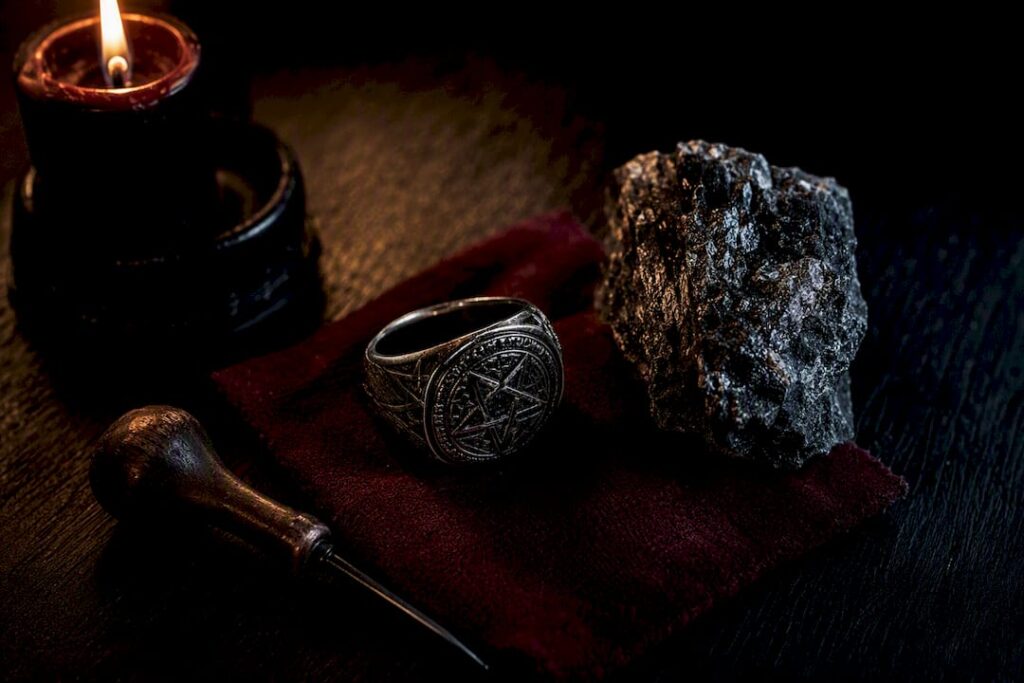
In the coercion account, Solomon receives a ring with a seal, often described as given by an archangel, that gives him power over demonic beings. He uses it to bind figures like Ornias and interrogate them about their names, weaknesses, and functions. Once bound, the demons get put to hard labor: cutting and hauling stone for construction that human workers supposedly couldn’t manage alone. The Testament of Solomon is the fullest surviving version of this motif, and it treats the ring less as a symbol than as a functioning magical technology.
In the alternative account, the shamir does the work instead. Descriptions vary between a worm-like creature and a stone with cutting properties, but its defining trait is that it needs no coercion and involves no demon. Builders use it, or it is used on their behalf, and the stones are shaped without iron tools, which rabbinic tradition treats as a requirement for a sanctified building site.
Here’s how the two accounts actually differ:
- Agency: demons are coerced under threat; the shamir requires no negotiation or command at all.
- Method: the ring functions as a legal and magical instrument of control; the shamir functions as a natural or semi-magical tool.
- Theology: the demon account frames Solomon’s power as dominion over evil; the shamir account frames his power as wisdom and access to secret knowledge.
- Narrative function: the demon story explains an impossible labor problem through supernatural force; the shamir story explains it through supernatural craftsmanship.
The Katz Center points out that these aren’t rival “true” and “false” accounts competing for the same slot. They’re parallel traditions that different communities preserved for different reasons, sometimes within the same body of literature.
Where These Stories Actually Come From
None of this comes from a single, stable text. It comes from a scattered, centuries-long literary tradition that scholars have had to reconstruct piece by piece.
The Testament of Solomon is the anchor text for the coercion narrative. It’s generally dated to somewhere between the first few centuries CE, written in Greek, and structured as a series of demon interrogations: Solomon asks each spirit its name, its harmful function, and the angel or method that neutralizes it. Scholars studying medieval reception of demon motifs treat it as a hybrid of Jewish legend, Hellenistic magical practice, and early Christian demonology, not a straightforward historical record of Solomon’s reign.
The shamir tradition surfaces separately, mainly in Talmudic and midrashic material tied to figures like Ashmedai. Consider a few key sourcing points:
- The Katz Center’s analysis traces how Talmudic passages sometimes have Solomon command Ashmedai directly, and other times route the solution through the shamir instead.
- Medieval and folk retellings blend these strands further, often smoothing over the contradiction rather than acknowledging it.
- Some later summaries, including entries on sites like Jewish Mythology, preserve the binding-and-interrogation motif almost intact from the older sources.
Treat all of this as myth with a documented paper trail, not as a chronicle. The value is in what the stories reveal about the cultures that told them, not in whether Solomon literally owned a magick ring.
Why Storytellers Reached for Demons in the First Place
Four interpretive lenses explain why demon motifs attach to construction stories at all, and each one answers a different question.
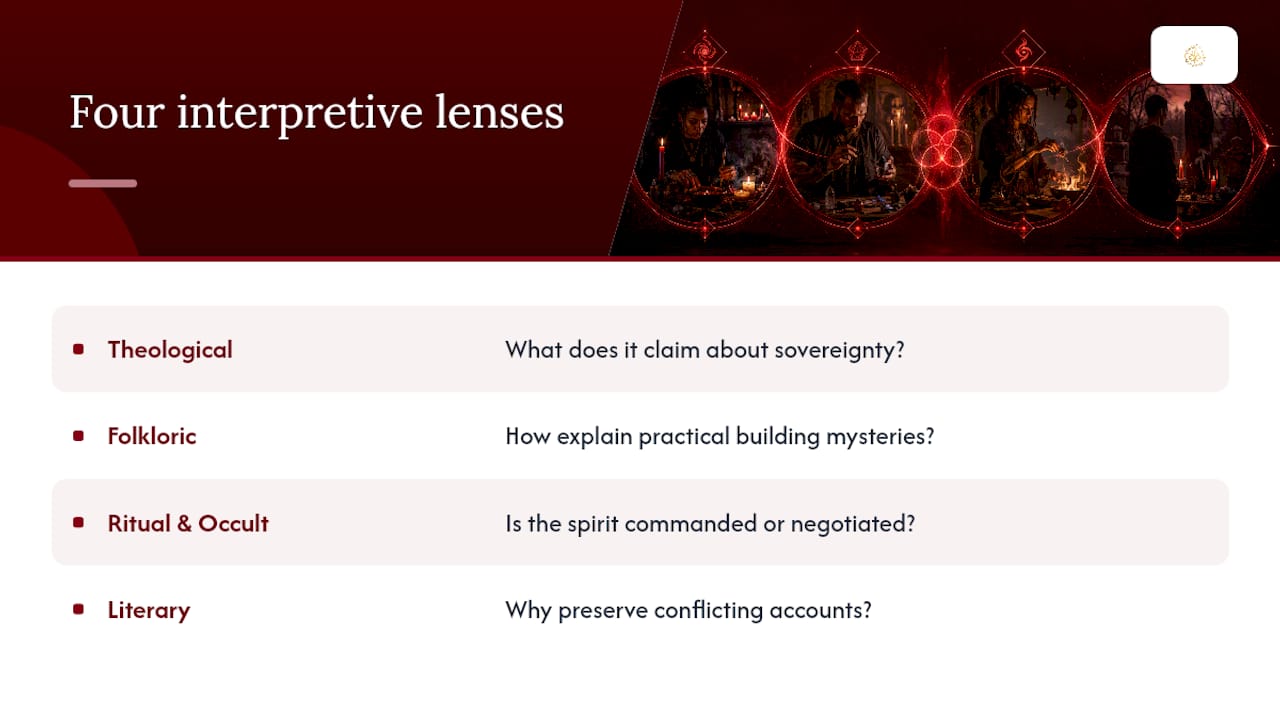
The theological lens treats the demon-labor story as a statement about sovereignty. If God’s chosen king can command the very forces that oppose divine order, that’s a claim about hierarchy, not architecture. It’s also a deliberate paradox: using adversarial power to build something sacred forces the audience to sit with an uncomfortable question about where legitimate authority ends.
The folkloric lens is more practical. Ancient builders faced genuine mysteries, like how a temple got built without iron tools touching consecrated stone. A supernatural explanation fills that gap more satisfyingly than “we don’t know.”
The ritual and occult lens matters most for witches. The vocabulary of names, seals, and rings in the Testament tradition isn’t decorative. It reflects real technical distinctions between command (binding a spirit against its will) and pact (negotiating with one). Modern ceremonial magick still preserves that distinction, and reading the Grimorium Verum or similar grimoires makes clear that binding and pact-making were never treated as interchangeable operations.
The literary lens explains the mess itself: cultures preserve conflicting accounts side by side because oral and manuscript traditions rarely get edited into consistency.
Pro Tip: When you read any Solomon legend, ask which of the four lenses the storyteller is using before you ask whether the story is “true.” The answer changes what the demon in the story is actually for.
“Feeding Your Demons” Is Not a Construction Story
This is where modern readers most often trip. Machig Labdrön, the eleventh-century Tibetan teacher credited with developing the Chöd lineage, is the source behind a practice now taught widely as “feeding your demons.” It has zero connection to Solomon, stone, or labor.
The method runs in five recognizable steps:
- Personify the inner obstacle (fear, shame, an addictive pattern) as a demon with a shape and a voice.
- Find its need, asking what the demon actually wants rather than what it seems to threaten.
- Feed it, symbolically giving it what it needs through visualization.
- Integrate the transformed energy back into yourself.
- Rest in the calm that follows the exchange.
Teachers at Spirit Rock and Tara Mandala both present this as psychological and contemplative work, not ritual construction magick. The “demon” here is a metaphor for an obstacle inside your own mind. If you want to explore the actual technique, read those primary sources directly rather than treating “feeding your demons” as a variant of Solomon’s Temple story. The word overlap is coincidental at best, and misleading at worst.
Reading the Myth Like a Magician, Not a Literalist
Solomon’s ring is a myth about total command. Real ritual partnership, the kind serious occultists build over years, works differently, and conflating the two leads people into bad assumptions about how entity work actually functions.
Binding rituals use commands, seals, and coercive language, and they carry real containment risk if the witch lacks the skill to close what they open. Negotiated partnerships, built through offerings, pacts, and ongoing relationship, function more like the arrangements described in accounts of making a pact through Lucifuge Rofocale. There, the entity’s cooperation is earned and maintained, not extracted by force.
Solomon’s ring is a story about total control, not a manual. Anyone who reads it as an operational instruction, rather than as a mythic template for command, misunderstands what the text is doing and what real ritual partnership actually costs.
Myths inform ritual imagination. They were never meant to double as procedure.
Our Take: Read the Categories Before You Read the Myth
The Solomon material rewards readers who resist the urge to flatten it into one tidy story. The demon-labor account and the shamir account aren’t competing eyewitness reports. They’re two different theological arguments wearing the same cast of characters, and pretending otherwise is where most popular retellings fail.
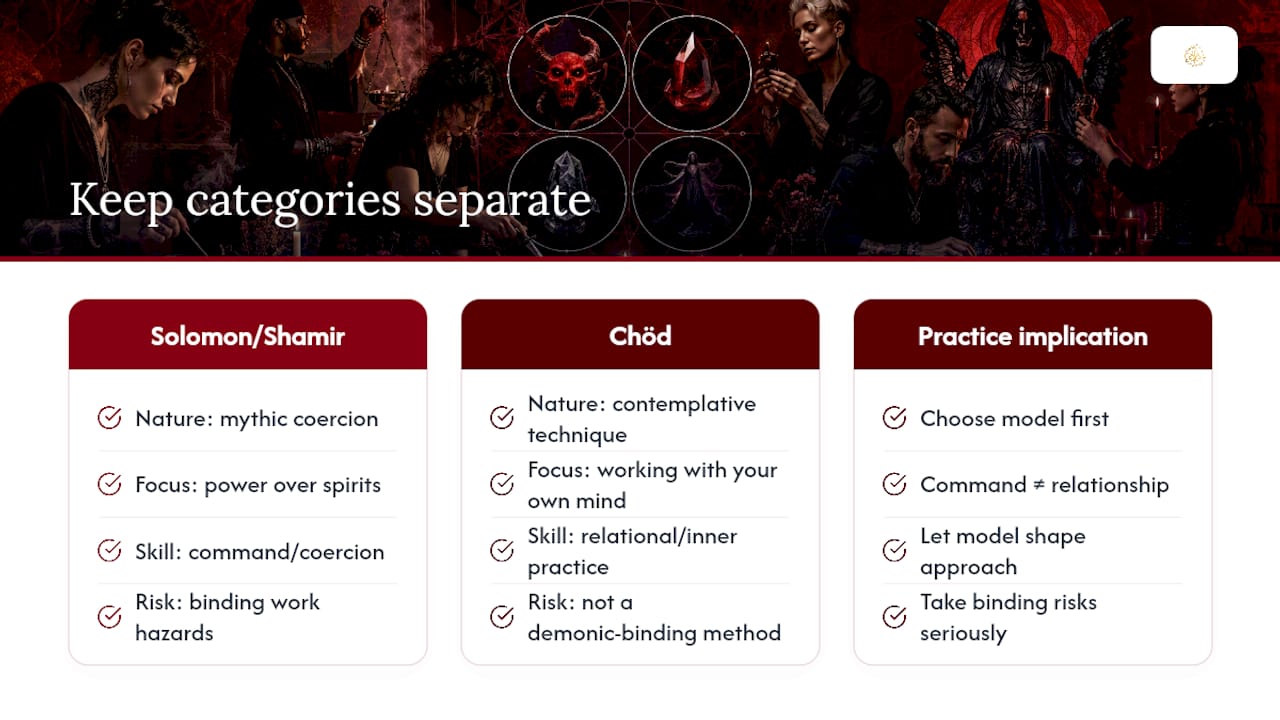
The bigger error, though, is importing “feeding your demons” into the same conversation as if Machig Labdrön’s Chöd practice were somehow a gentler version of Solomon’s ring. It isn’t. One is a mythic claim about coercive power over spirits. The other is a contemplative technique about your own mind. Magicians serious about entity work owe themselves the discipline to keep those categories separate, because the ritual risks of actual binding work are real, and no metaphor cancels them out.
If you’re drawn to the partnership model rather than the coercion model, that distinction should shape how you approach any working, including the kind of demonic pact work Black Witch Coven has guided clients through for years. Command and relationship are not the same skill, and myths that blur them make for bad ritual education.
— Black Witch Coven
Sources
For primary and scholarly grounding, consult the Testament of Solomon, the Katz Center’s essay on Ashmedai, Spirit Rock’s guide to feeding your demons, and older public-domain retellings via Project Gutenberg.
- The Demons inside Ashmedai — Katz Center
- Feeding your demons — Spirit Rock
- Testament of Solomon (Wikipedia)
- 5 Steps of Feeding Your Demons — Tara Mandala
FAQ
Did King Solomon use demons to build his Temple?
According to the Testament of Solomon, yes, Solomon bound demons with a magical ring and forced them into construction labor. A separate Talmudic tradition credits the work instead to the shamir, a non-demonic tool.
What’s the difference between demons and strongholds?
In demonology, a demon refers to a specific entity or spirit, while a “stronghold” is a theological term for an entrenched pattern of sin or belief that a demon is said to exploit or reinforce, not the spirit itself.
Who is Satan’s favorite demon?
No primary source or established occult tradition names a single “favorite” demon of Satan; this framing comes from popular folklore rather than any textual or historical account addressed in Solomon-era demonology.
What keeps demons away from you?
Traditional protective practices vary widely by tradition, but Christian commentators caution against treating folklore about cursed objects or automatic protections as doctrine; protection in most serious practice comes from deliberate ritual work, not passive objects or charms.
