
 New Years Eve Ritual 2026/2027 with Savannah
Black Magic, Blog
Types of Black Magick Traditions: A Global Guide
Jun
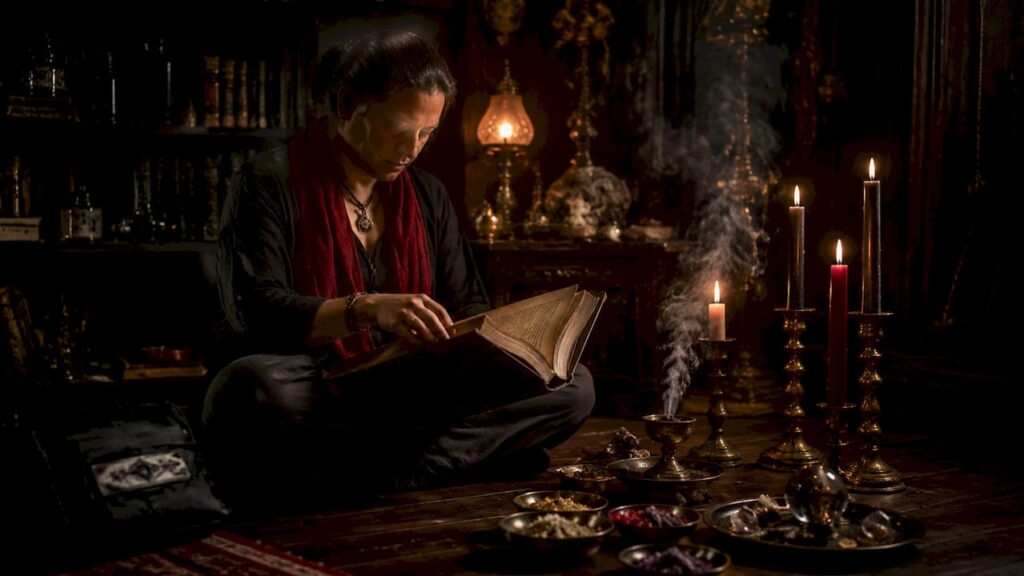
Black magick is defined as the deliberate use of supernatural forces to influence, manipulate, or transform reality, often through spirit invocation, symbolic ritual, and focused intent. The types of black magick traditions span every inhabited continent, from ancient Mesopotamian curse tablets dating to around 2500 BCE to living practices like West African Vodou and South Asian Left-Hand Tantra. What unites them is not evil intent but a shared ritual architecture: preparation, a symbolic act, words of power, and a sealing method. Understanding these traditions on their own terms, rather than through a simplified good-versus-evil lens, is the first step toward serious practice.
1. What are the major types of black magick traditions?
The major types of black magick traditions share a universal ritual framework while drawing on distinct cultural histories. Each tradition uses its own symbolic vocabulary, spirit relationships, and methods of directing energy toward a specific outcome.
Tradition comparison at a glance:
| Tradition | Origin | Core Ritual Method |
|---|---|---|
| Curse tablets | Mesopotamia, Egypt | Inscribed clay or lead tablets buried or thrown into water |
| Da Siu Yan | China (Hong Kong) | Paper effigy striking, burning, divination confirmation |
| Vodou | West Africa, Caribbean | Loa invocation, spirit dolls, offerings |
| Hoodoo | American South | Rootwork, condition oils, candle burning |
| Left-Hand Tantra | South Asia | Mantra, yantra, transgressive ritual |
| Onmyōdō | Japan | Yin-yang divination, spirit invocation, talismans |
| European witchcraft | Western Europe | Poppets, incantations, herbal workings |
Each row above represents a living or historically documented system, not a literary invention. The distinctions matter because borrowing techniques without understanding their context produces weak results and disrespects the source tradition.
2. Mesopotamian and Egyptian execration rituals
Mesopotamian curse tablets are among the oldest documented dark magick rituals in human history. Practitioners inscribed the name of an enemy onto clay or lead, spoke binding words over the object, and buried it or cast it into water to activate the curse. Egyptian execration rituals followed a similar logic: a clay figurine representing the target was smashed, burned, or buried with spoken imprecations to destroy the enemy’s power.
Both traditions treated the symbolic act as a direct channel to real-world consequence. The name written on the tablet was not a representation of the person. It was the person, in ritual logic. This principle of sympathetic correspondence runs through nearly every black magick tradition that followed.
3. Chinese Da Siu Yan: beating the petty person
Da Siu Yan, practiced actively in Hong Kong, is a structured curse tradition involving eight distinct ritual steps. A practitioner strikes a paper effigy of the target with a shoe, performs a symbolic White Tiger sacrifice, and concludes with divination to confirm the curse has taken hold. The entire ritual is typically performed under a highway overpass or at a crossroads, locations considered liminal and energetically potent.
The precision of Da Siu Yan is instructive. Each step has a specific purpose, and skipping one weakens the working. This is a feature of serious black magick practice across cultures: the ritual structure is not decorative. It is functional.
4. West African Vodou and American Hoodoo
Vodou and Hoodoo are frequently confused but represent distinct systems. Vodou is a structured spiritual religion originating in West Africa and the Caribbean, built around relationships with specific spirit entities called loa. Practitioners do not simply cast spells. They negotiate with beings like Baron Samedi or Maman Brigitte through offerings, possession ceremonies, and formal protocols.
Hoodoo, by contrast, is a folk magic tradition rooted in the American South. It draws on African, European, and Indigenous American practices and focuses on practical outcomes: rootwork and condition oils for love, money, protection, and harm. Hoodoo does not require initiation into a spiritual lineage. Vodou does. That distinction shapes everything about how each system is practiced and transmitted.
5. South Asian Left-Hand Tantra
Left-Hand Tantra, known in Sanskrit as Vamachara, uses transgressive ritual to harness cosmic energy that conventional spiritual paths avoid. Practitioners work with mantras, yantras, and ritual substances considered impure by mainstream Hindu or Buddhist standards, including meat, wine, and sexual energy. The goal is not transgression for its own sake. The goal is to dissolve the ego’s fear of taboo and access deeper reservoirs of power.
Left-Hand Tantra represents one of the clearest examples of a tradition that Western observers have labeled “black magick” while practitioners understand it as a precise technology for liberation and power. The black and white magick binary simply does not apply here.
6. Japanese Onmyōdō spirit invocation
Onmyōdō is a Japanese occult tradition blending Taoist cosmology, Buddhist ritual, and indigenous spirit work. Onmyōji, the practitioners, used yin-yang divination, talismans, and spirit invocation to protect the imperial court, curse enemies, and manipulate fate. The most famous historical Onmyōji, Abe no Seimei, is credited with binding malevolent spirits and redirecting their energy toward protective ends.
What distinguishes Onmyōdō from casual spirit work is its formal training structure and cosmological precision. Practitioners mapped every ritual action onto a system of elemental correspondences and celestial timing. Improvisation was not a feature of the tradition.
7. European witchcraft: poppets and incantations
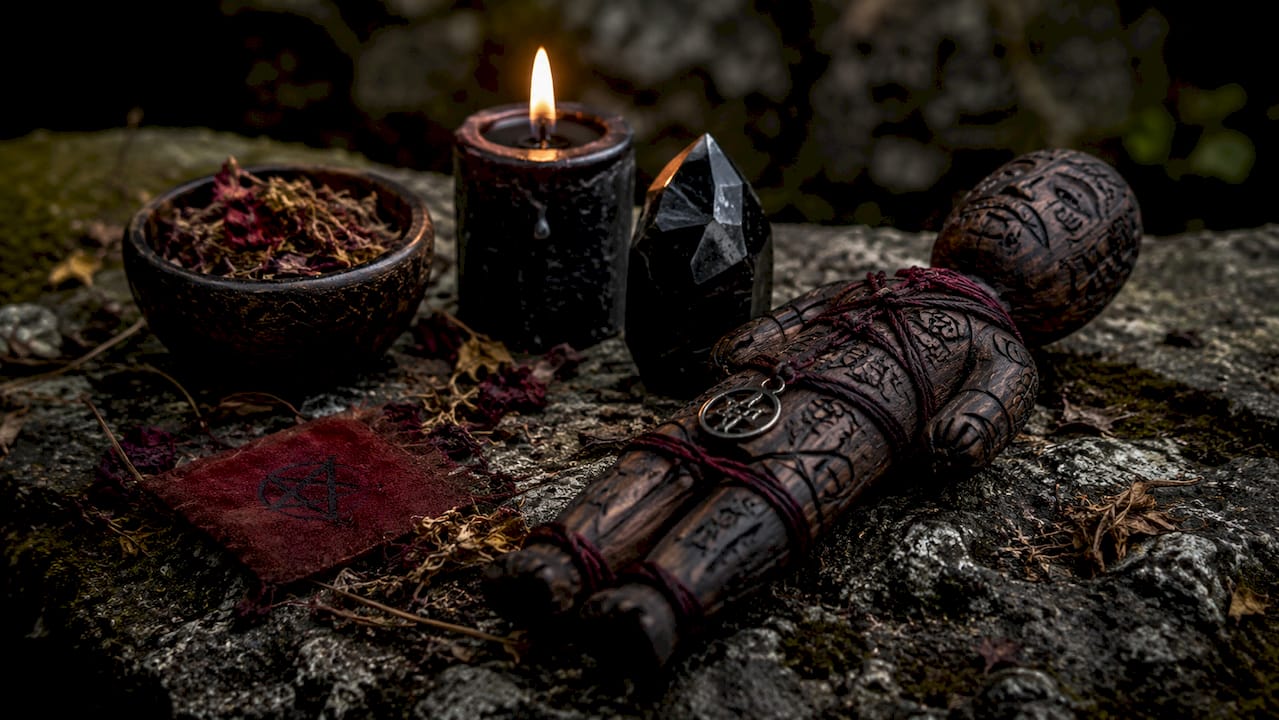
European witchcraft, as documented from the medieval period onward, relied heavily on poppets, herbal workings, and spoken incantations. A poppet is a cloth or wax figure made to represent a specific person. The practitioner binds, pierces, or treats the poppet to produce a corresponding effect on the target. This is sympathetic magic in its most direct form.
European witchcraft also integrated planetary timing and herbal correspondences into its practice. Spells cast during Saturn’s hour for binding, or during Mars’s hour for aggressive workings, were considered more potent than those cast without attention to timing. This attention to ritual correspondences connects European witchcraft to the broader global pattern of structured, precision-oriented black magick.
8. Modern categories: necromancy, demonology, shadow magic, and cursecraft
Modern practitioners organize black magick practices into four primary categories:
- Necromancy: Communicating with or raising the dead to gain knowledge or influence the living. It ranges from scrying spirits to full corpse-raising depending on the tradition and practitioner.
- Demonology: Summoning demonic entities and forming pacts with them for power, knowledge, or specific outcomes. Goetic practice, which works with the 72 demons of the Ars Goetia, is the most documented Western form.
- Shadow and void magic: Working with subconscious forces, anti-energy, and the psychological shadow to produce real-world effects. This modality draws heavily on Carl Jung’s concept of the shadow self.
- Cursecraft and hexing: Directing harmful intent toward a target through jinxes, binding spells, or full curses. The spectrum runs from mild jinxes to serious binding work.
These categories are not mutually exclusive. A single ritual working can involve necromantic consultation, demonic assistance, and a binding component simultaneously.
9. Ritual structure: the four components of effective black magick
Every effective black magick ritual, regardless of tradition, follows four core components. Understanding them is more useful than memorizing any single spell.
- Workspace preparation. Clear and consecrate the ritual space. Set up the altar with tradition-appropriate tools, candles, and symbolic objects. This step creates the energetic container for everything that follows.
- The symbolic act. Burn an effigy, tie a knot, inscribe a name, strike a poppet. The physical action encodes the practitioner’s intent into the material world and activates sympathetic correspondence.
- Words of power. Speak, chant, or vibrate the ritual formula. Words of power are not decorative. They direct and amplify the energy raised during the symbolic act.
- Sealing. Close the ritual formally. Bury the remains, extinguish candles in a specific order, or perform a banishing. Sealing prevents energy from dissipating and protects the practitioner from blowback.
Pro Tip: Consecrate your ritual tools under the appropriate planetary hour before use. Black Arts Oil, specific incense, and candles charged under lunar or Saturnian conditions produce measurably stronger results than unconsecrated materials.
Practitioners who skip the sealing step report the most problems with unintended consequences. Sealing is not optional. It is the difference between a controlled working and an open energetic wound.
Psychic constructs called servitors add another layer of complexity. Servitor creation demands strong mental focus and sustained visualization. A poorly constructed servitor can drain the practitioner’s energy or act outside its intended parameters. This is advanced work, not a beginner’s starting point.
10. How cultural perspectives shape black magick ethics
The black-versus-white magick binary is a largely Western and colonial construction. Many traditions treat magic as a tool, neither inherently good nor evil, used for protection or aggression depending on context. Vodou and Chinese folk magic both illustrate this clearly: the same loa or ritual method can heal or harm depending on the practitioner’s intent and the situation’s demands.
Aleister Crowley’s framework offers the most influential modern reframe. Crowley defined magick’s morality by alignment with True Will and consent rather than by the nature of the forces invoked. Under this model, a curse cast to protect an innocent person is ethically sound. A love spell cast without the target’s consent violates True Will regardless of how “white” the practitioner considers their intent.
“The notion of ‘black’ and ‘white’ magic is a simplification that obscures more than it reveals. What matters is whether the working aligns with True Will and operates with integrity.” — Aleister Crowley, Magick in Theory and Practice
Modern Left-Hand Path practitioners extend this framework to include shadow integration. Dark magic as shadow work means engaging with suppressed psychological material to produce genuine personal transformation. The darkness is not the enemy. Unconsciousness is.
Pact-making with demonic entities sits at the far end of the ethical and practical spectrum. It is a formal, high-stakes ritual requiring strict protocols. Casual or poorly prepared pact work produces the worst outcomes in black magick practice. Protective warding and a clear exit strategy are not optional additions. They are prerequisites.
Key takeaways
The most effective black magick practice combines deep knowledge of a specific tradition’s history, precise ritual execution, and a clear ethical framework grounded in intent and consent rather than simplistic moral labels.
| Point | Details |
|---|---|
| Traditions are culturally specific | Vodou, Hoodoo, Onmyōdō, and Left-Hand Tantra each require their own protocols and cannot be freely interchanged. |
| Ritual structure is universal | Preparation, symbolic act, words of power, and sealing appear across every documented black magick tradition. |
| The black-white binary is a Western construct | Most global traditions treat magic as a functional tool without fixed moral designations. |
| Modern categories clarify practice | Necromancy, demonology, shadow magic, and cursecraft each target different forces and require different skills. |
| Ethics center on intent and consent | Crowley’s True Will model and Left-Hand Path ethics both locate morality in the practitioner’s intent, not the forces invoked. |
What 16 years of practice actually teaches you about these traditions
Most newcomers approach black magick traditions as a menu. They sample a Goetic summoning here, a Hoodoo candle working there, and wonder why nothing sticks. The problem is not the tradition. The problem is the absence of a container.
Every tradition covered here developed inside a specific cultural and cosmological framework. That framework is not decoration. It is the operating system. When you strip out the cosmology and keep only the technique, you get a ritual that looks right but produces nothing. I have seen this pattern repeat for over 16 years at Black Witch Coven.
The second thing experience teaches is that the ethical questions are not abstract. They are practical. A poorly sealed curse rebounds. A servitor built without discipline drains the practitioner. A pact entered without preparation produces chaos. The ethics of black magick are not moral philosophy. They are engineering constraints.
Shadow work is where the real transformation happens, and it is also where most people stop. Engaging with the shadow self through dark magick rituals requires you to look at what you have been avoiding. That is uncomfortable. It is also the most direct path to genuine power and personal clarity that I know of.
Respect the tradition you work in. Learn its history before you touch its tools. And seal every working.
— Black Witch Coven
Deepen your practice with Black Witch Coven
Black Witch Coven has spent over 16 years helping serious practitioners move from curiosity to results. Whether you are mapping your first ritual structure or working with demonic entities at an advanced level, the resources and spellwork available at Black Witch Coven are built for practitioners who want real outcomes, not vague spiritual comfort.
Explore binding and protection spells crafted for specific situations, or work with Black Witch Coven’s experienced practitioners directly. If you have cast a working that needs reversal, the spell to break your own cast is available for exactly that situation. Every service is delivered with confidentiality, precision, and 16 years of Left-Hand Path expertise behind it.
FAQ
What is black magick, and how does it differ from white magic?
Black magick is the use of supernatural forces to influence reality through spirit invocation, symbolic ritual, and focused intent, often without regard for the target’s consent. The distinction from white magic is largely a Western moral construct. Many global traditions make no such division.
What are the oldest documented black magick traditions?
Mesopotamian curse tablets dating to around 2500 BCE are among the oldest documented dark magick rituals. Egyptian execration rituals from a similar period also demonstrate a fully developed ritual structure.
What is necromancy, and is it part of black magick?
Necromancy is the practice of communicating with or raising the dead to gain knowledge or influence the living. It is classified as one of the core modern categories of black magick practice.
How do I know which black magick tradition to study first?
Start with the tradition closest to your cultural background or the one whose cosmology resonates most clearly with your existing worldview. Depth in one tradition produces better results than surface knowledge of many.
Is pact-making with demons safe for beginners?
Pact-making is a formal, high-stakes ritual requiring strict preparation and protective protocols. It is not beginner work. Practitioners who attempt it without proper training and warding report the most serious unintended consequences in black magick practice.
Recommended
- Understanding black magick – Black Witch Coven
- The reason why there is no such thing as black and white magick – Black Witch Coven
- Love Magick – Black Witch Coven
- Blood Magick – For when you are serious about your spell work – Black Witch Coven
Article generated by BabyLoveGrowth
