
 New Years Eve Ritual 2026/2027 with Savannah
Blog, Death & Beyond, Spirits & ghosts
You Can Honour Your Ancestors Without Repeating Their Shit
Oct
Blessings Witches and Occultists,
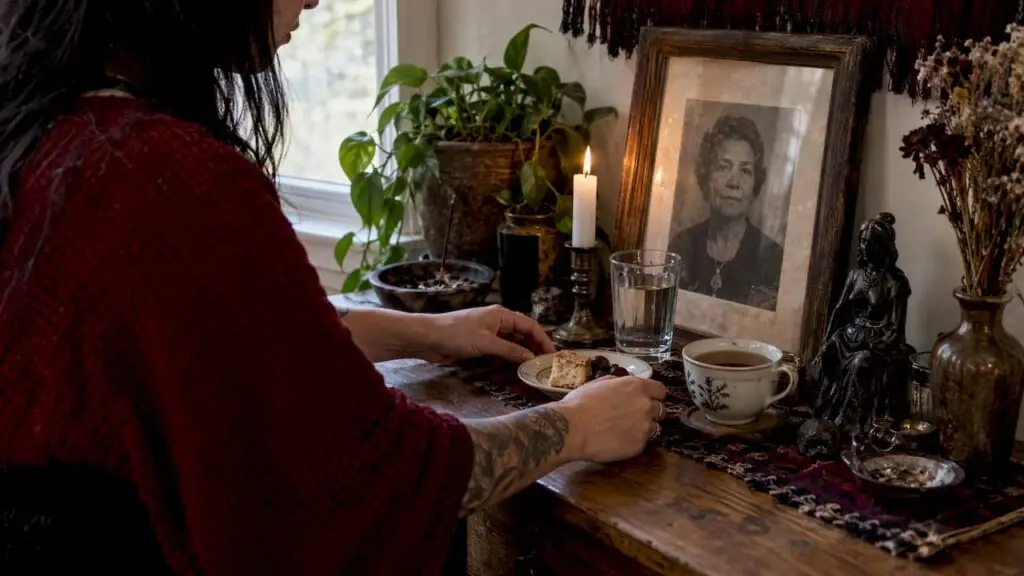
Bring out the photographs, light the candles, and make a little room for the dead.
Some will be remembered through a favourite meal. Some through a song, a familiar saying, or a story that becomes slightly less respectable with every telling. Let there be laughter. Our ancestors lived whole lives before they became names on the family tree, and plenty of them enjoyed a good time.
There may be more complicated company in those photographs too.
You can remember someone with affection and still recognise the trouble they carried. You can be grateful for what they gave you without agreeing to pass all of it on.
There’s room for that honesty at the altar.
As Samhain opens into November’s ancestral work, we’re looking at what we inherit, how we understand it, and what we might choose to do with it. There are several ways into this subject. Each deserves a little attention before we reach for the uncrossing oil.
The dead as company
For those who approach ancestors as spirits, ancestor work is a relationship. Offerings, prayers, remembrance, dreams, and divination may all have a place within it.
A photograph gives a face to your attention. A written name remembers someone whose image you don’t have. An heirloom or a handwritten recipe can hold a connection that no shop-bought altar ornament could replace.
The meaning of an offering depends on your practice. You may understand it as nourishment received by a spirit, an expression of gratitude, an act of hospitality, or several of these together.
Give some thought to the relationship you’re tending.
Remembering someone, honouring them, and inviting their participation in your magic are different choices. Love doesn’t oblige you to seek someone’s counsel. A place in the family tree doesn’t automatically mean a place in every working.
Be deliberate about whom you address. You might welcome ancestors who come in goodwill and whose presence supports your wellbeing.
And you’re allowed to be particular.
Death is a change of address. It isn’t automatically a character reference.
If you follow an established ancestral tradition, learn its customs and understand the reasons behind them. If you’re developing your own practice, begin with a clear intention and a manageable act of remembrance. You can deepen a relationship over time.
Refresh the water. Clear away the food. Keep the space clean. Say thank you.
The tending matters.
What might travel through a bloodline?
Ancestral wounds, bloodline curses, old vows, inherited obligations, family shadows: occult language gives us several ways to consider what may pass between generations.
These terms can describe quite different things.
An oath raises questions about who made it, what was promised, and whether you understand yourself to be bound by it. A suspected curse needs investigation. A difficult relationship with an ancestor might call for a boundary rather than a breaking rite.
Before deciding which explanation fits, gather what you actually know.
What repeats? How far back can you trace it? Is there a family account of a particular vow, practice, or obligation? Are you working with a specific history, or trying to put a name to an uneasy feeling?
Repeated relationship trouble, money difficulties, or a run of bad luck don’t, by themselves, establish a bloodline curse.
Take the occult possibilities seriously enough to examine them properly.
Divination can form part of that examination. Ask questions that allow more than the answer you already suspect:
What sustains this pattern?
What influence have I overlooked?
What work is appropriate, and what is mine to undertake?
Interpret the reading with care. Leave room for further information, ordinary causes, and the possibility that your first explanation needs revising.
There’s wisdom in knowing when to investigate further. A dramatic diagnosis is very easy to make and can become remarkably expensive to keep feeding.
What the living keep alive
Some inheritances arrive in sentences.
“Women in this family always suffer.”
“Money never stays with us.”
“You must keep the peace.”
Repeated often enough, these can become instructions nobody remembers agreeing to.
A witch might address those words through cleansing, spoken magic, or a working to withdraw participation from a named pattern. There’s also value in noticing when the instruction comes out of your own mouth and choosing what you say next.
Other fields offer their own ways of understanding what passes between generations. Intergenerational trauma, learned behaviour, and epigenetics are distinct subjects. They aren’t interchangeable explanations, or scientific proof of ancestral curses.
You can consider different perspectives without squeezing them into the same answer.
Keep the resourcefulness. Keep the recipe. Keep the magnificent ability to find something funny when the day has gone completely sideways.
Have a closer look at the rule that says you must make yourself permanently useful to deserve a place at the table.
Know what you’re bringing to the altar
Ancestral work can involve remembrance, relationship, investigation, cleansing, protection, or release.
Know the purpose of the work you’re choosing.
An offering may express gratitude or tend an established spirit relationship. A cleansing may prepare a space or address an unwanted influence. Protection concerns the boundaries you establish. An uncrossing addresses what you understand to be obstructive or harmful.
You may use more than one approach, but give each a reason to be there.
Before gathering ingredients, ask yourself:
Whom am I addressing? What am I asking? What would completing this working mean?
Once those answers are clear, choose your materials.
An extra seven ingredients won’t rescue an intention you haven’t settled on.
An ancestral blessing and uncrossing working
Tonight can begin a period of ancestral attention that continues through November. You don’t have to sort out the entire bloodline before midnight. Give the work some room.
The following is a contemporary ritual to adapt to your practice. It honours the benevolent dead, seeks blessing, and establishes a boundary around unwanted influence. It doesn’t require a declaration that your family is cursed, and it isn’t presented as a traditional rite from a particular lineage.
You’ll need:
-
A white candle in a fireproof holder.
-
A glass of fresh water as an offering.
-
A small bowl of lightly salted water.
-
Two pieces of paper and a pen.
-
A photograph, heirloom, or written name to represent your ancestry.
Place the ancestral representation behind the candle, leaving plenty of space around the flame. Put the offering water beside it and keep the salted water separate.
Cleanse the space using your usual method. Light the candle and make your invitation deliberately:
Ancestors of blood and spirit who come in goodwill,
whose presence supports my wellbeing,
I offer this light and water in remembrance.
Only those who meet this invitation may draw near.
All others remain outside this working.
Take a moment in silence. Let yourself settle. You don’t need to make every flicker or passing sound into a message.
On the first paper, write your name. Beneath it, name the ancestral blessings you wish to welcome: protection, wisdom, courage, or another quality appropriate to your practice.
Fold the paper towards you three times. Place it beneath the ancestral representation, safely away from the candle.
On the second paper, name the unwanted influence you wish to address. Be specific without claiming more than you know: inherited discord, unwanted ancestral obligations, or a clearly described repeating pattern.
Fold that paper away from you three times. Touch a little salted water to its four corners, saying:
What binds through harm, be loosened.
What clings without welcome, be cleansed.
What seeks to repeat through me meets this boundary.
By my will, this influence has no permission here.
Tear the paper away from you into the bowl of salted water. Press the pieces beneath the surface with a spoon or a tool suitable for that use.
Turn your attention back to the candle:
Let the blessing remain.
Let the burden depart.
May goodwill stand between the generations.
May my threshold be guarded.
Sit quietly for a few minutes, keeping the candle attended. Then thank those you invited and close the working:
For what has been freely given, I offer thanks.
Our exchange is complete.
Those invited may depart in peace.
This working is closed.
Extinguish the candle.
Remove the torn paper from the water and dispose of it in household rubbish. Empty the salted water down a suitable household drain rather than onto soil or plants. Clear away the offering water when you close the altar or the following day.
Keep the blessing paper with your ancestral representation for as long as it belongs in your practice.
Afterwards, tend the boundary you’ve established. If you’ve withdrawn your agreement from an obligation, notice when you’re about to take it up again. Give the working your cooperation.
Hecate at the threshold
Hecate has her own place in November’s themes. Ancestor work and a relationship with Hecate may meet within someone’s practice, but they don’t have to become the same rite.
For those who honour her, crossroads work offers a place to consider direction, responsibility, and what a choice will ask of us.
Bring your questions into your established devotional practice. Make your offering according to that relationship. Give yourself time to listen.
What am I asking to leave behind?
Which direction am I prepared to take?
What will this choice require of me?
If you don’t work with Hecate, you can consider those questions without making an invocation or beginning a relationship you haven’t chosen.
And if the door opens onto an uncomfortable conversation, try not to look too offended.
We did ask for an opening. We simply had something more decorative in mind.
A little warmth for the dead—and the living
Make room for the stories worth keeping. Feed a memory. Speak a name. Put on the song and let someone tell you, once again, exactly what happened at that wedding.
Let remembrance have its warmth.
Alongside it, keep your discernment. You can welcome blessing, tend a relationship, and address an unwanted influence without turning your entire ancestry into either saints or villains.
May the benevolent dead be kindly remembered. May their blessings find a welcome. And may we have the wisdom to choose what we carry into the next generation.
If this has stirred up a question, come and have a word with me. Tell me what’s happening, in your own words. We can look at whether a reading would help bring some clarity or whether there’s a working worth considering. You’ll find me over at BWC.
You know where to find me if you need me.
Big juicy blessings,
Gypsy
