
 New Years Eve Ritual 2026/2027 with Savannah
Blog, Curses Hexes
Understanding black magick
May
Is Baneful magic the same as black magic?
They overlap heavily in casual use but are not the same.
“Black magic” is an older, broader, and more culturally loaded term.
“Baneful magic” is a more precise, contemporary description focused specifically on harm, restriction, or misfortune.
Many modern witches prefer “baneful” to avoid the racial, colonial, and dualistic baggage of black/white categories.
Historical meaning of black magic
“Black magic” (sometimes nigromancy) traditionally meant magic used for evil or selfish ends, often involving demons, spirits of the dead, or practices seen as against nature or unsanctioned by the Church. It was the counterpart to “white magic.”
Historical accusations during European witch trials frequently involved maleficiumeg eg harmful acts such as cursing neighbors, blighting crops, or causing illness.
The term also covered evoking infernal spirits regardless of the stated purpose, pacts, and certain forms of necromancy. In popular culture it became sensationalized and loosely applied to anything occult that outsiders feared or disapproved of, including misrepresentations of Voodoo or folk practices.
Some systems later mapped it onto the “left-hand path.” The black/white split itself is relatively recent (a few centuries) and carries colonial and Christian dualistic assumptions.
Tradition-specific views
Wiccan-influenced paths often cite the Rede (“harm none”) and treat most baneful work as off-limits, though some allow binding for protection. Traditional witchcraft, many folk-magic systems, and Hoodoo treat malefic or crossing work as a normal part of the toolkit when needed.
In New Orleans and broader African-diaspora contexts, practical categories such as crossing, uncrossing, or “work” are more common than the black/white framing; outsider associations of Voodoo with “black magic” are frequently inaccurate or tourist-driven.
Debates persist around gray areas:
- Is a binding that stops harm itself baneful?
- Is a return-to-sender or justice working different from an unprovoked curse?
- Does affecting another’s circumstances always violate free will?
Different practitioners draw the line in different places.
What is baneful magick?
Baneful magick is any ritualistic operation intended to harm, restrict, disrupt, or deliver consequences to a specific target. The word “baneful” traces directly to “bane,” meaning something that causes destruction or serious harm. This is not metaphor. It is deliberate, directed ritual work with a defined outcome in mind.
The four primary forms of baneful magick are:
- Hexes: Targeted magical pressure producing specific discomfort, obstacles, or consequences. Short-term, directed, and proportionate to the harm caused.
- Curses: Broader and more sustained than hexes. A curse restructures the energetic conditions of someone’s life across multiple domains simultaneously, compounding over time without significant intervention.
- Jinxes: The most minor category. Minor annoyances, bad luck, general disruption. Less severe than a hex and typically self-resolving.
- Bindings: Restraint magic, not consequence magic. A binding restricts behavior or influence rather than creating suffering. A freezer spell is a classic binding: it stops ongoing harm rather than punishing past actions.
Each form serves a distinct purpose.
- Crossing work (a common Hoodoo/rootwork term for disrupting someone’s path).
Choosing the wrong one for your situation produces the wrong result. A binding does not punish. A curse does not simply inconvenience. Precision here is not optional.
Historical and cultural roots of baneful magick
Baneful magick is not a modern invention or a fringe practice. It runs through virtually every magical tradition in human history, often as one of the most documented and socially significant forms of ritual work.
Ancient Mesopotamian texts record elaborate curse tablets directed at enemies, thieves, and oath-breakers. The Maqlu ritual series, a collection of Babylonian anti-witchcraft texts, demonstrates that both the casting and the countering of harmful spells were considered serious priestly functions. Egyptian magical papyri from the Greco-Roman period contain detailed execration rites designed to destroy enemies by name. Greek and Roman curse tablets, known as defixiones, have been recovered by archaeologists across the Mediterranean, inscribed with specific targets and specific desired outcomes.
In West African and African diaspora traditions, including Vodou and Palo Mayombe, baneful workings occupy a recognized and respected place within the broader ritual system. These are not aberrations. They are tools wielded by specialists with deep training and clear protocols.
The Black Book of Satan from the Order of Nine Angles frames ceremonial magick as requiring complete emotional control during ritual, stopping just short of possession, to channel sinister energies effectively. This mirrors what practitioners across cultures have always known: baneful work demands more discipline, not less, than any other form of ritual.
Folk traditions across Europe, from Scottish cunning folk to Italian malocchio practitioners, treated harmful magic as a legitimate response to injustice. The idea that baneful magick is somehow a modern taboo or an aberration from “true” spiritual practice is a recent and culturally narrow position. Across most of human history, the ability to curse an enemy was considered a mark of genuine power.
The ethics of practicing baneful magick
The Left-Hand Path does not operate under a “harm none” framework. That belongs to other traditions. From a Luciferian, Demonolatry, or Sinister perspective, the ethical question is not whether to use baneful magick but when and why.
The core ethical precepts practitioners in these traditions hold:
- Sovereignty: You have the right to defend your existence, your peace, and your boundaries by any means necessary, including ritual force.
- Justification: Baneful work is warranted when a target is actively causing harm, violating boundaries, or threatening your stability. It is not a tool for wounded pride.
- Precision: Collateral damage is a practitioner failure. Sloppy intent harms the wrong people and reflects poor craft.
- Responsibility: You own the consequences of every working you cast. No deflection, no excuses.
- Clarity of motive: Revenge and justice feel similar in the moment. They are not the same thing. Know which one you are actually acting from.
Emotional volatility is the most common cause of baneful spell misfires. Practitioners who cast from rage, grief, or panic frequently find the working either fails entirely or produces unintended consequences. The ethical stance in Left-Hand Path occultism frames baneful magick as boundary enforcement, not vengeance. That distinction changes everything about how you prepare and execute.
Pro Tip: Before casting any baneful working, sit with your intent for 48 hours. If your justification still holds after two days of sober reflection, you have a legitimate working. If it has shifted or softened, you were acting from emotion, not will.
Primary types and forms of baneful magick
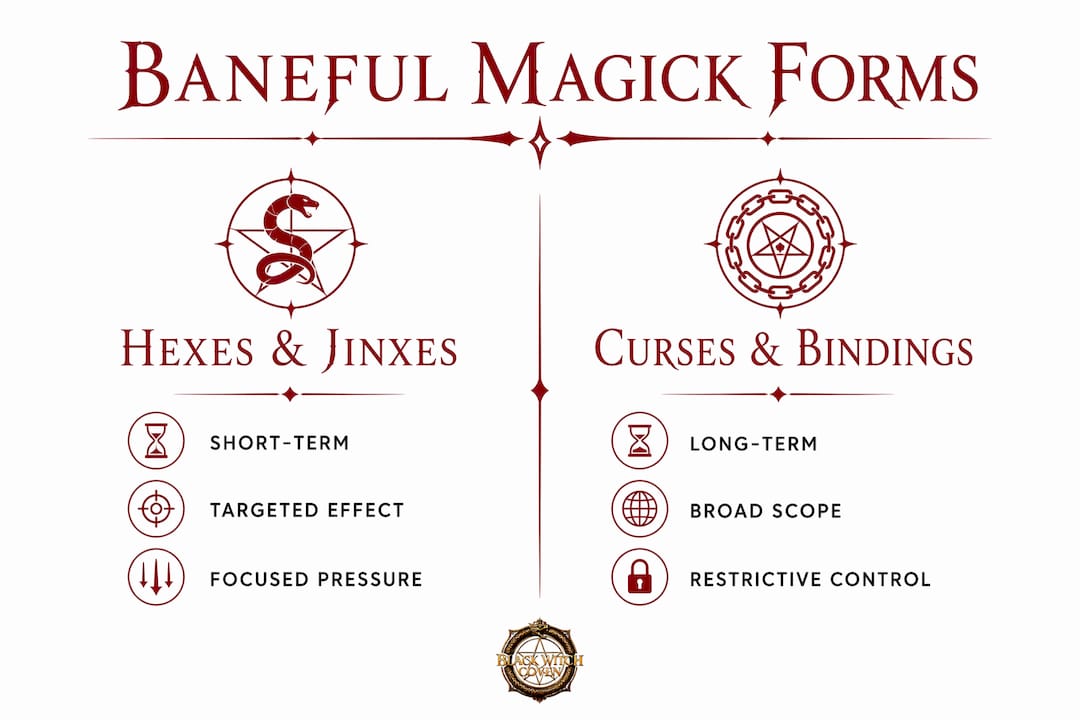
Understanding the distinctions between types is what separates effective practitioners from reckless ones. The table below maps the four primary forms by duration, scope, and target effect.
| Type | Duration | Scope | Primary Effect |
|---|---|---|---|
| Hex | Short-term | Specific and targeted | Focused consequences, obstacles, or discomfort |
| Curse | Long-term or permanent | Broad, multi-domain | Sustained misfortune compounding over time |
| Jinx | Brief | Minor | Annoyance, bad luck, general disruption |
| Binding | Ongoing until removed | Specific behavior or influence | Restricts action without necessarily causing suffering |
A hex applies targeted pressure around a specific outcome. A curse restructures energetic conditions across multiple areas of life simultaneously. The difference matters practically: if someone spread damaging lies about you once, a hex addresses that. If they have been systematically destroying your reputation, relationships, and livelihood over years, a curse may be the appropriate response.
Bindings deserve special attention because they are often the first working a situation actually requires. Stop the active harm first. Then address accountability. A freezer spell, for example, restricts a target’s ability to interfere with your life without necessarily generating suffering in the target at all. It is containment, not punishment.
Why practitioners turn to baneful magick
Baneful magick functions as a strategic tool when mundane systems fail to deliver justice or protection. Courts move slowly. Institutions protect themselves. Social consequences rarely reach people who cause serious harm. Ritual force operates outside those limitations.
Practitioners in Demonolatry and Luciferian traditions reject the simplistic black-and-white division of magic entirely, as explained in Advance Your Spiritual Awakening Practice: A Deep Guide. From their perspective, baneful work is a natural expression of will and a restoration of balance when that balance has been broken. The Left-Hand Path frames dark magick as empowerment and sovereignty, not mere destruction.
Common motivations practitioners cite:
- Enforcing personal boundaries after repeated violations
- Stopping active harm when no other recourse exists
- Delivering proportionate consequences to those who caused injury
- Protecting third parties, such as children or vulnerable people, from ongoing threat
- Restoring natural order when someone has gained through deception or exploitation
The critical distinction is restoration versus punishment. Baneful magick used to restore balance has a clear endpoint. Baneful magick used purely to punish tends to spiral, consuming the practitioner’s energy long after the situation has resolved.
Practical guidance for beginners approaching baneful magick
Beginners fail at baneful magick for one reason above all others: they act before they are ready. Emotional reactivity, insufficient preparation, and no protection framework combine to produce misfires, blowback, and in some cases, genuine harm to the practitioner.
A grounded beginner approach follows this sequence:
- Establish emotional mastery first. You must be able to hold intense emotion without being controlled by it. This is not suppression. It is the ability to channel anger, grief, or outrage as fuel without letting it distort your intent.
- Prepare your ritual space. Wards, sigils with mirrors facing outward, and protective materials like black salt and obsidian create a contained working environment.
- Time your workings deliberately. The new moon is the traditional timing for destructive and baneful operations. Sunrise during a new moon amplifies this further. New moon rites for banishment and deep disruption have roots across multiple traditions.
- Track every working. Keep a detailed grimoire recording your intent, timing, materials, and observed results. Patterns emerge over time that refine your craft.
- Build in protection. Ground yourself after every baneful working. Salt baths, obsidian, and smoke cleansing clear residual energies that can attach to the practitioner.
- Start proportionate. A jinx or targeted hex is a far better first baneful working than a full curse. Learn to control smaller workings before scaling up.
Pro Tip: To build tolerance for Acausal energies before a major baneful working, visualize the sigil of the relevant dark force each night for seven nights before the rite, reciting its Word of Power 13 times. This conditions your psyche to the energy before direct invocation, reducing the risk of psychic disruption during the working itself.
The Black Fast is an advanced preparatory practice from the Sinister Tradition: seven days of abstinence from intoxicants, meat, sexual activity, and reduced eating, speaking, and sleeping. It strips causal-world distractions and lowers natural resistance to Acausal energies, creating a state of heightened receptivity. This is not beginner territory. Approach it only after conditioning through sigil work and Words of Power recitation.
For those concerned about spell backfires, the most common cause is misaligned intent, not insufficient power. Clarity of will matters more than the intensity of the working.
Why the terms are not interchangeable
Most harmful work that people once called black magic is now described as baneful. However:
- Black magic is broader and more ambiguous. It can include evoking “dark” entities, certain ceremonial or infernal practices, or any magic deemed socially unacceptable, even if the goal is not personal harm.
- Baneful is narrower and functional: it describes the effect (causing bane) rather than a moral color or a specific cosmology.
- Some people still use the terms as synonyms. Others argue that not every “dark” or spirit-working practice is baneful, and not every act of restriction is equivalent to a curse.
Modern pagan and witchcraft writers often recommend dropping “black/white” language because it is imprecise, racially charged, and rooted in a binary that many traditions reject. Magic is frequently described as a neutral tool whose character comes from the practitioner’s intent and the situation.
