
 New Years Eve Ritual 2026/2027 with Savannah
To manipulate a person, you must first be able to attract and hold his attention. The three methods by which the command to look can be accomplished are the utilization of sex, sentiment, or wonder, or any combination of these. A witch must, honestly, decide into which category she most naturally falls.
The Satanic Bible
Principles of Satanic Magic
Satanic magic does not have one single official rulebook, because Satanism itself is not one single system.
The principles below reflect the main currents, with clear notes on where LaVeyan and theistic approaches diverge.
Core Shared Principles
1. Will is central
Magic is the deliberate use of will to produce change that ordinary methods cannot easily achieve. The strength and clarity of the operator’s will determines the strength of the working.
2. Emotion is fuel I
ntense, genuine emotion is treated as a primary power source. Lust, anger, compassion, pride, and focused desire are not obstacles to be overcome, they are the current that drives the work. Weak or performed emotion produces weak results.
3. No artificial division between “black” and “white”
Satanic magic rejects the moral colouring that other systems place on magic. Magic is a tool. The ethics sit with the operator, not with the technique itself.
4. The self is the primary instrument
Whether the approach is symbolic or theistic, the practitioner’s own mind, body, and emotional intensity remain the foundation. External forces (when accepted) amplify or partner with the self; they do not replace it.
5. Results over dogma
Effectiveness matters more than correct belief or correct aesthetics. Methods are judged by whether they produce observable change.
LaVeyan Principles (Atheistic / Symbolic)
We will jump deeper into the psychology behind his principles in some of the information below, but here are the key bullet points about his principles of Satanic Magick.
- Magic is divided into Greater Magic (ritual psychodrama used to focus and release intense emotion) and Lesser Magic (everyday psychological manipulation, charm, and influence).
- Ritual is an “intellectual decompression chamber” a space where disbelief is deliberately suspended so emotion can be fully expressed and directed.
- The three classic ritual types are Lust, Compassion, and Destruction, each built around a core human emotion.
- Demonic names and imagery are used as powerful psychological focal points, not as real external beings.
Theistic and Freestyle Principles (Including Black Witch Coven)
- Satan and the demons are regarded as real spiritual intelligences.
- Ritual is not only psychodrama. It is a method of genuine contact, honour, and working relationship.
- Emotion still matters, but it is joined to actual presence and reciprocity with the spirits.
- Respect and clarity of relationship are practical requirements, not optional courtesies.
- The operator remains sovereign. Contact does not mean surrender of will.
Practical Working Principles
- Desire must be specific and strongly felt.
- Timing and atmosphere are used to support focus, not as superstition.
- Imagery and directed attention give the energy a clear path.
- Once the force is sent, the operator releases attachment and allows the work to move.
- Balance and self-knowledge matter: attempting work far beyond one’s actual capacity or emotional control usually produces mess.
These principles can be adapted. A freestyle or theistic practitioner may keep the emotional intensity and ritual structure taught by LaVey while rejecting the purely symbolic interpretation of the spirits.
That combination real contact plus disciplined use of emotion and will is the approach taken at Black Witch Coven.
LaVeyan Ritual Psychology
LaVey designed Satanic ritual as a form of controlled psychodrama. He did not claim the rituals worked by supernatural intervention. He claimed they worked by deliberately manipulating the operator’s own psychology and physiology.
The Intellectual Decompression Chamber
LaVey called the ritual space an “intellectual decompression chamber.” The purpose of the formal structure (candles, bell, robes, Enochian Keys, Infernal Names, etc.) is to create a temporary break from ordinary rational, sceptical thinking. Inside that space the practitioner is meant to suspend disbelief on purpose and allow intense emotion to rise without self-censorship.
The intellectual mind is useful for planning the ritual, but it is a hindrance during the working itself. The ceremony is built to push the operator out of analysis and into full emotional engagement. Bells, darkness, archaic language, and dramatic gesture all serve this shift in consciousness.
Emotion as the Engine
Greater Magic (the formal ritual work) is organised around three primary emotions:
- Lust
- Compassion / Sentiment
- Destruction / Anger
LaVey’s position was that these strong emotional and adrenal states produce real physiological energy. In ordinary life that energy is usually dissipated or suppressed. Ritual isolates it, intensifies it, and gives it a single clear direction. The goal is to convert scattered emotional force into a focused, transmittable current aimed at a specific outcome.
This is why the rituals demand genuine feeling. Performed or half-hearted emotion produces weak results because there is little real charge to work with.
Catharsis and Focus
There is a strong cathartic element. By fully expressing lust, rage, or deep care inside a contained ritual structure, the practitioner releases pressure that might otherwise remain stuck or leak into daily life in unhelpful ways. At the same time, the ritual trains the will to concentrate that released force toward a chosen goal rather than simply discharging it.
After the ritual the operator is expected to return to ordinary consciousness, leave the working alone, and allow the focused intention to operate without further interference.
Lesser Magic
Alongside the formal rituals, LaVey described Lesser Magic: the everyday use of psychology, appearance, charm, timing, and calculated behaviour to influence other people. This is not ceremonial. It is applied social and psychological manipulation used to create change in accordance with one’s will.
Summary of the Psychological Model
LaVeyan ritual psychology rests on a few clear ideas:
- Intense emotion generates usable force.
- Formal ritual creates the conditions in which that emotion can be fully felt and directed.
- The tools and theatrical elements exist to bypass the rational mind and deepen the emotional state.
- The real work happens inside the operator; the spirits and names function as powerful focal points rather than independent beings.
- Once the energy is raised and released, attachment and over-analysis are deliberately dropped.
LaVey treated ritual as psychodrama.
- The ritual chamber is an “intellectual decompression chamber.” Its job is to temporarily shut down the rational, sceptical mind so intense emotion can rise without interference.
- The power source is the operator’s own adrenal and emotional energy (lust, anger, compassion).
- Demonic names, the Baphomet, Enochian Keys, and the whole theatrical apparatus are tools to focus and amplify that internal emotion.
- Spirits are not regarded as real external beings. They function as powerful psychological symbols and focal points.
- The goal is catharsis plus directed will: raise the emotion, give it a clear target, release it, then return to ordinary consciousness.
- Success is measured by psychological shift and practical results in the everyday world.
In short, LaVeyan ritual is a technology for concentrating and discharging human emotion under controlled conditions.
Temple of Set Ritual Approach
How the Temple of Set Approaches a Working
The Temple of Set does not use the same ritual model as LaVeyan Satanism. They rarely speak of “Satanic ritual” in the theatrical, psychodramatic sense. They speak of Workings being deliberate acts of Greater Black Magic performed by an isolate consciousness.
Core Orientation
A Setian Working is not primarily about raising and discharging emotion. It is about the conscious exercise of the Black Flame, the non-natural spark of independent awareness that Setians identify as the essence of the self. The central purpose is Xeper: the process of coming into being, of strengthening and evolving the individual psyche toward greater sovereignty and eventual self-deification.
Set is regarded as real & the original isolate intelligence, not a symbol. The Working is therefore an act of alignment, communication, or deliberate magical causation performed in relation to that principle, not a psychological drama staged for the operator’s own subconscious.
Typical Structure of a Setian Working
There is no single fixed script that every Setian must follow. The Temple deliberately avoids the highly standardised theatrical format of the Church of Satan. Workings are usually solitary and are shaped by the individual magician. That said, a common practical pattern looks like this:
-
Preparation and isolation The magician creates a space free from ordinary interruption. This may involve formal tools or almost none. The emphasis is on mental separation from the everyday world rather than on elaborate staging.
-
Centering in the Black Flame The operator focuses on the sense of isolate self — the part of consciousness that stands apart from the mechanical, natural universe. This is the true starting point of the Working.
-
Statement of Will The intention is formulated with precision. Because the goal is conscious becoming rather than emotional release, the statement of will tends to be clearer, more intellectual, and more long-term than a typical LaVeyan emotional outburst.
-
The Magical Act This may involve:
- Direct focused will
- Visualisation or symbolic action
- Spoken words (sometimes in Egyptian or other forms)
- Use of the Pentagram of Set or other personal symbols
- Contact or alignment with Set or other intelligences recognised by the magician
Emotion can be present, but it is subordinate to will and clarity. The magician is not trying to overwhelm the rational mind; the rational and conscious self remains in command.
-
Closing and integration The Working is closed cleanly. The magician then returns to ordinary life and looks for evidence of change both in the subjective universe (shifts in perception, will, or self-understanding) and, where relevant, in the objective world.
Key Differences from LaVeyan Practice
- Less theatre, more precision. The full apparatus of robes, gong, phallus, and formal psychodrama is optional and often minimised.
- Spirits are real. Set (and other entities a Setian may work with) are not treated as psychological projections.
- Goal is evolutionary. The Working serves the long-term strengthening and immortalisation of the individual psyche, not primarily short-term emotional or material results.
- Will over emotion. Intense feeling may be used, but the decisive factor is the conscious, isolate will of the magician.
- Highly individual. There is far less emphasis on performing a correct group ritual and far more on the magician designing a Working that genuinely advances their own Xeper.
In practical terms, a Temple of Set Working feels more like a deliberate, lucid act of magical self-creation than like the cathartic emotional theatre of LaVeyan Greater Magic. The operator remains fully conscious and in command throughout. The aim is not to temporarily shut down the intellect, but to wield it, along with the Black Flame, as the primary instrument of change.
Broader Theistic Satanic Styles
Most theistic and freestyle Satanic approaches sit closer to the Setian side than the LaVeyan one on the key question of reality:
- Spirits and Satan (or Set, Lucifer, etc.) are treated as real.
- Ritual is a meeting point or working relationship, not only a psychological tool.
- Emotion remains important, but it is joined to presence, reciprocity, and respect for the entities involved.
- The operator does not surrender sovereignty, but neither do they reduce the spirits to masks for their own psyche.
Summary Contrast
| Aspect | LaVeyan | Temple of Set / most theistic |
|---|---|---|
| Nature of spirits | Symbolic / psychological | Real metaphysical beings |
| Main power source | Operator’s emotion | Isolate will + Black Flame |
| Purpose of ritual | Catharsis + directed emotion | Self-deification / Xeper |
| Role of theatre | Central (psychodrama) | Secondary or optional |
| View of the self | Carnal, emotional animal-god | Evolving isolate consciousness |
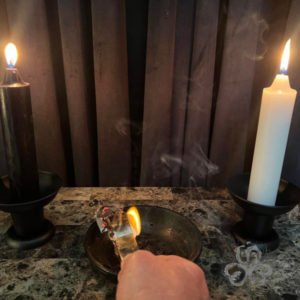 Tools of Satanic Magic
Satanic magic does not require a large collection of elaborate tools.
The emphasis is usually on focused will, intense emotion, and clear intention.
Tools are used to support those things, not to replace them.
Practical and Theistic Approaches
Many independent, freestyle, and theistic practitioners work with a much simpler set:
- A single black candle or a small group of candles
- A focused image or sigil (of Satan, a specific demon, or the desired outcome)
- A cup or glass for offering
- Personal items that carry strong emotional or magical charge
- Written petitions or names
- Incense or smoke for atmosphere and as an offering
- The practitioner’s own body and sexual or emotional energy (especially in Lust or high-intensity workings)
Some theistic workers also keep specific offerings, dedicated cloths, or items that have been repeatedly used in contact with particular spirits. These accumulate charge over time and become more effective with continued use.
Core Tools in LaVeyan / Classic Satanic Ritual
Anton LaVey outlined a specific set of ritual tools in The Satanic Bible. These form the classic equipment for formal LaVeyan (and many later Satanic) rituals. The tools are theatrical and symbolic, designed to focus emotion, create atmosphere, and support the psychodramatic nature of the working.
- Altar A raised surface. In group rituals a nude woman often served as the living altar, representing the earth and passive receptor. In private work any elevated surface can be used.
- Symbol of Baphomet (Sigil of Baphomet) Placed on the wall above the altar. This is the central sacred image of LaVeyan Satanism.
- Candles Only black and white candles are used.
- Black candles (one or more) are placed on the left and used for illumination and for burning petitions of blessing, lust, or personal power.
- One white candle is placed on the right and is used specifically for destruction/cursing work. Petitions for harm are burned in its flame.
- Bell A loud, clear bell is rung nine times at the beginning and end of the ritual to mark the opening and closing of the working and to clear the space.
- Chalice (Goblet) Holds the “Elixir of Life” (usually wine or another stimulating drink). It should not be made of gold. The contents are drunk during the ritual.
- Sword Symbol of aggressive force and authority. Used by the priest to point, direct energy, and gesture during the invocations. A long knife or staff can substitute.
- Phallus A model phallus (made of wood, plaster, wax, etc.) used as an aspergillum (for sprinkling) and as a symbol of generative power.
- Gong Used for dramatic effect and to punctuate stages of the ritual. A concert gong was preferred.
- Parchment or paper Used to write petitions, blessings, or curses. These are read aloud and then burned in the appropriate candle flame (black for beneficial, white for destructive).
Clothing
- Men traditionally wear black robes (often hooded).
- Women wear sexually suggestive clothing, or all black for older participants.
- Some participants wear an amulet bearing the Sigil of Baphomet or an inverted pentagram.
LaVey presented these tools as ideal, but later Church of Satan commentary (including from High Priest Peter Gilmore) has emphasised that the most important instrument is the operator’s own imagination and emotional intensity. The physical tools support focus and atmosphere; they are not strictly required for the magic to function.
Many modern practitioners simplify the setup considerably while still keeping the black/white candle distinction and a central Baphomet or demonic image.
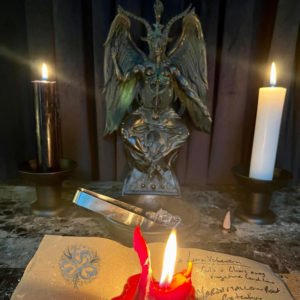
Black and White Candles in Ritual
One of the most practical and visually striking setups used in Satanic ritual comes from LaVey’s original instructions and is still widely used, including by many of us here.
The basic arrangement is simple and effective:
- One or more black candles stand on the left side of the working space. These represent the Powers of Darkness and the Left-Hand Path. Petitions written for personal power, success, lust, protection, or any beneficial outcome are burned in the black candle flame.
- A single white candle stands on the right side. LaVey originally placed it there to represent the hypocrisy of white-light magicians. In practice it is used for destruction and cursing work. Written petitions aimed at harm, removal, or justice-by-force are released into the white candle’s flame.
- In the centre, above or behind the main working area, stands the Sigil of Baphomet, or an image of the specific demon being called. This gives the ritual a clear focal point and anchors the presence being worked with.
The act of writing the petition and then deliberately feeding it into the correct flame is both symbolic and practical. It gives the intention a physical release point and creates a strong visual and energetic moment in the ritual. Many practitioners, including those of us at Black Witch Coven, continue to use this method because it is clean, direct, and powerful when performed with real focus.
You can adapt the number of black candles, the exact placement, and whether you use a full Baphomet image or a specific demon’s seal. The core principle remains the same: black flame for what you want to draw in or strengthen, white flame for what you want to destroy or remove, and a clear central image of the force you are honouring or working with.
What Actually Matters
In both LaVeyan and theistic practice, the tools are secondary. The primary instruments remain:
- Clear and intense will
- Genuine emotion
- Focused attention
- The ability to raise and direct energy
- In theistic work, the quality of the relationship with the spirit being called
A skilled operator can perform effective Satanic magic with almost no physical tools. The props help concentration and atmosphere, especially for those still developing control, but they are not the source of the power.
4 thoughts on “Satanic Magick”
Leave a Reply
You must be logged in to post a comment.
Yes there are
Dose anyone know
Where I can buy some.
Hi I wish to learn black witch craft. With help
I pray for those whom seem to think that witchcraft sorcery black magic can over come GODS HOLY Words read the story of mose how. He lead the Jews -(Israelites to thru the red sea and they made it to the promise land flowing with milk and honey. . evil is always overcomes by the LOVE of GOD
There is more interesting books, and ancient books out there, to many to really say.