
 New Years Eve Ritual 2026/2027 with Savannah
Author: Max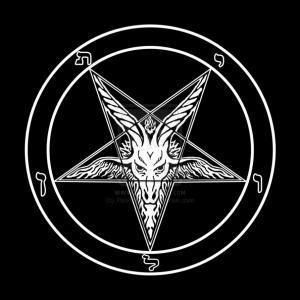
Last Version: 2015
Black Witch Coven Perspective
We do not treat any single symbol as mandatory. The Sigil of Baphomet and the inverted pentagram are powerful because decades of concentrated attention have charged them. They work as focal points.
At the same time, a practitioner who has a direct relationship with Satan or with specific demons may find that a personal image, a particular seal, or even no physical symbol at all is more accurate for their work.
Symbols are tools. They gather meaning through use. The ones that have been heavily used in Satanic contexts now carry a current that can be felt and directed. That is their practical value. Everything beyond that is a matter of which current you are actually working with and what produces results for you.
Does Satan Himself Have a Symbol?
There is no single ancient, universal symbol that belongs exclusively to Satan in the way a cross belongs to Christianity.
What exists instead are later attributions:
- The inverted pentagram and Sigil of Baphomet became the dominant modern visual stand-ins.
- The number 666 (or 616 in some older manuscripts) comes from the Book of Revelation and has been applied to Satan or the Beast by Christian tradition. Some Satanists have reclaimed it; others ignore it.
- Various demonic seals from grimoires (especially the Goetia) are used when working with specific spirits, but those are individual seals, not a general mark of Satan.
- Some theistic practitioners simply use an image or statue of a horned or dark figure, or work with no fixed public symbol at all.
In short, Satan does not have one official, historical glyph the way many polytheistic gods do. The symbols most people recognise as “his” are modern constructions that gained power through repeated use and cultural association.
Satanic Symbols and Symbolism
Most public lists of Satanic symbols are a mixture of Christian fear, confused occultism, and modern invention. The older version of this page suffered from the same problem.
What follows is a clearer and more detailed account of the main symbols that appear in Satanic, Left-Hand Path, and related occult contexts.
The aim is that by the end of the page you actually understand what these images are, where they came from, and how they are used.
The Sigil of Baphomet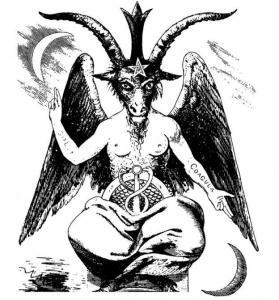
This is the most recognisable modern Satanic emblem: a goat’s head inside an inverted pentagram, usually enclosed by two circles containing the Hebrew letters that spell Leviathan.
The goat-headed figure originates with Éliphas Lévi’s 1856 drawing of Baphomet, the Sabbatic Goat. Lévi’s image was a complex hermetic symbol of duality and the union of opposites (human and animal, male and female, light and dark, mercy and severity). It was never simply “the Devil.”
The specific design that places the goat head inside an inverted pentagram first appeared in 1897 in Stanislas de Guaita’s La Clef de la Magie Noire. Anton LaVey later adopted a cleaned-up version of this design for the Church of Satan in the 1960s. He made it the central visual identity of his organisation, and from that point the Sigil of Baphomet became the dominant public face of Satanism.
In practical terms the symbol is heavily charged. Decades of concentrated attention and ritual use have given it real weight. Many practitioners, including those at Black Witch Coven, still use it or a related goat or demonic image as a primary focal point. It functions well as a battery and a banner.
Baphomet (the Full Figure)
Distinct from the simplified sigil. Lévi’s original Baphomet is an androgynous seated figure with a goat’s head, female breasts, a caduceus for the phallus, one arm pointing up and one pointing down, and the words Solve and Coagula on the arms. It represents the complete magical universe in a single image: the reconciliation of all dualities and the living embodiment of occult force.
Modern Satanism often collapses Baphomet into a simple stand-in for Satan. The original image is more sophisticated. It is a symbol of magical attainment and hidden knowledge rather than pure adversarial rebellion.
The Inverted Pentagram
A five-pointed star oriented with two points upward. In contemporary popular culture this is automatically read as Satanic or “evil.” Historically the pentagram itself is ancient and appeared in many cultures with protective, mathematical, or magical meanings and no negative moral loading.
The inverted orientation received its dark reputation largely from Éliphas Lévi in the nineteenth century, who associated the two-points-up form with the descent of spirit into matter and with the goat of lust. LaVeyan Satanism and many later Left-Hand Path groups deliberately adopted the inverted pentagram as a rejection of the upright “white light” version used in more conventional occultism.
In practice it functions as a sign of material power, carnal existence, and refusal of spiritual hierarchy that places spirit permanently above matter.
The Leviathan Cross (Sulfur Symbol / Satanic Cross)
A double-barred cross standing on the infinity symbol. This was originally an alchemical glyph for sulfur (brimstone). In alchemy sulfur represented the active, fiery, masculine principle.
Anton LaVey used the symbol in The Satanic Bible, and from that point it became associated with modern Satanism. Some practitioners read the infinity loop as a statement of endless possibility or as a rejection of any single divine authority placed above the individual. Others simply value it as a strong, recognisable mark of the current.
It is less common as a primary altar focus than the Sigil of Baphomet, but it remains one of the core modern Satanic emblems.
666
The number appears in the Book of Revelation as the number of the Beast. In most Christian interpretation it was linked to Satan or to a future Antichrist figure. Some older manuscripts give the number as 616 rather than 666.
In modern Satanism the number has been both ignored and actively reclaimed. Some use it as a provocative badge. Others treat it as Christian material that has little to do with their actual practice. It carries cultural weight because of its biblical origin and its heavy use in popular culture, not because it is an ancient mark of Satan.
The Inverted Cross
Originally associated with the Apostle Peter, who according to tradition requested to be crucified upside down because he felt unworthy to die in the same manner as Jesus. In that context it was a symbol of humility.
Centuries later the inverted cross was re-interpreted as an anti-Christian gesture and was adopted by some modern Satanists for that reason. Claims that it represents “the correct way to align the chakras” are modern invention and have no historical basis in Satanic tradition.
Ouroboros
The serpent or dragon that swallows its own tail, forming a circle. This is an ancient symbol of eternity, cyclical time, and the unity of beginning and end. It appears in Egyptian, Greek, and later alchemical and occult material long before modern Satanism.
Some Satanic and Left-Hand Path practitioners use it to express the idea of self-contained power or the closed loop of magical will. It is not exclusively Satanic, but it sits comfortably within the wider symbolic vocabulary.
The Skull
A direct emblem of death and mortality. In some older grimoire and folk practices a skull (or a representation of one) has been used as a vessel or focus for certain currents, including necromantic or cursing work. In modern aesthetic Satanism it appears frequently as jewellery and decoration.
Its meaning is practical rather than doctrinal. It carries the current of death and endings. How it is used determines whether that current is directed outward, inward, or simply worn as a reminder.
The All-Seeing Eye
Primarily a Masonic and general Enlightenment-era symbol of divine watchfulness or enlightened oversight. Its strong association with “Satanism” in popular conspiracy culture is largely modern and external. Actual Satanic traditions have not historically treated it as a core emblem.
The Ankh
An Egyptian hieroglyph meaning life or living. It appears in modern occult contexts of many kinds, including some Satanic and Luciferian ones, because of its connection to vital force and immortality. It is not originally a Satanic symbol.
The Italian Horn (Corno)
A traditional Italian folk amulet, usually made of coral, gold, or silver, used for protection against the evil eye and for general good fortune. It has no historical connection to Satanism. Its occasional appearance in modern lists is the result of confusion with other “occult-looking” charms.
The Sigil of Lucifer
Several different designs have been called the Seal or Sigil of Lucifer. One well-known version appears in older grimoire material and has been adopted by some modern Luciferians and theistic Satanists as a specific mark of Lucifer. It is distinct from the Sigil of Baphomet and is used when the practitioner is focusing specifically on Lucifer rather than on the broader Satanic current.