
 New Years Eve Ritual 2026/2027 with Savannah
Blog, Demons, Working With Demons
Duke Sallos: The Nineteenth Goetia Spirit
Jan
“Sallos is the nineteenth spirit of the Ars of Goetia. He is a Great and Powerful Duke (a Grand Count to Johann Weyer ) who is also referred to as a Day Demon. This demon is mentioned at the 65th position in the Pseudomonarchia Daemonum. Duke Sallos is one of the most sensitive and sweet demons who prefers peace to war. He rules over 30 Legions of Spirits.”
Unveiling Duke Sallos: The Enigmatic Spirit of Love in the Goetia
In the shadowy annals of demonology, few spirits evoke as much intrigue as Duke Sallos, the 19th entity listed in the Ars Goetia the infamous first book of the Lesser Key of Solomon.
Often depicted as a gentle facilitator of romance rather than a harbinger of doom, Sallos stands out among the 72 Goetic demons for his peaceful demeanor and focus on human connections.
But who is this spirit really?
Beyond the standard grimoire descriptions, alternative histories suggest layers of forgotten pagan roots, linguistic twists, and modern reinterpretations that paint Sallos as a complex figure of love, lust, and subtle power.
In this deep dive, we’ll explore his origins, etymology, and evolving identities, drawing from historical texts, occult scholarship, and contemporary views to uncover the essence of this enigmatic duke.
The Traditional Portrait: Sallos in the Grimoires
Sallos first emerges in the occult record through Johann Weyer’s Pseudomonarchia Daemonum (1577), a foundational demonology text that influenced the Ars Goetia. Here, he’s described as a “great and mighty duke” (sometimes ranked as an earl) who commands 30 legions of spirits. His appearance is striking yet non-threatening: a gallant, handsome soldier adorned with a ducal crown, riding atop a crocodile, and manifesting “peaceably.” His primary power? To “causeth the love of women to men, and of men to women.” This ability to kindle mutual affection sets him apart from more destructive Goetic entities, emphasizing harmony over coercion.
The Ars Goetia itself, compiled in the 17th century and later popularized by Aleister Crowley and S.L. MacGregor Mathers in their 1904 edition, echoes this:
“The Nineteenth Spirit is Sallos (or Saleos). He is a Great and Mighty Duke, and appeareth in the form of a gallant Soldier riding on a Crocodile, with a Ducal Crown on his head, but peaceably. He causeth the Love of Women to Men, and of Men to Women; and governeth 30 Legions of Spirits.”
His seal, essential for evocation, features symbolic elements like a double-headed axe, hinting at deeper mythological ties we’ll explore later.
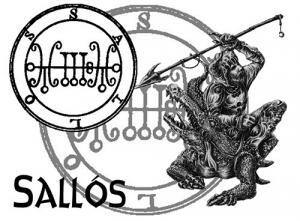
This portrayal underscores Sallos as a “pacifist” among demons, unusual in a roster filled with tempters and destroyers. Yet, his soldierly form suggests an undercurrent of martial prowess, blending love with latent strength.
Origins: From Solomonic Lore to Pre-Christian Shadows
The Ars Goetia draws from the legendary tradition of King Solomon, who purportedly bound 72 demons to build his temple and wield magical power. This narrative stems from Jewish midrash and the Talmud, amplified in medieval European grimoires. Sallos, like his Goetic brethren, likely entered the canon via Weyer’s work, which cataloged demons as “fallen angels” or adversarial spirits.
But his roots may predate Solomon.
Scholars speculate that many Goetic demons were once pagan deities demonized during Christianity’s rise in Europe. There’s no direct Middle Eastern mythological counterpart for Sallos, but his name and attributes could be Latinized distortions of older entities.
The spread of Christianity transformed fertility gods, love spirits, and nature deities into “devils,” stripping them of divinity and assigning them infernal ranks. Most of us here at Black Witch Coven and anyone who is an occultist of any type knows this already, but it’s really important to continue to talk about this and highlight the fact that our ancient Gods deserve respect. We need to start all digging in and discovering the truth about their origins. For instance, pagan temples were repurposed as churches, and gods like those of lust and passion (associated with Venus/Aphrodite) were recast as tempters like Sallos.
In some narratives, Sallos is a fallen angel who joined Lucifer’s rebellion not out of malice but to “make something better of creation,” benefiting humanity. This alternative history positions him as a reformer rather than a rebel, aligning with his benign reputation.
Again, this fits into the black and white thinking of the Abrahamic religions. The concept that Sallos was once good, as an angel, but now bad “a devil” because the church needed Jesus to be followed exclusively, therefore demonized all the other spirits & Gods. Any spirit, good or bad, is a demon if it isn’t Jesus. and from that jumping pad, income, income, income, income.
Etymology: Unraveling the Name’s Mysteries
The name “Sallos” (with variants Saleos, Zaleos, Zaebos) lacks a definitive origin, but etymological clues offer tantalizing insights. One theory traces it to Hebrew “Sha’alosh” (שאלוש), meaning “questioning” or “seeking,” symbolizing Sallos’ role in probing and fulfilling romantic desires. Another links “Saleos” to Greek “saleuo” (σαλεύω), “to shake” or “stir,” evoking the emotional agitation of love and passion.
Variations like “Zaleos” may stem from Latinization during the Christian era, a common tactic to “demonize” pagan names. Astrologically, Sallos is tied to Gemini (June 18-22), signifying “forgetfulness and the release of unpleasant thoughts,” which complements his love-inducing powers by clearing emotional baggage.
These linguistic threads suggest Sallos wasn’t born in grimoires but evolved from ancient words evoking inquiry, disruption, and renewal.
These linguistic threads….linking “Sallos” (or its variants) to roots meaning “questioning/seeking,” “to shake/stir,” or emotional agitation, suggest that the name did not originate as a random label slapped onto a demon in a medieval grimoire. Rather, it likely emerged as a descriptive term for a distinct and recognizable type of spiritual energy or force that ancient practitioners encountered and worked with long before the Solomonic tradition codified it.
In pre-Christian and early esoteric cultures, spiritual workers, shamans, mystics, and seers did not invent entities out of thin air. They observed, interacted with, and named real energetic presences (intelligences, currents, or egregores)that produced consistent, tangible effects in the human experience.
Love, desire, passion, reconciliation, and the stirring of mutual affection are not abstract concepts; they are powerful, almost tangible forces that can sweep through individuals, relationships, and even groups.
When someone experienced (or deliberately invoked) that specific quality of energy, the gentle yet insistent pull toward union, the warming of the heart, the dissolution of barriers without violence, it would have felt unmistakably distinct from other spiritual forces (vengeance, destruction, wisdom, chaos, etc.).
See – Bring back an Ex-Partner with Demon Sallos
Because the energy was so recognizable and repeatable, it received a name that captured its essence. “Sallos” (or whatever proto-form preceded it) became the phonetic and conceptual vessel for that particular vibration, the one that induces love between people, that shakes apathy into longing, that questions separation until connection is restored. The name was not arbitrary; it was earned through direct spiritual perception and interaction.
To those who dismiss Goetic spirits (or any named entity) as mere “aspects of the imagination” or psychological archetypes with no objective reality, this view falls short when one has personally felt the qualitative difference between energies. Once you develop sensitivity through practice, whether through evocation, meditation, energy work, or trance, you can distinguish the “flavor” of a force the way a sommelier distinguishes vintages.
The Sallos current does not feel like the sharp, coercive edge of a domination spirit, nor the cool detachment of a knowledge-bringer, nor the raw wildfire of lust alone. It has a unique signature: warm, persistent, harmonizing, soldier-like in its disciplined pursuit of union, yet crowned with genuine affection rather than domination.
That signature is what ancient practitioners met, named, and passed down. Over centuries, as pagan love-forces were reframed through Judeo-Christian lenses, the name “Sallos” survived, perhaps slightly altered in spelling and rank, but carrying the same core energy that had always been there. We still call upon Sallos today not because a 16th-century text invented him, but because that same love-inducing, heart-stirring current continues to answer when called by that name.
In short: the name describes the experience, and the experience proves the name. Sallos is not a fiction we project; he is the label humanity gave to a living spiritual reality that has been moving through lovers, reconciliations, and quiet passions since long before any grimoire was written.
Alternative Histories: From Warrior of Love to Modern Ally
Beyond canonical texts, Sallos’ identity shifts in alternative lenses. In demonolatry practices, he’s a “spirit of lust and desire,” promoting sensual unions and inspiration for romantic pursuits. Modern occultists view him as inclusive, aiding love regardless of gender or orientation…. a far cry from the heteronormative phrasing in old grimoires. His peaceful soldier form embodies paradox: a warrior who wages “wars” of the heart, fostering reconciliation and emotional security rather than conflict.
Some connect Sallos to Yoruba deity Shango, god of thunder, justice, and virility. The double-headed axe in Sallos’ seal mirrors Shango’s symbol, and the crocodile mount evokes African river spirits or primal forces. This syncretism suggests African influences via the slave trade or shared archetypal themes. Others propose ties to Semitic or Greek love gods, like those linked to Aphrodite, where sexuality was divine before being “fallen.”
In pop culture, Sallos inspires characters in manga like The Seven Deadly Sins, where a antagonist bears his name, reimagining him as a nightmare entity born from rage and self-loathing. These adaptations highlight his fluidity..from benevolent duke to tormented force.
Possible Connections to Ancient Gods and Pagan Deities
Sallos’ demonization fits the pattern of pagan gods recast as devils. His love powers echo fertility deities like Adonis or Eshmun, who blended passion with renewal. The crocodile ride may link to Egyptian Sobek, god of fertility and military might, or Nile spirits symbolizing primal desire. Astrological ties to Venus further align him with love goddesses like Astarte (linked to fellow Goetic demon Astaroth), suggesting a shared lineage of demonized Near Eastern divinities.
In Afro-Brazilian traditions like Quimbanda, Goetic spirits merge with African entities, potentially equating Sallos with Exu figures of love and crossroads. While not direct, these connections underscore how Sallos might represent a syncretic survivor of ancient worship, stripped of godhood but retaining essence.
Embracing the Mystery of Sallos
Duke Sallos defies the stereotypical demonic archetype, emerging as a spirit of gentle persuasion, emotional healing, and passionate bonds. From his murky pagan origins and linguistic enigmas to modern roles in inclusive love magic, he invites us to question the boundaries between god, demon, and archetype. Whether evoking him for romance or reflection, Sallos reminds us that love—stirred, sought, and shaken—transcends labels. As with all Goetic workings, approach with respect; his peaceful facade belies profound power.
If you’re drawn to Sallos, start with his sigil and a simple petition.
Share your experiences in the comments…..what alternative histories resonate with you?
READ MORE ABOUT WORKING W SALLOS
Basic correspondences
Other Names: Saleos, Zaleos
Rank: Duke
Direction: West
Zodiac: Libra
Planet: Venus
Dates: September 23rd – October 2nd (Connolly)(Day Time)
Alternate Dates: September 23rd – October 3rd (Tikaboo)
Tarot: 2 of Swords
Element: Earth/Water
Metal: Copper, Silver
Color: Green
Incense: Sandalwood
Plant: Aster
Demon Summoning: Daytime
Candles: Red candles
Demonic Enn: Serena Alora Sallos Aken
Appearance:
Duke Sallos is manifested in the form of a brave and handsome soldier, with a ducal crown on his head and riding on a crocodile. He has bright orange hair and a silvery aura. He has the ability to change the color of his hair to black and his aura to gold. He wears armor. He also disappears so that you can only see his head. He is a very peaceful demon.
Collin de Plancy described him as a man with a full beard, wearing a horned helmet and holding a short spear. When a Demon is seen with a specific animal, then it is possible that he could have a link with the beast. The crocodile is connected to water and is a southern predator. For this reason, Sallos can be said to have a fiery and water quality.
Abilities of Duke Sallos:
- He causes love between two people.
- He stimulates sexual desire and incites the passions.
- He encourages the loyalty of a partner.
Working with Sallos:
Sallos is summoned during love rituals because he can make people fall in love and incite lust. But one thing about this demon is that he doesn’t do so in a creepy way. His main aim is to encourage fidelity and the blossoming of the relationship.
If he is summoned at the appropriate time and season then working with him would be very cool. In addition to the necessary ritual items, his sigil should be used during the ritual. Write out your petition then after you have created a connection with him, make your requests known to him.
Just like other demons, Sallos loves offerings. He is fond of silver, wine, and you can use red candles for this ritual. ,
You can also find out what other offerings he wants from you… ( or you might also want to offer your blood).
