
 New Years Eve Ritual 2026/2027 with Savannah
Blog, Demons, Working With Demons
Tiamat: The Mother Goddess of Creation
Jun
“When skies above were not named nor earth below pronounced by name, Apsu, the first one, their begetter and maker Tiamat, who bore them all, had mixed their waters together, … Then gods were born within them.”
Tiamat: The Mother Goddess of Creation
Tiamat is one of the oldest and most formidable powers in the ancient Mesopotamian current. She appears in the Babylonian creation epic Enuma Elish as the primordial goddess of the salt sea, the living abyss that existed before form, order, or the younger gods. Together with Apsu, the freshwater deep, she is the original source from which the first divine generations were born.
In the earliest phase of the myth she is the fertile Mother, calm and generative. From the mixing of her waters with those of Apsu come the first gods. As those younger gods grow noisy and disruptive, Apsu decides to destroy them. Tiamat initially urges restraint. When the younger gods kill Apsu instead, her nature shifts. Grief and rage transform her into the great Dragon, the monstrous Mother who will not forgive the murder of her consort.
She takes a new partner, Kingu, elevates him, and gives him the Tablet of Destinies. Together they produce eleven powerful monsters to wage war against the younger gods. The conflict ends when Marduk faces her. He traps her with the winds, drives an arrow into her body, and splits her in two. From one half of her corpse he forms the heavens; from the other, the earth. Her eyes become the sources of the Tigris and Euphrates. Kingu is later slain and his blood is mixed with clay to create humanity.
That is the official story written by the winners.
In Left-Hand Path and Draconian reading, the myth is understood differently. Tiamat is not simply a monster who had to be destroyed so that order could exist. She is the primal chaos that precedes and underlies all structure.
The younger gods did not create the world from nothing; they built it from her divided body. Even in defeat she remains the substance of existence.
Many modern practitioners regard her “death” as a transformation rather than an ending. She continues as the deep, sleeping force beneath the ordered world, the Dragon who can still rise.
Description of Tiamat:
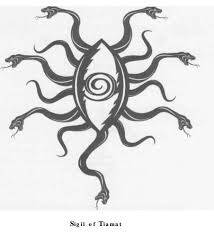
Different sources gave a different description of this goddess. She is often described as a woman, the glistening one. In the beginning, Tiamat personifies young and fertile motherhood, having given birth to generations of gods. At this stage, she was a calm, loving, and caring mother. However, when her off springs became murderous, she decided to deal with them by transforming into a vengeful monster with five independent heads.
Another source says Tiamat possesses a head, skull, eyes, mouth, nostrils, lips, tail, thigh, belly, ribs, neck, heart, arteries, and blood. Tiamat is also recognized as a sea dragon with the head of a griffin or tiger. She has wings, claws, four feet, and a scaly tail. This figure signifies both the power and hideousness of this great goddess. Other sources identify her with images of a sea serpent.
Abilities of Tiamat:
Tiamat can shapeshift into different forms according to her needs and desire. When Tiamat joined with Kingu, they became one great beast, with one female head and one male head. Together they begat the monsters.
Tiamat is the foundational force of chaos that uplifts and gives power to fiends and Adversarial Powers of the Abyss. She is the Mother of All. She offered clues to the gods and humanity. Her children are descendants of Kingu and they carry his blood within them.
Tiamat in Magical Practice
In contemporary Draconian, Chaos, and certain Vampyric currents, Tiamat is approached as the Mother of the Abyss and the embodiment of primordial power. She represents the raw, pre-civilised forces of creation and destruction, the hunger for existence, and the capacity to dissolve what has become rigid so that something stronger can emerge. She is both the womb and the devouring mouth.
Those who work with her seriously often describe the contact as intense, dissolving, and deeply transformative. She is not a gentle mother figure. She is the Dragon who demands that the practitioner be willing to be unmade. In return she offers access to a current of power that feels older and more fundamental than the structured gods of later pantheons.
Some practitioners link her to the awakening of the Inner Dragon and the rising of the Black Flame in its most primal form. Others meet her as the source of certain adversarial and abyssal spirits. In all cases the relationship is one of power and reciprocity rather than comfortable devotion.
Stones and Practical Notes
Amazonite is sometimes used to connect with her creative and path-opening aspects. Emerald has been employed when the work involves endurance through difficulty. These are secondary tools. The real work with Tiamat is internal and relational: the willingness to stand in her current without flinching and to accept the changes she brings.
Tiamat remains one of the purest expressions of the primordial feminine in the adversarial sense: not nurturing in the domestic way, but generative, destructive, and sovereign.
She is the Mother who gives birth to monsters and gods alike, and who can swallow worlds when the cycle demands it.
For those who are ready, she is a profound and dangerous ally.
For those who are not, she is best left undisturbed.
Sources:
- Maskim Hul Babylonian Magick by Michael W. Ford
- https://www.ancient-origins.net/myths-legends-asia/tiamat-mesopotamia-0010565
- https://www.newworldencyclopedia.org/entry/Tiamat
- Grimoire of Tiamat by Asenath Mason
