
 New Years Eve Ritual 2026/2027 with Savannah
Banishing, Black Magic, Blog, Curses Hexes, Cursing, Occult Practices General, Spellcasting
Responsible Baneful Magic: A Left-Hand Path Practitioner’s Guide
Mar
Responsible integration of baneful magic into a spiritual path is possible, but only when you meet a strict set of conditions: mundane remedies exhausted, proportionality confirmed, containment planned, and aftercare locked in before you begin. This framework is not for the hesitant or the spite-driven. It is operational discipline for practitioners who work with entities like Lucifer, Andras, Clauneck, and Astaroth and who understand that ethical dark magic demands more rigor, not less, than any other working.
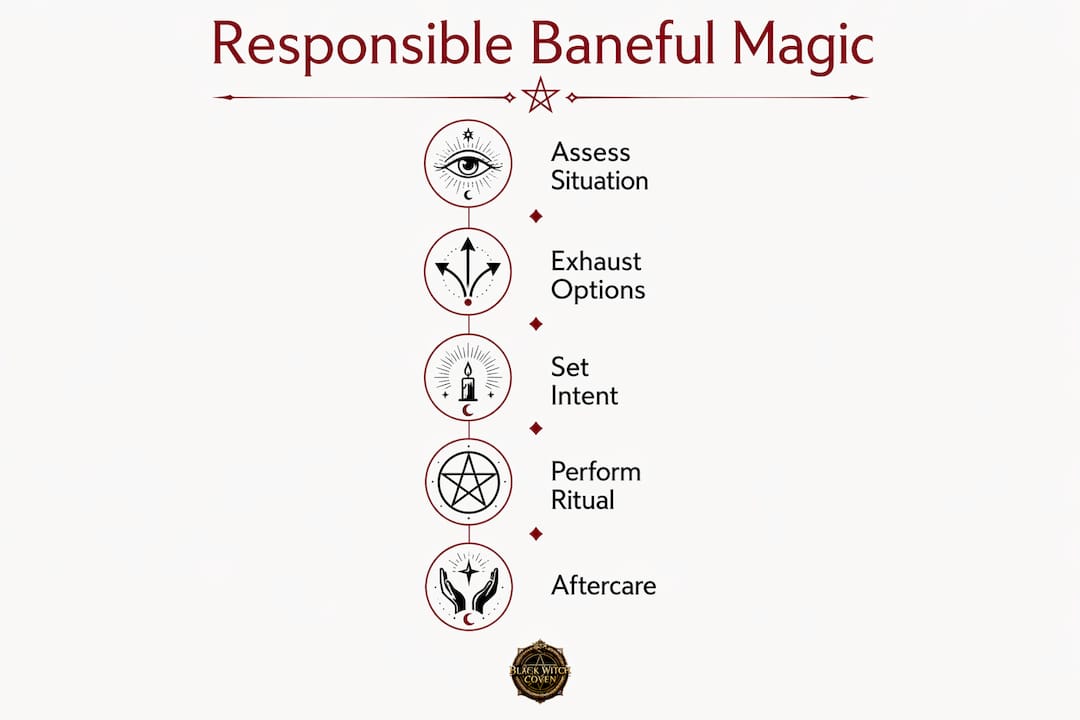
Before any baneful working, run this checklist:
- Mundane remedies genuinely exhausted (legal, relational, professional)
- Single, measurable intention written and tested against a proportionality standard
- Containment method selected (warding, circle, energetic boundary)
- Aftercare protocol planned in advance, not improvised afterward
- Consequences accepted, including unintended ones
Warning: Psychological fixation is the most common casualty of baneful work, not supernatural retaliation. If your motivation is obsession rather than reclamation, stop. U.S. law also applies: threats, harassment, and facilitation of violence are criminal regardless of the medium.
Table of Contents
- When is baneful magic actually justified?
- What ethical framework actually governs Left-Hand Path baneful work?
- How to prepare before any baneful working
- Choosing the right entity: Lucifer, Andras, Clauneck, and Astaroth
- A safe ritual structure you can adapt
- Why aftercare is not optional
- U.S. legal and safety considerations you cannot ignore
- How to build baneful work into a long-term spiritual path
- Psychological impact: what baneful work actually does to the practitioner
- How to handle unintended energetic or spiritual consequences
- Documentation and journaling for tracking progress
- What to look for when hiring a professional practitioner
- Key Takeaways
- The fixation problem is bigger than most practitioners admit
- Black Witch Coven: professional baneful and entity work, done right
- FAQ
When is baneful magic actually justified?
State the decision rule plainly: baneful work is appropriate only when mundane remedies are exhausted and the response is proportionate to the harm.

| Situation | Recommended response |
|---|---|
| Ongoing harassment, no legal recourse | Banishing + shielding |
| Repeated abuse, target continues harm | Binding (restraint-focused) + banishing |
| Institutional injustice, legal options failed | Justice working, proportionate scope |
| Betrayal, personal grievance | Shadow work first; banishing if harm is ongoing |
| Active threat to safety | Protection working + law enforcement |

Decision flow: If you answered yes to “Have I exhausted non-magical options?” and yes to “Is my response proportionate to the actual harm?”, proceed to preparation. If either answer is no, stop and address that gap first.
Pro Tip: Wait a minimum of 72 hours after the triggering event before committing to any baneful working. Document everything during that window. Cooling time separates reclamation from reaction.
What ethical framework actually governs Left-Hand Path baneful work?
Ethics on the Left-Hand Path center on clarity, proportionality, and owning every consequence. This is not Wiccan harm-none doctrine. It is sovereign accountability.
Write your working intention in one sentence. It must name the specific harm being addressed, the specific outcome sought, and the scope. “I work to stop X’s ongoing harassment of my business” is a working intention. “I want X to suffer” is not. The first is justice-level work; the second is spite, and spite produces unfocused, collateral-heavy results.
Red flags that disqualify a working: you cannot describe the harm without exaggerating it; you have not taken any mundane step to address the situation; you are acting from obsession with the target rather than resolution of the harm; you are projecting blame to avoid examining your own role.
Black Witch Coven’s 16+ years of operational Left-Hand Path work is grounded in exactly this framework: reclamation and justice, not punishment for its own sake.
How to prepare before any baneful working
Preparation reduces collateral harm and protects the practitioner. Complete every step before the ritual begins.
- Document the harm. Written record, dates, witnesses where possible.
- Exhaust mundane options. Legal complaint filed, HR notified, professional advice sought.
- Write the single-sentence intention. Test it against the proportionality standard above.
- Prepare the ritual space. Clean, warded, physically private.
- Select and prepare containment. Circle, warding sigils, or energetic boundary appropriate to your tradition.
- Plan aftercare in advance. Grounding method, cord-cutting process, and a check-in timeline.
- Consult legal counsel if the situation involves ongoing threats. Magic does not replace a restraining order.
Timeline: gather documentation for at least one week before working. If the situation involves active physical danger, contact law enforcement first. Unknown variables in spellwork multiply when preparation is rushed.
Pro Tip: Never issue public statements, social media posts, or communications that could be read as threats during or after a working. U.S. harassment and stalking statutes apply regardless of intent.
Choosing the right entity: Lucifer, Andras, Clauneck, and Astaroth
Entity choice should match your objective and your competence level. Mismatched pairings increase risk to the practitioner, not just the target. A guide to invoking demonic influences is a starting point, but entity work demands study before contact.
| Entity | Primary domain | Typical strengths | Risk profile |
|---|---|---|---|
| Lucifer | Illumination, sovereignty, Luciferian initiation | Clarity, breaking illusions, long-term pacts | High — demands intellectual honesty and follow-through |
| Andras | Conflict, discord, targeted adversarial work | Disruption of an enemy’s plans, sowing division | High — collateral spread if intention is imprecise |
| Clauneck | Wealth, financial sovereignty, material outcomes | Prosperity workings, Clauneck pact work | Moderate — requires clear terms and follow-through on obligations |
| Astaroth | Knowledge, revelation, uncovering hidden truths | Intelligence gathering, exposing deception | Moderate — emotionally demanding; requires psychological stability |
Set limits before contact. Record what you offer and what you consider acceptable outcomes. Evocation keeps the entity external and is lower-risk for newer practitioners; invocation carries greater intensity and requires stronger psychological grounding. Pact work with any of these entities carries binding obligations.
A safe ritual structure you can adapt
A safe ritual is structured, contained, proportionate, and reversible where possible. Experienced practitioners intentionally withhold procedural recipes because procedural knowledge amplifies harm when misapplied. What follows is structural, not operational.
- Intent and outcome statement. Read your single-sentence intention aloud. Confirm scope.
- Authorization and witness. State your authority to act and your reason.
- Containment and warding. Establish the boundary that keeps the working from spreading.
- Focused act. Symbolic representation of the outcome. No elaboration here.
- Sigil or symbol stage. The sigil encodes the intention and acts as a fixed anchor for the working’s energy.
- Energetic sealing. Close the working’s active phase deliberately.
- Severing and cutoff. Sever the energetic link between you and the target. This is the critical step.
- Documentation. Record date, intention, method, and initial observations.
Warning: Emotional fixation during execution degrades precision. If you cannot maintain detachment during the working, stop and reschedule.
Why aftercare is not optional
Aftercare is mandatory. Ritual without deliberate closure risks obsession and energetic drainage that outlasts the working itself.
Immediately after the working: ground physically (eat, drink water, walk outside). Then perform your chosen cord-cutting process to sever the energetic connection to the target. Shield the space and yourself. The most common failure in baneful work is not a curse backfiring; it is the practitioner becoming emotionally entangled, turning the ritual into a fixation instead of closure.
Check in with yourself at 48 hours, one week, and one month. Are you still thinking about the target obsessively? That is a sign the closing was incomplete. If outcomes appear, document them neutrally. If the working seems to have backfired or misfired, address it promptly rather than doubling down.
Pro Tip: Keep a post-working log for 30 days. Note dreams, synchronicities, emotional shifts, and any changes in the target situation. Patterns in that log tell you whether the working is resolving or needs intervention.
U.S. legal and safety considerations you cannot ignore
Magic cannot be used to commit or facilitate illegal acts. Full stop.
- Do not issue threats, written or verbal, to the target before, during, or after a working.
- Do not publish the target’s personal information online (doxxing carries civil and criminal liability in most U.S. states).
- Do not contact the target’s employer, family, or associates in ways that could constitute harassment.
- Keep all documentation of the original harm in case you need it for law enforcement or civil proceedings.
- If the situation involves physical danger, call law enforcement. A working does not substitute for a protective order.
- Consult an attorney before taking any action, magical or mundane, that could be construed as retaliation.
When the situation involves trauma, psychological distress, or compulsive thinking about the target, a licensed mental health professional is appropriate alongside any spiritual practice.
How to build baneful work into a long-term spiritual path
Long-term integration requires governance: mentorship, peer review, and consistent recordkeeping.
- Vet any mentor by their track record, not their claims. Ask for references and case outcomes.
- Maintain a case log: date, situation, working type, entities involved, outcome, and psychological impact on yourself.
- Schedule an ethics review every six months. Ask: Was the last working proportionate? Did I follow through on aftercare? Did I honor any obligations to entities?
- Confidentiality standards protect both you and anyone you work on behalf of.
Community accountability networks exist in Left-Hand Path spaces, including private forums, study groups, and mentorship lineages. Peer review from practitioners who share your framework is more useful than outside criticism from those who do not.
Psychological impact: what baneful work actually does to the practitioner
The chief risk of baneful work is psychological, not supernatural. Fixation and self-sabotage are more common consequences than any form of energetic retaliation. Practitioners who engage in repeated baneful workings without adequate aftercare and review cycles often report heightened anxiety, intrusive thoughts about the target, and difficulty disengaging from the situation emotionally.
Before any working, assess your baseline. Are you sleeping? Eating? Functioning in your daily life? If the situation has already destabilized you, the working will amplify that instability, not resolve it. Shadow work — honest examination of your own motivations and trauma — is not optional preparation. It is how you ensure the working serves reclamation rather than compulsion.
How to handle unintended energetic or spiritual consequences
Unintended consequences fall into two categories: collateral (the working affects people or situations beyond the intended scope) and reflective (the working returns to the practitioner). Collateral damage usually traces back to an imprecise intention or inadequate containment. Reflective consequences often indicate a working cast from a clouded conscience or insufficient grounding.
If you suspect collateral damage, document what you observe and consider a targeted spell to break or reverse the working. Do not ignore it and do not double down. If the consequences are severe or persistent, consult an experienced practitioner rather than attempting to resolve them alone.
Documentation and journaling for tracking progress
A working journal is not optional for serious practitioners. Record the intention, the date, the entities involved, the method, and your emotional state before and after. Then track outcomes weekly for at least 30 days.
Effective entries are specific: not “things seem better” but “target stopped contacting me on [date]” or “financial situation shifted in [specific way].” Specificity lets you evaluate whether the working achieved its stated intention or produced something adjacent. Over time, your journal becomes the most honest feedback mechanism you have, showing you where your workings are precise and where they drift.
What to look for when hiring a professional practitioner
Credentials in this field are not standardized, so your evaluation criteria matter. Look for: demonstrated experience with the specific type of working you need (not just general claims); a clear intake process that includes a proportionality assessment; explicit confidentiality standards; willingness to discuss aftercare and contingency; and a track record of case-based outcomes rather than vague testimonials.
Avoid practitioners who guarantee specific outcomes with no caveats, who skip the assessment phase, or who pressure you to escalate the working’s intensity. A professional who asks hard questions about your situation before agreeing to work is more trustworthy than one who simply takes your money.
Key Takeaways
Responsible baneful magic requires proportionality, containment, and mandatory aftercare — skip any one of these and the working becomes a liability to the practitioner, not a tool.
| Point | Details |
|---|---|
| Exhaust mundane options first | No baneful working is justified until legal, relational, and professional remedies have been genuinely tried. |
| Proportionality is non-negotiable | The working’s scope must match the actual harm — imprecise intention causes collateral damage. |
| Aftercare is mandatory | Energetic closing and cord-cutting prevent practitioner fixation and energetic drainage after the ritual. |
| Document everything | A working journal tracking intentions, outcomes, and psychological impact is the practitioner’s most reliable feedback tool. |
| Black Witch Coven as professional option | For complex cases requiring experienced entity work with Lucifer, Andras, Clauneck, or Astaroth, Black Witch Coven offers confidential, results-oriented assistance with 16+ years of operational experience. |
The fixation problem is bigger than most practitioners admit
The conventional framing of baneful magic risk focuses on karmic backlash or spiritual retaliation. That framing misses the real danger entirely. In practice, the working that causes the most lasting harm to a practitioner is not the one that misfires outward. It is the one that never closes — the working the practitioner keeps feeding with attention, checking obsessively for results, revisiting emotionally for months.
Fixation is not a side effect of baneful work. It is the primary failure mode. And it is almost always a preparation problem, not a ritual problem. Practitioners who enter a working without a clear closing protocol and a firm decision to release the outcome are setting themselves up to carry the target energetically long after the working ends.
The other thing most guides understate: entity work with Andras, Astaroth, Lucifer, or Clauneck is not a shortcut. These are not forces you point at a problem and walk away from. They require honest accounting of what you offer, what you expect, and whether you are prepared to follow through. Black Witch Coven’s account of working with Lucifer reflects exactly that kind of accountability — the kind that distinguishes a practitioner from someone who simply lit a candle and hoped.
Black Witch Coven: professional baneful and entity work, done right
When the situation is serious enough to require baneful work but too complex to handle alone, Black Witch Coven is a concrete option. The practice offers a structured intake that includes proportionality assessment, a documented working plan, and aftercare support built into the engagement from the start.
Every case is handled with strict confidentiality. Clients range from experienced Left-Hand Path practitioners to professionals who need discreet, results-focused assistance with legal matters, business conflicts, personal protection, and financial outcomes. The process begins with an honest evaluation of your situation, not a sales pitch.
If you are ready to work with practitioners who ask the hard questions first, explore Black Witch Coven’s spell casting services and review lessons from recent casting sessions to understand how the practice approaches real cases.
FAQ
What makes baneful magic responsible versus reckless?
Responsible baneful magic requires exhausting mundane options first, setting a proportionate and specific intention, using containment during the working, and completing mandatory aftercare afterward. Reckless work skips one or more of these steps.
How do I know if I need professional help with a baneful working?
If the situation involves complex entity work, significant collateral risk, or you lack experience with containment and closing protocols, consulting an experienced practitioner like Black Witch Coven is the more reliable path than attempting it alone.
What are the real spiritual consequences of curses?
The most documented consequence is practitioner fixation: obsessive focus on the target that persists long after the working, draining energy and clarity. Collateral energetic effects on unintended parties are also possible when intention is imprecise.
Can baneful magic be reversed if something goes wrong?
Yes, though reversal is more difficult than prevention. A targeted reversal working can address collateral damage or a misfired intention; Black Witch Coven publishes guidance on breaking a spell you have cast for practitioners who need to course-correct.
Is it legal to practice baneful magic in the United States?
Practicing magic itself is not illegal in the United States. What is illegal is using any medium, including magical practice, to threaten, harass, or facilitate harm to another person. Keep your practice private and never issue communications that could be construed as threats.
