
 New Years Eve Ritual 2026/2027 with Savannah
Blog
Left-Hand Path Discipline: A Practitioner’s Guide to Self-Mastery

Aug
Left-Hand Path discipline is a self-enforced system built to make your Will sovereign. There is no priest, no karmic ledger, and no divine parent grading your homework. You are the authority, the enforcer, and the one who pays for every skipped session. Success looks concrete: a daily rite you actually perform, a ritual journal with real entries instead of good intentions, and milestones you can measure instead of feel.
Start today with three moves:
- Perform one short rite before sunrise or sunset, even five minutes of focused invocation.
- Open a ritual diary tonight and write down what you did, when, and what shifted in your energy.
- Set a fixed time for a daily Black Flame or solar invocation and treat that appointment as non-negotiable.
Table of Contents
- What Are the Core Principles Behind Left Hand Path Approaches to Discipline and Self-Mastery?
- How Do You Build a Daily Ritual Discipline?
- What Techniques Build Left Hand Path Self-Mastery?
- How Do You Build Psychological Sovereignty Without Losing Discipline?
- What Are the Safety Boundaries for Serious LHP Practice?
- What Does a 30-Day and 90-Day LHP Discipline Program Look Like?
- What Do Experienced Practitioners Wish Beginners Knew?
- Sources
- FAQ
What Are the Core Principles Behind Left Hand Path Approaches to Discipline and Self-Mastery?
Left Hand Path approaches to discipline and self-mastery rest on two pillars: self-deification and antinomianism. Self-deification, or apotheosis, means you work toward becoming your own governing authority rather than submitting to an external one. Antinomianism means deliberately stepping outside inherited moral conditioning to test what actually serves your sovereignty, not just what you were told was good.

That distinction traces back to Tantric vāmācāra and dakṣiṇācāra, the original left and right hand split, long before Western occultism adopted the terms.
Right-Hand Path traditions typically lean on external accountability: karma, church authority, a moral rulebook enforced from outside. LHP flips that structure entirely. There is no cosmic auditor checking your ritual log.
- RHP discipline: enforced by doctrine, community, or fear of consequence.
- LHP discipline: enforced by you, for you, with no safety net if you quit.
- Praxis over belief: knowing the theory of magick changes nothing without repetition.
That’s precisely why LHP demands more rigor than most newcomers expect, not less.
How Do You Build a Daily Ritual Discipline?
A repeatable schedule beats sporadic bursts of enthusiasm every time. Structure your day around three anchor points rather than one grand ritual you’ll eventually skip.
Morning: A brief solar adoration or Black Flame invocation, five to ten minutes, done at the same hour daily.
Midday: A command practice, short assertions of Will directed at a specific goal, spoken aloud or visualized with intent.
Evening: A banishing to close the day’s energetic loop, followed by journaling.
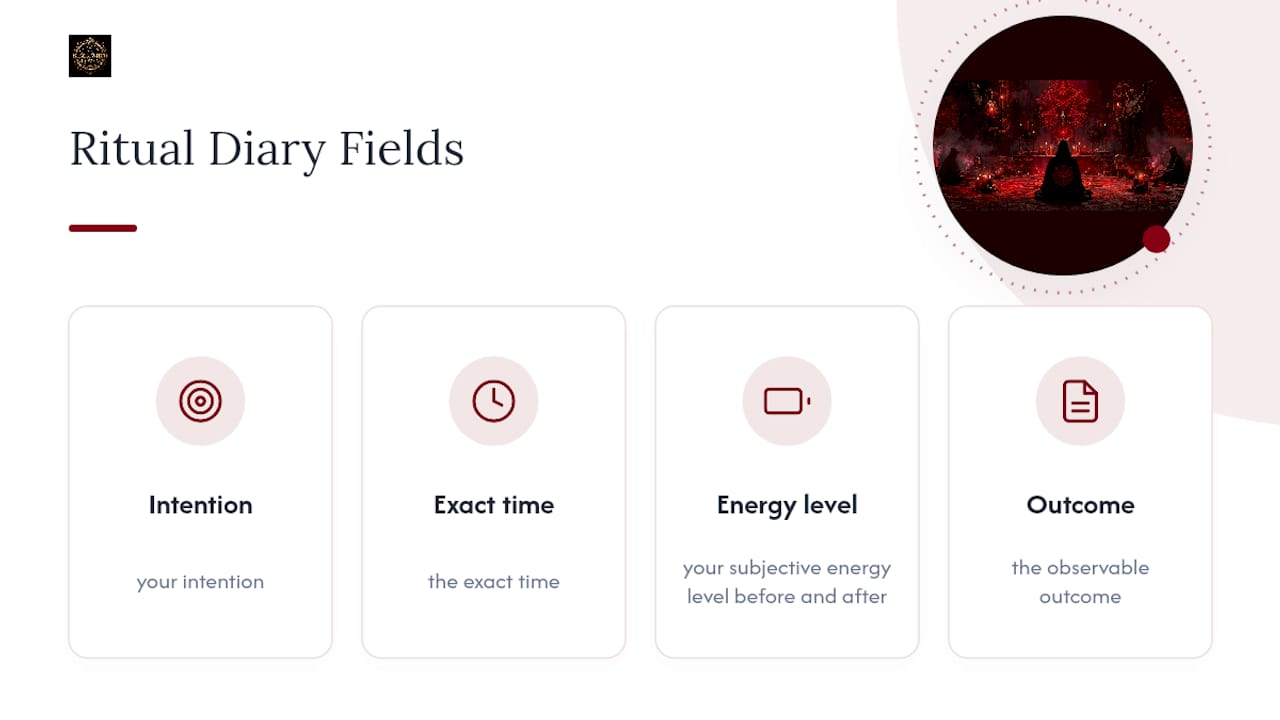
Your ritual diary should log four things every time: your intention, the exact time, your subjective energy level before and after, and the observable outcome, even if the outcome is “nothing yet.” Practitioners who treat mundane scheduling as ritual infrastructure, using a dedicated calendar and diary the way a strength athlete uses a training log, tend to hold consistency longer than those relying on memory and mood.
Habit scaffolding works the same way it does in any serious discipline: anchor new rites to existing habits (invocation right after brewing coffee), and use small wins to build momentum before attempting longer workings. Structured daily spiritual practice research supports this same anchor-habit logic outside occult contexts, too.

Pro Tip: Turn one mundane chore, dishes, a commute, folding laundry, into a silent recitation of your working intention. You get free repetition without adding a single minute to your day.
What Techniques Build Left Hand Path Self-Mastery?
Skill comes from repeated, embodied technique, not from reading about it. Magick demands practice until a rite becomes second nature, and that principle governs every technique below.
Simple invocation: Ground for one minute. State your intention aloud in the present tense. Visualize the outcome as already real. Close with a single word of command.
Sigil creation: Write your intention as a sentence. Strip repeated letters. Design a glyph from what remains. Charge it through focused stare, breath, or brief trance, then release it from conscious thought.
Shadow ritual: Name the impulse or fear you’re confronting directly, out loud. Sit with it inside a deliberate ritual container rather than pushing it away. Convert the raw material into a stated intention or action.
Banishing as command: Rather than a defensive gesture, treat banishing as an assertion, you are declaring the space yours, not begging for protection.
- Scale rituals by duration and complexity: sixty seconds for daily maintenance, fifteen to thirty minutes for weekly workings, full ceremonial length only for major operations.
- Never work with another person’s energy, sigil, or name without their explicit consent.
- Keep psychological containment in place: a defined start and end to every rite prevents bleed into ordinary waking life.
How Do You Build Psychological Sovereignty Without Losing Discipline?
Sovereignty collapses fast without an internal check on ego. Active shadow work, direct confrontation of the impulse rather than passive journaling about it, is what separates a disciplined practitioner from someone indulging impulses and calling it magick. Responsible shadow integration is the stated goal of serious modern LHP work, not chaos for its own sake.
Solitary practitioners still need accountability. Build it yourself:
- Keep a ritual diary you reread monthly, looking for patterns of avoidance or excuse.
- Write and periodically renew a personal oath that states what you will and will not do.
- Seek occasional peer review from a trusted, experienced practitioner rather than working in total isolation forever.
Watch for these red flags: rituals that only ever serve your vanity, refusal to ever record a failed working, and treating other people as props for your “power” rather than autonomous beings. That’s ego wearing sovereignty’s mask.
What Are the Safety Boundaries for Serious LHP Practice?
Discipline without boundaries turns into damage fast. Watch for emotional destabilization, sudden isolation from support systems, or a creeping sense that ordinary ethical limits no longer apply to you, that’s boundary erosion, not enlightenment.
Seek professional mental-health support if you experience persistent dissociation, intrusive thoughts you can’t ground, or an inability to distinguish ritual trance from daily reality. Magick is not a substitute for treating clinical depression or psychosis.
Operate ethically with a short checklist:
- Never invoke or work on another person’s behalf without their informed, explicit consent.
- Never break the law in pursuit of a working, full stop.
- Set a hard stop time for every session and honor it, even mid-rite.
What Does a 30-Day and 90-Day LHP Discipline Program Look Like?
Structure beats intention every time. A 30-day base program looks like this:
- Days 1 to 7: Daily five-minute invocation, nightly diary entry, no exceptions.
- Days 8 to 14: Add midday command practice and your first sigil working.
- Days 15 to 22: Introduce one shadow confrontation session per week.
- Days 23 to 30: Full daily rite (invocation, command, banishing) plus a written self-review.
Scale to 90 days by adding weekly milestones: month one builds consistency, month two adds a peer-reviewed oath renewal, month three introduces a full ceremonial working evaluated against your original written intention.
A sample oath: “I bind myself to my own Will. I answer to no authority but my own discipline. I will record my failures as honestly as my victories.”
Measure outcomes with behavioral markers, not vibes: rites completed versus rites skipped, diary entries per week, and whether stated intentions actually manifested within your set timeframe.
What Do Experienced Practitioners Wish Beginners Knew?
Practitioners who track consistency for ninety straight days typically report the same shift: results stop feeling random once the ritual becomes habit rather than event.
Pro Tip: Months one through three should prioritize consistency over complexity. A five-minute rite performed sixty days straight outperforms one elaborate working done once.
- Prioritize showing up daily before adding advanced techniques.
- Track everything, especially the failures; they’re your best data.
- Build containment first; sovereignty without boundaries burns out fast.
The most common derailer is skipping the diary. Without a written record, you can’t tell discipline from delusion.
Why Disciplined Sovereignty Matters on This Path
Undisciplined power is just risk with better marketing. A practitioner who tracks results, honors consent, and returns daily to the work is the only one who lasts on this path.
Where Structured Guidance Accelerates Your Practice
Building this discipline alone works, but it’s slower, and mistakes cost more when nobody experienced is checking your containment. Black Witch Coven has spent over sixteen years guiding practitioners through exactly this kind of structured LHP work, from daily ritual scaffolding to bespoke pacts built around your specific goals. Our ritual mentorship and ongoing pact maintenance give you the accountability a solitary diary can’t always provide, someone with real Goetic and Luciferian experience reviewing your progress instead of just your own hopeful notes.
If you’re ready to formalize your practice with guidance grounded in real results, start by reading our page on understanding black magick and reach out to discuss a tailored ritual schedule.
Sources
- XXIX · The Left-Hand Path — Giansanti Codex
- Azazel Ra: The Primacy of Praxis – Why Magick Demands Practice – Mithraic Magazine
- The Unconventional Ascent: Exploring the Left Hand Path in Spiritual Development – Worldwide Temple of Aurora
FAQ
Is the Left-Hand Path Evil?
No. LHP rejects conventional morality’s authority over you, which isn’t the same as malice; it centers self-deification and personal accountability, not harm for its own sake.
What Is the Left-Hand Tantric Path?
Left-hand tantra, or vāmācāra, is the original source of the left/right hand distinction, involving transgressive practices meant to break conditioned limits rather than follow orthodox ritual purity.
What Is Left-Hand Mysticism?
It refers to esoteric practices that pursue self-realization through antinomian methods, deliberately working outside sanctioned moral or religious frameworks rather than within them.
Is There a Book Called “The Left-Hand Path”?
The phrase appears across multiple works and encyclopedic treatments rather than one single canonical title; foundational reading includes The Satanic Bible, Luciferian Witchcraft, and primary grimoires like the Grimorium Verum.
How Long Before I See Results From Daily LHP Practice?
Most disciplined practitioners report noticeable shifts within a month of consistent daily ritual, with clearer measurable outcomes emerging over a sustained period of practice.
Primary Texts and Modern Reading for Deeper Practice
- The Satanic Bible by Anton LaVey, the foundational modern text on antinomian self-assertion.
- Mitch Horowitz’s writing, a modern, accessible entry into LHP philosophy and accountability.
