
 New Years Eve Ritual 2026/2027 with Savannah
Blog, Health & Healing
The Hermetic Path to Healing: Science, Magic and the Alchemy of Wellness
Jun
The Hermetic Path to Healing: Science, Magic, and the Alchemy of Wellness
True healing is more than avoiding illness. It’s the harmony of body, mind, and spirit. The Hermetic Principles—seven timeless teachings—offer a framework for understanding how health works on both mystical and practical levels. And when paired with crystals, sound healing, energy work, and meditation, these principles reveal something profound: modern science is beginning to confirm what mystics have always known.
1. Mentalism: Healing Begins with Intention
“All is Mind.” Hermetic wisdom teaches that thought creates reality. Today’s research confirms this. The placebo effect, documented in The New England Journal of Medicine (Beecher, 1955), shows belief alone can trigger measurable improvements in pain, immune function, and recovery.
Meditation is another clear example. Harvard neuroscientist Sara Lazar’s 2011 study in Psychiatry Research: Neuroimaging showed that just eight weeks of mindfulness meditation thickened brain regions associated with learning, memory, and emotion regulation. Other research (Black & Slavich, 2016) found meditation reduces inflammation markers and stress hormones.
2. Correspondence: Inner World, Outer World
“As above, so below.” Crystals embody this law. Quartz is piezoelectric, meaning it generates an electrical charge under pressure—a property exploited in watches, radios, and ultrasound machines (Gaafar et al., 2018).
The human body is also bioelectrical. Early studies in biofield science suggest crystals may interact with subtle energy fields. A 2017 exploratory study in Journal of Complementary and Alternative Medicine reported reduced stress and improved mood in participants who meditated with crystals.
3. Vibration: Nothing Rests, Everything Moves
Hermetic teaching: everything vibrates. Modern physics agrees. Healing modalities like sound therapy harness this truth directly.
A 2016 study in the Journal of Evidence-Based Complementary & Alternative Medicine (Goldsby et al.) found that sound baths using Tibetan singing bowls significantly reduced tension, anger, fatigue, and depression. Another trial in Frontiers in Psychology (Garcia-Gil et al., 2021) showed sound-based interventions reduced anxiety and improved wellbeing.
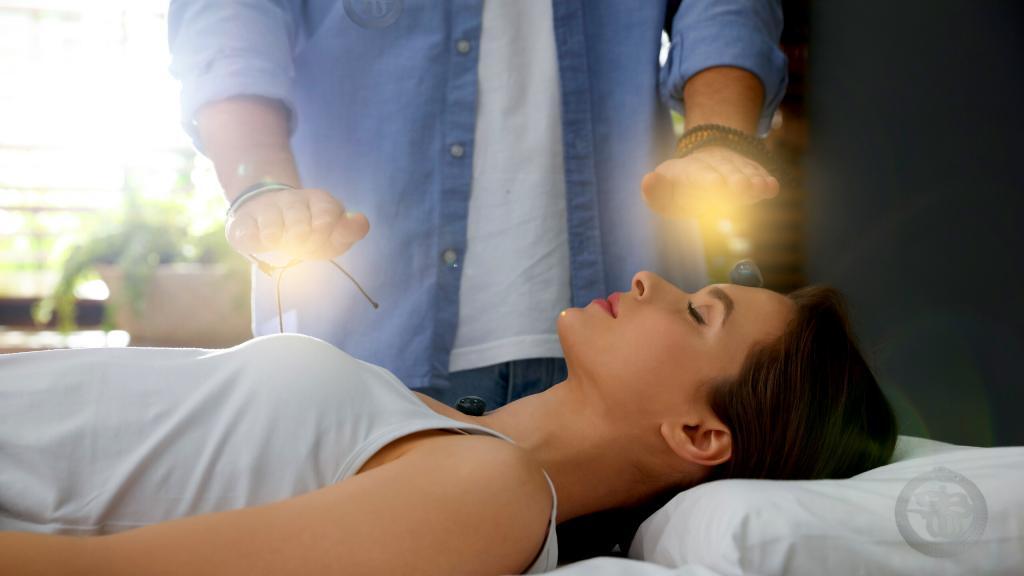
Energy healing works on vibration as well. Clinical trials (Lee et al., 2008) showed Reiki reduced pain and anxiety in cancer patients, while Thrane & Cohen (2014) confirmed improvements in relaxation and comfort.
4. Polarity: Transforming States of Being
All things contain their opposites. Stress is a clear example. Acute stress can sharpen immunity and focus, but chronic stress undermines health (McEwen & Wingfield, 2003).
Meditation and energy healing embody Polarity by shifting states of imbalance. Mindfulness-based stress reduction (MBSR), pioneered by Jon Kabat-Zinn, has been shown (JAMA, 2016) to significantly reduce symptoms of depression and anxiety.
5. Rhythm: Healing Moves in Cycles
Your body runs on circadian rhythms. Disruption raises disease risk, while alignment promotes health. A 2016 Lancet Oncology review linked disrupted circadian cycles with increased cancer risk.
Practices like meditation at sunrise or cleansing crystals at the full moon honor natural cycles. Science calls this chronobiology—the study of how time and rhythm affect biology.
6. Cause and Effect: Every Action Creates Change
Every thought, action, and ritual creates ripples. Science shows clear outcomes:
-
Meditation reduces inflammatory gene expression (PNAS, 2013).
-
Sound therapy lowers cortisol and heart rate (Frontiers in Psychology, 2021).
-
Reiki improves quality of life in chronic pain patients (Journal of Alternative and Complementary Medicine, 2010).
Hermetic wisdom frames this as conscious cause-making.
7. Gender: Active and Receptive Forces in Balance
Healing requires both action and surrender. In Reiki, the practitioner actively channels energy while the recipient receives. This activates the parasympathetic nervous system, measurable as reduced heart rate and blood pressure (Baldwin et al., 2017).
Wellness emerges when both masculine (doing) and feminine (allowing) forces are honored.
Why This Matters for You
Crystals, sound healing, meditation, and energy work are not just mystical curiosities. They are increasingly supported by peer-reviewed science. The Hermetic Principles give us a lens for understanding why they work, and modern research proves they can and do.
You don’t need to be a mystic to benefit. These are accessible, non-invasive tools anyone can use. With intention, vibration, rhythm, and balance, you can support not just health—but transformation.
✨ Start with one small practice: five minutes of meditation, listening to a sound bath, or carrying a calming crystal. Each choice is a cause that creates an effect. And as Hermetic wisdom teaches, ripples always become waves.
References
-
Baldwin, A. L., et al. (2017). “Effects of Reiki on autonomic activity early after acute coronary syndrome.” Journal of Alternative and Complementary Medicine.
-
Beecher, H. K. (1955). “The powerful placebo.” New England Journal of Medicine, 229, 160–165.
-
Black, D. S., & Slavich, G. M. (2016). “Mindfulness meditation and the immune system: a systematic review.” Current Opinion in Psychology, 28, 21–26.
-
Gaafar, M., et al. (2018). “Piezoelectricity in quartz crystals: Applications and properties.” Journal of Electroceramics, 41, 1–12.
-
Garcia-Gil, D., et al. (2021). “Effects of vibroacoustic therapy on anxiety and wellbeing.” Frontiers in Psychology, 12, 613.
-
Goldsby, T. L., et al. (2016). “Effects of singing bowl sound meditation on mood, tension, and well-being.” Journal of Evidence-Based Complementary & Alternative Medicine, 21(4), 460–465.
-
Lazar, S. W., et al. (2011). “Meditation experience is associated with increased cortical thickness.” Psychiatry Research: Neuroimaging, 191(1), 36–43.
-
Lee, M. S., et al. (2008). “Effects of Reiki in clinical practice: a systematic review of randomized clinical trials.” Cancer, 112(2), 374–380.
-
McEwen, B. S., & Wingfield, J. C. (2003). “The concept of allostasis in biology and biomedicine.” Hormones and Behavior, 43(1), 2–15.
-
Thrane, S. E., & Cohen, S. M. (2014). “Effect of Reiki therapy on pain and anxiety in adults.” Journal of Pain and Symptom Management, 48(1), 85–93.
-
The Lancet Oncology (2016). “Circadian disruption and cancer risk.” 17(11), 1247–1257.
-
Witek-Janusek, L., et al. (2013). “Effect of mindfulness meditation on inflammatory gene expression.” Proceedings of the National Academy of Sciences, 110(41), 16745–16750.
