
 New Years Eve Ritual 2026/2027 with Savannah
Blog
Fear-Based vs. Power-Based Spirituality: The LHP Difference
Feb
Power-based spirituality, as practiced on the Left-Hand Path, means one thing: you are the sovereign author of every outcome.
Fear-based approaches delegate that authorship to an external force, whether a deity, a doctrine, or a collective moral code, and ask you to comply, submit, or wait. The difference between fear-based spirituality and power-based spirituality is not aesthetic. It is structural, metaphysical, and operational.
Three differentiators that matter in practice:
- Goal: LHP practice targets individual apotheosis, the permanent expansion and sovereignty of the Self. Fear-based modes target dissolution, obedience, or protection from punishment.
- Method: Power-based work uses invocation, pacts, sigils, and direct command. Delegatory practice uses prayer, renunciation, and petitionary ritual.
- Ethics: On the LHP, you own every consequence. There is no divine safety net to absorb your errors.
Power-based LHP spirituality preserves the autonomous Self through direct command, pact work, and full ownership of consequences, while fear-based approaches delegate Will to an external authority and avoid that responsibility entirely.
| Point | Details |
|---|---|
| Core distinction | LHP targets apotheosis and sovereignty; fear-based modes target dissolution or compliance. |
| Ritual method | Command, sigils, pacts, and offerings replace petition and renunciation. |
| Responsibility | Every consequence belongs to the practitioner; no external authority absorbs errors. |
| Readiness test | Three successful micro-operations with verifiable outcomes before escalating to pact work. |
| Black Witch Coven | Offers professional pact drafting, Goetic invocation, and backfire containment for serious practitioners. |
Table of Contents
- What does power-based spirituality actually mean for LHP practitioners?
- What does power-based ritual actually look like?
- Which entities should you work with, and what do they actually do?
- How do you manage ethics and risk in LHP practice?
- How do you shift from delegatory practice to disciplined LHP work?
- What do real outcomes look like? Three anonymized cases
- Who is behind this guide?
- Why sovereignty is worth the weight
- Professional LHP services from Black Witch Coven
- Sources
- FAQ
What does power-based spirituality actually mean for LHP practitioners?
The Giansanti Codex defines the LHP goal as individual apotheosis: the practitioner becomes a sovereign being who preserves and expands the autonomous Self rather than dissolving into an external divinity. That single distinction separates every ritual decision that follows.
PhilArchive’s collected scholarship frames this as a “regime of Will,” a positive philosophical program in which the practitioner accepts full authorship of action, including its costs. As Thalira’s survey of LHP history notes, the path is defined by goal and orientation, not by taboo or shock value alone.
The two regimes in practice:
| Dimension | Fear-based / Delegatory | Power-based / LHP |
|---|---|---|
| Goal | Dissolution, obedience, salvation | Apotheosis, sovereignty |
| Method | Prayer, petition, renunciation | Invocation, pacts, command |
| Ritual form | Supplication, offerings to appease | Contracts, sigils, binding |
| Responsibility | Delegated to deity or doctrine | Owned entirely by practitioner |
Self-assessment sequence: delegation (you ask and wait) → ownership (you command and verify) → selective dissolution (you merge temporarily for specific operations, then return to Self). Most practitioners who feel “stuck” are still in the first stage without knowing it.
What does power-based ritual actually look like?
Effective Goetic practice runs on command, precise sigils, and boundary rituals. Theatrical display is not the point. Repeatable architecture is.
Ritual template (order of operations):
- State the intention in writing before you open the space. One outcome, one timeframe, one measurable marker.
- Prepare the space: circle or boundary, entity sigil activated with blood or breath, candle and incense appropriate to the spirit.
- Open with authority, not supplication. Name the entity, state your Will, and specify the terms.
- Deliver the offering as part of the contract, not as a gift hoping for favor.
- Seal with a signature or physical mark on the pact document.
- Dismiss formally. The entity leaves; you close the space.
- Verify: track synchronistic and material feedback daily for the agreed timeframe.
Preparation checklist:
- Sigil drawn or printed, consecrated before the session
- Boundary ritual rehearsed and memorized
- Offering prepared and appropriate to the entity
- Written pact with specific terms, no vague language
- Ritual diary open and dated
Pro Tip: Write pact clauses conditionally: “Deliver X by [date] without harm to my health, finances, or legal standing.” Conditional language limits collateral effects. Never leave the scope open-ended.
Test low-stakes operations first. A micro-operation with a clear, verifiable outcome (a specific contact reaching out, a specific sum arriving) validates your command structure before you escalate to high-risk pact work.
Which entities should you work with, and what do they actually do?
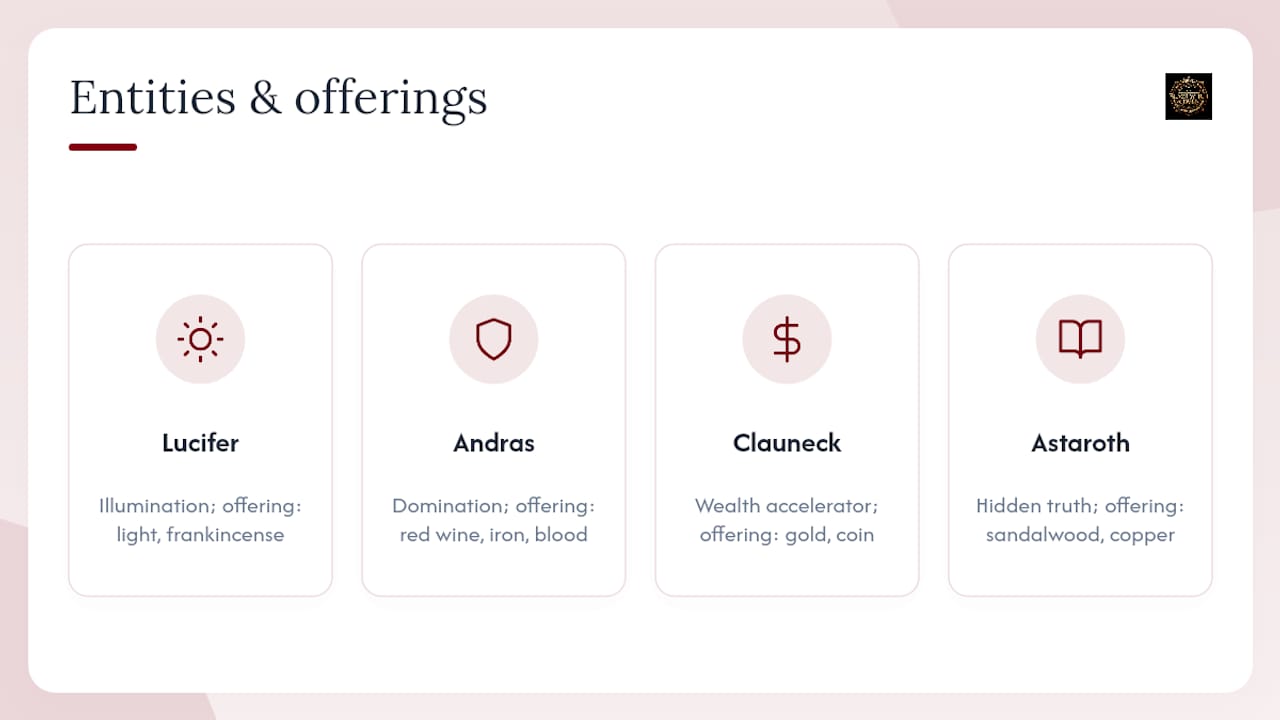
Lucifer operates in illumination, self-knowledge, and the removal of false beliefs. Practitioners call on him when they need clarity about their own Will or when conditioning from fear-based systems is blocking progress.
Typical offering: light, frankincense, written acknowledgment of what you are releasing.
Red flag: if working with Lucifer produces confusion rather than clarity after two weeks, your intention is not clean.
See My Pact With Lucifer for a practitioner account of the intake process.
Andras is a spirit of domination and conflict resolution, one of the most volatile in the classical Goetia. He delivers results in situations requiring force: breaking opposition, neutralizing enemies, ending stalemates.
Offerings: red wine, iron, blood.
Risk level is high.
Never work with Andras without a sealed boundary and a written dismissal clause. If you feel aggression bleeding into your daily behavior after a session, stop immediately and perform a grounding ritual.
Clauneck governs wealth, treasure, and the flow of money. He is among the most responsive entities in the Grimorium Verum tradition and responds well to practitioners who already have a financial strategy in place. He accelerates what exists; he does not conjure from nothing.
Offering: gold, coin, written financial target.
Red flag: if you notice compulsive spending or financial recklessness after working with Clauneck, reassess the pact terms.
Astaroth covers knowledge, hidden truth, and past-life or ancestral material. Practitioners use her when they need to understand the root cause of a block rather than just remove its surface symptom.
Offering: sandalwood, copper, written question. She tends to surface uncomfortable truths. If the material that surfaces feels destabilizing rather than clarifying, pause and integrate before continuing.
Sample invocation phrasing (Clauneck, illustrative):
“Clauneck, I call you by your seal.
My Will is [specific financial outcome] by [date].
I offer [offering] in exchange for your work.
Deliver without harm to my health or legal standing.
I bind this agreement by my signature.”
When to escalate to professional help: if you cannot hold a clear, single intention for the full duration of a ritual, you are not ready for pact work alone.
How do you manage ethics and risk in LHP practice?
The Worldwide Temple of Aurora’s analysis makes the point plainly: no external authority enforces LHP conduct. That means discipline is entirely self-imposed, and the cost of carelessness lands entirely on you.
Ethical screening questions before any pact or coercive working:
- Is my intention specific enough that I can verify the outcome?
- Does this working harm someone who has not consented to the risk?
- Am I in a stable mental and emotional state to own the consequences?
- Do I have a containment plan if the operation produces unintended effects?
Backfire remediation (stepwise):
- Ground immediately: feet on earth, breath work, physical movement.
- Close all open ritual space and revoke any unsealed permissions.
- Perform a containment ritual (salt boundary, banishing, or psychic shield).
- Identify the specific clause or intention that misfired and rewrite it.
- Contact a professional practitioner if the effects persist beyond 72 hours.
Stop and seek help if: you are experiencing intrusive thoughts you cannot interrupt, your daily functioning is impaired, or you cannot clearly state your original intention from memory.
How do you shift from delegatory practice to disciplined LHP work?
Days 1–30 (foundations):
Daily Will practice: write one intention each morning, track one verifiable outcome each evening.
Activate one sigil per week from a classical source.
Use a shadow and healing spread at the end of each week to surface what is resisting.
Days 31–90 (micro-operations to mid-risk invocations):
Run three micro-operations with measurable outcomes before attempting any entity invocation.
Once two of three produce verifiable results, move to a single invocation with a low-stakes request.
Document every session. Clarity of intent and incremental testing are the core operating method at this stage.
Pact readiness markers:
You are ready for pact work when you can hold a single, specific intention for a full ritual without deviation, you have documented at least three successful micro-operations, and you have a written containment plan for the entity you intend to work with.
What do real outcomes look like?
Three anonymized cases
All client details are anonymized. Black Witch Coven maintains strict confidentiality for all practitioners and clients.
-
Business owner, financial block. A client running a service business had stalled revenue for eight months despite strong demand. Intervention: Clauneck invocation with a written financial target and a 60-day pact. Outcome: a major contract arrived in week five, representing a significant revenue increase. Verification metric: signed contract and bank deposit. Lesson: the client already had the infrastructure; Clauneck accelerated the conversion.
-
Legal dispute, domination working. A practitioner facing a protracted legal conflict engaged Andras through a sealed boundary ritual with a specific dismissal clause. Outcome: the opposing party withdrew their claim within 45 days. Verification metric: written legal withdrawal. Lesson: the containment clause prevented the aggression from bleeding into the client’s personal relationships, which had been a concern.
-
Practitioner in fear-based conditioning. A client with a background in restrictive religious practice was unable to hold a clear intention without guilt interrupting the ritual. Intervention: 30-day Will practice protocol plus a Lucifer invocation focused on releasing false belief structures. Outcome: by day 28, the client completed a full ritual without interruption and reported a measurable shift in decision-making confidence. Verification metric: self-reported ritual diary entries and one verifiable external outcome (a professional opportunity accepted that the client had previously declined out of fear).
Why sovereignty is worth the weight
Most practitioners who leave fear-based systems do not fail because the LHP is too dangerous. They fail because they underestimate how much of their identity was built on delegation. Sovereignty means you carry the outcome, every time, without appeal. That is not a burden to minimize. It is the point.
The loneliness of the LHP is real. There is no congregation to absorb your doubt, no doctrine to fall back on when a working misfires. What you get instead is authorship: the permanent, verifiable knowledge that you shaped the outcome. That trade is worth accepting, but only if you accept it fully.
Sources
- XXIX · The Left-Hand Path — Giansanti Codex
- Goetia Spirits: A Practical Guide to Solomonic Demons — Agartha Sarcanum
- Magia Caotica: King Paimon — A Pragmatic Guide
- The Unconventional Ascent: Exploring the Left Hand Path — Worldwide Temple of Aurora
FAQ
What is the core difference between fear-based and power-based spirituality?
Fear-based spirituality delegates Will to an external authority and asks the practitioner to comply or petition. Power-based spirituality, as defined by the Left-Hand Path, treats the practitioner as the sovereign author of every outcome, using direct command, pacts, and sigil work to manifest specific results.
Is the Left-Hand Path inherently dangerous?
Risk exists, but it is manageable through precise ritual architecture, conditional pact language, and incremental testing before escalating to high-stakes work. The Agartha Sarcanum Goetia guide identifies clear intent and boundary enforcement as the primary factors that prevent backfire.
Which entity is best for a first Goetic working?
Clauneck is often the most responsive entry point for practitioners with a specific financial target, because his domain is concrete and his feedback is measurable. Lucifer is appropriate when the primary block is psychological or rooted in conditioning from fear-based systems.
When should I hire a professional instead of working alone?
Seek professional help when you cannot hold a single, stable intention for a full ritual, when a working has produced effects you cannot contain, or when you lack a documented track record of at least two verifiable micro-operation results. Black Witch Coven offers intake assessments specifically for practitioners at this threshold.
How long does it take to see results from LHP practice?
Micro-operations with clear, bounded intentions typically produce verifiable feedback within a few weeks. Pact-based workings usually span a period sufficient for observing medium complexity outcomes. The timeline depends on the specificity of the intention and the practitioner’s containment capacity, not on effort alone.
