
 New Years Eve Ritual 2026/2027 with Savannah
Why Evocation Belongs in Advanced Work
Evocation is placed here because it demands reliable control. The operator must raise and direct attention with stability, keep a clear sense of self while a distinct presence occupies the space, communicate without losing coherence, and close the contact completely afterward. Basic calling can be simple. Full, deliberate evocation of a spirit as a separate intelligence in the working space is not. Without those foundations the result is often unfinished contact, confusion, or residual interference. That is why it sits among the advanced techniques.
Evocation is the act of calling a spirit to appear or operate outside the practitioner.
The spirit is addressed as a distinct presence in the space, not drawn into the operator’s own body or consciousness. This is the core difference from invocation.
In invocation the boundary is opened so the spirit can enter the vessel. In evocation the boundary is kept and the spirit is met as something separate.
What Evocation Actually Involves
A successful evocation produces a sense of presence that is not the practitioner’s own. That presence may be felt as a shift in atmosphere, a pressure in the room, a visible or semi-visible form, a voice, a strong focused attention, or a combination of these. The spirit is there, in the working space, and communication or exchange can take place while the operator remains distinctly themselves.
The formal structure of an evocation usually includes:
- A clear identity for the spirit being called
- A defined space or focus for the appearance (this may be a triangle, a seal, a mirror, a particular area of the room, or simply a directed point of attention)
- A method of calling that is repeated or intensified until contact is established
- A period of communication or charge
- A deliberate closing so the spirit departs and the space returns to ordinary conditions
The outer tools and wording vary widely. The underlying movement does not: the practitioner reaches out, establishes contact with a separate intelligence, interacts with it, and then ends the contact cleanly.
Evocation Across Different Systems
Evocation is not limited to demonic work or to what people call black magic.
In classical and medieval ceremonial magic, spirits of many kinds were evoked into triangles or crystals. The same basic technique appears in Solomonic texts for both angels and demons.
In Renaissance and later ceremonial magic, planetary spirits, elemental beings, and various intelligences were called to visible or audible appearance.
In some folk traditions, spirits or the dead are called to a prepared space or object rather than into the living body.
In modern ceremonial and chaos-influenced practice, the same principle is used with a wide range of entities.
Even in systems that emphasise relationship rather than command, the act of calling a spirit to be present in the space while the practitioner remains separate is still evocation. The difference lies in tone and theology, not in the basic mechanical structure of the operation.
Is Evocation “Black”?
No. Evocation is a method, not a moral category. It becomes “black” only when the current, the intent, or the spirits involved are those that a given culture labels as dark. The same technique is used to call angels, planetary spirits, ancestors, and other beings that no one would describe as demonic. Treating the method itself as inherently black confuses the tool with the use to which it is put.
Is Evocation Advanced?
It is advanced in the same practical sense that full invocation is advanced.
The operator must be able to raise and direct attention with stability, maintain a clear sense of self while a strong presence is in the space, communicate without losing coherence, and close the contact completely afterward. Poor preparation can produce confusion, unfinished contact, or residual interference.
At the same time, basic forms of evocation are often more accessible than full invocation because the spirit remains outside the practitioner.
Many people begin with simple, respectful calling of a spirit into a space long before they attempt to bring anything into their own being. The technique scales. A short, focused call to a familiar spirit and a full traditional Goetic operation with circle and triangle are both forms of evocation; they differ in complexity and intensity, not in fundamental type.
How to Perform an Evocation
Evocation is the deliberate calling of a spirit to be present in the space as a separate intelligence. You remain yourself. The spirit remains itself. Contact happens across that clear boundary.
This guide assumes you already have basic control of attention, the ability to centre yourself, and a reliable way to close a working. If those foundations are missing, build them first.
1. Preparation
Choose a time and place where you will not be interrupted. Clear the space physically and by whatever simple method you already trust.
Decide exactly which spirit you are calling and why. Vague targets produce vague results.
Prepare any tools you intend to use:
- The spirit’s seal or a clear written name
- A candle
- Incense if desired
- A defined focus point for the presence (this can be the seal itself, a triangle, a mirror, a particular area of the floor or table, or simply a directed point of attention in front of you)
Sit or stand in a stable posture. The body should be alert, not collapsed.
2. Opening and Centering
Take several slow breaths until your attention is gathered.
State your intention clearly: “I am about to evoke [Name]. I do this of my own will.”
Feel the boundary of your own awareness. You need a clear sense of yourself before you call something else into the space.
3. Establishing the Space
If you use a circle or other protective boundary, create it now by your usual method.
Place or face the focus point where you want the spirit to make its presence known. Keep it outside your immediate personal space so the separation remains clear.
4. The Call
Speak the call with focus and authority. It does not need to be long, but it must be precise and meant.
A basic pattern:
“[Name], I call you by your name and nature. I ask you to be present in this space, before me, as a distinct presence. Come if you will. Make yourself known.”
You may add titles, attributes, or a short statement of purpose. Some practitioners vibrate the name, use an enn, or combine speech with visualisation of the spirit approaching the focus point. Use what strengthens the call for you without becoming empty theatre.
Repeat or intensify the call if needed. Do not beg and do not threaten. Call as someone who knows what they are doing.
5. Receiving the Presence
After the call, be still. Do not immediately fill the silence.
Presence may arrive as:
- A change in the atmosphere or pressure in the room
- A sense of attention directed toward you
- Temperature shifts
- A visual impression, shadow, or form near the focus point
- A voice or clear knowing
- A strong, distinct energetic presence that does not feel like your own
When you notice the presence, acknowledge it simply: “I recognise you. You are welcome in this space for the purpose of this working.”
Keep your own centre. You are meeting the spirit, not merging with it.
6. Communication or Charge
State your purpose clearly. Ask what you need to ask, or give the charge you intend to give.
Listen. Record anything important if you can do so without breaking focus.
Keep the exchange clean and limited to the purpose of the working. Do not drift into unnecessary conversation unless that is part of the intended contact.
7. Closing
When the work is complete, end the contact deliberately.
“The purpose of this evocation is fulfilled. I thank you for your presence. Depart now from this space and return to your own domain. This working is closed.”
Feel the presence withdraw or the intensity lessen. Confirm that the space has returned to ordinary conditions.
Ground yourself. Extinguish candles, dispose of any offerings as appropriate, and record the working while the details are still fresh.
Additional Practical Notes
- Shorter, focused calls are usually stronger than long theatrical speeches.
- The quality of your attention matters more than perfect wording.
- If nothing noticeable happens, close properly anyway. Do not keep pushing indefinitely.
- If the presence feels wrong or destabilising, end the working immediately and banish if needed.
- Repeated clean contacts with the same spirit build familiarity and make later evocations clearer and more efficient.
Evocation is a precise tool. Used with preparation and respect, it becomes one of the most direct methods of meeting a spirit as a separate presence. Used carelessly, it produces unfinished contact and unnecessary confusion. Treat it with the seriousness it requires.
John Dee’s Work: Evocation, Not Necromancy
The rituals of John Dee and Edward Kelley are best understood as a form of
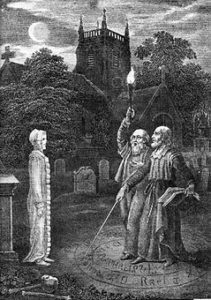
evocation, not necromancy.
What They Were Actually Doing
Dee and Kelley used a scrying stone (or showstone) to make contact with spirits. Kelley acted as the scryer, gazing into the stone and describing what he saw and heard. Dee recorded the sessions, asked questions, and directed the work.
The primary beings who appeared were angels (Uriel, Michael, Gabriel, Raphael, and many others), along with a complex hierarchy of spiritual creatures that delivered the Enochian material.
The spirits were called to appear in the stone or in the visionary space associated with it. The operators themselves remained separate.
That structure is classic evocation: the intelligence is summoned to a defined focus outside the practitioner, communication takes place, and the contact is later closed.
Why It Is Not Necromancy
Necromancy, in the strict sense, is the calling or raising of the dead for information or power. Dee’s recorded actions with Kelley were not aimed at the dead. They were aimed at angelic and spiritual intelligences believed to be of a higher or intermediate order. Dee himself was careful to frame the work as communication with good angels and repeatedly expressed concern about being deceived by dark spirits.
Kelley later attracted separate accusations and legends of necromancy (including stories of raising the dead), but those are distinct from the main body of the Dee–Kelley angelic sessions that produced the Enochian system.
Practical Classification
| Aspect | Dee–Kelley Work | Necromancy | Classic Evocation |
|---|---|---|---|
| Target | Angels and spiritual beings | The dead | Spirits (various) |
| Location of presence | In the stone / visionary space | Often at a grave or summoned shade | Outside the operator, in a focus |
| Operator remains separate | Yes | Usually yes | Yes |
| Primary goal | Knowledge, revelation, language of the angels | Information or power from the dead | Contact and exchange with a spirit |
Crowley and Evocation
Crowley was unusually clear about the difference between the two main operations:
- Invocation: the magician identifies with or draws a force into themselves (becoming the god or principle).
- Evocation: the magician calls a spirit before them, keeping it separate (classically into a triangle while the operator remains in the circle).
He treated the Goetia primarily as an evocatory system and insisted that the operator should first perform a strong invocation in order to work from a position of authority.
What Crowley changed was the preparation. He insisted that a serious evocatory operation should be preceded by a strong invocation so that the magician does not address the spirit from an ordinary human state. The Preliminary Invocation (later developed into Liber Samekh) was designed to elevate the operator’s consciousness first. Only after that shift did the actual evocation of the Goetic spirit begin.
In practice this produced a two-stage structure:
- An intense invocatory opening that identifies the magician with a higher or “Bornless” force.
- The formal evocation of the spirit into the triangle, using the traditional seals, names, and sequential conjurations.
The Bornless Ritual / Liber Samekh
One of Crowley’s most important contributions was his development of the Preliminary Invocation used before Goetic work. He took an older Greek magical text (the Bornless One ritual) and reworked it into a powerful invocation.
In its mature form, published as Liber Samekh (Theurgia Goetia Summa), this ritual became his method for attaining the Knowledge and Conversation of the Holy Guardian Angel. It is a long, intense invocation that uses barbarous names, repeated identification with the “Bornless One,” and a structure designed to produce a profound shift in the operator’s consciousness. Crowley used a version of this as the opening for serious Goetic operations so that the magician would speak from an elevated, almost divine position rather than as an ordinary human petitioning a spirit.
Crowley’s Goetia
In 1904 Crowley published an edition of the Goetia (based on Mathers’ translation) with his own introduction and the Preliminary Invocation. His attitude toward the spirits was complex. In the introduction he offered a psychological reading (suggesting the spirits could be understood as portions of the human brain), yet he still treated the practical system as effective when performed with skill and proper preparation.
He kept the skeletal forms of older ceremonial magic (circle, names of power, sequential conjuration) but shifted the emphasis onto the internal attainment of the magician. Where the old grimoires often treated the operator as a human commanding spirits by borrowed divine authority, Crowley pushed the operator to first become something more than ordinary through invocation, and only then to perform evocation.
This is why his versions of the work feel different in flavour even when the outer tools look similar. The real operation, in his approach, begins with the change in the consciousness of the magician.
Other Major Ritual Types in His Work
- Assumption of God-forms: a core invocatory technique in which the magician builds the image and posture of a deity and identifies with it.
- Pentagram and Hexagram rituals: used for banishing, invoking elemental and planetary forces, and structuring space.
- Liber Resh: four daily adorations of the Sun, serving as regular solar invocation and alignment.
- Eucharistic rituals (including the Gnostic Mass and the Mass of the Phoenix): operations in which ordinary substances are consecrated and consumed as a means of identifying with divine force.
- The Abramelin Operation: Crowley regarded the Sacred Magic of Abramelin as one of the highest practical methods for achieving Knowledge and Conversation of the Holy Guardian Angel; Liber Samekh was the ritual he used during his own attempt at this working.
Practical Character of Crowley’s Ritual Style
Crowley’s rituals tend to be:
- Highly structured and repetitive
- Dependent on vibration of names and concentrated visualisation
- Aimed at producing intense, altered states rather than polite external petition
- Oriented toward the transformation of the operator as much as toward external results
For anyone studying formal methods of evocation, Crowley’s approach is useful because it shows how the traditional Goetic framework can be kept intact while the emphasis is moved onto the preparation and consciousness of the magician. The spirit is still evoked but kept outside, met as a separate presence, given its charge, and dismissed. The operator simply arrives at that meeting in a more deliberately exalted condition.
-
 Summoning Spirits: The Art of Magical Evocation
Original price was: $17.99.$9.99Current price is: $9.99.
Summoning Spirits: The Art of Magical Evocation
Original price was: $17.99.$9.99Current price is: $9.99. -
 The Magick of Aleister Crowley
$20.67
The Magick of Aleister Crowley
$20.67 -
 Grimoire of Aleister Crowley
$22.00
Grimoire of Aleister Crowley
$22.00 -
 Practice of Enochian Magick by Aleister Crowley
$15.00
Practice of Enochian Magick by Aleister Crowley
$15.00 -
 Thelema
$19.99
Thelema
$19.99
Evocation Rituals Across Traditions
Evocation rituals vary widely in outer form, but they share the same basic movement: the practitioner calls a spirit to be present as a separate intelligence in a defined space, interacts with it, and then closes the contact.
1. Classical Goetic Evocation
This is the most fully described formal method in the Western grimoire tradition.
Structure
- Operator stands inside a protective circle marked with divine names.
- A triangle is placed outside the circle.
- The spirit’s seal is prepared and used as a focus.
- A sequence of conjurations is recited, beginning with appeals to higher authority and escalating if the spirit does not appear.
- Once present, the spirit is given its charge.
- A formal License to Depart is issued.
Character Hierarchical, commanding, and heavily structured. The spirit is constrained to the triangle and addressed from a position of authority backed by divine names.
2. Simplified Ceremonial Evocation
Many modern ceremonial practitioners keep the skeleton of the Goetic method while reducing the length and complexity.
Common features
- A simple circle or banishing to define the space.
- A focus point (seal, triangle, mirror, or open area).
- A shorter, direct call using the spirit’s name and office.
- Clear statement of purpose.
- Clean dismissal.
This version retains the separation between operator and spirit while dropping much of the repetitive threatening language of the older texts.
3. Relational or Theistic Evocation
In approaches that emphasise respect and relationship rather than coercion, the outer structure is often lighter.
Typical pattern
- Quiet space, candle, incense, and the spirit’s seal or name.
- Centering and a clear statement of intent.
- Direct, respectful call asking the spirit to be present in the space.
- Period of communication or offering.
- Thanks and deliberate closing.
The spirit is still kept outside the operator (this remains evocation, not invocation), but the tone is one of invitation and exchange rather than command.
4. Scrying-Based Evocation
Seen in the work of John Dee and Edward Kelley and in many later crystal or mirror practices.
Method
- A scrying surface (crystal, black mirror, bowl of water) serves as the focus.
- The operator or a separate scryer gazes into the surface while calls are made.
- The spirit is expected to appear or communicate within the visionary space of the stone or mirror.
- The operators remain separate from the presence.
This is still evocation because the spirit is encountered as distinct and located in the scrying focus rather than inside the practitioner.
5. Folk and Spiritist Forms
In various folk traditions, spirits or the dead may be called to a prepared room, a table, a specific object, or an open area. The methods are usually simpler and less formalised than ceremonial magic, but the structure is the same: the spirit is invited or called to be present externally, communication occurs, and the contact is ended.
Shared Practical Elements
Regardless of tradition, effective evocatory rituals tend to include:
- A clear identity for the spirit being called
- A defined location or focus for the presence
- A method of calling that is focused and repeated if necessary
- A period of stable contact and exchange
- A deliberate, complete closing
The differences lie mainly in tone (command versus relationship), complexity of tools, and the theological framework used to justify the operation. The underlying technique of meeting a spirit as a separate presence in the space remains consistent.
One thought on “Evocation”
Leave a Reply
You must be logged in to post a comment.
I am enchanted of all that’s life and specially of unseen world.
I’ve been longing to start a course for the beginners for a long time.
Please tell me if it is possible for me to learn if I don’t have such a bright memory?
That is the reason I didn’t start yet.
Thank you to the team BWC for everything you are doing !