
 New Years Eve Ritual 2026/2027 with Savannah
HAURES
Haures is the sixty-fourth spirit of the Ars Goetia, a Great Duke who rules thirty-six legions. He comes first as a mighty, terrible leopard and then, at the magician’s command, as a man with flaming eyes and a terrible face. He gives true answers about the past, present and future, but only when he is commanded into the triangle; left free, he lies. He speaks of the creation of the world, of divinity and of how he and the other spirits fell, and he will destroy and burn up the magician’s enemies if asked. He is the same spirit Johann Weyer called Flauros.
Haures at a glance
- Number: 64th of the 72 spirits of Solomon
- Rank: Great Duke
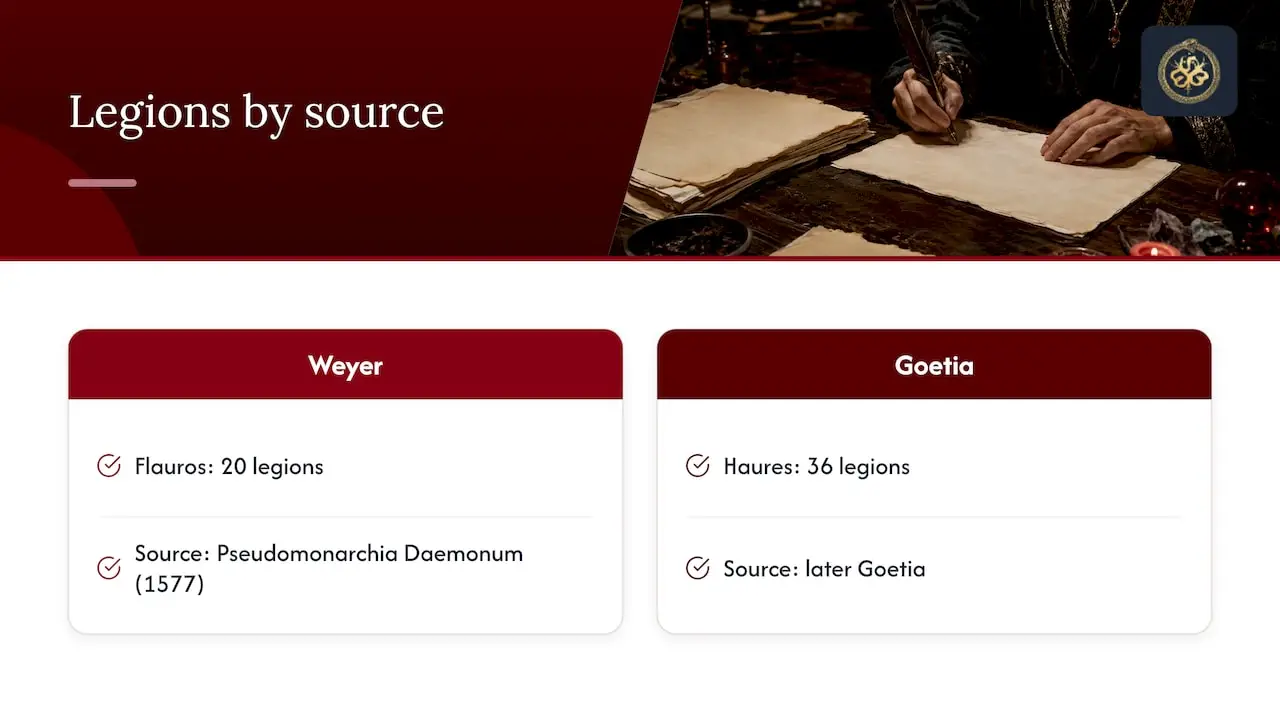
- Legions: 36 in the Goetia (20 in Weyer)
- Appearance: first a leopard, mighty, terrible and strong; then a man with flaming, fiery eyes and a most terrible countenance
- Other spellings: Hauras, Havres, Flauros, Flavros
- Enn (modern demonolatry, not in the grimoires): Ganic tasa fubin Flauros (see our demonic enns page)
What the Goetia says
The entry is short, and every line of it matters:
- True answers of all things, past, present and to come. Haures is a spirit of divination.
- The condition. If he is not commanded into the triangle, he will lie in all these things and deceive and beguile the magician. His honesty depends on your control.
- Hidden knowledge. He will talk of the creation of the world, of divinity, and of how he and other spirits fell.
- Fire against enemies. He destroys and burns up the enemies of the magician, should the magician desire it.
- Protection from other spirits. He will not allow the magician to be tempted by any other spirit or otherwise.
Notice the shape of that list. It pairs the philosophical with the martial: a spirit who will discuss the fall of the angels in one breath and burn your enemy in the next. And it describes a spirit whose truthfulness is not given by default. It is a function of how well you hold him. Every later reading of Haures either honours that condition, softens it, or quietly drops it.
Where Haures comes from
His first printed appearance is in Johann Weyer’s Pseudomonarchia Daemonum (1577) under the name Flauros, followed by Reginald Scot’s English version in 1584. Weyer already has the leopard, the fiery eyes, the answers about past, present and future, the talk of divinity and the fall, and the burning of the conjuror’s adversaries, but he gives twenty legions rather than thirty-six. The Ars Goetia, the first book of the Lemegeton compiled in the seventeenth century, raises the count and fixes him at number 64.
One textual detail is worth knowing. Scot’s English, read literally, says that if he is in a triangle he lies. The Goetia says the reverse: if he is not commanded into the triangle, he lies. The Goetia’s reading is the one magicians have followed since, and it fits the whole logic of Solomonic evocation, but it is a reminder that the grimoires were copied by hand and that small words drift.
The names are less confusing than they look. The 1904 Mathers edition heads the entry “Haures, or Hauras, or Havres, or Flauros”, treating them as one spirit. The H-forms are generally explained as a scribal corruption of the older Flauros. When a forum post or a print vendor sells Flauros and Haures as two different demons with separate personalities, it is building on a spelling difference. In Traditional Demonolatry the same spirit is associated with the divinity Flereous; that is a living modern current with its own correspondences, not another manuscript spelling.
The seal and the triangle
The Goetia instructs that his seal be worn as a lamen: a piece of metal, parchment or paper worn on the chest during the operation as a badge of authority over the spirit. In the historical frame the seal is a credential, not a decoration. Drawing it on a candle or carrying it as a protective talisman reverses that logic. Those uses can still be legitimate in devotional work, but choose them on purpose. Copy the seal from the Mathers plate or a manuscript facsimile, not from a redrawn image of unknown origin; errors pile up with every copy.
The triangle is the heart of his entry. In the old method the magician stands in the circle, the spirit is called into the triangle outside it, and he is compelled by divine names and by the seal. Haures is one of the spirits for whom the text spells out that the triangle is the condition of honesty. Read broadly, the triangle is any structure that forces clarity: a written question, a testable prediction, a record kept the same day. Whether you work in the old coercive style or the modern devotional one, build that structure before you trust a word he says.
Benefits people seek
- Destruction of enemies. This is in the grimoire, plainly. Haures is called on to burn up those who work against the magician.
- Justice and opposition in legal disputes, harassment and workplace conflict.
- Protection, both against human enemies and against interference from other spirits.
- True divination about past, present and future, under the right conditions.
- Hidden knowledge of creation, divinity and the fall of the spirits.
Modern devotees describe him as intense and angry, and as a strong fit for protection, baneful work and spiritual ascendancy. Some pair him with a second spirit when removing an enemy: Haures supplies the offensive fire and the other spirit the defence. These are reports of experience, not doctrine.
Working with Haures
The Goetia gives his seal and offices, not a modern ritual. The structure below is how we approach him.
1. Decide what you are asking for. Divination, protection or the burning of an enemy: one purpose per working. Write it down in a single sentence. For divination, write each question in a form that can be answered yes or no, or with a specific fact.
2. Prepare the seal. Draw it by hand, large enough that every line is deliberate. If you work in the traditional way, wear it as a lamen. Spend some days with it before the first formal call.
3. Prepare the space. Work undisturbed, in low light, with a single flame as the focus, good incense, and a black mirror if you scry. If you use a triangle, set it outside your working area with his seal in it.
4. Call him. Speak his enn until the atmosphere changes. Many in our tradition first approach him through Satan or Lucifer, with a petition such as:
“Lord Lucifer, by your grace, grant me the power to see truly and to carry out that which I desire, the end I would reach by your help. I ask you to move Haures to come before me and stand where I have placed his seal, that he may give me a true and faithful answer and help me reach my desired end, provided it is proper to his office. This I ask in your name, Lord Lucifer.”
5. Hold him to the truth. Ask your written questions and record his answers immediately, in the words you received them, before you interpret anything. For work against an enemy, state plainly who and what, and what you will give in return.
6. Close properly. Thank him, give the offering you promised, and dismiss him with respect. Extinguish the flame deliberately.
7. Check the record. Separate answers you can verify within days from answers about the future, and score them. After a dozen workings you have a track record, and you can rely on him as far as the record supports. For work against an enemy, pair the rite with action in the world: the complaint, the documents, the lawyer. Fire needs something to travel along.
How it looks in practice
These are illustrations, not client cases.
- The tenant in a lease dispute asks Haures which of three clauses the landlord’s lawyer will rely on. A week later the letter arrives, and the answer was right or wrong. A small, honest test of the spirit’s word.
- The employee with a hostile boss keeps a dated record of every incident, files a formal complaint, and runs a weekly working asking Haures to burn the boss’s influence out of her working life.
- The household under threat works with him steadily on a schedule, candle and seal and a plain statement of what is to be guarded, rather than in one dramatic rite.

Black Witch Coven’s view
We find Haures one of the most instructive spirits in the Goetia, because the text makes his honesty conditional. Most magicians who struggle with spirit work are not short of power. They are short of discernment: they cannot tell the spirit’s voice from their own hope, and the Haures entry names that problem in its first lines. Build the triangle first, in whatever form you work. And aim his fire at problems with a real-world handle. Burning an enemy’s influence means little if you never deal with the contract, the complaint or the conversation that gives that enemy leverage. Do the rite and do the paperwork.
If you would rather have the working done for you, see our VIP Legal Warfare Program, Protection Reversal Magick and the rest of our daemonic spell casting. As with all magick, results are never guaranteed.
Similar spirits
- Andras: sows discord and can kill the magician’s enemies
- Amon: tells past and future, reconciles friends and foes
- Balam: answers truly of past, present and future
- Halphas: builds and arms towers and sends men of war
- Focalor: drowns men and overthrows ships of war
Sources
| Pseudomonarchia Daemonum, Johann Weyer (1577), in Reginald Scot’s English (1584) | “Flauros a great duke, is seene in the forme of a terrible strong leopard, in humane shape, he sheweth a terrible countenance, and fierie eies…” |
| The Lesser Key of Solomon (Goetia), ed. S. L. MacGregor Mathers (1904) | “The Sixty-fourth Spirit is Haures, or Hauras, or Havres, or Flauros. He is a Great Duke, and appeareth at first like a Leopard, mighty, terrible, and strong…” |