
 New Years Eve Ritual 2026/2027 with Savannah
HALPHAS
Halphas is the thirty-eighth spirit of the Ars Goetia, a Great Earl who rules twenty-six legions. He appears as a stork or stock dove and speaks in a hoarse voice. His office is war: he builds towers, furnishes them with ammunition and weapons, and sends men of war to the places appointed for them. For a magician he is the spirit of the defended position: the stronghold, the arsenal behind it, and the force sent out from it.
Halphas at a glance
- Number: 38th of the 72 spirits of Solomon (43rd in Weyer’s list)
- Rank: Great Earl (Count)
- Legions: 26
- Appearance: a stork or stock dove, speaking with a hoarse voice
- Other spellings: Malthus, Malthas, Malthous
- Opposing angel (modern Shem ha-Mephorash scheme): Haamiah
What the Goetia says
The entry gives Halphas three tasks, all military:
- He builds towers. Fortified places, raised where they are needed.
- He furnishes them with ammunition and weapons. The stronghold is armed, not empty.
- He sends men of war to places appointed. Force is deployed where it is wanted.
Two details deserve attention. First, the voice. Most Goetic entries stress eloquence or authority; Halphas speaks hoarsely. Those who work with him find the exchanges short, blunt and unflattering in either direction. Second, the rank. An Earl who builds, arms and deploys is a spirit of planning and logistics rather than sudden reversals. His work tends to be structural.
Where Halphas comes from
Halphas first appears in print in Johann Weyer’s Pseudomonarchia Daemonum (1577), where he is the forty-third spirit, followed by Reginald Scot’s English version in 1584. Weyer said he drew his catalogue from an older manuscript, the Liber officiorum spirituum. The Ars Goetia, the first book of the Lemegeton compiled in the seventeenth century, places him at number 38. The order of spirits differs between the two lists, and Joseph Peterson has suggested that pages were scrambled somewhere in transmission, so the number belongs to a manuscript lineage rather than to the spirit.
The history of the name is uncertain. Anyone offering a confident Hebrew or Arabic etymology is guessing. The variant forms Malthus and Malthas are part of why he gets tangled with his neighbour Malphas.
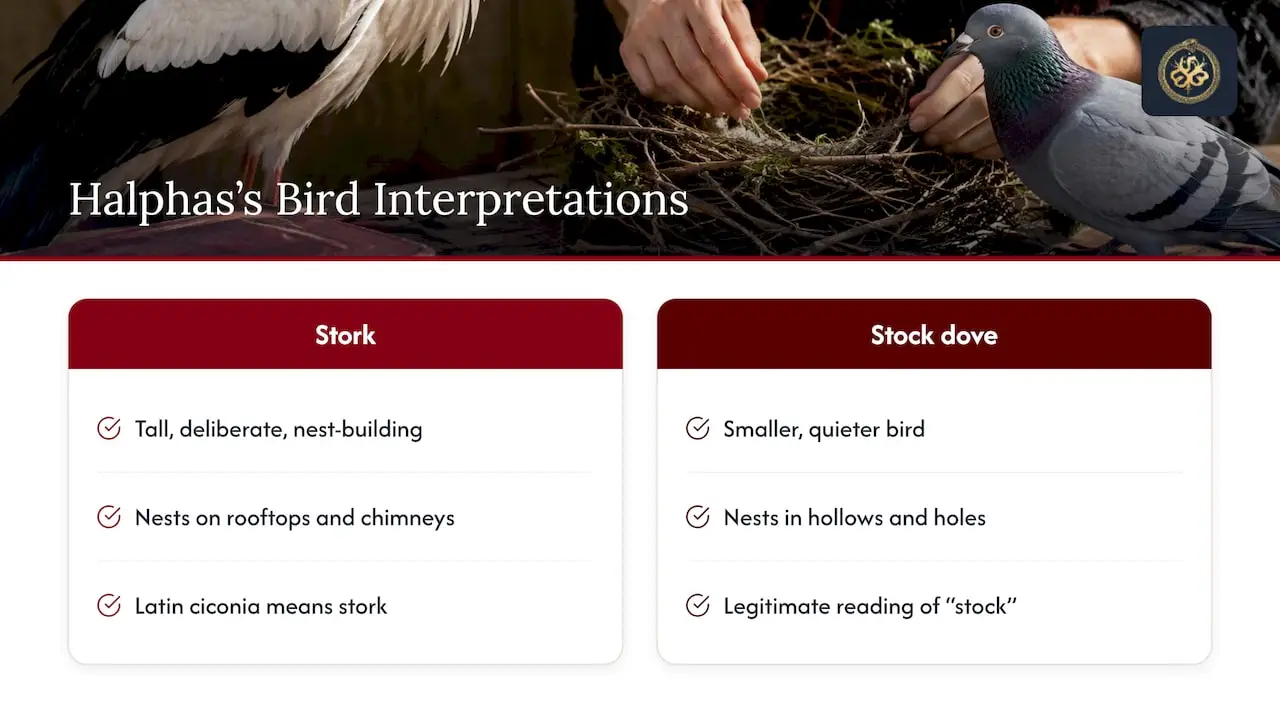
Stork or dove, towers or towns
The English Goetia gives his form as a “stock”, and the usual reading is stock dove. Weyer’s Latin says ciconia, which means stork, and Scot’s English follows with “like a storke”. The oldest witness favours the stork. In European folklore the stork is a tall, deliberate bird that nests on rooftops and chimneys, which suits a spirit of towers almost too well. If you meet a tall bird at the edge of a built structure in vision, the old text supports you; if you meet something small that nests in hollows, note it and do not force it into the textbook image.
The second variant changes his meaning. Where the Goetia says he builds towers, Weyer’s Latin has oppida, towns, and Scot writes that “he buildeth up townes full of munition and weapons”. Some modern summaries go further and say he burns towns, which the primary texts do not say. Taken together, the readings point to one profile: Halphas governs the whole life of a military position, from raising it, to arming it, to sending out the people inside it. Organised force applied to a place.
Halphas and Malphas
They are consecutive entries and distinct spirits, and merging them is the most common mistake in search results. Halphas is number 38, an Earl with 26 legions, a stork or dove, who builds and arms towers and sends soldiers. Malphas is number 39, a President with 40 legions, who appears first as a crow (raven in the Latin), builds houses and high towers, brings artificers together, destroys enemies’ desires, thoughts and buildings, and gives good familiars. A useful working distinction: if something you have built is exposed and under pressure, you are in Halphas’s territory. If an opponent’s ground needs taking apart, or you want a familiar, you are in Malphas’s.
Some magicians report that the two often arrive together and connect them with Harut and Marut, the angels of Islamic tradition. That is personal gnosis, not a grimoire statement.
Benefits people seek
- Victory in conflict, the literal reading of a spirit who arms towers and sends men of war.
- Defence and fortification of a home, a business, a legal position or a reputation.
- Reserves: the money, documents, allies and skills a position needs to hold.
- Discipline and boundaries, a reading developed in modern demonolatry.
- Deployment: sending your resources, people and attention where they will count.
Working with Halphas
The Goetia gives his seal and offices, not a modern ritual. The structure below is how we approach him.
1. Define the tower. Write one sentence naming the position you want built, armed or defended. “Protection” gives him nothing to build. “My business has signed contracts no single client can collapse” does. One tower per working.
2. Take inventory of the arsenal. List what the position needs: cash, contracts, evidence, allies, skills, time. Close the gaps you can close by ordinary means first. A working added to a prepared position focuses it.
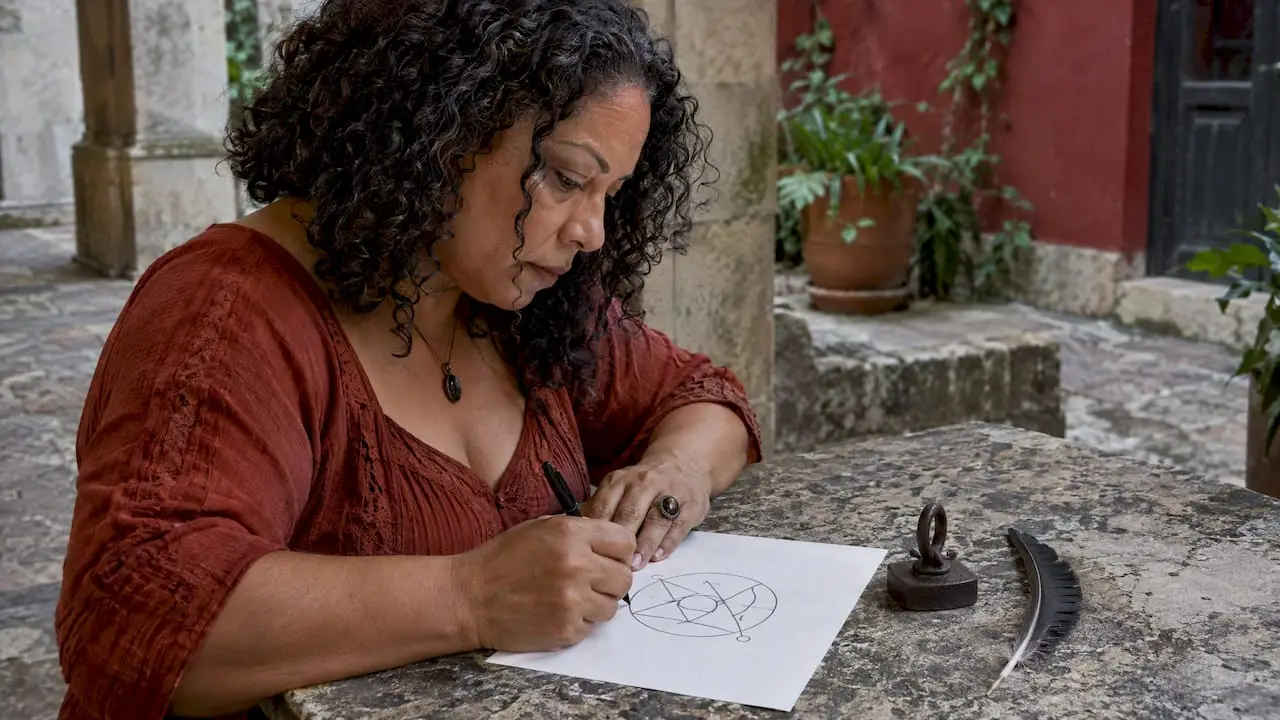
3. Prepare the seal and the space. Draw his seal by hand from a trusted edition. Many work in hours they associate with Mars, which suits his themes, though no grimoire requires it. A piece of iron, stone or brick makes a fitting anchor, a literal piece of the tower, and a feather suits the bird form.
4. Call him. Many in our tradition first approach him through Satan or Lucifer, with a petition such as:
“Lord Satan, by your grace, grant me the power to conceive in my mind and to carry out that which I desire, the end I would reach by your help. I ask you to move Halphas to come before me, that he may build and arm what I ask and send his forces where I appoint, provided it is proper to his office. This I ask in your name, Lord Satan.”
5. Speak plainly. Match his hoarse, unadorned voice with short sentences: the tower, the arsenal you have prepared, the actions you will take, and what you will give in return.
6. Run it for a fixed period. Thirty days works well: a brief daily call, followed by real work on the position. Keep the rite short and the physical work substantial.
7. Review and close. Compare your sentence with the facts. Did the tower stand, did the reserves grow, did anything deploy? Thank him, give the promised offering and dismiss him with respect. Those who use the angelic pairing bring in Haamiah here as a closing step.
How it looks in practice
These are illustrations, not client cases.
- The consultant with two clients who make up nearly all her income defines her tower as a broad client base on written retainers, inventories her contacts and reserves, works the rite in the evening and does one outreach task each morning.
- The tenant under pressure from a landlord defines the tower as a documented, defensible tenancy. The arsenal is dated photographs, written correspondence, the lease and a tenants’ association contact.
- The magician with leaky boundaries defines the tower as three protected hours of practice every evening, and logs every breach.
Black Witch Coven’s view
We read Halphas as a spirit of preparation for war. Before force is used there has to be a place to stand, something to stand with, and someone to send. Most failed workings fail at those three points, not at the level of the spirit’s power: people ask for an outcome and have built nothing for it to land in. “Demon of war” is accurate to the text, and he will answer that call. But the magician who treats him as a builder and quartermaster gets more from him than the one who only wants aggression. Control your position, your reserves and your deployments, and you are at no one’s mercy.
If you would rather have the working done for you, see our Protection Reversal Magick, the Protection Maintenance Subscription and the rest of our daemonic spell casting. As with all magick, results are never guaranteed.
Similar spirits
- Malphas: builds houses and towers, destroys enemies’ desires, gives familiars
- Andras: sows discord and can kill enemies
- Eligos: discovers hidden things and knows of wars and how soldiers will meet
- Marchosias: a strong fighter, true to the magician
- Haures: burns up the magician’s enemies
Sources
| Pseudomonarchia Daemonum, Johann Weyer (1577), in Reginald Scot’s English (1584) | “Halphas is a great earle, and commeth abroad like a storke, with a hoarse voice, he buildeth up townes full of munition and weapons…” |
| The Lesser Key of Solomon (Goetia), ed. S. L. MacGregor Mathers (1904) | “The Thirty-eighth Spirit is Halphas, or Malthus… His Office is to build up Towers, and to furnish them with Ammunition and Weapons…” |