
 New Years Eve Ritual 2026/2027 with Savannah
VEPAR
Vepar is the forty-second spirit of the Ars Goetia, a Great and Strong Duke who rules twenty-nine legions and appears like a mermaid. The grimoire gives Vepar charge over the waters and over ships laden with arms and armour; at the magician’s request Vepar makes the sea stormy and makes it appear full of ships, and causes men to die within three days through putrefying wounds and sores in which worms breed. Water, voyages, illusion and the slow wound are the whole of the record, and modern magicians build on it for travel, transition, glamour and grief.
Vepar at a glance
- Number: 42nd of the 72 spirits of Solomon
- Rank: Duke
- Legions: 29
- Appearance: a mermaid
- Other spellings: Separ (Weyer gives “Vepar, alias Separ”)
- Gender: the Goetia says “he” and gives the title Duke; because of the mermaid form, many modern magicians address Vepar as female, and some as Duchess
What the Goetia says
The entry is short and falls into three groups:
- Waters and ships. Vepar governs the waters and guides ships laden with arms, armour and ammunition.
- Storm and illusion. At the magician’s request Vepar makes the seas stormy and makes them appear full of ships, a power over weather and over what people see.
- The wound. Vepar causes men to die in three days by putrefying wounds or sores, causing worms to breed in them.
Notice what is missing. There is no personality, no mythology, no offering and no planetary attribution. Some modern summaries add that the afflicted can be healed; that line is not in the Mathers Goetia, so treat it as later interpretation. Everything beyond the paragraph above is later layering, and it pays to keep the two strata apart in your own notes. When you write that Vepar commands twenty-nine legions you are quoting the text. When you write that Vepar heals emotional wounds you are writing a modern reading.
Where Vepar comes from
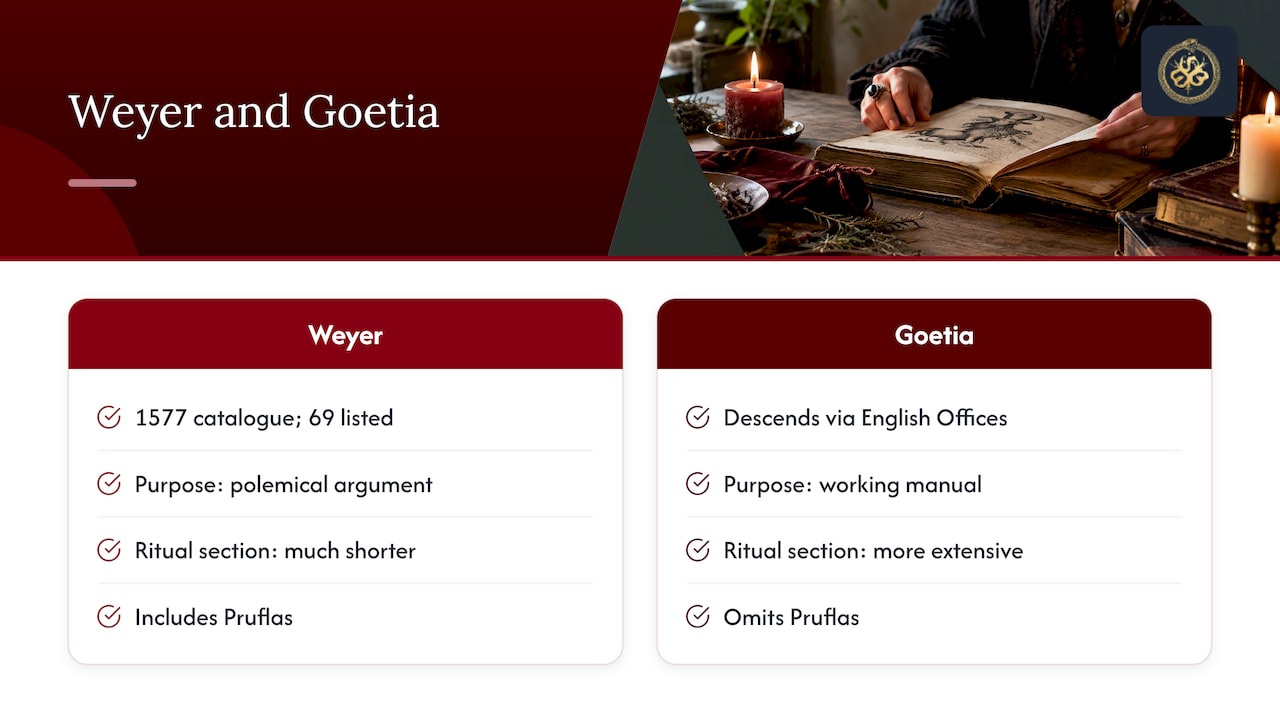
The Goetia did not appear whole. Its catalogue descends from Johann Weyer’s Pseudomonarchia Daemonum (1577), which listed sixty-nine spirits, through Reginald Scot’s English version of 1584, into the Ars Goetia, the first book of the Lemegeton, compiled in the seventeenth century. Weyer already describes the mermaid-like spirit of waters, armed ships, storms and fatal wounds, so the image is older in print than the Goetia, and the two entries agree closely. What changed was purpose: Weyer wrote as a physician arguing about the demonic, while the Goetia reuses his catalogue as a working manual.
Most people now meet Vepar through the 1904 Mathers and Crowley edition, which brought the Goetia to a wide audience and presented ritual both as spirit evocation and as exploration of the psyche. Black Witch Coven works with the spirits as real powers, but you will meet both readings in modern writing.
Reading the mermaid
The mermaid is the one image every source agrees on, and it opens everything else. Half human and half sea creature, she belongs to two realms and is fully at home in neither. Three working themes follow from it. None is stated in the catalogue, but each is a fair reading.
- Thresholds. A being who lives at the surface between air and sea suits crossings: voyages, relocations, the passage from one stage of life to the next.
- The slow wound. The entry is about injury that festers. Magicians bring Vepar the wounds that will not close: old grief, long resentment, a situation that keeps rotting. Others call on the same office against an enemy.
- Illusion. Making the sea look full of ships is power over perception, which points to glamour, misdirection and control of how a situation looks to others.
Choose one theme before you begin. A rite that tries to cover grief, travel and an enemy at once gives you nothing you can judge afterwards.
Benefits people seek from Vepar
- Safe passage for journeys over water, moves and shipments.
- Transition through a move, a break-up or a change of life.
- Healing old emotional wounds, alongside, not instead of, proper care for the body and mind.
- Glamour and misdirection, shaping what others think they see.
- Storm work: stirring up a stagnant situation, or turmoil for an opponent.
Working with Vepar
The Goetia gives the seal and offices, not a modern ritual. The structure below is how we approach Vepar.
1. Define one objective. Write one sentence with the outcome and a way to recognise it. “Within one lunar month the dispute over the shipping contract is settled” works. “Improve my life with water energy” does not.
2. Draw the seal. Copy Vepar’s seal by hand on clean paper or metal rather than printing it. Drawing it is the first act of attention towards the spirit.
3. Prepare the space. Work undisturbed, with a bowl of salted water or sea water on the altar, good incense, candles, and a black mirror if you scry. Decide beforehand how long the working will run and what your closing words will be.
4. Call Vepar. Gaze at the seal and speak the call until the atmosphere changes. Many in our tradition first approach the Goetic spirits through Satan or Lucifer, with a petition such as:
“Lord Satan, by your grace, grant me the power to conceive in my mind and to carry out that which I desire, the end I would reach by your help. I ask you to move Vepar, Duke of the waters, to come before me, that she may give me a true and faithful answer and help me reach my desired end, provided it is proper to her office. This I ask in your name, Lord Satan.”
5. State the objective and the terms. Say the one sentence, say what you will give in return, then stop and listen. Write down images, phrases, sensations and any sudden associations with water, ships or wounds. Do not interpret during the rite.
6. Close properly. Thank Vepar, give the offering you promised, and dismiss her with respect. Then eat something and drink water.
7. Review after three days. The grimoire’s own timeline for Vepar’s work is three days, which makes a natural review point. Reread your notes, list what you did in the physical world after the rite, and note what changed.
How it looks in practice
These are illustrations, not client cases.
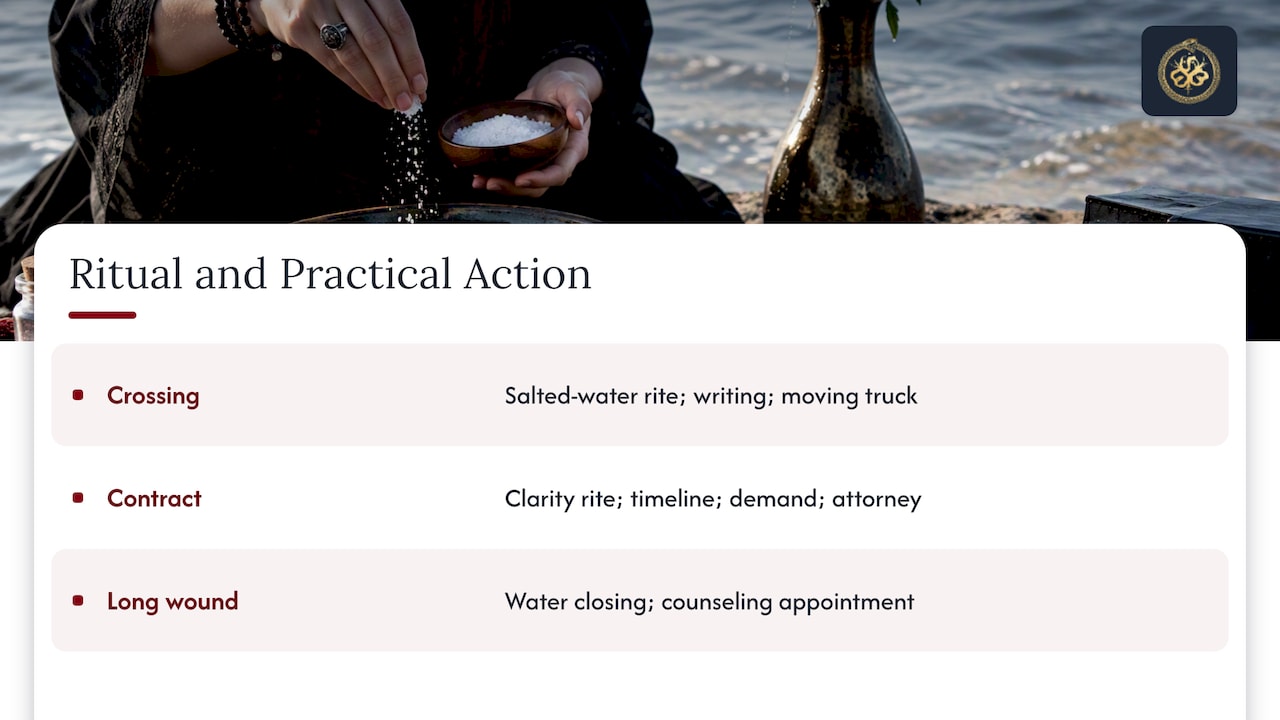
- A crossing. A woman moving across the country after the end of a long marriage asks Vepar to let her arrive without the argument she has replayed every night. She works on her last night in the old home, with salted water on the altar, and writes three lines each morning that week about what she has put down.
- A hostile contract. A small business owner who ships goods by sea is in a dispute over a delayed container. He calls on Vepar’s power over ships and appearances so that the other side’s real position comes into view, and alongside the working he builds a timeline, sends a written demand and calls a freight lawyer.
- A long wound. A surgeon who has carried a resentment against a former colleague for two years uses the festering wound as her image, names the injury in the rite, closes with water, and then books the counselling appointment she had put off.
Black Witch Coven’s view
We read Vepar as a spirit of passage. The grimoire gives her the waters, the ships and a wound that works slowly, and each of those images describes a state of transition that has not yet resolved. That is why we pair work with her to a concrete step in the physical world: a move, a negotiation, a conversation that keeps being postponed. You choose the spirit, the objective and the measure of success, and you answer for all three. The strongest workings we see have one problem, one rite, one review, and action in the world beside them.
Vepar is not offered as a separate service, but if you would rather have a working done for you, see our daemonic spell casting or ask us about a custom operation. As with all magick, results are never guaranteed.
Similar spirits
- Crocell: makes the sound of rushing waters and warms waters
- Vine: raises storms at sea
- Leviathan: the great serpent of the deep
- Marbas: causes diseases and cures them
Sources
| Pseudomonarchia Daemonum, Johann Weyer (1577) | Vepar, alias Separ: a great and strong duke in the likeness of a mermaid, guiding the waters and ships laden with armour. |
| The Lesser Key of Solomon (Goetia), ed. S. L. MacGregor Mathers (1904) | “The Forty-second Spirit is Vepar. He is a Great Duke and a Strong, and appeareth like a Mermaid…” |