
 New Years Eve Ritual 2026/2027 with Savannah
STOLAS
Stolas is the thirty-sixth spirit of the Ars Goetia, a Great and Powerful Prince who rules twenty-six legions. He appears first as a raven before the magician and then takes the image of a man, and he teaches the art of astronomy and the virtues of herbs and precious stones. Among spirits who promise treasure, lovers or the ruin of enemies, Stolas offers knowledge of the sky and the natural world, which makes him a patron of study, herbcraft, stone lore and astrology.
Stolas at a glance
- Number: 36th of the 72 spirits of Solomon
- Rank: Prince
- Legions: 26
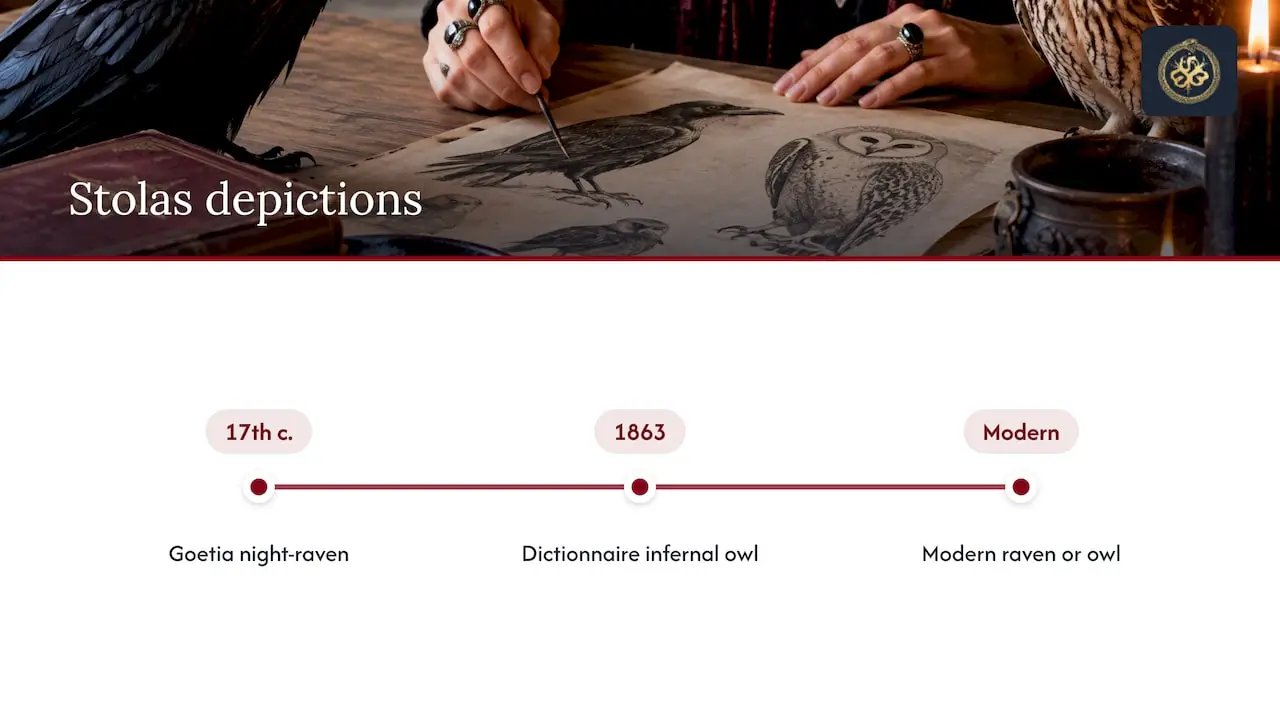
- Appearance: first a raven (a “night raven” in Weyer, a “mighty raven” in the Mathers Goetia), then a man; later tradition shows an owl
- Other spellings: Stolos, Solas
What the Goetia says he does
The entry gives four things: a rank, a number of legions, a form, and a field of knowledge.
- Astronomy. In the sixteenth and seventeenth centuries this meant the movements of the planets and stars and, inseparably, their influence: what we would now split into astronomy and astrology.
- The virtues of herbs. Their hidden powers and uses, medicinal and magical.
- The virtues of precious stones. The same for stones and gems.
Notice what is missing: no origin story, no temperament, no list of favours, no planetary attribution. The Goetia describes an office, the way a register describes a post. That office is intellectual, so the strongest workings ask him for what the record says he gives.
Where Stolas comes from
The earliest printed profile is in Johann Weyer’s Pseudomonarchia Daemonum (1577): a great prince appearing as a night raven, who takes the shape of a man before the exorcist, teaches astronomy, understands herbs and precious stones, and rules twenty-six legions. Reginald Scot carried Weyer’s list into English in 1584, and the compilers of the Lemegeton folded it into the Ars Goetia in the seventeenth century, adding the seals and the ritual frame. No early source gives a dedicated rite for him; the seal and the apparatus around it belong to the Lemegeton.
Raven or owl?
Most people arrive expecting an owl. The grimoires say raven. Collin de Plancy’s Dictionnaire Infernal (1863) describes Stolas as an owl, and that illustrated tradition gave later artists, and eventually animation, their model. A bird of the night tied to the stars and to hidden knowledge is easily read as an owl, the bird of Athena and Minerva. Whether you picture a raven or an owl is your choice, as long as you know which source you follow: the grimoires give the raven, the later illustrated line the owl.
Many people now know the name from the animated series Helluva Boss, whose Stolas keeps the princely rank, an owl form and a love of astronomy, and adds a family and a plot. It is an adaptation, not a source for ritual, but it explains why newer magicians come to him with a ready-made image.
Benefits people seek from Stolas
- Astrology and astronomy: learning the sky, chart work, timing of rituals.
- Herbcraft: the magical and practical properties of plants for spellwork, oils and rootwork.
- Stone and crystal lore: the traditional virtues of gems and how to use them in talismans.
- Study and focus for demanding courses and research.
- Night work and hidden knowledge, in keeping with his raven and owl forms.
Working with Stolas
The Goetia gives his seal and offices, not a modern ritual. A month-long study working suits him well. Adapt it to your own practice.
1. Choose one field. Astronomy, herbs or stones, and one concrete goal within it, such as learning the planetary movements this month, or the properties of six herbs you already stock.
2. Fix the time and place. Choose one place and one hour and keep them for the whole working. Night suits him. Keep a star chart, your herbs or your stones on the altar.
3. Draw the seal and prepare the space. Draw his seal by hand, light candles and incense, and keep a notebook open. Our conjuring method from the Goetia gives the traditional frame if you want it.
4. Call him. Gaze at the seal and speak the call. Many in our tradition first approach the Goetic spirits through Satan or Lucifer, with a petition such as:
“Lord Satan, by your grace, grant me the power to conceive in my mind and to carry out that which I desire, the end I would reach by your help. I ask you to move Stolas, Great Prince, to come before me, that he may teach me truly and help me reach my desired end, provided it is proper to his office. This I ask in your name, Lord Satan.”
5. State the request and the terms. Name the field and the goal, say what you will give in return, then listen and write down whatever comes.
6. Do the work between sessions. Watch the sky each night, or handle and identify one plant or stone each day. Stolas teaches through the material, so keep the material in your hands.
7. Close and review. Thank him, give the offering you promised, and dismiss him with respect. At the end of the month reread the notebook from the beginning, including the sessions where nothing seemed to happen, before you decide what the working did.
How it looks in practice
These are illustrations, not client cases.
- The herbalist. A rootworker who wants to deepen her herb lore picks six plants she already stocks and sits with one each week, recording everything she notices and cross-checking it against a reliable herbal. At the end she has a notebook of correspondences to test in later spells.
- The astronomy student. A graduate student uses the working for the discipline rather than the exam: a fixed nightly observation, a short invocation before study, and a log. When the log shows her focus is better on the nights she performs the opening rite, she has an observation worth keeping.
Black Witch Coven’s view
Stolas is a reminder that the Goetia’s profiles are small and precise: a prince, a raven, a teacher of the sky, of herbs and of stones. Those who respect that profile and choose goals that fit it tend to get cleaner results than those who ask for everything from every name. Know your sources, so you know the owl came later and the seal belongs to the Lemegeton, and then choose each element deliberately. The best Stolas working is the one with the star chart on the desk and the herbs in your hand.
If you would rather have a working done for you, see our daemonic spell casting, and for matching a goal to the right spirit, our guide to demons associated with specific powers. As with all magick, results are never guaranteed.
Similar spirits
- Morax: astronomy and the virtues of herbs and precious stones
- Bathin: knows the virtues of herbs and precious stones
- Buer: teaches philosophy and the virtues of herbs
- Caim: another bird-formed spirit, who gives understanding of the songs of birds
Sources
| Pseudomonarchia Daemonum, Johann Weyer (1577) | Stolas, a great prince, appears in the form of a night raven, takes the shape of a man before the exorcist, and teaches astronomy and the virtues of herbs and precious stones. |
| The Lesser Key of Solomon (Goetia), ed. S. L. MacGregor Mathers (1904) | “The Thirty-sixth Spirit is Stolas, or Stolos. He is a Great and Powerful Prince, appearing in the Shape of a Mighty Raven at first…” |