
 New Years Eve Ritual 2026/2027 with Savannah
FURCAS
Furcas is the fiftieth spirit of the Ars Goetia, a Knight who rules twenty legions, and the only spirit in the whole catalogue to hold that rank. He appears as a cruel old man with a long beard and a hoary head, riding a pale horse and carrying a sharp weapon. He teaches philosophy, astrology, rhetoric, logic, cheiromancy (palmistry) and pyromancy (divination by fire), perfectly and in all their parts. He is a teacher, and by reputation a severe one.
Furcas at a glance
- Number: 50th of the 72 spirits of Solomon
- Rank: Knight (the only Knight in the Goetia)
- Legions: 20
- Appearance: a cruel old man with a long beard and a hoary head, on a pale horse, holding a sharp weapon
- Other spellings: Forcas (a spelling shared with Foras, which causes confusion)
What the Goetia says
The entry is brief. It gives his rank, his appearance, his legions and six arts:
- Philosophy (Weyer says practical philosophy)
- Astrology (Weyer says astronomy, which in his day covered both)
- Rhetoric
- Logic
- Cheiromancy, reading the hand
- Pyromancy, reading fire
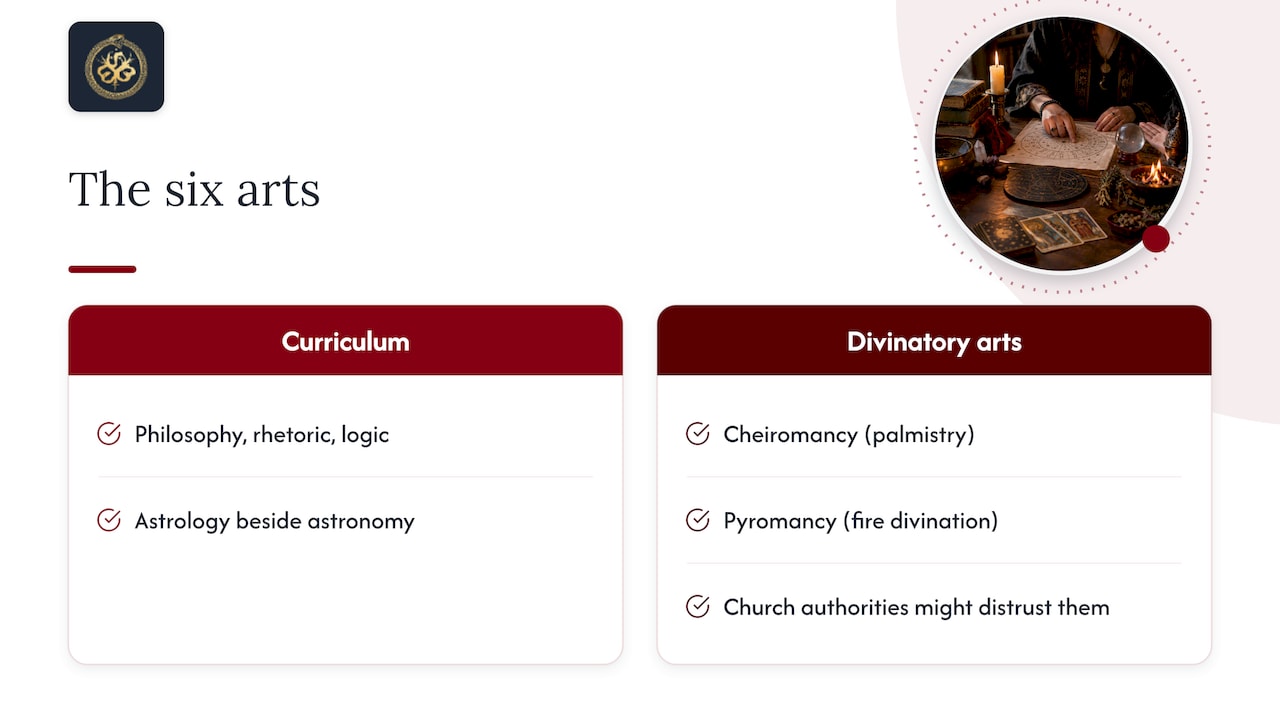
That is all. There is no planetary hour, no offering, no personality beyond the description. Everything you read about his temperament comes from later interpretation. The list itself is worth reading closely. Philosophy, rhetoric and logic belonged to the university curriculum; astrology sat beside astronomy in the same lecture hall. Palmistry and fire divination belonged to the arts a learned man might study and a churchman might distrust. Furcas covers both sides of that line: the lecture hall and the fire.
Where Furcas comes from
His first printed appearance is in Johann Weyer’s Pseudomonarchia Daemonum (1577), where he is already a knight, a cruel man with a long beard and a hoary head on a pale horse, teaching practical philosophy, rhetoric, logic, astronomy, chiromancy and pyromancy, with twenty legions. Reginald Scot’s English version followed in 1584, and the Ars Goetia, the first book of the Lemegeton compiled in the seventeenth century, fixes him at number 50.
Weyer also lists “Forras, or Forcas”, a president. Because of that shared spelling the two spirits were tangled in later sources and are still merged online. The Goetia keeps them apart: Foras is number 31, a President with 29 legions who teaches logic, ethics, herbs and stones; Furcas is number 50, the Knight. If you meet “Forcas” in an older text, check which one is meant before you build a working on the detail.
The name may come from the Latin furca, a fork, or from a term for a tomb. Neither is established. There is no ancient myth behind him, no cult and no biblical story: the paper trail begins in the sixteenth century. Planetary attributions such as Saturn come from later correspondence systems, not from the grimoire, and different systems disagree.
The rank of Knight
The Goetia sorts its seventy-two spirits into kings, dukes, princes, marquises, earls, presidents and knights, and Furcas is alone in the last category. A knight is neither a ruler nor a courtier. He is a trained fighter who has been through a hard formation and serves under authority. The grimoire only states the rank, but it fits a spirit whose subjects are the rigorous arts, and it fits his weapon. One modern reading takes the sharp weapon as the blade of logic, the edge that separates a sound argument from a fallacy. That tells you what kind of request suits him: questions that need cutting, distinguishing and judging.
How he is known today
The grimoire calls him cruel. Contemporary demonolatry describes him as a strict and demanding teacher, a mentor who will not flatter, who marks your errors and who expects the work to be done properly. Those who work with him approach him to strengthen psychic ability and to master divination. This personality is a modern reading of a very short entry. It does not make the reports worthless; it makes them first-person evidence, to be compared and tested.
Benefits people seek
- Mastery of a divinatory art, especially palmistry, fire-reading and astrology.
- Sharper logic and stronger argument for law, debate, study and negotiation.
- Rhetoric: the power to persuade an audience.
- Philosophical depth and understanding of hidden things.
- Psychic development, in modern practice.
- Discipline: a harsh teacher who will not let you coast.
Working with Furcas
The Goetia gives his seal and offices, not a modern ritual. The structure below is how we approach him.
1. Define the subject. Pick one of his six arts and write one sentence stating the competence you want in ninety days and how you would recognise it. A request that cannot be tested cannot be judged.
2. Do the reading first. Approach him as a student who has already started. Read his entry in the Goetia and Weyer, then read in the discipline: a classical treatise on rhetoric, the standard lines and mounts of the hand, a primer on syllogisms and fallacies. An old man with a sharp weapon is unlikely to be impressed by a student who skipped the primer.
3. Build the setting. Pyromancy is one of his arts, so a single flame is the natural focus: a candle, a lamp, or a bowl of coals if you have safe space and ventilation. Pale tones suit the horse. Keep the table plain and the room quiet, with his seal copied by hand from an edition you have checked.

4. Call him. Address him by rank and office: Knight Furcas, teacher of the six arts. Many in our tradition first approach him through Satan or Lucifer, with a petition such as:
“Lord Lucifer, light-bearer, by your grace grant me the power to conceive in my mind and to carry out that which I desire, the end I would reach by your help. I ask you to move Furcas to come before me, that he may teach me truly and perfectly and help me reach my desired end, provided it is proper to his office. This I ask in your name, Lord Lucifer.”
5. State your intent plainly. Your name, your subject, what you want to learn, and what you offer in return. No flattery; his reputation suggests he would ignore it.
6. Study inside the working. This is the stage most people skip. After the statement, do the thing you asked to learn, in the room, for a fixed time: read a set of hand photographs, work logic problems, deliver an argument aloud, watch the flame against a question. Then sit in silence and write down whatever comes, without editing.
7. Close and review. Thank him, give the promised offering, dismiss him with respect and put out the flame. Within a day, check your notes against the work: what proved accurate, what was wrong, what cannot yet be checked. Keep a ledger over weeks. A pattern that improves your measurable performance is evidence; so is a pattern that does not.
How it looks in practice
These are illustrations, not client cases.
- The litigator preparing for cross-examination reads on informal fallacies for two weeks, then holds a weekly working in which she rehearses a mock cross, records herself and marks where her reasoning slipped.
- The tarot reader adding palmistry learns the main lines, reads for friends with their consent and logs every reading with a date, so that after a year she can measure which statements held.
- The doctoral student with a stalled chapter lights a single flame one evening a week, reads the chapter aloud and cuts every sentence he cannot defend.
- The fire-reader rebuilds pyromancy by recording flame behaviour, smoke and ash across fifty sessions, alongside the questions asked and what followed.
Black Witch Coven’s view
Furcas exposes a confusion between harshness and harm. The grimoire calls him cruel; those who work with him report rigour. We approach him as a figure of discipline. Sovereignty does not come from being comforted. It comes from being able to think clearly, argue well, perceive accurately and hold a standard when nobody is watching, and his entire curriculum is made of exactly those skills. Bring him real work. His arts are testable, so test them, and let the old man with the blade cut away what does not hold.
If you want guidance on which spirit suits a goal, book one of our Left-Hand Path readings, an Occult Tarot Reading or a Demonic Tarot Reading, or see our daemonic spell casting. As with all magick, results are never guaranteed.
Similar spirits
- Foras: teaches logic and ethics, herbs and stones
- Buer: teaches moral and natural philosophy and logic
- Amy: gives perfect knowledge of astrology and the liberal sciences
- Bifrons: teaches astrology, geometry and the other arts
- Caim: a good disputer who gives understanding of the voices of birds
Sources
| Pseudomonarchia Daemonum, Johann Weyer (1577), in Reginald Scot’s English (1584) | “Furcas is a knight and commeth foorth in the similitude of a cruell man, with a long beard and a hoarie head, he sitteth on a pale horsse…” |
| The Lesser Key of Solomon (Goetia), ed. S. L. MacGregor Mathers (1904) | “The Fiftieth Spirit is Furcas. He is a Knight, and appeareth in the Form of a Cruel Old Man with a long Beard and a hoary Head…” |