
 New Years Eve Ritual 2026/2027 with Savannah

MOLOCH
His name is only a word for king. For a thousand years the peoples of Canaan and Carthage gave him the most precious thing they had, and the people who wrote the Bible never forgave them for it.
Who Moloch is to practitioners today
Moloch is the fire god of the Ammonites and Canaanites, the king to whom the Tophet burned, the bull-headed bronze of the old engravings, and in demonology a prince of Hell and, with Satan, the first of the demons of the Kabbalistic Tree; to the practitioners who work with him now he is an ancient god of fire, kingship, sacrifice and the price that every real ambition demands.
Molech was the ancient Ammonite fire god. He was worshipped across the ancient Near East and North Africa, by Canaanites and Philistines, Arameans and other Semitic peoples, and later by the Phoenicians and Carthaginians. His name comes from the Semitic root mlk, “king,” the same root that gives melek in Hebrew and malik in Arabic.
No god in the ancient world carries a heavier reputation. The Bible and the Greek and Roman historians tie his name to the sacrifice of children by fire, and the archaeology of the Phoenician Tophets has kept that argument alive for more than a century. We will not pretend that history away, and we will not add a modern sermon to it. Every old religion, the Abrahamic ones included, has offered life to its gods. The question is what that meant to the people who did it.
There is little surviving information about how he was worshipped in his own words, and we feel that he is somewhat like Lilith: he comes to you. He comes to specific people at times when they are hungry for personal growth, or breaking away from traditional religious systems to build a stronger understanding of the occult. This page starts with how people actually work with him now, the offerings and prayers they use and the questions they ask, and ends with what the old texts and the archaeology say.
Why people work with Moloch
People come to the right spirit for the right purpose. These are the reasons practitioners come to Moloch, from his oldest offices to what people actually bring him today.
Classic reasons
- Kingship: rule, sovereignty and the authority of the crown his name means
- Fire: the consecrating, consuming fire of the Tophet
- Sacrifice and vows: the gift of what is most precious, in return for the god’s protection of the whole people
- Protection of the city: a god turned to in siege, war, plague and famine
- Fertility: the male principle of life and reproduction, beside Ashtoreth as the female principle
- Time and Saturn: his old identification with Kronos, the god who devours his children
Modern reasons
- Ambition and power: people work with Moloch to reach for rank, wealth and position and pay the real price of it
- Sacrifice as transformation: giving up a habit, a comfort, a relationship or an old identity in the fire, in exchange for what they want to become
- Breaking from religion: many feel his call while leaving the faith they were raised in
- Fire magick: burning petitions, effigies and the past itself
- Protection of home and family: calling on the old protector of the city to guard the household
- Blessing a child: following the reading that children were passed over consecrated fire for the god’s protection
- Masculine power and virility: the male principle, strength and sexual force
- Fertility work with Astaroth: honouring him with his consort as the male and female principles together
- Endurance: the strength to hold through hardship, siege and loss
- Kabbalistic and Qliphothic work: as one of the archdemons of Thaumiel, the shadow of Kether
- Personal growth: those he comes to describe a demand to grow up, take responsibility and stop asking for things without giving
Traditional, for reference
What scripture, the classical historians and demonology assign him. This is historical background, not modern practice.
- Leviticus 18:21 and 20:2–5: the law against giving one’s “seed” to Molech
- 1 Kings 11:7: King Solomon builds a high place for Molech, “the abomination of the children of Ammon”
- 2 Kings 23:10: King Josiah defiles the Tophet in the valley of Ben-Hinnom so that no one could make a son or daughter pass through the fire to Molech
- Diodorus Siculus and Plutarch: the bronze Kronos of Carthage and the sacrifices to him
- Milton, Paradise Lost: “horrid king,” first of the fallen to speak in the council of Hell, the voice for open war
- Collin de Plancy, Dictionnaire Infernal (1863): a bronze statue with a calf’s head, a royal crown, and arms extended
- Kabbalah: with Satan, the archdemon of Thaumiel, the averse of Kether
Spirit Temperament
Ease of working: 3/10
How easy Moloch is for a witch, magician or devotee to work with
- Beginner-friendly: 🔥
He comes to whom he chooses, and he expects people who already know how to give. Not a first spirit. - Human tolerance: 🔥🔥
A god of kings and their bargains. He is said to be fair to those who keep their vows and utterly indifferent to those who only ask. - Intensity: 🔥🔥🔥🔥🔥
Fire, heat and weight. Practitioners describe a furnace-like presence, a roar, or the sense of standing before a huge seated figure. - Upheaval factor: 🔥🔥🔥🔥🔥
He takes the sacrifice. Whatever you put in the fire tends to leave your life, and quickly. - Speed: 🔥🔥🔥🔥
Once the offering is truly given, the exchange is often reported to move fast. - Demands: 🔥🔥🔥🔥🔥
Real sacrifice. Not a token, but something that costs you. He is the god of the hardest bargain in the ancient world.
Best for: ambition and rank, transformation through sacrifice, fire magick, protection of home and family, masculine and sexual power, and experienced practitioners ready to pay a real price.
Scores are Black Witch Coven’s view, drawn from practitioner reports and our own work.
Moloch at a glance
- Other names: Molech, Mo-lech, Mollok, Milcom, Malcam, Melkom, Molek, Malec, Malik, Melek, Malkum, Melqart, Melkart, Milk, Melqarth, Kronos, Cronus
- Name: from the Semitic mlk, “king”; the Hebrew vowels may echo bosheth, “shame,” given by scribes who hated him
- Peoples: Ammonites, Canaanites, Philistines, Arameans, Phoenicians and Carthaginians
- Consort: Ashtoreth, our Astaroth
- In Islam: Malik, “King,” the angel in charge of Jahannam
- Later form: it is said that Moloch later became Adramelech, with the same archetype and demand for offerings
- Kabbalah: with Satan, archdemon of Thaumiel, the shadow of Kether
- Month: December, in the sixteenth-century scheme of demons by month
Correspondences
Used in Black Witch Coven (from our own practice):
- Colours: black and red
- Element: Fire, the element of sacrifice
- Day: Saturday, for Saturn and the darker currents
- Symbols: the bull, historically linked to Moloch; the owl, for wisdom and the underworld
- Plants: mugwort for divination and communication; hemlock to invoke the darker energies; nightshade for deeper, hidden knowledge
- Offerings: wine, incense and food traditionally offered in ritual, and above all the sacrifice of something you value
- Month: December
Also used by other practitioners:
- Planet: Saturn, for his identification with Kronos
- Metals: bronze and iron, for the statue and the furnace
- Incense: dragon’s blood resin, myrrh, cedar, and anything burned whole
- Stones: garnet, red jasper, obsidian, lava stone
- Sounds: drums and flutes, the music the classical writers say filled the Tophet
- Tools: a brazier, a fire bowl, a bronze bowl or a bull figure
Working with Moloch today
Moloch has no grimoire rite and no seal in the Goetia. The way practitioners work with him now grew up around the one thing every source agrees on: he is a god of fire and of the gift that costs. This is how people approach him today, and how we work with him in Black Witch Coven.
He comes to you
As with Lilith, many people who work with Moloch say they did not choose him. He arrived in dreams of fire, bulls or a huge seated bronze figure, or as a pull that would not go away while they were breaking from an old faith or reaching for something much bigger in their lives. If he has come to you, you will know.
The law of sacrifice
Everything about Moloch turns on one idea: to honour your god, you give your most prized possession. That is how the ancient world understood sacrifice, from the Tophet to the Temple in Jerusalem, and it is how practitioners understand Moloch now.
Today the offering is not a life. It is the thing in your own life that you value and that stands between you and what you want: a comfort, an addiction, a relationship that keeps you small, a habit of wasting time, a version of yourself you are proud of but have outgrown. Practitioners write it down, name it before him, and give it to the fire. The common report is that whatever is truly given does not come back.
The altar and the fire
- A fire you can safely keep burning: a brazier, a cauldron, a fire bowl, or a large black or red candle
- A bull figure, horns, or an image of the seated bronze king
- Black and red candles
- Dragon’s blood, myrrh or cedar burned on charcoal
- A chalice of strong red wine
- The written sacrifice, and a written petition
- A drum, if you can keep a beat
A sacrifice working
- On a Saturday night, build the fire and light the incense
- Keep a slow, steady beat on a drum, or play drums and flutes
- Write on one paper what you ask of him: rank, money, power, protection, a goal
- Write on a second paper what you give: the thing you value that stands in the way
- Read both aloud before him, and seal the gift with a drop of your own blood, since blood is life force and nearly every faith speaks of it as life itself
- Give the paper of sacrifice to the fire first, and watch it burn completely
- Then give the petition to the fire
- Pour the wine, give thanks, and from that night keep your word: do not take back what you burned
Offerings
- The sacrifice itself: a comfort, habit, possession or part of your old life, given up for good
- Wine and strong spirits: poured into the fire or onto the earth beside it
- Burnt offerings: food burned whole, rather than left on the altar
- Incense: dragon’s blood, myrrh, cedar
- Blood: a drop of your own blood on the candle or the written sacrifice
- Sexual energy: the oldest offering of his consort’s temples, and the one we consider central to his advanced work
Inside the Course
Savannah’s advanced offering to Moloch, the sexual rite drawn from the temple worship of his consort Ashtoreth, is taught inside our course. On this public page we can only point you to the history: the fertility cults of Canaan offered sacred sexual union to their gods. Explicit ritual material of this kind has had our site flagged by hosting companies before, and we have been taken offline and forced to change hosts because of it. That is not a sales pitch, only the reality of running a site like ours.
Signs of contact
- A sudden wave of heat, or the fire flaring, roaring or leaning toward you
- Drumming or a deep roar heard at the edge of hearing
- Dreams of bulls, furnaces, bronze, a crowned seated figure or a city under siege
- The thing you offered leaving your life quickly, sometimes painfully
- A hard, clear sense of what you must give up next
- Owls appearing, as they do for several of the old gods of the night
Working with Moloch and Astaroth
In the old religion Moloch and Ashtoreth stood together: Molech the male principle of life and reproduction, Ashtoreth the female principle of fertility. Practitioners who honour them together set both on one altar and work fertility, sexuality and creation with the pair. Our own coven’s long relationship with Astarte makes this pairing especially important to us; see our Astaroth page for her side of it.
Prayers and invocations to Moloch
Moloch is addressed as a king and a fire, and the prayers people use for him are short, heavy and spoken over flame. There is no widely shared demonolatry enn for him; most practitioners call him by his names and titles. The pieces below are written by Black Witch Coven for your own use.
How people pray to him
- Over fire: always, with a flame you can feed
- With a beat: drums or a steady rhythm under the words
- By his names: Molech, Milcom, Malik, King, repeated as a chant
- With a gift in hand: nothing asked without something given
- Candle colours: black and red
Opening invocation
Moloch, King, fire of the Tophet,
Molech of Ammon, Milcom, Malik,
bull of bronze with outstretched hands,
I call you to this fire.
I come with a gift and not with empty hands.
Receive what I give, and hear what I ask.
Hail Moloch.
Spoken as the fire is lit and the drum begins.
Prayer of sacrifice
King of fire, here is what I value.
I name it before you: [name it].
I give it to your flame and I will not take it back.
Burn it out of my life,
and in its place give me what I came for.
As it is consumed, so let it be done.
Said as the written sacrifice is given to the fire.
Prayer for power and rank
Moloch, whose name is King,
set a crown on my work.
Raise me over those who stand in my way.
Give me the strength to take what I have earned
and the nerve to pay what it costs.
I will not come to you with empty hands.
Said over a red candle, with the offering ready beside the fire.
Prayer for protection of the household
Moloch, protector of the city in the day of siege,
stand at the gate of this house.
Let fire stand between my family and all harm.
Let those who come against us
find the walls burning
and turn away.
Said with a black candle at the threshold.
Blessing through the fire
Moloch, King, I pass this through your fire.
Bless it, guard it, keep it strong.
Let no evil spirit of the underworld touch it,
for it has been shown to you
and you have seen it.
Said while passing an object, photograph or written name quickly through the candle flame or the smoke.
Gratitude
Moloch, I thank you.
What I gave, you took. What I asked, you answered.
I keep my word to you,
and I pour this offering into your fire.
Hail Moloch, King.
Said as wine is poured into the fire.
Questions people actually ask
These are the questions that come up again and again about Moloch, answered the way we would answer them.
Did people really sacrifice children to Moloch?
The ancient sources say so plainly, and many archaeologists agree. The Bible condemns making children “pass through the fire to Molech.” Greek and Roman writers describe the Carthaginians placing children on the hands of a bronze statue of Kronos, from which they rolled into fire, and Plutarch writes that flutes and drums were played so the cries would not be heard. At Carthage and other Phoenician sites, the Tophets hold thousands of urns of burnt infant and animal remains, buried over several centuries.
Some scholars argue the Tophets were cemeteries for children who died naturally, and that the ancient accounts were hostile propaganda. Others, after studying the bones and the inscriptions vowing a child to the god, are convinced the sacrifices were real. That debate is still open.
Was there another reading?
Yes. You have to research wide and deep to form another opinion, which may be more accurate in some places and times: that babies were passed quickly over a fire consecrated to Moloch, with no harm to the child, to ask the god’s blessing and protect the child from evil spirits of the underworld. “Passing through the fire” can be read that way, and some scholars do. Both readings deserve to be known.
Was this unusual in the ancient world?
No. Human sacrifice appears in cultures all over the world. In the royal cemetery at Ur in Mesopotamia, some 4,500 years old, servants, handmaidens and warriors were put to death and laid in neat rows beside their king or queen. In the Shang dynasty of China, thousands of prisoners and slaves were offered to the supreme god Shang-Di in a single reign. Among the Maya, blood was the nourishment of the gods and human sacrifice was the greatest offering of all. Abraham was asked for Isaac. To honour your god with your most precious possession is one of the oldest religious ideas there is.
We give these examples not to excuse anything but to remove the idea that Moloch was uniquely monstrous. He was a god of his time, and the time was hard.
Does Black Witch Coven practise sacrifice to Moloch?
No. We do not practise human or animal sacrifice. Child sacrifice is totally unnecessary in this day and age. What we offer Moloch is what costs us in our own lives, our own blood in a drop, our wine, our fire, and the sexual offering of his consort’s temples. We present the history as it was, without softening it and without judging the people who lived it.
Is Moloch the same as Baal or Kronos?
They overlap. “Molech” and “Baal” are both titles, King and Lord, and the Bible sometimes connects them. The Greeks and Romans called the Carthaginian god Kronos, and in the Kabbalah Moloch is linked to Kronos, the god of time who devoured his own children so that they could not challenge his rule. The Phoenician god Melqart, “king of the city,” is another face many practitioners see in him.
What about the owl?
The owl is a symbol of wisdom and the underworld that some modern practitioners attach to Moloch. Much of the owl lore around him is modern, not ancient; the bull is his oldest animal.
Is Moloch evil?
To the prophets of Israel he was the worst of all the gods. To the people of Ammon, Canaan and Carthage he was the king who protected their cities when everything else failed, and who asked for the highest price in return. To those who work with him now, he is an ancient fire god who teaches that nothing great is gained without something real being given up.
Is he good for beginners?
No. He is one of the hardest gods to work with in the whole tradition, because he takes what is offered. Most people who work with him well came to him after years of other spirit work, or because he called them.
What works, what doesn’t
These patterns come from practitioner accounts and our own coven. None of it is a rule.
What practitioners report works
- Real sacrifice. Something that genuinely costs you.
- Fire. Everything burned, not left on the altar.
- Keeping your word. Never taking back what you gave.
- Rhythm. Drums or a steady beat to carry the rite.
- Working him with Astaroth for fertility, sexuality and creation.
What practitioners say doesn’t work
- Token offerings. Giving something you do not care about.
- Taking it back. Returning to the habit or relationship you burned.
- Asking without giving. He is the god of the exchange.
- Coming to him from horror films. He is a god of kings, not a movie monster.
What changed when they kept going
People who work with Moloch describe becoming lighter and harder at the same time: lighter because so much that held them back has gone into the fire, harder because they have learned that everything has a price and they are willing to pay it. Several say he taught them to stop asking for things they were not prepared to give anything for.
The darker work: war, siege and the enemy
Moloch was the god a city turned to when the enemy was at the gates. People still bring him their enemies, their wars and their sieges, and ask the King of fire to burn the threat away.
Inside the Course
The fire workings practitioners bring to Moloch against a named enemy, and the full rite of dedication to him, are taught inside our course. Baneful material aimed at a specific person, and dedication rites of this kind, have had our site flagged by hosting companies before and taken offline. We say that plainly; it is not a pitch.
What the old texts and the archaeology say
The living practice above is the real work. The history is its background, and with Moloch the history is the heaviest of any spirit on this site.
The Ammonite god
In the Bible, Milcom is “the abomination of the Ammonites,” and King Solomon built a high place for Molech on the hill east of Jerusalem (1 Kings 11). Molech was represented as the male principle of life and reproduction, with Ashtoreth as the female principle of fertility.
The law and the Tophet
- Leviticus 18:21: do not give any of your children to be sacrificed to Molek, so as not to profane the name of your God
- Leviticus 20:2–5: whoever gives of his seed to Molech shall be stoned by the people of the land, and God will cut off him, his family, and all who go astray after him
- 2 Kings 23:10: King Josiah defiles the Tophet in the valley of Ben-Hinnom, so that no man might make his son or daughter pass through the fire to Molech
- Jeremiah 7:31 and 32:35: the high places of Tophet, where sons and daughters were burned in the fire
The valley of Ben-Hinnom, Ge-Hinnom, gave its name to Gehenna, the Jewish and Christian hell.
“Molk” and the Phoenician Tophets
In 1935 the scholar Otto Eissfeldt argued from Punic inscriptions that molk was not a god’s name at all but the name of a type of sacrifice, so that “to Molech” might mean “as a molk offering.” Some modern readers of the Bible follow this; others hold that Molech was a real god. Our earlier page noted that the forms containing mlk are often left untranslated for exactly this reason.
At Carthage, at Motya in Sicily, in Sardinia and elsewhere, archaeologists have found Tophets: open-air precincts with thousands of urns holding the burnt bones of infants and young animals, often under stone markers vowing the offering to Baal Hammon and Tanit. Whether these were sacrifices or the graves of children who died naturally is one of the longest arguments in Mediterranean archaeology.
The Greek and Roman accounts
Diodorus Siculus describes a bronze image of Kronos at Carthage with hands extended, palms up and sloping toward the ground, so that each child placed on them rolled down into a pit of fire. He says the Carthaginians, besieged in 310 BCE, sacrificed two hundred children of noble families to win back the god’s favour. Plutarch writes that the whole area before the statue was filled with the noise of flutes and drums so that the cries would not reach the people.
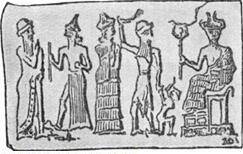
A Babylonian cylinder seal often cited in discussions of sacrifice to Molech.
Milton and the demonologists
John Milton opens his list of the fallen with Moloch, “horrid king besmear’d with blood of human sacrifice, and parents’ tears,” and in Hell’s council he is the voice for open war against Heaven. Collin de Plancy’s Dictionnaire Infernal describes him as a bronze statue with a calf’s head, a royal crown, seated on a throne, arms extended to receive the children. In the sixteenth-century scheme that gave each demon a month of power, Moloch’s was December.
The Kabbalah
In Kabbalistic lore Moloch is, with Satan, one of the first of the demons of the Tree. Kether, the Crown, number one, the Ancient of Days, whose divine name is Eheieh, “I Am,” has as its shadow Thaumiel, “the Two Contenders,” whose archdemons are Satan and Moloch. The crown and its shadow: the King of Heaven, and the King of fire.
Islam and later
In Islam, Malik, “King,” is the principal angel in charge of Jahannam, the fire of hell, and some writers connect the name to Molech. In the modern world Moloch became a symbol of anything that devours its own children for power, in poetry, film and political writing.
How this differs from how he is worked today
- The sacrifice: what costs you in your own life, not a life
- The god: a king and protector to be honoured, not only a monster to be condemned
- The fire: transformation as well as consumption
- The consort: worked again beside Astaroth, as the male and female principles together
Black Witch Coven’s view
We find Moloch to be the clearest teacher of one of the oldest truths in religion: that nothing great is given for nothing. The ancient world understood sacrifice in a way the modern world has forgotten, and its people gave their god the most precious thing they had. We do not ask anyone to do what they did, and we do not judge them for it. What Moloch asks of us now is that we put real things in the fire, keep our word, and never come to him with empty hands. He comes to those he chooses, usually when they are ready to grow. If he has come to you, honour him as a king.
Work with Moloch through Black Witch Coven
- Candle for Demonic Request: a petition to Moloch burned on our altar for you
- Monthly Demonic Praise Subscription: ongoing devotion on your behalf
- Daemonic Spell Casting: where we work with specific spirits for clients
- Demonic Pact with Savannah: for a pact or dedication
- Consultation with Savannah: if Moloch has come to you and you want guidance
As with all magick, results are never guaranteed.
Related spirits
- Astaroth: Ashtoreth, his consort, the female principle
- Adramelech: said to be the later form of Moloch
- Satan: with Moloch, archdemon of Thaumiel
- Baal: the Lord beside the King
- Lilith: another ancient power who comes to those she chooses
Sources
| Leviticus 18:21; 20:2–5; 1 Kings 11:7; 2 Kings 23:10; Jeremiah 7:31 | Molech, Milcom and the Tophet |
| Diodorus Siculus, Library of History 20.14 | The bronze Kronos of Carthage; the sacrifices of 310 BCE |
| Plutarch, On Superstition | Flutes and drums before the statue |
| Otto Eissfeldt, Molk als Opferbegriff (1935) | molk as a type of sacrifice |
| John Milton, Paradise Lost (1667) | “Horrid king besmear’d with blood” |
| Collin de Plancy, Dictionnaire Infernal (1863) | The calf-headed bronze statue |
| University of Pennsylvania Museum, Royal Cemetery of Ur (CT studies, 2009) | Human sacrifice in Mesopotamian royal burials |